Employer-based Insurance and Entrepreneurial Lock
Kauffman-Rand Institute for Entrepreneurship Public Policy
Some would-be entrepreneurs are discouraged from starting their own business because they are worried about losing their employer-based health insurance.
Multi-State Insurance Exchanges
Urban Institute
It might make sense for states to collaborate in creating Obamacare-mandated health exchanges, especially when large metro areas cross state boundaries. Metropolitan Washington, anyone?
-
Wonk Salon: April 12, 2011
-
The Wonk Salon: April 11, 2011
I’m filing this a day late. My apologies. From now on, I will list only those Wonk Salon entries that I have not otherwise highlighted on Bacon’s Rebellion with their own blog posts.
Free the Schools
Heritage Foundation
The federal involvement in K-12 education has been a budget-busting disaster. It’s time to re-think the federal role in education.How to Get Good Teachers and Principals
Center for American Progress
Congress should use its funding “more strategically” to prod/goad/bribe states and local governments to develop a cadre of good teachers and school principals.Who Purchases Long-Term Insurance?
Urban Institute
What a surprise — more affluent Americans purchase long-term care insurance. The rest, presumably, are counting on good fortune or Uncle Same to take care of them.Why Manufacturing Matters
Center for American Progress
Manufacturing is still a pillar of the United States economy. We under-estimate its value at our peril.Does the U.S. Need Foreign Teachers?
Center for Immigration Studies
The H-1B visa system is being used increasingly to hire foreign teachers, taking away opportunities for American teachers.
-
Virginia’s Structural Budget Gap $8 Billion and Counting

Legislators have succeeded the past few years year in balancing Virginia’s budget during trying times without major tax increases (“fees” are a different matter). But a new report by the Commonwealth Institute contends that the current biennial budget falls $8 billion below pre-recession levels once spending is adjusted for the rising cost of providing services to a growing population. Other major conclusions:- Even without adjusting for population and inflation, the General Fund falls $657 million below pre-recession levels.
- The Commonwealth has reduced state support for K-12 education by $2.6 billion over this year and next.
- Virginia faces a $400 million gap in current spending compared with pre-recession levels in Health and Human Services.
Were it not for the recent economic up-tick, which improved the revenue outlook, the gap would have been even larger, the report says. But the authors do not extrapolate from those findings to draw any conclusions.
That won’t stop me from weighing in. Two main points:
First, economic growth generally, and state/local tax revenues specifically, will continue to lag. This is not your father’s economic recovery. This is one of the most anemic business cycles on record, and there is absolutely no reason to think that it is going to get better. That is a non-partisan judgment. It doesn’t matter who occupies the White House. Bottom line: Austerity stinks, but we’d better get used to it.
Second, we need to start thinking radically differently about how government provides core services in Virginia. Sticking with the old model will not work. Raising taxes will not work. Trimming spending and spreading the pain will not work. We need deep-rooted institutional change. We need to ramp up conversations about how to enact balanced, market-driven land use patterns, user-pays transportation, a consumer-responsive education system, and market-driven health care.
Tinkering on the margins of the status quo will take us nowhere.
-
Do Colleges Really Subsidize Tuitions?
 Back to one of my favorite themes… It is an article of faith in the higher education industry that tuition falls far short of what it costs to educate a student. The Dartmouth College Fund, for instance, claimed in fund-raising material that it charged only $49,974 for undergraduate tuition, room and board even though it spends $104,402 per student per year.
The fallacy in that logic, write the authors of “Who Subsidizes Whom? An Analysis of Educational Costs and Revenues,” is that not all college spending is used for instructional purposes. Colleges do many things other than educate their students, most notably conduct research. After adjusting for student aid, the authors estimate that Dartmouth receives $23,079 in tuition-related revenue per student. But after adjusting for the amount of time that professors actually spend teaching, the cost of providing the education is only $13,000 per student (of which only $9,100 can be attributed to faculty compensation).
Conclude the authors: “Between 52% and 60% of students attend institutions that are paid more than they spend to educate them. If wasteful spending is disallowed, the figure rises to 76%. At four-year institutions, it is between 59% and 87%. In other words, not only are most students not being subsidized by their college, but most colleges are able to divert money towards non-educational activities, all the while claiming that this spending is for the benefit of students.”
How does this apply to Virginia institutions of higher education. Frankly, I don’t know. But these are the kinds of questions that members of the General Assembly should be asking — and the State Council for Higher Education in Virginia should be analyzing. There is probably a better match at Virginia’s public universities between what students pay in net tuition and what it costs to educate them than in other university systems. But who knows for sure? How can we hold Virginia colleges and universities accountable unless we find out?
-
All for One (percent)
 In these days of budget buzz and deficit dallying, it is useful to consider just where things are in terms of wealth in the U.S. Nobel prize-winning economist and Columbia University professor Joseph Stiglitz presents some unsettling realities.While the Baconauts and Boomergeddons bemoan their idea that profligate spending and “Mass Overconsumption” (an EMR buzzword) will bring an end to the American dream, Stiglitz says it’s already gone.
He notes some familiar but still vital information that the top 1 percent in terms of personal wealth are taking in 40 percent of income. Twenty-five years ago, it was the top 12 percent taking in 33 percent of income, Stiglitz wrote in a recent Vanity Fair piece.
The usual conservative dogma has it that if you have an extraordinary income, somehow you deserve it. Stiglitz exposes this horrendous myth, nothing that the current income inequality in the U.S. makes old Europe seem far more egalitarian. With wealth distribution numbers like these, the U.S. has more in common with the rulers of Iran or the oligarchs of Russia, which is cold comfort indeed. The American big wigs have been helped along by tax cuts and easy regulation, especially regarding trusts, during Republican administrations.How this new American elite got there is a curious story, basically a tale of tax cuts, overweening self-interest and lobbying and a general change in attitudes. Rather than science or manufacturing, finance is the most popular field for the most talented youth go so they can divvy up and massage the wealth of the tiny rich rather than create new wealth.
The new ultra-rich are inclined to cut public spending for such things as government research that brought us such advantageous innovation as the Internet and breakthoughs in public health. The One Percenters, you see, don’t need public research or public health since they have their ownlabs and their own private doctors. Here in Virginia, there’s even talk about “privatizing” the University of Virginia, a top-rated public university. To get an idea where this comes from, take a peek at the school’s alumni magazine, which I get because I am a U.Va. parent. The back pages are stacked with four-color ads for multi-million-dollar Albemarle County estates. One wonders where their values have gone.Speaking of health, the Baconauts among us cling to the tired idea that private corporations are the only salvation to our health issues. Funny, but Stiglitz points out that with the top 1 percent game plan, the health care market is rigged from the start, meaning there isn’t any market economy that the Baconauts claim is the salvation of all things. Pharmaceutical companies, for instance, are getting a $1 trillion gift from the federal government, which has agreed to not negotiate the prices for drugs of which it is the single largest buyer. Odd, but I thought that negotiating prices was a key part of a market economy.
As the tiny slice of rich even richer, the American middle class is slipping. The number of men with only high school degrees has actually dropped 12 percent in the past 25 years. And if they get their degrees, or even a college sheepskin, their jobs will be easily thrown away by an elite that is more than willing to bargain U.S. employment for cheaper foreign labor since the price is right. I guess that kind of market economics is OK. Congress? They are part of the 1 percent themselves and are funded by it.The problem with the Boomergeddons is that they tend to be upper middle class types or aspire to that group distinction and see a lot of the problems with the greed and irresponsibility of lower income people. This classist, if not racist, view is out of whack since these less wealthy people have responded positively during the Great Recession by cutting back on purchases and paying off credit cards that the 1 percenters and their companies have thrust upon them.
I know Stiglitz isn’t exactly popular reading for the Baconauts. When I wrote a piece a couple of years ago about Stiglitz’s observation that Iraq-Afghanistan will cost is $3 trillion that we haven’t even begun to pay for, I might as well have been put in stocks and pummeled with rotten tomatos. I am sure to be accused of harboring “socialist” views and perhaps I am.But the elite had better pay attention. Watch what is happening in the Middle East against ruling oligarchs. And the rebels won’t exactly be Jefferson-spouting Tea Baggers lecturing about individual freedom.
Peter Galuszka
-
What a Gerrymander-Free Virginia Would Look Like
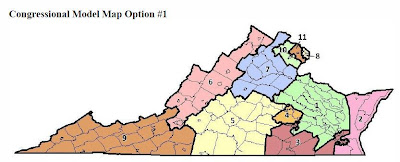 Everyone knows that Virginia’s redistricting process is an abomination: an occasion for back-room deals in which the power brokers reward their friends, punish their enemies, protect incumbents, split municipalities between multiple representatives and effectively disenfranchise swaths of the electorate.
But let’s see you do better. The Bipartisan Advisory Commission on Redistricting, chaired by Bob Holsworth, was tasked with developing principles for Virginia’s 2010 redistricting process and found itself juggling oft-conflicting goals of: (1) creating equally sized districts and (2) maintaining compactness, while (3) not splitting cities and counties or (4) diluting African-American votes. It ain’t easy. But the commission’s efforts did yield a new electoral map for Congress that Virginians can take pride in. Above is the first of three options presented. (The 3rd District is the state’s minority-majority district.)
Consider it a yardstick of truth, justice and the American way with which we can measure whatever the gerrymander artists in the General Assembly devise. (Click map for more legible image.)
-
Retail Vacancies Hit 20-Year Highs
 It’s nice to be proven right. I make a lot of predictions on this blog but most will not be proven right or wrong for many years, by which time everyone (including, probably, me) will have forgotten I ever made them. But once in a while a prediction comes true within my gnat-like memory span, allowing me an opportunity to gloat.
Such is the case with the news reported by the Wall Street Journal that malls in the nation’s largest 80 metro areas hit their highest vacancy rates since 1990 in the first quarter of 2011, and could reach 11% later this year for strip malls and regional shopping centers. Now, I was hardly the only one to observe that the recession would severely impair retail sales and put a dent in retail vacancies, so I cannot claim any special prescience on that score. But only a few observers of the retail scene (Ed Risse was another) went out on a limb and predicted that the vacancies would hit hardest on the metropolitan periphery.
Lo and behold, the Journal reports:
A broader glut has struck some of the exurbs that saw heavy housing development during the boom, where malls and strip centers built for growth that never came. More than one billion square feet of retail space was added in the 54 largest U.S. markets since the start of 2000, according to CoStar Group’s Property & Portfolio Research Inc. of Boston.
What the Journal article does not do is explain why this is happening. The reason for rising vacancies nationally is the demise of Mass OverConsumption. The consumer bubble has burst. Consumer spending will be very slow to recover as households deleverage and Boomers start saving for retirement. With consumers buying less, the retail sector will need fewer stores.
The reason that projects on the metro periphery are suffering more than other areas is that “suburban sprawl” (scattered, disconnected, low-density development) is receding. When Americans have choices, they tend to avoid the residential monoculture, strip malls and long commutes of the periphery in favor of walkable, mixed use communities closer to their jobs in the urban core. Thus growth in population and consumer demand never materialize. Stores close and vacancies rise. Just wait until gasoline prices pass $4 per gallon (and $5 per gallon later in the business cycle) — economics on the suburban edge will look even uglier.
So, why does this matter? Because public policy has not caught up with economic reality. Our zoning and transportation policies are still geared to the era of MassOverconsumption, when development pushed relentlessly outwards from the urban core during the post-World War II era. That epoch is over. The forces that propelled outward growth have spent themselves.
I hope to develop these themes in future posts.
-
What! No High Speed Rail Funds?
 Holy conservative! Richmond’s ruling elite is having a train wreck with the McDonnell Administration. After several years of pushing higher speed rail, Gov. Robert McDonnell’s secretary of transportation announced that the state would not be applying for some of the $2.4 billion made available for higher speed rail after Florida nixed such a project that would serve Tampa and Orlando.Sean Connaughton says that the state is simply being “realistic” and that it does not have the money for its 20 percent share for the project that would boost higher speed rail from Richmond to Washington.That flies in the face of Richmond’s business class, which is solidly behind boosting train speeds between the two cities to about 90 miles an hour. Top speeds, rarely reached by passenger trains on the route, are 79 miles per hour. True “high speed” rail kicks in at 110 m.p.h.The plan is backed by none other that the conservative House Majority Leader Eric Cantor, a congressman from Henrico County, along with such groups as the Greater Richmond Chamber of Commerce and various commercial barons, including James Ukrops, the former head of the now defunct Ukrops grocery stores.They all like the idea of using the fancy, 1901 Renaissance-style Main Street Station to be whisked quickly and effortlessly to Union Station for their meetings in D.C., thus avoiding the abomination of Interstate 95.One problem is that Main Street Station was obsolete from the day it opened more than a century ago. A bigger and political one soon arose. Higher speed rail is Barack Obama’s baby. Strict. dogmatic conservatives see federal and state spending as unneeded now that they all are carrying the banner of deficit and debt cutbacks.Not to be outdone, Richmond’s equally conservative ruling elite struck back. On March 30, they trotted out William S. Lind, director of the American Conservative Center for Public Transportation, who weighed in with the idea that it’s OK to be right wing and go for public subsidies for higher sped rail.The fight over the dogma soul is delicious to the observer and conjures up the Great Schism of 1054 or maybe even Martin Luther hammering his edicts on the church door some time later.The Big Example, of course, is Rick Scott, the Republican governor of Florida who said that funding higher speed rail between Orlando and Tampa made no sense because the demand wasn’t really there and billions for trains would only cut the car travel time by a few minutes. He, naturally, doesn’t have to deal with the glue of I-95 and the Beltway around D.C., but some of the points are the same.Not all states see things the same way. Twenty-four of them are vying for the extra funding including the District of Columbia.Thelma Drake, the former Congresswoman who is now the state director of rail and public transportation under Connaughton, said Virginia wasn’t going for the federal bucks because the state could not guarantee a 2017 deadline for completing work and didn’t have the 20 percent match. If the state missed the deadline, which could be hampered by required environmental impact statements, Virginia might have to give the money back.In a sense, it’s good that some on McDonnell’s administration have the chops to tell it like it is. What’s going to be interesting is how the Richmond Elite respond.Peter Galuszka
-
PAUL RYAN’S CHARADE CRUSADE
Dana Milbank knows how to skewer pandering politicians of both political Clans.
Milbank does it by using their own words. On 6 April Milbank did a fine job on the blue eyed wunderkind from the southern part of Wisconsin, Paul Ryan, Chair of the House of Representatives Budget Committee in “Paul Ryan picks a fight.” (WaPo 6 April 2011)
At a press conference wunderkind Ryan referred to the House Budget Committee’s proposed federal budget proposal as a ‘cause,’ not a ‘budget.’
Ryan is on a crusade to support his ‘cause.’ That is not bad per se, unless as is the case here, it is a very BAD cause.
Ryan is on a crusade to save his congressional seat and pave the way to ‘higher office.’
Ryan is on a crusade to save his and other Clan member’s campaign supporters.
Ryan’s crusade is fanning the Anger of Ignorance and contributing to Intentional Ignorance.
Ryan’s crusade sounds a lot like the rhetoric of another pretty young fellow from the central part of Virginia: Choirboy Cantor. Mr. Bacon did not vote for Cantor. For the record, EMR would not have voted for him either. EMR would have written in James A. Bacon unless there was a AntiPartisan candidate… but that is another story.
Ryan in on a mission, a cause.
That cause is not in the best interest of the vast majority of the citizens of the US. It is a hard turn away from democracy and from preserving a market economy to allocate resources and fairly distribute total costs of human activities.
Ryan, and those he speaks for, hope to squeeze a few more years out of the current trajectory but they do not understand the full context of THE CURRENT TRAJECTORY.
No one in their right mind thinks the federal Agencies should spend as much money as they do.
No one in their right mind thinks that the Federal Agencies should spend the citizens resources on all the things that resource is spent on.
That said;
No one in their right mind thinks the place to start is to shut down the government (‘starve the beast’) or cut taxes for those at the top of the Ziggurat.
First, both Clans – and everyone else in the US – must understand and publicly admit that it will cost FAR more than anyone is now paying to maintain anything like the quality of life that has been enjoyed during the Age of Gluttony.
Citizens and their Organizations have been enjoying the Era of Mass OverConsumption. Federal, state and municipal Agencies – along with Enterprises, Institutions and Households – have been living off Natural Capital. That Natural Capital – energy of course, but also top soil, potable water, fresh air and everything else the environment provides–is running low and half the human population is in active pursuit of far more than they have been getting. See ENOUGH? (Forthcoming)
The fundamental flaw in this “starve the beast, budget for the 1960s” approach is that to meet Core Agency responsibilities it will require FAR MORE RESOURCES than are now being applied to PUBLIC health, safety and welfare.
The infrastructure that is needed to support an advanced civilization is falling apart.
It is not just roadways and bridges, it is water and sewer lines,too Communications networks over burdened to support Mass OverConsumption and the waste of time.
Airplanes are popping open and diving out of the sky. Every existing nuclear facility is near obsolescence. Coal is more dangerous to humans (in deaths per megawatt) that nuclear. Any strategy to supply as much energy consumption per capita for all humans as is now consumed by citizens of the US will trigger an economic and physical disaster.
And then there are the basics needed to support even a New Bronze Age: Water, Food and Shelter.
Fresh and sea water is growing more contaminated.
The food supply chain is long and unsafe by the standards humans have come to expect. Food costs are skyrocketing because energy is skyrocketing. Top soil continues to erode.
In shelter, Agencies and Enterprise have conspired to create the Wrong Size House in the Wrong Locations – exacerbating the Mobility and Access Crisis, creating the Affordable and Accessible Housing Crisis and compounding the Helter Skelter Crisis.
Health Care has higher costs and worse outcomes than in most other ‘developed’ nation-states. Mental Health Services are a discrase.
AND SHUTTING DOWN THE FEDERAL GOVERNMENT IS A ‘PRIORITY?’
Most efficient and effective way to achieve a sustainable trajectory is to evolve a Fundamental Transformation of settlement patterns.
However, as pointed out in TRILO-G, that will not happen until there is Fundamental Transformation of both the governance structure and the economic system.
As pointed out in the Section 1.4 of CITIZEN MEDIA, THE NEXT STEP, until reality is understood by a majority of citizens and the processes is underway to achieve those Fundamental Transformations, citizens of the US will be not be happy or safe.
Charades and Causes will not address the problems, causes make them worse.
Full disclosure:
When Groveton first started to sing the praises of Paul Ryan, EMR printed out Ryan’s “A Roadmap for America’s Future” May 2008 (H.R. 6110) and read it from cover to cover. We just dug it out, it was filed away under the title “Saving Public Ryan.” From himself.
“A Road Map for America’s Future” is an historical artifact. If this WAS a roadmap it was a guide for the late 1940s. Citizens needed a pep talk, lest they lose confidence and abandon the rebuilding of Europe and Japan and stop applying the innovations and technology that evolved from 1870 to 1950.
Since then citizens of the US have been sharpening the points. From 1950 to the mid 70s ‘everyone’ benefitted. Since then only those at the top of the Ziggurat.
Anytime since the wake up call of 1973, Ryan provides a roadmap to Lemmings Cliff.
Along the way the signs read: “Buy More and More”, “Spend More and More – On Credit”, “Consume, Grow and Expand – The Cancer Cell is our Hero,” “Drive Here, There and Everywhere”, “Exploit Whatever You Can”. “What Great Grandchildren?” The road led from “Morning in America” to “Go Shopping” and on to “Next Stop, The Cliff.”
This is not a partisan issue. This is not a political spectrum issue. This is a survival of Civilization as it has been known issue. See ENOUGH? (Forthcoming)
Humans cannot “grow” out of problems they have created. They must Balance consumption with conservation and Balance competition with cooperation. The true Conservatism.
Fundamental Transformation must start with each Household understanding their best interest – individually and collectively.
Understanding must grow to shape the future of Dooryards, Clusters, Villages and Communities. It does not start with shutting down the federal government or with cutting taxes on those at the top of the Ziggurat.
The federal Agencies must spend less, but far MORE must be spent than the current total being spent at federal, state and municipal scales to provide Core Agency health, safety and welfare priorities.
Anyone who does not acknowledge this is just trying to ride the tiger one more hour, one more mile, to get one more perk.
Those willing to hack at federal programs before establishing a path for MegaRegions, Regions (See Mr. Bacon’s 5 April post on the Brookings Regional proposal — metro’s rule), SubRegions, Communities, Villages, Neighborhood and Cluster governance is putting all citizens and their future at risk. See ENOUGH? (Forthcoming)
EMR
-
The Wonk Salon: April 7, 2011
Why Colleges Grow Fat while Students Starve
Center for College Affordability & Productivity
Colleges and universities capture the economic value of increased financial aid, so tuition and fees remain as unaffordable as ever. (See related Bacon’s Rebellion blog post below.)
-
Why Colleges Grow Fat while Students Starve
 The cost of higher education remains unaffordable to so many students because colleges and universities “capture” the benefits of financial aid (federal grants, veterans benefits, state grants and private grants) by increasing tuition and fees, argues a recent report, “How College Pricing Undermines Financial Aid,” issued by the Center for College Affordability and Productivity.
The authors identify a little appreciated mechanism that enable colleges and universities to charge what the market will bear: They possess information that players in other industries do not. They know how much their customers (students) can realistically afford to pay and how much external aid they receive from third parties. Armed with that information, they know how much they can increase tuition or lower their own grant aid without losing market share.
As prestige-maximizing institutions, universities are driven to increase spending. “Competition between institutions is driven by academic reputation,” the authors write. “Due to this persistent uncertainty, each institution must signal quality through expensive proxy signals, such as the quality of their students, research, facilities, or athletic teams. If an individual institution forgoes capturing increased financial aid dollars, it cannot compete; its status will decline as will its ability to attract good students. This behavior is reinforced by the fact that students and their parents associate high cost with high quality. … Higher education is engaged in an expenditure ―arms race that thwarts policies to increase public access and redistributes wealth to higher education insiders.”
Where does the money go? The authors cite the falling productivity and rising compensation for faculty as a major driver of costs. Over the past three decades, the faculty-wage component of cost per student rose by 33% among public institutions and 72% for private. At the same time, student-faculty ratios declined by 25% and 28% respectively. Evidence from other sources suggests that institutions of higher ed have experienced considerable administrative bloat as well.
There is reason to believe that Virginia’s institutions of higher education do deliver more bang for the educational buck than public institutions in other states. Yet tuition and fees are soaring here in Virginia as well. The usual college gambit is to blame insufficient state funding — which will take a big hit in FY 2012. But that excuse is wearing thin.
-
Virginia PeaceNix
 An Aussie organization called the Institute for Economics and Peace, publisher of the Global Peace Index, has now rolled out a American version, the United States Peace Index, that ranks the 50 states by their “peacefulness.” There are “hundreds of billions of dollars” of potential economic benefits associated with domestic tranquility, asserts the Institute, if only Americans would only get with the program and become more like Canadians.
The Old Dominion may strike Virginians as a fairly peaceable state, given the fact that 2009 crime statistics rank it 7th in the country (as in 7th lowest) in the category of violent crimes per 100,000 people. Yet the commonwealth ranks only 25th nationally for peacefulness under the Institute’s methodology.
What’s that? It turns out that there’s more to “peacefulness” than a proclivity to avoid shooting and stabbing one’s neighbors. The methodology for compiling the Institute’s index also includes the number of murders — a legitimate metric, in my book, in which Virginia fares rather badly. But it also uses metrics of dubious value, such as the number of incarcerations per 10,000 people, the number of police per 10,000 people and the “availability” of small arms. And it turns out that Virginia has more police and puts more of its criminals in jail than many other states.
What? To my feeble mind, peacefulness should reflect actual conditions — freedom from murders and violent crime. But apparently that’s not sufficient. Is there a social justice aspect to this — incarcerating criminals is a negative, even if it means they aren’t committing mayhem? Hiring more police to arrest criminals and ward off crime is a negative… because it’s evocative of a police state? Someone please help me here.
The most ludicrous metric is “availability” of small arms. It doesn’t matter if people actually bear the arms, much less if they actually use them against one another. Simple access to small arms is presumed to be a negative.
Well, I suppose if Virginians were truly peaceful folk, they would have low crime rates like the inhabitants of Maine, New Hampshire and Vermont. I don’t know if it’s because the compilers were foreigners and not attuned to regional differences or just because they had their goody-two-shoes blinders on but they go to great lengths to correlate peacefulness with “significant socio-economic correlations” with such factors as educational achievement, infant mortality, teen pregnancy, poverty and the like. What they don’t explore is the connection between peacefulness and race/ethnicity.
As it turns out, the most peaceful states in the country happen to be among the whitest states, as in low percentages of African-Americans, Hispanics and even Asians. But they don’t have just any old kind of white people. They have white people from the New England Yankee tradition and white people of Scandinavian heritage. These states do not have large percentages of Scotch-Irish white people, or white people of Southern redneck lineage, both of which have long traditions of violence. I would argue that cultural traditions of peacefulness and a social homogeneity that preserves those traditions explain a whole lot more than anything that the peacenik Institute touched upon.
States with peaceful populations have lower crime along with low rates of incarceration and small police forces because people behave themselves. Maine Yankees and Minnesota Swedes, like Canadians, are different from most Americans. The rest of us, well, we need more police and bigger jails to take the bad guys out of circulation. Considering the recalcitrant raw material we have to work with — us — I think Virginia does pretty darn well in maintaining the peace. We should have ranked higher.
-
The Wonk Salon: April 6, 2011
More Poor in Virginia
The Commonwealth Institute
The recession pushed thousands of Virginians into poverty — college graduates were hardest hit.Breaking the “Whole School” Model
American Enterprise Institute
America’s centralized, one-size-fits-all schools are so 20th century. The future is in virtual schooling and customized education.Medicaid Expansion and Physician Supply
Robert Wood Johnson Foundation
What happens when Obamacare expands the insured population by tens of millions of Americans? Poor people will have insurance — they just won’t have doctors.
-
Virginia’s Lopsided Tax Burden
 A commonly used measure of the tax burden is the average tax revenue a state and its localities collect per resident. But that’s not the same as the amount of taxes that residents actually pay. How can that be?
Mark Robyn with the Tax Foundation provides the explanation in a new analysis: “Some states have special sources of revenue, such as oil taxes and large tourist industries, which are easily exported to residents of other states. Also, some taxes are naturally exported through no effort of state lawmakers. For instance, since the burden of corporate taxes ultimately falls upon customers, shareholders and employees, who are all located in many different states, the burden of taxes on corporations is naturally exported.”
“It turns out a quarter of the average taxpayer’s tax burden originates in states where he or she doesn’t reside.” Thus, Alaska ranks No. 1 nationally in “taxes collected” as a percentage of residents’ income (21%) but 50 in terms of “taxes paid” by residents (6.3%) thanks to its taxes on the petroleum industry.
How does Virginia stand? We’re in the opposite situation from Alaska — apparently, Virginians “export” very few of their taxes. Viewed by conventional measures, we are a low tax state. Using 2009 numbers, we rank No. 45 in state taxes collected as a percentage of residents’ income (8.9%). But we are a moderate/low-tax state, ranking 33, when measured by taxes paid by residents as a percentage of their income (9.1%).
Virginia is one of only eight states (by my quick eyeball count) in which taxes paid per resident exceeds taxes collected. Other states have figured out something that we haven’t. At least we can be thankful we aren’t New Jersey whose “taxes collected” rank it as the 7th highest-tax state but “taxes paid” ranks it the No. 1 most highly taxed state in the country.
The implication of this analysis is that Virginians are shouldering the burden of their own state-local taxes — and chipping in, through what they spend on gasoline, tourism and goods and services produced by out-of-state corporations, significant sums to other states. Maybe Gov. Bob McDonnell’s idea to put Interstate polling booths on the state line isn’t such a bad idea after all! (Actually it is an atrocious idea, but for other reasons. It would stick out-of-staters with a bigger share of the cost of running Virginia state government.)
-
Factoid of the Day: Virginia’s Child Population Growth

This helps explains why the pressure for educational spending did not relent in Virginia over the past decade. I’d like to know what the demographers predict for the decade ahead. (The map comes from “America’s Diverse Future: Initial Glimpses of the U.S. Population from the 2010 Census” from the Brookings Institution.)Click on map for clearer image.