• Autism Coverage and the Hidden Man

    Republicans still need remedial instruction, it appears, on the meaning of free markets. Occasionally, they get it right. When President Obama passed healthcare reform that coerces uninsured individuals to sign up for health insurance or pay big penalties, for instance, members of the Elephant Clan raised a ruckus over the abrogation of personal economic freedom.

    But if you want to buy an insurance policy that doesn’t include coverage for cancer screenings or reconstructive breast surgery, then you are not free to do so. Republicans in the General Assembly routinely vote for laws requiring individuals to purchase health insurance plans that may provide coverage options they do not want.

    The most recent case in point: Gov. Bob McDonnell has signed a bill requiring health insurers to offer treatment for autistic children ages 2 to 6. (The law will cap annual coverage costs at $35,000, would not apply to self-insured companies and would exempt businesses with 50 or fewer employees, according to the Times-Dispatch.)

    Before anyone accuses me of being insensitive to the challenges of autism, let me quickly say that I am very sympathetic to the plight of parents raising an autistic child. Raising a “normal” child (if there is such a thing) is difficult enough. I can only imagine the emotional and financial roller coaster that people go through with an autistic child. My heart goes out to them.

    But I am sympathetic to other people with all kinds of medical maladies, from broken bones to heart attacks, from diabetes to lung cancer. And I am aware that adding millions of dollars of new liabilities to policies that cover those basic illnesses will require insurers to raise rates. Thus, for every family that benefits from the new autism coverage, some other family will lose coverage for everything because they find the new-and-improved package to be unaffordable.

    The problem isn’t autism so much as it is the whole panoply of mandated benefits. Autism is only the latest in a long list of requirements that make basic health care insurance so expensive and unaffordable to many. Among the categories of coverage mandated by Virginia law:

    • Pap smears
    • Hemophilia
    • Prostate-Specific Antigen (PSA) testing
    • Colorectal cancer screenings
    • Infant hearing screenings
    • Biologically based mental illness

    Click here to see the State Corporation Commission’s full list.

    Any single mandate appears to be defensible. Autism coverage seems no more unreasonable than, say, hemophilia. The problem is that the costs add up. Unlike the advocates of reconstructive breast surgery or autism, however, there are no organizations representing the interests of people who lost health insurance coverage because they or their employer could no longer afford it. They are the “hidden man.” There are thousands of them but politically they do not exist. Therefore, their interests go ignored.

    Advocates of free markets understand that there is always a hidden man who loses when someone passes a seemingly altruistic law. But Republicans, like Democrats, are suckers for anyone with a heart-rending story that tugs at their heart strings. No one wants to seem indifferent to the travails of an autistic child, so Republicans abandon their free-market principles.

    Now the cost of health care insurance in Virginia will rise, the number of Virginians who cannot afford it will increase, and the champions of government-run health care will blame the “failure of the free market.”
  • Dulles Rail Controversy Jumps the Track to RoVa

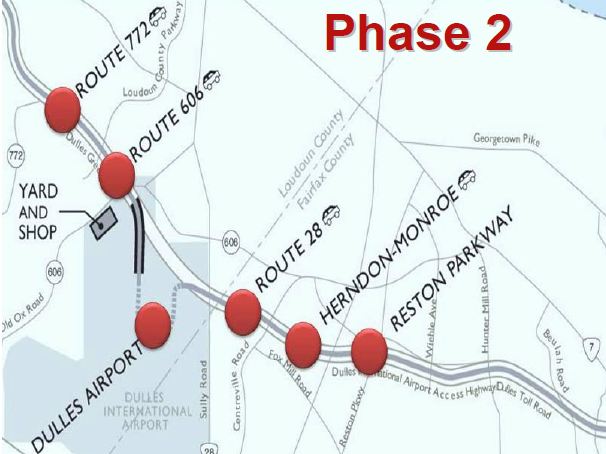
    Once upon a time, the Rail-to-Dulles project was a matter of all-consuming interest only to those living in Northern Virginia (NoVa) and a handful of us in the Rest of Virginia harboring an obsession with transportation and land use issues. The attitude among most RoVa residents, assuming they knew anything about Rail-to-Dulles at all, is that it was a Northern Virginia thing, nobody else would understand… or care.

    But now the heavy rail controversy, with all its cost overruns and desperate grabbing for financial support, has implications for another part of the state — Hampton Roads.

    The root of the problem is the continually escalating cost of extending heavy rail from the Washington Metro system through Tysons Corner and all the way through Dulles airport. The cost of the project, billed at roughly $3.5 billion only a few years ago, has leaped to $6.8 billion. All the key players signed onto the project at a much lower cost. Now the question arises, who pays? How do they spread the pain?

    Aha, one miraculous possibility presented itself. The Metropolitan Washington Airports Authority (MWAA), which has taken over management of the project, has decided to apply for $1.7 billion in federal loans under the Transportation Infrastructure Finance and Innovation Act (TIFIA). That financing would bear significantly lower interest rates than conventional municipal bonds, potentially saving hundreds of millions of dollars over the 30-year life of the loan and making it possible to dampen the toll increases on the Dulles Toll Road, the cash cow expected to pay for nearly three-fifths of the project.

    But there’s a hitch, explained MWAA Vice Chair Tom Davis at a recent MWAA meeting. The TIFIA loans are highly competitive. As the Fairfax Times quotes him as saying, Virginia has other large projects, such as the “Third Crossing” bridge-tunnel in Hampton Roads that it hopes to get the loans for. To win a TIFIA grant, NoVa needs to coax all of its funding partners, including the state of Virginia, on board, Davis said. Trouble is, he added, “The commonwealth, right now, is not on board.”

    I wouldn’t want to be in Gov. Bob McDonnell’s shoes. I would guess that the prospect of Virginia winning TIFIA backing for two mega-projects is pretty remote. At some point, McDonnell is going to have to pick sides. No matter what he decides, he’ll make somebody really, really mad.

    Meanwhile, the statewide political dynamics make the project dicey for Northern Virginia’s political leaders. The project has the potential to pit Virginia’s largest metropolitan region against its second largest metropolitan region in a battle of the bull elephants. If enough blood is spilled, that’s a battle nobody wins. Rest assured, I’ll be sitting on the sidelines chewing popcorn and keeping up a spirited commentary.


  • The Wonk Salon: May 6, 2011

    Expanding Medicaid Could Result in Worse Overall Health Care
    Heritage Foundation
    Studies show that the medical care provided Medicaid patients is no better, maybe worse, than the care provided indigent patients. Obamacare’s expansion of Medicaid is not likely to improve matters.

    Competition Blasts Off in the Space Industry
    Government Accountability Office
    Bottom line for Virginia: Wallops Island is getting a lot more competition in the bid for commercial space transportation.

    Making the Most of Childhood Visitation Programs
    National Governors Association
    The authors claims a 5-to-1 cost-benefit ratio in state visits to homes of at-risk children and expectant mothers. Sounds like the Nanny State run wild to me.

    Transforming Mental Health Care
    National Governors Association
    Many mental disorders once deemed incurable can now be treated. State mental health systems need to change focus from long-term custodial care to fostering mental health recovery.


  • Highway Robbery


    Wow! Commuters on the Dulles Toll Road, now paying $4 for a round trip, could be paying $40 by the year 2040 to help pay for construction of the Dulles rail extension, reports the Washington Examiner. Those numbers came from financial consultants reporting yesterday to the Metropolitan Washington Airports Authority.

    The tolls could be 30% lower if the project can qualify for lower interest-rate financing from a Transportation Infrastructure Finance and Innovation Act loan, but that probably won’t prove to be much consolation to Northern Virginia commuters. Not all motorists will drive the full distance and pay the full freight, but in theory some could be paying $10,000 a year for the privilege of using the toll road. Reducing that sum to only $7,000 a year won’t be much consolation — it’s still equal to what many will be paying on their car loans!

    Unidentified “officials” (presumably MWAA officials) are so concerned that they’re considering actually tolling the free access road to the airport, which runs in between the toll lanes. Do ya think? Faced with the prospect of charging local-destination drivers up to $40 per round trip MWAA actually may slap a toll on a free expressway to help pay for other people who are riding the Metro, whose fares, by the way, will be massively subsidized. You gotta love it.

    I am making a surmise here: MWAA officials plan not to charge Metro riders the full cost of operating the rail service because, if they did, fewer people would ride it, thus defeating the whole purpose of building the rail line. Board members understand the idea that there is a limit to peoples’ willingness to pay to ride the rail.

    Assuming they embrace that logic, I would heartily urge MWAA’s board to ask its financial consultants the following questions: If MWAA charged up to $2o per trip for access to the Dulles Toll Road, would drivers avoid using the toll road? Might they revert to such unseemly remedies as car sharing, riding buses or telecommuting or… taking alternate routes? And if they do, would they do so in such large numbers as to undermine the traffic counts that MWAA is planning on to generate the revenue required to meet its share of the Rail-to-Dulles bond obligations?

    In other words, is it possible that the project costs have escalated so much that no matter how aggressively MWAA gouges Dulles Toll Road commuters, it might be impossible to raise the sums of money required to pay the rail line’s debt service?


  • The Wonk Salon: May 5, 2011

    School Teachers and the Crisis in Math and Science
    Center for American Progress
    Teachers who teach math and science should understand math and science. Here’s how to make sure they do.

    Does Limited Government Mean Abandoning the Poor?
    Heritage Foundation
    We’re spending $1 trillion a year to fight poverty. It doesn’t work. Civil society could do a better job.

    Linking Higher Ed and Economic Development
    National Governor’s Association
    It’s not enough to increase the number of citizens with college degrees. More state policy makers are asking, degrees for what kind of jobs?


  • The Minimum Wage: Institutional Racism at Work

    Liberals love to talk about discrimination and racism. When they can’t prove racist intent on the part of individuals, they blame “institutional racism.” How do they know when institutional racism exists? When there is disparate impact.

    Thus, when a company in my home town like the (now departed) Circuit City promoted disproportionately more whites than blacks, it was found guilty in U.S. federal court of discrimination, even if it’s impossible to identify any individual acting out of conspicuously racist motives. When minorities graduate from high school at lower rates than whites or achieve lower scores on standardized tests, that’s another example of institutional racism at work.

    Hold that thought as I describe a new study, “Unequal Harm: Racial Disparities in the Employment Consequences of Minimum Wage Increases,” published by the Employment Policies Institute. Authors William E. Even and David A. Macpherson examined the interstate variation in the minimum wage between 1994 and 2010 to shed light on the employment patterns of 16-to-24 year-old males without a high school diploma.

    They found that for white males, each 10% increase in a federal or state minimum wage decreased employment by 2.5%. For Hispanic males, the figure was 1.2%. For black males, the figure was 6.5%. States the executive summary: โ€œAcross all 50 states and the District of Columbia, approximately 34,300 black young adults lost their job due to the recession; during the same period, 26,400 lost their job due to minimum wage increases that occurred.โ€

    Among the 21 states whose state minimum wage tracks the federal minimum wage — that would include Virginia — the consequence of minimum wage increases in 2007, 2008 and 2009 for young African-American males were more harmful than the effects of the recession.

    Now, let’s use lib-logic: The minimum wage has a disparate impact upon whites and blacks. Blacks are more negatively impacted than whites. Therefore, the minimum wage constitutes institutional racism. Legislators like Nancy Pelosi who championed the minimum wage are peddling racist policies, and all those who advocate the minimum wage should be presumed, absent evidence to the contrary, to be racist as well.

    Do I really believe that liberals are racist? No, I just think they’re misguided. But they love throwing around the “r” word epithet, and they deserve to be skewered with their own logic.


  • Offshore Drilling: Beating a Dead Horse

    Trying to take advantage of consumer unease over gasoline prices above $4 a gallon, Virginia Republicans are trying to reopen lease sales offshore the Old Dominion to oil companies.

    Gov. Robert F. McDonnell and U.S. Rep. Eric Cantor are trying to reverse the Obama Administration’s decision to delay a lease sale off the Virginia coast until 2017 after a rig leased by BP, the British energy giant, exploded and released about 5 million barrels into the Gulf of Mexico. Oil was gushing into the bottom of the Gulf 5,000 feet down at a rate of 53,000 barrels per day for three months in this country’s worst environmental disaster.

    McDonnell and Cantor want Congress to pass the Restarting American Offshore Leasing Now Act. McDonnell wants a second chance at his “vision” to make Virginia the “energy capital of the East Coast” (whatever that means). Initially, his big plans for such a vision, of course, were pretty much blown away with BP’s Deepwater Horizon rig.

    For his second try, McDonnell has tapped the state’s conservative establishment, such as the Richmond Times-Dispatch which ran a McDonnell column promoting the bill on its op-ed page along with ordering up a front page story by Olympia Meola trumpeting the new charge.

    Bob’s op-ed piece states: “We are simply too dependent on foreign sources of oil. More than half of the oil we use comes from imports. And many of those barrels come from countries that are not our allies.”

    Well, let’s take that statement apart. As far as our enemies supplying us oil, the No. 1 exporter is Canada, which we all know views us with great disdain (probably jealousy). No 2. is Saudia Arabia, which may hate us but we let them rent our Army from time to time. No. 3 is Mexico, which probably hates us because of our Neanderthal immigration policies. No 4. is Nigeria, unstable but not an enemy. No 5 is Venezuela, Marxist president but they’ve been supplying us since about the 19th century. Following these are Angola, Iraq, Ecuador, Brazil, Colombia, Algeria and Kuwait. Lot’s of enemies there!

    Regarding the Deepwater Horizon blow out, McDonnell writes: “We know that lessons are being learned and that new safety standards are being put in place.”

    Huh? It’s going to take a little longer than one year for the standards to be raised. “A year from now, and no one seems to have learned a lesson from the disaster,” writes Canadian newsmagazine Macleans. Are there blow-out preventers in place of the more sophisticated type that Norway and Brazil use for their deepwater rigs? No. Have there been plans to put in place to deploy wells to be drilled quickly and relieve pressure? Don’t know. Has the Department of the Interior’s Minerals Management Service, the regulator, been through a housecleaning? During the Bush Administration, the MMS was approving rigs left and right while some of its staffers were, literally, in bed with the oil companies.

    The last fallacy of the McDonnell-Cantor idea is that even if a lease sale off of Virginia gets the OK, and if oil is found (no discovery yet), it won’t be until 2020 or later before oil will make any difference. It will not be a panacea for today’s higher oil prices, which are being driven by great demand from Asia, not hatred for America. By the time any oil might get to market, it could well go to those few, leftover cars that are still powered by the internal combustion engine. Plus, any number of economic movers in Virginia, from commercial fishing to the Navy, are against drilling.

    A wiser choice would be for Virginia to drop the oil idea and pursue alternate energy ones. Car-makers in Detroit and Tokyo have already pushed electric batteries using better, higher tech batteries. There’s a big proposal for a wind farm off the Virginia to New Jersey coast backed by search engine Google. Why doesn’t McDonnell push conservation and electricity generation by smaller sources than big, base-loaded plants?

    By beating this dead horse, McDonnell and Cantor are once again showing how firmly they are stuck in the past.

    Peter Galuszka


  • The Wonk Salon: May 4, 2011

    The Ryan Plan Would Whack Children, the Elderly, the Disabled and Pregnant Women
    Center on Budget and Policy Priorities
    Rep. Paul Ryan’s plan to transform Medicaid to a program that guarantees coverage to one that would issue block grants to states would result in states distributing cuts to society’s most vulnerable groups.

    Election Day Registration in California
    Demos
    Enacting election-day registration would increase voter turnout in California, particularly among young and Hispanic voters… Gee, which way do those groups tend to vote?

    How Obamacare Will Impact Charity Care in Virginia
    (Virginia) Joint Commission on Health Care
    By increasing the percentage of people with health care coverage, the Patient Protection and Affordable Care Act could reduce the burden of charity care and indigent care, which cost Virginia hospitals roughly $1 billion a year.


  • Good Mexicans and Bad Mexicans: It All Depends on Which Side of the Border They Live

    A deteriorating balance of trade with Mexico since enactment of NAFTA in 1994 has cost the U.S. economy 683,000 jobs and Virginia 13,100 jobs, asserts a new paper by the Economic Policy Institute, “Heading South: U.S.-Mexico trade and job displacement after NAFTA.

    Before the North American Free Trade Agreement, the U.S. enjoyed a small balance-of-trade surplus with Mexico. But massive U.S. investment into our south-of-the-border neighbor fueled the outsourcing of jobs and production, especially in the manufacturing sector. The lost jobs were distributed across the U.S., with California, Texas and Michigan being the hardest hit. Virginia was among the states experiencing a moderate impact.

    According to author Robert E. Scott’s calculations, Virginia gained 16,800 jobs from increased exports thanks to NAFTA but lost 30,000 jobs, for a net loss of 13,100. (See Table 4B.)

    Wow, it sounds like NAFTA was a raw deal for the U.S. Ross Perot was right when he said we’d all hear a “giant sucking sound” of jobs to Mexico…. Only one thing: Scott is telling only part of the story.

    The period between 1994 and 2010 saw a massive deterioration in the U.S. balance of trade with the entire world. We went from a foreign trade deficit in goods of $150 billion in 1994 to a deficit of $634 billion in 2010. We didn’t lose ground just with Mexico and Canada, we lost ground pretty much across the board.

    Some have made the argument that we would have lost more ground were it not for NAFTA. Jobs shipped to Mexico were jobs not shipped to China, Malaysia, Vietnam or other Asian export powerhouses as U.S. manufacturers chose a manufacturing platform close to the U.S. Given the realities of globalization, those jobs were goners regardless. But thanks to our free trade agreement with Mexico, Mexicans in turn bought a whole lot of stuff from the United States. Thus, while total U.S. exports increased 150% between 1994 and 2010, exports to Mexico increased 212%.

    What amuses me is how lefties think that competition with Mexican labor is ruinous to U.S. jobs when trade takes place across the U.S.-Mexican border. But when Mexicans come into the United States illegally and compete directly with U.S. workers, the impact on jobs and wages is dismissed as insignificant. Bashing Mexicans inside Mexico… OK. Bashing Mexicans living illegally inside the U.S…. racist! Go figure.


  • Black City/White Suburb Stereotype Fading Fast

    The stereotype of โ€œchocolate city and vanilla suburbsโ€ is fast eroding, argues William H. Frey in a new report, “Melting Pot Cities and Suburbs,” based on data from the 2010 United States census.

    Minorities, especially Hispanics, are fueling population growth in a wider array of places, including suburbs in all parts of the country. Meanwhile, โ€œblack flightโ€ from cities with large African-American populations is also changing the population mix of cities and suburbs. โ€œThese dynamics combined in the 2000s to produce more diverse โ€œmelting pot suburbsโ€ and increasingly multi-hued cities, stark changes from the binary race/place images of the past,โ€ Frey writes.

    Frey’s report does not provide a metro-by-metro breakdown. But the narrative and infographics do contain nuggets pertaining to the three Virginia metro areas, Washington, Hampton Roads and Richmond, that are included among the 100 largest metro areas covered by the study. Among the nuggets:

    Washington, D.C., was one of six individual cities that experienced an increase in the white share of population. The white share now stands at 35%, up 7% from a decade ago. Blacks comprise 50% of the population, down 9%. Hispanics and Asians grew their shares of the population by 1% each.

    The suburbs of the Washington metropolitan area turned “majority minority” over the decade, with the white share slipping to 50% of the population. The growth rate was most rapid for Hispanics (6%) and Asians (3%) but modest for African-Americans (1%).

    Extraordinarily, of the 20 exurban counties ranked by the rate of population growth, five are located on the fringes of the Richmond metro area — one out of four in the country! Even as white population growth slowed to a crawl nationally, whites predominated in these counties.

    • New Kent County: Grew 37% over the decade. Whites contributed 82% of that growth.
    • Louisa County: Grew 29% over the decade. Whites contributed 80% of that growth.
    • Caroline County: Grew 29% over the decade. Whites contributed 69% of that growth.
    • Goochland County: Grew 29% over the decade. Whites contributed 90% of that growth.
    • Powhatan County: Grew 25% over the decade. Whites contributed 90% of that growth.

    I’m not sure what that says about the white population of the Richmond region, but it certainly does confirm one thing I’ve warned about for years: Richmond is one of the fastest sprawling metro regions in the country.


  • The Wonk Salon, May 3, 2011

    Are Community Colleges the Future of Higher Ed?
    John William Pope Center for Higher Education Policy
    Community colleges, focused on instruction, deliver far more value than colleges and universities, which pursue multiple agendas.

    Cops + Professors = Better Law Enforcement
    Rand Corporation
    The Caruth Police Institute in Dallas: smarter policemen makes better crime fighters.

    Prison Inmates: Ideal Citizens (for a Gerrymander District)
    Demos
    Here’s a neat gerrymandering trick: Pack you district with prisons. Inmates can’t vote, meaning all the more influence for the rest of your constituents.

    Combining Law Enforcement with Social Services
    Urban Institute/Brookings Institution
    Suppress crime with law enforcement and attack root causes with social services.


  • Rail-to-Dulles Exposed: Subsidize the Rich and Plunder the Middle Class

    Jamie Radtke, who is running for Jim Webb’s U.S. Senate seat, has criticized the Metropolitan Washington Airports Authority for recent decisions it has made relating to the Rail-to-Dulles heavy rail project. Specifically, the board approved an underground station that would cost millions of dollars more than an above-ground alternative and agreed that anyone bidding on the $3.8 billion second phase of the construction project would have to agree to use union labor.

    As Radtke rightfully pointed out in a Friday email blast, “This is an appalling example of arrogance from unelected officials with no accountability to the citizens.”

    I agree. I think that Virginians will come to rue the day that former Gov. Tim Kaine turned over responsibility for Rail-to-Dulles to the unelected MWAA, only a minority of whose board members are appointed by the Virginia governor. The MWAA suffers a clear conflict of interest on the project: It cannot possibly be expected to dispassionately represent its own interests as well as the interests of Virginia citizens.

    I will deal with the union issue in a later post. For now, I want to focus on the issue of the underground station. The issue, to my mind, isn’t whether an underground station is preferable to an above-ground station — of course it is — but the question of who pays for it.

    In a recent op-ed in the Washington Post, former MWAA Chair Mame Reily did a good job of justifying the underground station.

    Itโ€™s better for baggage-laden travelers, who will not have to trek 1,150 feet to an aboveground station to stand in steamy Washington summers or icy winter winds after long international flights. And itโ€™s better as an international gateway to Washington because it preserves the architectural vision of the masterful Eero Saarinen that has made Dulles a design icon worldwide. Washingtonโ€™s two airports, designed by world-class architects, are worthy of the capital of a great nation. For the airports authority to have decided to provide anything other than a first-rate rail connection at Dulles would have been shortsighted โ€” and soon regretted.

    If we’re going to spend in excess of $6.8 billion extending heavy rail from the existing Metro system to Dulles airport, it makes sense to do it right. At the same time, the MWAA deserves credit for seeking to shave costs from the original plan. The newly approved design will knock $330 off the previous version by revising the tunnel length and depth, using a different excavation method, and finding ways to cut costs relating to air conditioning and electricity. Moreover, the service life of an underground facility is expected to last twice that of an above-ground station.

    So, it’s not as if the MWAA is spending money cavalierly. But Reily ducked the critical issue in her op-ed. If the underground station is so vitally important to Dulles, why isn’t the airport authority paying for it? What Reily didn’t mention in her op-ed, nor did the MWAA in its press release, was that the Dulles station will still cost $912 million, even after the cost savings. None of the other stations, not even in densely urbanized Tysons Corner, will be build underground. No one can afford it! The return on investment isn’t there.

    Under current financing arrangements, Dulles is getting a sweet deal. The Dulles station accounts for 13.8% of the $6.6 billion total project cost (Phase 1 and Phase 2 combined). Yet the MWAA is contributing only 4.1% of the total funding, according to the formula negotiated by the participants. The costs are allocated as follows:

    Federal grants – 14.8%
    Commonwealth of Virginia – 3.0%
    Airports authority – 4.1%
    Loudoun County – 4.8%
    Fairfax County – 16.1%
    Dulles Toll Road – 57.2%

    Thus, the MWAA is paying roughly one-third of its proportionate cost, while most of the financial burden will be dumped on the users of the Dulles Toll Road who, by definition, aren’t even using the Metro.

    Such a meager share might be justifiable if Dulles airport had no capacity to raise a proportionate level of funds. But that’s hardly the case. Dulles is a massive business enterprise, generating revenues from terminal leases, airport concessions, landing fees and other sources. Its 2011 operating budget is $420 million. But its operating expenses are only $200 million. After $163 million in principal and interest payments on bonds, Dulles runs a “net remaining revenue” of $67 million, which is distributed between the airport and the airlines. (These numbers do not include Dulles Toll Road fees.)

    As one of the nation’s fastest-growing airports, Dulles has massive expansion plans. Its 2011 budget describes $4.1 billion in capital construction projects authorized for 2010-2016. That encompasses everything from roads, terminals and airfield improvements to cargo buildings, parking facilities, utility systems and… a $211 billion contribution to Dulles Rail.

    In other words, Dulles airport is not an impoverished entity desperately scraping up every nickle and dime it can find to pay its share of the heavy rail project. Its 4.1% share of Dulles Rail constitutes only 5% of its capital spending project through 2016! Yet for some reason, Northern Virginia commuters using the Dulles Toll Road are expected to fund 57.2% of the project even though they will not be using the Metro.

    Yes, the Dulles corridor needs a heavy rail line. Yes, someone has to pay for it. But why are middle-class road warriors expected to subsidize the Congressmen and business executives who wish to ride the Metro from downtown D.C., Pentagon City or Tysons Corner to a nice, air conditioned station located only a short walk from their destination? Why can’t the Congressmen and business executives who benefit from the facility, or their proxy the MWAA, pay for the convenience?

    As it stands now, the financial arrangements for Dulles Rail represent a massive transfer of wealth from middle-class commuters and small property owners to the elites that (a) own property adjacent to the Metro stations and (b) who frequently patronize Dulles airport to fly around the country. But that’s pretty much the story of America today, isn’t it? Plunder the middle class to benefit the moneyed and politically connected special interests, and then plunder taxpayers generally to assuage the elite’s guilt by transferring wealth to the poor. Jamie Radtke gets it. And Tim Kaine, if he runs for U.S. Senate, will have to answer for it.


  • Could the Right-Wing Be Wrong on Obama?

    The killing of terrorist Osama bin Laden is a major victory for President Barack Obama, showing, once again, that maybe he is ready for the presidency after all.

    The last phrase is facetious because all the pundits, especially on the right side of the aisle, constantly raise questions about his experience, his world view and even his citizenship.
    How quickly one forgets that his predecessor, George W. Bush, was in charge when U.S. forces missed Bin Laden in Tora Bora. He also launched an unnecessary war into Iraq based on faulty intelligence about Saddam Hussein’s weapons of mass destruction that turned out not to exist.
    The news today is undeniable. Even Fox News seems to be playing it straight. It is a major victory for the U.S. and for Obama.

    In time, the more delusional elements of the right wing will likely claim that Bin Laden is not dead after all. They still believe that Obama was not born in the U.s. and is not entitled to be U.S. president, Hawaii birth certificate notwithstanding.
    But these are the same people who believe that the $12 trillion swing from a budget surplus with adequate revenues when Bill Clinton left office to debt today. Two recessions were part of the problem, reports yesterday’s Washington Post, but Bush was responsible for more of the shift than Obama with his Iraq and Afghan Wars, Medicare drug shifts, and, of course, a $1.7 trillion loss in tax revenue due to tax cuts mostly for the rich. Obama is responsible for only about 6 percent of the shift from riches to rags (but not if you listen the James A. Bacon Jr. and his cabal).
    Not two weeks ago, the right-wingers were ripping Obama apart for supposedly mishandling popular uprisings against Middle East dictators. He was too soft, too incompetent, makes the wrong decisions. Apparently, Obama made the right one when he had the sense not to share intelligence about Bin Laden’s whereabouts with the Pakistanis.
    Imagine the uproar had the mission failed.
    Peter Galuszka

  • The Wonk Salon: May 2, 2011

    Obama’s New “Urban Manufacturing” Push
    The Urban Institute
    Federal policy needs to support state-regional initiatives to support Small Urban Manufacturing enterprises (SUMs), which are a major source of innovation and job creation.

    D.C. School Choice Works – with Caveats
    The Urban Institute
    School choice programs in Washington, D.C., do provide disadvantaged students options to improve their educations, but they also exacerbate student-quality disparities.

    Realignment: Shifting Responsibility and Power from State to Local Governments
    Public Policy Institute of California
    As part of his campaign to close the budget gap, Gov. Jerry Brown wants to shift responsibility and funding sources from state to local government. This report identifies key issues to be resolved.


  • Virginia: Home to War-Torn Refugees

    I have been fortunate to become friends with a remarkable young man, Awer Bul, who is a refugee from the southern Sudan. Born into the Dinka tribe, he was raised with a family of cattle herders. He remembers living happily and blissfully unaware of the outside world until the Sudanese civil war reached his village. His family tried to flee the violence but the fighting caught up. Mother, father and children were separated. Cattle, their main form of wealth, were stolen. Awer wound up living in a series of refugee camps in Uganda and Kenya. By a series of remarkable events, he wound up in Richmond, Virginia.

    Speaking very little English and having very little formal education, Awer was deposited as a teenager in J.R. Tucker High School in Henrico County. Within eight years, he had graduated from high school and Virginia Commonwealth University. Today, he works in retail while he pursues his painting, drawing upon traditional Dinka society for inspiration, and capturing video footage of other Sudanese “lost boys” to capture their stories and preserve memories of Dinka culture. He also is raising money to build schools and dig wells for villages back in the Sudan. (Visit Awer’s website to see his art, photos and videos.)

    By happenstance, Richmond is home to more than 100 Sudanese refugees. And to many Bosnian refugees. And Vietnamese, and Cambodian. I have come to know several of these people very well, and appreciate how hard they have worked to adapt to American ways and become contributing members of society. And I think of them as I read a new report by the Center for Immigration Studies, “Refugee Resettlement: A System badly in Need of Review,” by Don Barnett.

    The United States plans to admit 80,000 political refugees into the country in 2011, nearly three times the number accepted by the rest of the developed world combined. Barnett argues that the U.S. has surrendered control of refugee resettlement to the United Nations and non-governmental organizations (NGOs) that stand to benefit from the program.

    Refugeesโ€™ widespread use of welfare, subsidized housing, Medicaid and other programs โ€œeasily raises the cost of the domestic resettlement program to 10 times the official estimates of $1.1 billion annually.โ€ Moreover, many religious organizations and NGOs โ€œconsistently refuse to commit any of their own resources for the resettlement effort,โ€ turning the refugee program into an income stream and abandoning traditional charitable works that do not pay. Despite the fiscal impact on small towns, communities are rarely consulted about where the refugees are resettled. Barnett recommends setting a ceiling of 20,000 refugees per year.

    Among Barnett’s concerns is that the U.S. Refugee Admissions Program (USRAP) is bringing in people from groups that “have stated openly that they do not intend to assimilate into American culture.” Fortunately, the number of refugees admitted into Virginia seems to be small enough, and the refugees come from such a diversity of homelands, that there seems to be little prospect of them creating self-imposed ghettos.

    Believe it or not, Virginia has an Office of Newcomer Services that keeps track of the refugees settled in the commonwealth. According to an April 2011 report, Virginia had resettled 975 “refugees, asylees, Afghan and Iraqi special immigrant visa (SIV) holders, secondary migrants and victims of human trafficking” during the first six months of fiscal 2011. The immigrants came from 32 different countries. They came from Asia, the Middle East and Africa mostly, with a smattering from Cuba, the former Soviet Union and Latin America.

    Refugees settled all around the state: 30% in Northern Virginia, 18% in Hampton Roads, 14% in Richmond, 13% in Roanoke, 12% in Charlottesville, 9% in the Shenandoah Valley, and 3% in Fredericksburg.

    Refugees may pose a social-services burden upon their new communities for a while. But Virginia does not encourage a culture of dependency. All of the refugees that I have known personally — and I can think of nearly a dozen off-hand — have become productive members of society. Barnett may have a point, and the refugee program may be out of control. But from my limited, admittedly anecdotal, viewpoint, I have seen no evidence of it. The refugees I have met do not weaken American society, they strengthen it.