Perhaps it was inevitable. Guess which giant American corporation stands to rake in dough by grabbing branding related to SEAL Team 6, the Navy commando unit based in Virginia Beach that killed Osama Bin Laden?
-
Disney Cashes in on SEALs
Disney. Surprised? You shouldn’t be.It isn’t the first time that the California company that brought us Mickey Mouse has tried to cash in on tragic historical events. In the early 1990s, they tried to build a $650 million theme park near the Civil War battlefield near Manassas that would have dishonored war dead.Now, Disney has filed for three trademark applications to claim rights to the phrase “SEAL Team 6.” These would cover “entertainment and education services, “toys, games and playthings” and “clothing, footwear and headwear.”SEAL Team 6 is a special unit of the Navy SEALs that is based at Dam Neck in Virginia Beach and is tasked with handling anti-terrorist operations. The Team has seen extensive combat in Iraq and Afghanistan following the 9/11 attacks. Its members are credited with assaulting bin Laden’s stronghold in Pakistan and killing him.Peter Galuszka
-
How Much School Spending Makes It to the Classroom?
Public education costs federal, state and local governments upward of $500 billion annually, up $354 billion 15 years ago. While spending increased nearly 50 percent, enrollment increased by just over 10 percent, reading and science scores held steady, and on-time graduation hovered at 70 percent. The question arises: Can we cut school spending without harming educational outcomes?
School districts claim that funding cuts would require them to close schools and increase class sizes. But an issue brief published by the National Center for Policy Analysis (NCPA), “How Much Do Public Schools Spend on Teaching,” argues that roughly half of school spending never makes it to the classroom. Official counts of instructional spending typically exclude capital spending and sometimes lump in line items such as food service, property insurance, vehicle maintenance and refreshments for meetings with genuine classroom spending to calculate โinstructionalโ spending.
Concludes the author: โInstead of cutting dollars spent in the classroom, state legislators should require clear accounting for how education tax dollars are spent, cap non-instructional spending and limit the growth of spending outside the classroom.โ
The brief draws upon a study by the National Center for Educational Statistics that calculated instructional spending for the 100 largest school districts in the United States. Six of those giant schools systems are located in Virginia. (Can you spell “bureaucracy,” anyone?)
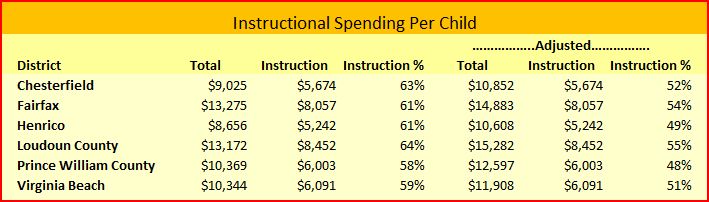
Even by the standards of big school systems, Virginia districts did not perform especially well. Loudoun, Fairfax and Chesterfield counties devoted slightly higher percentages to instruction than the national norm, but Henrico and Prince William delivered less, and Virginia Beach matched the national average of the Top 100. (Click table for more legible image.) Clearly, there is room for improvement. New York City, for instance, devotes 70% of its educational dollars to classroom instruction. Do Virginia schools have that much more overhead?
Bacon’s bottom line: The percentage of educational dollars funneled to classrooms has been an issue in Virginia. I don’t recall seeing any rankings of the state’s school systems, however. The NCPA’s call for transparency in accounting is a good one. Results should be reported for every school system in the state using the same accounting methodology. Then let the citizens judge whether they are getting value for their tax dollars.
-
How States Divvied up their Stimulus Funds
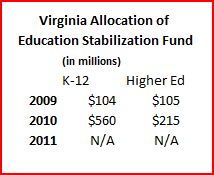
The American Recovery and Reinvestment Act of 2009 provided nearly $48.6 billion in direct aid to states in the form of the State Fiscal Stabilization Fund. The program was designed to help states maintain support for public K-12 and higher education spending. A report published by the New America Foundation, “
-
All Hail Deena Flinchum
Bacon’s Rebellion contributor Deena Flinchum has hit the big-time. The Wall Street Journal printed her letter to the editor in the most prominent position of its editorial page today.
Her letter supported a recent Journal editorial that took a hard line against proposed laws involving illegal emigration, noting recent efforts in Arizona and Utah. Flinchum unflinchingly states that any immigration reform should not include a tradeoff between “amnesty” for undocumented workers and tougher enforcement.
“A quarter of a century after supporting the (1986 Immigration Reform and Contract Act) we are still waiting for the enforcement that is not only more accurate now but much easier to deliver than it was back then,” she wrote.
The Flinchum missive was twined with another by Cecilia Wang of the ACLU and Linton Juaoquin of then National Immigration Law Center attacking the Journal editorial.
To be sure, I do not agree personally with Deena or the Journal but it is great to see a fellow BR blogger out there smacking ’em in the big leagues.
Peter Galuszka
-
The Wonk Salon: May 13-14, 2011
Reducing Greenhouse Gas Emissions through Compact Development
Urban Institute
Compact development cuts down on driving. Cutting down on driving reduces emissions of greenhouse gases. Ergo, compact development reduces greenhouse gas emissions.Virginia Population Now 8% Hispanic
Weldon Cooper Center
The Hispanic population in Virginia nearly doubled in the 2000s and now accounts for nearly one in seven births in the state.New Evidence of Racial Bias in Capital Sentencing
National Bureau of Economic Research
The authors find that the probability of legal error found in Direct Appeal and Habeas Corpus is 3 percent and 9 percent higher for minority defendants who killed white victims than for those who killed minority victims.
Building Streets for Everyone, Not Just Drivers
Victoria Transportation Policy Institute
“Complete streets” are designed with the needs of pedestrians, cyclists and the handicapped in mind, not just people who drive cars.
-
Virginia’s Nuclear Industry Takes a Hit
Virginia’s once-promising nuclear industry is feeling the impacts of Japan’s reactor disaster which has dampened market demand for goods and services related to nuclear-powered generating plants.Construction delays have been announced at the $363 million Areva Newport News facility that would make large components for the nuclear power industry. In Pittsylvania County, support seems to be growing against a proposal to mine about 119 million pounds of uranium worth about $8 billion.The Old Dominion is a major center for the nuclear industry. French-owned Areva has its North American headquarters in Lynchburg where it provides maintenance crews and parts to service nuclear power stations throughout the U.S. Dominion Virginia Power operates four nuclear units in the state. A Newport News shipyard that has just been spun off to Huntingon Ingalls by Northrop Grumman is the only yard in the country that can make nuclear-powered surface ships.As worries over disasters at Three Mile Island and Chernobyl faded and concerns about climate change grew, Virginia seemed well-position to cash in on its civilian nuclear prowess.
The meltdown March 11 at Japan’s Fukushima plant has changed all of that. Japan and Germany are limiting or phasing out their reliance on nuclear power although developing nations such as China, Mexico and Iran are pressing on.The market uncertainty has prompted Areva Newport News, owned by Areva and Huntington Ingalls, to announced May 9 that it was halting construction of its Newport News components facility which would employ 540. Company officials cited unfavorable market conditions but said that building could begin again if that changes. Construction had begun in 2009.Meanwhile, the new anti-nuclear atmosphere is giving a boost to the 41 groups and localities that oppose Virginia Uranium Inc.’s plans to mine uranium in Pittsylvania County and create 300 jobs. The state has banned uranium mining but the General Assembly make reconsider it in 2012. ” We are not willing to risk our health and our property values and our future for low-quality jobs with such a toxic result,” Naomi Hodge-Muse, president of the Martinsville-Henry chapter of the NAACP was quoted as saying.If advanced industrialized countries such as Germany and Japan start dissing nukes, then the uranium market will take a hit. Much of our supply comes from fissile product recycled from old U.S. and Soviet warheads and other countries such as Kazakhstan are moving ahead with supplies, making the Virginia product seem unnecessary.Peter Galuszka
-
The Wonk Salon, May 12, 2011
Thinking Logically about Class Size
Brookings Institution
Smaller classes sizes make a bigger difference in some instances — for earlier grades and disadvantaged children — than in others. Spending on class-size initiatives should be targeted.Drive Less, Pay Less Insurance
Victoria Transport Policy Institute
Pay-As-You-Drive insurance reduces rates for motorists who drive less on the grounds that they are less likely to have accidents. PAYD also encourages people to drive less, thus promoting other goals such as energy efficiency and pollution reduction.More Transparency, Please, for State Tax Expenditures
Center of Budget and Policy Priorities
States allow billions of dollars of tax credits, deductions and exemptions that reduce tax revenue. These loopholes run on autopilot with little scrutiny. States should issue comprehensive annual “tax expenditure reports.” Virginia’s report is incomplete.Reducing Emergency Room Use for Non-Urgent Care
Government Accountability Office
Non-urgent care in an emergency room setting costs seven times as much as an appropriate setting. This report suggests strategies for reducing that cost.How Goes the Federal Investment in Health Care IT?
James A. Baker III Institute for Public Policy
Uncle Sam is investing $19 billion in health care IT in the hope that providers can boost productivity and improve quality. Progress is being made, though challenges remain.
-
Virginia’s Measures Measure Up
In fiscal 2010, the states spent an estimated $131 billion on transportation. What return did they get on their investment? Most policy makers can’t tell you. That’s because most states have inadequate systems for setting goals and measuring performance, concludes a new report by the Pew Center for the States and the Rockefeller Foundation, “Measuring Transportation Investments: The Road to Results.”
Fortunately, Virginia is an exception to the norm. The Old Dominion is one of only six states in the country (the others were Georgia, Maryland, Minnesota, Missouri and Oregon) that scored a rating of “leading the way” on all six criteria chosen by the authors: safety, jobs and commerce, mobility, access, environmental stewardship and infrastructure preservation.
We Virginians may not have the road system we’d like but at least we have a better idea of how well or how poorly it’s measuring up than most other states do. Even so, our performance criteria and data quality are far from perfect. Even the “leaders” can improve by adopting best practices found in other states.
Bacon’s bottom line: Every transportation project in the state should be rated and evaluated on the basis of standard performance criteria. Every project should have a projected Public Return on Investment. All projects should be prioritized based on their expected Public ROI. And the process should be made totally transparent to the public.
Map code:
Green states – leading the way
Yellow states – mixed results
Red states – trailing behind
-
The Wonk Salon: May 11, 2011
How Elastic Is the Demand for Travel?
Victoria Transport Policy Institute
Recent studies suggest that the demand for particular modes of travel is becoming more elastic, or more sensitive to price. If so, transportation pricing reforms make sense.Solar Power: Reaching Grid Parity
National Center for Policy Analysis
Solar power is reaching “grid parity” with conventional fuels in Hawaii, but in the continental United States, given tighter environmental restrictions and more solar-technology breakthroughs, it could take until the end of the decade.
-
Finally, Fresh Thinking on the U.S. Economy
Ever since the Great Recession, plenty has been written on the fate ofthe U.S. economy, as it naturally would be. Negative themes suddenly shot into the sky practically on the exact day Barack Obama, our firstAfrican-American president, was inaugurated. Many tomes were jeremiads painting very dark and dreary images of our future.We are enormously in debt. Our free-spending ways are our children’s ruination. America has lost its competitive edge. Innovation is in shambles. And on and on go the deficit freaks whose Calvinistic works scatter the tables at Barnes & Noble or online. Read them and see who can outdoom the other.
So, it is a really nice respite to pick up “The Next American Economy, Blueprint for Real Recovery,” by international business journalist William J. Holstein (Walker & Company). Full disclosure: Bill has been a close friend of mine since the 1980s when we were working at BusinessWeek. I was on my way to Moscow and Bill, who had spent years covering China and was in Kabul when the Soviets invaded, was on the international desk in New York.
Bill hits themes familiar to anyone who knows his previous work, especially his 1990 explanation of how Japan’s economic bureaucrats operate. The U.S. still thrives on creative effort, has plenty of brainpower and works best when it lets in people from many different countries with many ideas so they can work together. Foreign competition is not something to fear, but rather, embrace.
As far as government policy, Bill leaves the tut-tutting about free market dogmatism to the libertarians, Baconauts and others. There is an obvious role for government help in terms of R&D funding, especially defense funding which has proved very successful. Local, state and federal governments have a role to boost geographic “clustering” of like industries, and coordinate an export offensive featuring high tech goods.
The most interetsing part of the book is not the wonkery but the reporting. Rather than sit around in a basement, reading and regurgitating think tank reports, Bill gets into the field with a vengeance. He finds there’s a lot going on:
Men originally from Venezuela and Taiwan get together to form a start-up structured around a new, self-organizing battery named the A123, which is lighter and powerful than previous batteries. Applications are endless, from Black & Decker tools to automobiles. With federal grant money from the SBA and Department of Energy, plus backing from MIT a firm named A123 took root, flourished and started to compete head on with strong Asian firms. By 2009, it had 1600 employees, a manufacturing plant in Michigan, and sales of $91 million.
In Orlando, an Iranian immigrant with a doctorate from the University of Louisville ends up in Orlando to take part in the region’s efforts to become a “cluster” for computer simulation. In that effort, Orlando had a couple of things going for it. It’s not far from NASA’s huge Cape Kennedy space port. Big theme parks run by Disney and Universal employ lots of simulation experts to make the rides more thrilling. Tapping these labor pools, the cluster was established. Money, especially defense funds, started flowing in since the armed forces need simulation to train troops.
Another immigrant, this time of Polish and Czech background, ends up in San Diego after medical school and intends to research cancer. Rather than toil in a school lab, he wants to start his own firm, which his local college resented (Some like MIT embrace professorial entrepreneurship). Long story short, the result was a genomics cluster that rivals Boston, the Maryland suburbs and the Bay Area.
Corning, the glassmaker, has been around for decades and may seem oh so Rust Belt. But the firm is one of the few U.S. companies that spends up to 10 percent of its sales on R&D (other firms skimp on R&D in the recession wash-over and to cover next quarter’s earnings). Corning scientists kept wondering about a new type of glass that had applications as millions of cell phones, iPads and other small electronic devices need a new type of tough, scratch-resistance glass for their displays. They found it with Gorilla Glass, first made at a Corning plant in Danville with production later shifting to Kentucky.
Like Virginia, North Carolina has been struggling to shift away from traditional manufacturing industries like tobacco, furniture and textiles. The state, which had the foresight to create the Research Triangle Park as early as the 1950s, came up with ways to combine state, federal and private resources to facilitate of Tar Heel-made niche products. One is nanotechnology tools from Raleigh. Another is a new type of software from the small, Eastern North Carolina city of Greenville that can be used around the world to keep up with the expiration dates of pharmaceuticals in storage.
Holstein’s bottom line is that despite the naysayers, there’s plenty of brainpower and innovation potential that should help position the U.S. far ahead of the current economic disaster. Having broad experience overseas, he’s immune from the irrational fears many conservatives have that government involvement will turn them into zombies. He says CEOs have to constantly assess their company’s innovation and changing global conditions. Chinese labor costs, for instance, are under pressure and land in places like South Carolina is cheaper than suburban Shanghai so some U.S. firms are coming back home.
But if they do, wonders Holstein, will they find an educated work force? There’s an area needing much work. Ditto immigration law since the current, emotional debate is enormously damaging to this nation of immigrants and the great, new ideas they bring here. My view is that it is absolutely pathetic that a place so rich in foreign born folks as Northern Virginia is also home to racist politicians like Corey A. Stewart and his immigrant bashing “Rule of Law” campaign.
And to his credit, Bill doesn’t bore us with how much money we’re not going to have in 2030. Ugh!
Peter Galuszka
-
Natural Gas Kicks *ss
Americans still haven’t come to grips with the magnitude of the Marcellus Shale revolution. Gas companies have perfected two technologies, horizontal drilling and hydraulic fracturing (fracking), that have unlocked trillions of cubic feet of natural gas stored in shale beds. Virtually overnight, estimates of recoverable gas reserves in the United States have doubled. The energy potential far exceeds that of Saudi Arabia.Fracking is a controversial practice because of the contamination risk it poses to underground water reserves. At the same time, natural gas is the cleanest of all fossil-fuel energy resources. In a new paper, “Ten Reasons Why Natural Gas Will Fuel the Future,” Robert Bryce with the Manhattan Institute for Policy research, explains why the trend to “decarbonization” in energy sources makes natural gas the preferred fuel from an environmental perspective.
Carbon, when released into the atmosphere, combines with oxygen to create carbon dioxide, the gas widely implicated in global warming. Fossil fuels release a lot of carbon. Wood has a carbon-to-hydrogen ratio of about 10 to 1, make it a tremendous source of atmospheric carbon when burned. Coal has a ratio of about 2 to 1, petroleum about 1 to 1.2, and natural gas 1 to 4. If the entire energy economy of the U.S. shifted to natural gas, we would see a dramatic fall-off in carbon dioxide emissions.
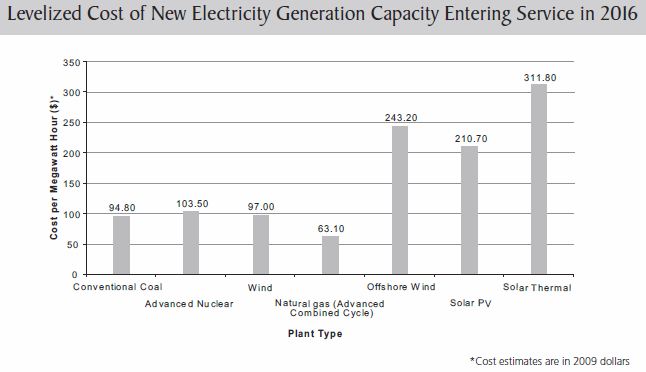
Of course, there is the non-trivial matter of price. Not only is natural gas now the least expensive of the fossil fuels, the cost of installing gas-fired electrical generating capacity is less costly than the alternatives. (See top chart. Click for more legible image.) As renewable fuels like wind and solar power constitute a larger percentage of the energy mix, gas-fired capacity will become more desirable. Because wind and solar are inherently variable, power companies need to add capacity that can offset fluctuations in energy production. Gas fills the bill. Coal and nuclear do not.
There is one more reason to like gas, which Bryce does not consider. Gas is the ideal fuel for a decentralized power grid. Coal and nuclear power plants require massive scale to be economical. Gas does not. It is entirely practicable to produce competitively priced electricity with scattered, small-scale gas plants. Gas is the fuel of the “small is beautiful” movement.
Implications for Virginia: As Virginians ponder their energy future, they need to consider two things. First, what energy mix do we want to build our electric-power infrastructure around? Should we be building more natural-gas facilities, and if so, where should we build them and what are the implications for the design of the electric power grid?
Second, what can Virginia do to produce more natural gas? The commonwealth will never be a major oil producer, but it has significant deposits in the coalfields and, potentially, offshore. The offshore drilling debate usually focuses on the merits of drilling for oil. But the BTUs buried off Virginia’s coast are more likely to come in the form of gas. Oil drilling raises fears of oil spills, some legitimate, some hysterical and ill informed. But I’ve never heard of a “gas spill.” Is there a compromise between drill-baby-drill and the environmentalists that would allow drilling for gas but not oil? Something to think about.
-
The Wolf at MWAA’s Door
The stakes are increasing in the Rail-to-Dulles controversy. In light of recent decisions made by the board of the Metropolitan Washington Airports Authority (MWAA) that could potentially add hundreds of millions of dollars to the cost of the heavy rail line, Rep. Frank Wolf, R-10, has introduced legislation to give Virginia a bigger representation on the 13-person board.Wolf’s bill would amend the 1986 legislation that established the regional operating authority for Dulles and Reagan National airports by increasing Virginia’s representation from five to nine. (The other seats are appointed by the president of the United States, the governor of Maryland and the mayor of Washington, D.C.) It also would allow board members to be replaced at any time by the respective executives who appoint the board. By way of explanation, the congressman said, “My primary interest is to see the project completed on time and at or under budget and I believe the board’s decision to opt for an underground station at Dulles airport would be disastrous.” (Read Wolf’s press release.)
The project is threatening to unravel as key funding partners Fairfax County and Loudoun County have indicated that they would not assume the extra costs of the underground station. Meanwhile, said Wolf, “airport authorities nationwide have been placed on notice that bond ratings could be lowered in the future. And an additional $300 million or more for Dulles Rail could be a troublesome sign for the bond markets. I fear an increase in borrowing costs could effectively kill the project in the design phase.”
Wolf is playing hardball, and Gov. Bob McDonell is backing him up. “I applaud Congressman Wolfโs efforts to expand Virginiaโs oversight of the MWAA board decision making process,” the governor said in a prepared statement this afternoon.
Meanwhile, two users of the Dulles Toll Road have filed a suit challenging the legality of the decision by former Gov. Tim Kaine to put MWAA in charge of the Rail-to-Dulles project. By giving MWAA power to raise Dulles Toll Road tariffs and divert revenue to the heavy rail project, the transfer of authority granted taxing power to an unelected board in violation of the U.S. and Virginia constitution, the suit contends.
That suit makes a very strong case. I’ll have more tomorrow.
-
Funding Transportation by Capturing Increases in Property Value
The United States must continue to invest in its transportation infrastructure to maintain a competitive economy in the 21st century. Two broad sets of questions arise: (1) where to invest, and (2) how to fund the investment. In a new paper, “Access for Value,” two scholars with the Brookings Institution address the second question, making the case that the nation can finance much of its transportation needs through the capture of increased land values created by that investment.David M. Levinson and Emilia Istrate make three broad recommendations.
Use accessibility as a performance metric in funding transportation projects. Transportation planners typically use the metric of “mobility,” which describes how fast people move along the transportation network. When mobility is the chief criteria, traffic congestion is the chief evil because it slows the speed of travel. But mobility is not the same thing as access. Access describes the number of potential destinations that can be reached within a certain time. Thus, increased development density may lead to congestion and slower travel speeds yet improve access if the higher density places a greater number of destinations within closer geographic proximity.
Employ value-capture techniques to fund local transportation. When government builds new roads, highways and passenger rail lines, it adds value to property located at key interchanges and stations. Why? Because the new infrastructure improves access. As a rule, private property owners capture the increased value of that investment. That’s why developers invest so much money influencing the political system. But that gain constitutes a windfall to the property owner. It is not unreasonable for the public to “capture” some of that added value to help finance the construction of the infrastructure.
The authors discuss a variety of techniques that have been used to capture the value created by improved access: impact fees, joint development (as in public-private partnerships), the sale or lease of air rights over rail and transit stations, special tax districts, land-value taxes (taxing property on the value of its land rather than on the improvements made to it), and transportation utility fees.
Increase accessibility by coordinating local transportation and local land-use policies. Local land use policies often restrict development at the optimum locations, such as around rail stations. Intelligent zoning decisions can increase property values which, in turn, can be captured for purposes of paying for infrastructure.
Virginia, as best I can determine, follows most states in tracking mobility rather than access. Average travel speed is not the best metric. The average number of destinations reachable within a certain frame of time give us more useful information. In particular, we need to recognize that increased density can worsen traffic congestion (decreasing mobility) while simultaneously putting more destinations within reach (increasing access).
Instead of funding transportation improvements through a dog’s breakfast of taxes, levies, local proffers, impact fees and selling bonds, which severs the connection between those who use and benefit from transportation improvements and those who pay for them, Virginia should rely more upon revenue sources that capture the value created by the public investment.
-
The Wonk Salon: May 10, 2011
Addressing the Constraints to Growth in Charter Schools
Center for American Progress
A limited supply of effective teachers and administrators is the main constraint on the growth of charter schools. This report describes how successful charter schools manage human capital.Black Mayors and Big City Patronage
Mercatus Center
Like white politicians before them, black mayors use the powers of their office to reward members of their own ethnic group. Welcome to the club.
-
Chart of the Day: Nursing Home Complaints
Virginia authorities received 517 complaints about nursing homes in 2009, according to data in a new report published by the Government Accountability Office (GAO). The good news is that the rate of complaints per 1,000 residents was somewhat lower than the national average. The not-so-good news is that the GAO is not impressed with the quality of data that states report to the federal government, so it’s hard to know how valid the comparisons are.
Of Virginia’s complaints, nearly all — 515 — were investigated. In none of the cases were nursing home patients deemed to be in immediate jeopardy. But in one quarter of the cases, investigators substantiated at least one deficiency in federal standards of care. (Click map for more legible image.)