
Public education costs federal, state and local governments upward of $500 billion annually, up $354 billion 15 years ago. While spending increased nearly 50 percent, enrollment increased by just over 10 percent, reading and science scores held steady, and on-time graduation hovered at 70 percent. The question arises: Can we cut school spending without harming educational outcomes?
School districts claim that funding cuts would require them to close schools and increase class sizes. But an issue brief published by the National Center for Policy Analysis (NCPA), “How Much Do Public Schools Spend on Teaching,” argues that roughly half of school spending never makes it to the classroom. Official counts of instructional spending typically exclude capital spending and sometimes lump in line items such as food service, property insurance, vehicle maintenance and refreshments for meetings with genuine classroom spending to calculate “instructional” spending.
Concludes the author: “Instead of cutting dollars spent in the classroom, state legislators should require clear accounting for how education tax dollars are spent, cap non-instructional spending and limit the growth of spending outside the classroom.”
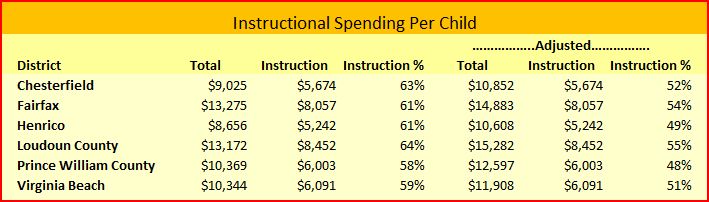
The brief draws upon a study by the National Center for Educational Statistics that calculated instructional spending for the 100 largest school districts in the United States. Six of those giant schools systems are located in Virginia. (Can you spell “bureaucracy,” anyone?)
Even by the standards of big school systems, Virginia districts did not perform especially well. Loudoun, Fairfax and Chesterfield counties devoted slightly higher percentages to instruction than the national norm, but Henrico and Prince William delivered less, and Virginia Beach matched the national average of the Top 100. (Click table for more legible image.) Clearly, there is room for improvement. New York City, for instance, devotes 70% of its educational dollars to classroom instruction. Do Virginia schools have that much more overhead?
Bacon’s bottom line: The percentage of educational dollars funneled to classrooms has been an issue in Virginia. I don’t recall seeing any rankings of the state’s school systems, however. The NCPA’s call for transparency in accounting is a good one. Results should be reported for every school system in the state using the same accounting methodology. Then let the citizens judge whether they are getting value for their tax dollars.
Leave a Reply
You must be logged in to post a comment.