• Finally, Fresh Thinking on the U.S. Economy

    Ever since the Great Recession, plenty has been written on the fate ofthe U.S. economy, as it naturally would be. Negative themes suddenly shot into the sky practically on the exact day Barack Obama, our firstAfrican-American president, was inaugurated. Many tomes were jeremiads painting very dark and dreary images of our future.

    We are enormously in debt. Our free-spending ways are our children’s ruination. America has lost its competitive edge. Innovation is in shambles. And on and on go the deficit freaks whose Calvinistic works scatter the tables at Barnes & Noble or online. Read them and see who can outdoom the other.

    So, it is a really nice respite to pick up “The Next American Economy, Blueprint for Real Recovery,” by international business journalist William J. Holstein (Walker & Company). Full disclosure: Bill has been a close friend of mine since the 1980s when we were working at BusinessWeek. I was on my way to Moscow and Bill, who had spent years covering China and was in Kabul when the Soviets invaded, was on the international desk in New York.

    Bill hits themes familiar to anyone who knows his previous work, especially his 1990 explanation of how Japan’s economic bureaucrats operate. The U.S. still thrives on creative effort, has plenty of brainpower and works best when it lets in people from many different countries with many ideas so they can work together. Foreign competition is not something to fear, but rather, embrace.

    As far as government policy, Bill leaves the tut-tutting about free market dogmatism to the libertarians, Baconauts and others. There is an obvious role for government help in terms of R&D funding, especially defense funding which has proved very successful. Local, state and federal governments have a role to boost geographic “clustering” of like industries, and coordinate an export offensive featuring high tech goods.

    The most interetsing part of the book is not the wonkery but the reporting. Rather than sit around in a basement, reading and regurgitating think tank reports, Bill gets into the field with a vengeance. He finds there’s a lot going on:

    Men originally from Venezuela and Taiwan get together to form a start-up structured around a new, self-organizing battery named the A123, which is lighter and powerful than previous batteries. Applications are endless, from Black & Decker tools to automobiles. With federal grant money from the SBA and Department of Energy, plus backing from MIT a firm named A123 took root, flourished and started to compete head on with strong Asian firms. By 2009, it had 1600 employees, a manufacturing plant in Michigan, and sales of $91 million.

    In Orlando, an Iranian immigrant with a doctorate from the University of Louisville ends up in Orlando to take part in the region’s efforts to become a “cluster” for computer simulation. In that effort, Orlando had a couple of things going for it. It’s not far from NASA’s huge Cape Kennedy space port. Big theme parks run by Disney and Universal employ lots of simulation experts to make the rides more thrilling. Tapping these labor pools, the cluster was established. Money, especially defense funds, started flowing in since the armed forces need simulation to train troops.

    Another immigrant, this time of Polish and Czech background, ends up in San Diego after medical school and intends to research cancer. Rather than toil in a school lab, he wants to start his own firm, which his local college resented (Some like MIT embrace professorial entrepreneurship). Long story short, the result was a genomics cluster that rivals Boston, the Maryland suburbs and the Bay Area.

    Corning, the glassmaker, has been around for decades and may seem oh so Rust Belt. But the firm is one of the few U.S. companies that spends up to 10 percent of its sales on R&D (other firms skimp on R&D in the recession wash-over and to cover next quarter’s earnings). Corning scientists kept wondering about a new type of glass that had applications as millions of cell phones, iPads and other small electronic devices need a new type of tough, scratch-resistance glass for their displays. They found it with Gorilla Glass, first made at a Corning plant in Danville with production later shifting to Kentucky.

    Like Virginia, North Carolina has been struggling to shift away from traditional manufacturing industries like tobacco, furniture and textiles. The state, which had the foresight to create the Research Triangle Park as early as the 1950s, came up with ways to combine state, federal and private resources to facilitate of Tar Heel-made niche products. One is nanotechnology tools from Raleigh. Another is a new type of software from the small, Eastern North Carolina city of Greenville that can be used around the world to keep up with the expiration dates of pharmaceuticals in storage.

    Holstein’s bottom line is that despite the naysayers, there’s plenty of brainpower and innovation potential that should help position the U.S. far ahead of the current economic disaster. Having broad experience overseas, he’s immune from the irrational fears many conservatives have that government involvement will turn them into zombies. He says CEOs have to constantly assess their company’s innovation and changing global conditions. Chinese labor costs, for instance, are under pressure and land in places like South Carolina is cheaper than suburban Shanghai so some U.S. firms are coming back home.

    But if they do, wonders Holstein, will they find an educated work force? There’s an area needing much work. Ditto immigration law since the current, emotional debate is enormously damaging to this nation of immigrants and the great, new ideas they bring here. My view is that it is absolutely pathetic that a place so rich in foreign born folks as Northern Virginia is also home to racist politicians like Corey A. Stewart and his immigrant bashing “Rule of Law” campaign.

    And to his credit, Bill doesn’t bore us with how much money we’re not going to have in 2030. Ugh!

    Peter Galuszka

  • Natural Gas Kicks *ss


    Americans still haven’t come to grips with the magnitude of the Marcellus Shale revolution. Gas companies have perfected two technologies, horizontal drilling and hydraulic fracturing (fracking), that have unlocked trillions of cubic feet of natural gas stored in shale beds. Virtually overnight, estimates of recoverable gas reserves in the United States have doubled. The energy potential far exceeds that of Saudi Arabia.

    Fracking is a controversial practice because of the contamination risk it poses to underground water reserves. At the same time, natural gas is the cleanest of all fossil-fuel energy resources. In a new paper, “Ten Reasons Why Natural Gas Will Fuel the Future,” Robert Bryce with the Manhattan Institute for Policy research, explains why the trend to “decarbonization” in energy sources makes natural gas the preferred fuel from an environmental perspective.

    Carbon, when released into the atmosphere, combines with oxygen to create carbon dioxide, the gas widely implicated in global warming. Fossil fuels release a lot of carbon. Wood has a carbon-to-hydrogen ratio of about 10 to 1, make it a tremendous source of atmospheric carbon when burned. Coal has a ratio of about 2 to 1, petroleum about 1 to 1.2, and natural gas 1 to 4. If the entire energy economy of the U.S. shifted to natural gas, we would see a dramatic fall-off in carbon dioxide emissions.

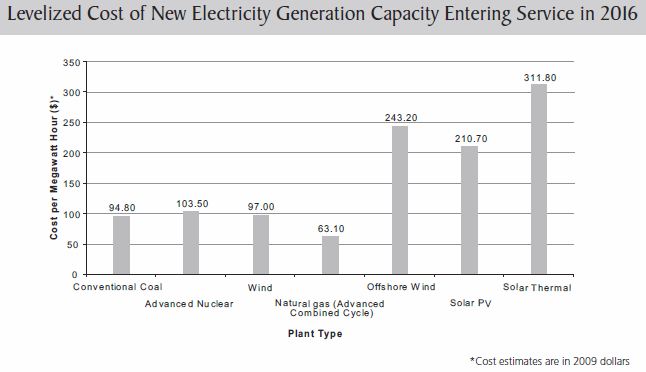
    Of course, there is the non-trivial matter of price. Not only is natural gas now the least expensive of the fossil fuels, the cost of installing gas-fired electrical generating capacity is less costly than the alternatives. (See top chart. Click for more legible image.) As renewable fuels like wind and solar power constitute a larger percentage of the energy mix, gas-fired capacity will become more desirable. Because wind and solar are inherently variable, power companies need to add capacity that can offset fluctuations in energy production. Gas fills the bill. Coal and nuclear do not.

    There is one more reason to like gas, which Bryce does not consider. Gas is the ideal fuel for a decentralized power grid. Coal and nuclear power plants require massive scale to be economical. Gas does not. It is entirely practicable to produce competitively priced electricity with scattered, small-scale gas plants. Gas is the fuel of the “small is beautiful” movement.

    Implications for Virginia: As Virginians ponder their energy future, they need to consider two things. First, what energy mix do we want to build our electric-power infrastructure around? Should we be building more natural-gas facilities, and if so, where should we build them and what are the implications for the design of the electric power grid?

    Second, what can Virginia do to produce more natural gas? The commonwealth will never be a major oil producer, but it has significant deposits in the coalfields and, potentially, offshore. The offshore drilling debate usually focuses on the merits of drilling for oil. But the BTUs buried off Virginia’s coast are more likely to come in the form of gas. Oil drilling raises fears of oil spills, some legitimate, some hysterical and ill informed. But I’ve never heard of a “gas spill.” Is there a compromise between drill-baby-drill and the environmentalists that would allow drilling for gas but not oil? Something to think about.


  • The Wolf at MWAA’s Door

    The stakes are increasing in the Rail-to-Dulles controversy. In light of recent decisions made by the board of the Metropolitan Washington Airports Authority (MWAA) that could potentially add hundreds of millions of dollars to the cost of the heavy rail line, Rep. Frank Wolf, R-10, has introduced legislation to give Virginia a bigger representation on the 13-person board.

    Wolf’s bill would amend the 1986 legislation that established the regional operating authority for Dulles and Reagan National airports by increasing Virginia’s representation from five to nine. (The other seats are appointed by the president of the United States, the governor of Maryland and the mayor of Washington, D.C.) It also would allow board members to be replaced at any time by the respective executives who appoint the board. By way of explanation, the congressman said, “My primary interest is to see the project completed on time and at or under budget and I believe the board’s decision to opt for an underground station at Dulles airport would be disastrous.” (Read Wolf’s press release.)

    The project is threatening to unravel as key funding partners Fairfax County and Loudoun County have indicated that they would not assume the extra costs of the underground station. Meanwhile, said Wolf, “airport authorities nationwide have been placed on notice that bond ratings could be lowered in the future. And an additional $300 million or more for Dulles Rail could be a troublesome sign for the bond markets. I fear an increase in borrowing costs could effectively kill the project in the design phase.”

    Wolf is playing hardball, and Gov. Bob McDonell is backing him up. “I applaud Congressman Wolfโ€™s efforts to expand Virginiaโ€™s oversight of the MWAA board decision making process,” the governor said in a prepared statement this afternoon.

    Meanwhile, two users of the Dulles Toll Road have filed a suit challenging the legality of the decision by former Gov. Tim Kaine to put MWAA in charge of the Rail-to-Dulles project. By giving MWAA power to raise Dulles Toll Road tariffs and divert revenue to the heavy rail project, the transfer of authority granted taxing power to an unelected board in violation of the U.S. and Virginia constitution, the suit contends.

    That suit makes a very strong case. I’ll have more tomorrow.


  • Funding Transportation by Capturing Increases in Property Value

    The United States must continue to invest in its transportation infrastructure to maintain a competitive economy in the 21st century. Two broad sets of questions arise: (1) where to invest, and (2) how to fund the investment. In a new paper, “Access for Value,” two scholars with the Brookings Institution address the second question, making the case that the nation can finance much of its transportation needs through the capture of increased land values created by that investment.

    David M. Levinson and Emilia Istrate make three broad recommendations.

    Use accessibility as a performance metric in funding transportation projects. Transportation planners typically use the metric of “mobility,” which describes how fast people move along the transportation network. When mobility is the chief criteria, traffic congestion is the chief evil because it slows the speed of travel. But mobility is not the same thing as access. Access describes the number of potential destinations that can be reached within a certain time. Thus, increased development density may lead to congestion and slower travel speeds yet improve access if the higher density places a greater number of destinations within closer geographic proximity.

    Employ value-capture techniques to fund local transportation. When government builds new roads, highways and passenger rail lines, it adds value to property located at key interchanges and stations. Why? Because the new infrastructure improves access. As a rule, private property owners capture the increased value of that investment. That’s why developers invest so much money influencing the political system. But that gain constitutes a windfall to the property owner. It is not unreasonable for the public to “capture” some of that added value to help finance the construction of the infrastructure.

    The authors discuss a variety of techniques that have been used to capture the value created by improved access: impact fees, joint development (as in public-private partnerships), the sale or lease of air rights over rail and transit stations, special tax districts, land-value taxes (taxing property on the value of its land rather than on the improvements made to it), and transportation utility fees.

    Increase accessibility by coordinating local transportation and local land-use policies. Local land use policies often restrict development at the optimum locations, such as around rail stations. Intelligent zoning decisions can increase property values which, in turn, can be captured for purposes of paying for infrastructure.

    Virginia, as best I can determine, follows most states in tracking mobility rather than access. Average travel speed is not the best metric. The average number of destinations reachable within a certain frame of time give us more useful information. In particular, we need to recognize that increased density can worsen traffic congestion (decreasing mobility) while simultaneously putting more destinations within reach (increasing access).

    Instead of funding transportation improvements through a dog’s breakfast of taxes, levies, local proffers, impact fees and selling bonds, which severs the connection between those who use and benefit from transportation improvements and those who pay for them, Virginia should rely more upon revenue sources that capture the value created by the public investment.


  • The Wonk Salon: May 10, 2011

    Addressing the Constraints to Growth in Charter Schools
    Center for American Progress
    A limited supply of effective teachers and administrators is the main constraint on the growth of charter schools. This report describes how successful charter schools manage human capital.

    Black Mayors and Big City Patronage
    Mercatus Center
    Like white politicians before them, black mayors use the powers of their office to reward members of their own ethnic group. Welcome to the club.


  • Chart of the Day: Nursing Home Complaints

    Virginia authorities received 517 complaints about nursing homes in 2009, according to data in a new report published by the Government Accountability Office (GAO). The good news is that the rate of complaints per 1,000 residents was somewhat lower than the national average. The not-so-good news is that the GAO is not impressed with the quality of data that states report to the federal government, so it’s hard to know how valid the comparisons are.

    Of Virginia’s complaints, nearly all — 515 — were investigated. In none of the cases were nursing home patients deemed to be in immediate jeopardy. But in one quarter of the cases, investigators substantiated at least one deficiency in federal standards of care. (Click map for more legible image.)


  • Chart of the Day: Who Pays Income Taxes?

    This chart, published by Veronique de Rugy with the Mercatus Center, compares (1) the share of national income earned by each tax quintile and (2) the share paid in personal income taxes. It bears repeating: Yes, the rich are getting richer, but they are paying more in taxes, too.


  • Why College Textbooks Cost So Much

    While the soaring price of tuition and fees is the primary reason that college education has become so unaffordable, as any parent of a college kid knows, the price of college textbooks has followed close behind. As the Government Accountability Office reports in a newly released study, the cost of textbooks has increased at a rate more than twice that of the Consumer Price Index. At community colleges, which tend to be more affordable than four-year institutions, the cost of textbooks amounts to 72% of tuition and fees.

    Textbook publishers give two primary reasons for the relentless price increases: (1) the cost of developing products to accompany the textbooks such as CD-ROMs and instructional supplements in response to demand from instructors, and (2) the increased frequency with which text books are revised and updated. The GAO report largely accepts that explanation.

    Publishers invest in instructional supplements because the demand for such materials has intensified in recent years “in an environment of funding cuts.” Tools designed to enhance instructor productivity are in demand because reductions in the number of teaching assistants has increased the administrative burden for instructors. Thus, publishers develop online homework and quizzes that save instructors time. Work completed online can be graded immediately to provide immediate feedback on performance.

    Another source of demand for special instructional materials: “The number of students who are unprepared for college-level work has been increasing.”

    However, there is a bit more to the story: the pricing power of the textbook publishers. โ€œU.S. college textbook prices may exceed prices in other countries because prices reflect market conditions found in each country, such as the willingness and ability of students to purchase the textbook,โ€ states the report. In Canada, the United Kingdom and other English-speaking countries, there is less demand for instructional supplements and more resistance to paying higher prices. Accordingly, textbook publishers sell their books there for significantly less.

    One factor the GAO appears to overlook in its analysis is the willingness of the U.S. government to inflate demand through cheap, easy college loans — leading to a “buy now, pay later” mentality. In other words, flooding the educational market with cheap credit leads to inflation not only in tuition and fees but textbooks.

    One more point regarding the restructuring of the higher ed industry: It is interesting to see that colleges are feeling pressure to increase productivity. If supplementary materials save instructors time and labor, who is capturing that value? Are college labor costs shrinking? Are colleges providing the same educational value with fewer faculty and teaching assistants? If so, there may be a silver lining to the higher cost of textbooks. If not, then students are just paying higher textbook prices to make the jobs of faculty members a little easier.


  • Why, Bob, Why?

    Bob McDonnell is off visiting Asia, but here are a few questions for him when he gets back. They have to do with just how much he really buys into the conservative orthodoxy thing.

    McDonnell has finally gotten his way and line itemed $424,000 in state funding for NPR, the right-wing bug-a-boo that conservatives claim gets public money for its pinko views, but in fact is a great teaching tool for pre-schoolers and helps their parents and grand parents make sense of a world the rest of the Big Media, like Clear Channel and its army of radio stations, ignores.

    So what else is up with Bob?

    • Big-time movie producer and director Steve Spielberg will get $3.5 million in money from the Governor’s Motion Picture Opportunity Fund and the Virginia Motion Picture Tax Credit program to make a movie in Richmond and Petersburg about Abraham Lincoln. The movie will be based on Doris Kearns Goodwin’s popular history “Team of Rivals.”
    • General Electric, which made profits last year of $14.2 billion but paid no federal income tax is setting up a cyper security division to Henrico County with lots of public money help, rumored to be about $300,000. The move will help Richmond’s IT market which was hard hit by the demise of Circuit City and LandAmerica.
    • GE also is being coaxed back, with public money, to reopen a light bulb plant that it had closed in Winchester. Democrat Mark Warner is helping Republican McDonnell with this oh-so-sweet arm-twisting.

    Now, I may not be living up to my liberal credentials by criticizing government involvement with the private sector and I apologize. I do believe it can be a good and essential thing.

    But one does have to question McDonnell’s priorities. Spielberg is a huge cinematic success. GE is a gigantic and powerful and rich company. Why do they need handouts courtesy of the Virginia taxpayers which a trying useful and sustainable service like NPR goes wanting?

    Peter Galuszka


  • Is the “Freedom to Drive” without Paying for It Really a Right?

    Republicans — you can’t live with ’em, and you can’t live without ’em. Partisans of the elephant clan deem themselves faithful supporters of free market principles. And they are… until they encounter a concrete situation where those principles have to be applied. Then they revert as easily to government controls as the Dems do. I highlighted an example in my previous post about mandated insurance benefits. On a much larger scale, the same is true of transportation. The Rs support subsidies for roads and highways that would make a welfare queen blush, and they don’t even see the contradiction.

    Ladies and gentlemen of the jury, I present to you Exhibit A, an op-ed written by former Gov. Jim Gilmore and published in Townhall.com. I’ve known Gilmore a very long time, and I like him personally. Also, he and I share very similar philosophies regarding the size and scope of government. He is a genuine small-government, low-tax fiscal conservative. But I take issue with the way he applies his principles to the transportation realm, and I urge him to re-think his position.

    Gilmore uses the column to address a proposal originating from the Obama administration to implement a Vehicle Miles Driven (VMD) tax, which would “tax” motorists according to the number of miles they drive, presumably as an alternative to the soon-to-be antiquated gasoline tax. I share Gilmore’s concerns about the potential privacy issues entailed with installing technology that allows government to track an individual’s movements. Those concerns need to be addressed, or the VMD tax is a non-starter.

    But Gilmore goes beyond privacy concerns to disapprove of the impact of such a tax. “The idea is … awful because beleaguered motorists are entering the summer driving season with $4 gas at the pump. Already, people are stretched to the limit economically. … People do not expect government to impose burdens and limitations on their freedom to drive and move about freely. Imposing a per-mile usage fee on vehicles impairs our fundamental right to move freely without inhibition.”

    Key phrase: “the fundamental right to move freely without inhibition.” Gilmore expresses the views of many Republicans (and not a few Democrats) by referring to driving as a “right,” and implying, though not saying so outright, that “someone else” should pay for the maintenance and expansion of the road network.

    Here’s the problem: It costs billions of dollars to build new roads and maintain them. The mainstay of road funding, the gasoline tax, has remained fixed since 1986. Consequently, the quality of Virginia’s road network is eroding, basic maintenance is going unfunded, and traffic congestion is increasing. As Republicans like to say in other contexts, you can’t get something for nothing. There is no free lunch. If we want better roads — and who doesn’t? — we need to find more money. Yes, yes, we can extend existing cash flows by conducting maintenance operations more efficiently, we can cut VDOT overhead and we can do a better job of prioritizing new road projects. We can flush idle funds out of forgotten accounts and we can re-write the highway funding formula more equitably to steer more money to where it is needed, like Northern Virginia. We need to spend every dollar wisely. But given the magnitude of the needs, we also need more money.

    Republicans hate the idea of raising the gasoline tax (god forbid that anyone would even mention the VMD tax) on the grounds that Gilmore stated: Hard-pressed Americans just can’t afford to pay more. I hear that refrain over and over. Instead of taxing the people who use the roads, the Republican solution is to raise money in little bits and pieces through obscure fines and levies that people barely see. And by borrowing money. Thus, Gov. Bob McDonnell raised $2 billion for new road projects by borrowing the money… which has to be repaid from the General Fund. In other words, hard-pressed Virginians still have to pay back the money. They just don’t see where the money is coming from or where it is going. They are powerless to adapt their behavior in order to minimize the impact on their personal finances.

    There is a maxim of economics that if you under-price the cost of something, people demand more of it. Thus, if the people who use the road network regard it as a free good and drive “without inhibition,” they drive more more than they would if they had to pay for their habit directly. Severing the connection between the use of roads and the paying for roads thus encourages to people to use roads more than they would otherwise, making traffic congestion worse. Democrats, for all economic illogic in other fields of governance, do grasp this economic reality. That’s why Obama’s VMD plan makes sense: It is based on a simple principle: The more you drive, the more you pay. You, not someone else, pay for what you use.

    (I’m not a big Obama fan, in case anyone noticed. But that doesn’t mean I automatically discount every idea that comes out of his administration. The VMD idea is a good one.)

    Conversely, when people pay more for a good or service, they use less of it. On the margin, if Virginians paid the full cost of building and maintaining roads, some would change their behavior. A few more would walk to work, a few more would ride bicycles or ride mass transit. A few more would carpool. When buying a new house, a few would select a location closer to where they work. The result would be a little less stress on the road network.

    Now, I understand why Republican politicians stake out the position they do. They overwhelmingly represent voters who live in counties outside the urban core. Nearly all of their constituents drive cars, and I would wager that they drive more vehicle miles on a yearly basis than does the average Democrat, who is more likely to live in urban areas and have access to mass transit and other transportation alternatives. Therefore, making drivers pay the full cost of their preference for driving equates to making Republicans pay more for driving. Republican legislators don’t want to to cross their constituents! Free markets should be applied only when they harm Democratic constituents, it seems.

    But the same logic that Republicans apply to subsidizing mass transit — without appropriate land use around the stations, it is wildly inefficient — applies to subsidizing roads. All transportation projects of whatever stripe should be prioritized and funded on a Return on Investment basis, and, to the greatest degree possible, paid for either by the people who use that infrastructure or who benefit from it through the higher property values created. Grandmothers who rarely step outside the house except to get their blue-hair rinse should not pay General Fund taxes for roads. The poor, single mother who takes the bus to work should not have to pay General Fund taxes for roads. The greenie zealot who rides his bicycle to the office should not have to pay General Fund taxes for roads. People who inconvenience themselves by carpooling or vanpooling should not have to pay the same General Fund taxes as the guy who insists upon driving solo.

    Until Virginians abandon the idea that they have a “right” to drive roads at someone
    else’s expense, there is no hope of building a transportation system for the 21st century. There simply isn’t enough money in the world to do it the way the Republicans would like to.


  • Autism Coverage and the Hidden Man

    Republicans still need remedial instruction, it appears, on the meaning of free markets. Occasionally, they get it right. When President Obama passed healthcare reform that coerces uninsured individuals to sign up for health insurance or pay big penalties, for instance, members of the Elephant Clan raised a ruckus over the abrogation of personal economic freedom.

    But if you want to buy an insurance policy that doesn’t include coverage for cancer screenings or reconstructive breast surgery, then you are not free to do so. Republicans in the General Assembly routinely vote for laws requiring individuals to purchase health insurance plans that may provide coverage options they do not want.

    The most recent case in point: Gov. Bob McDonnell has signed a bill requiring health insurers to offer treatment for autistic children ages 2 to 6. (The law will cap annual coverage costs at $35,000, would not apply to self-insured companies and would exempt businesses with 50 or fewer employees, according to the Times-Dispatch.)

    Before anyone accuses me of being insensitive to the challenges of autism, let me quickly say that I am very sympathetic to the plight of parents raising an autistic child. Raising a “normal” child (if there is such a thing) is difficult enough. I can only imagine the emotional and financial roller coaster that people go through with an autistic child. My heart goes out to them.

    But I am sympathetic to other people with all kinds of medical maladies, from broken bones to heart attacks, from diabetes to lung cancer. And I am aware that adding millions of dollars of new liabilities to policies that cover those basic illnesses will require insurers to raise rates. Thus, for every family that benefits from the new autism coverage, some other family will lose coverage for everything because they find the new-and-improved package to be unaffordable.

    The problem isn’t autism so much as it is the whole panoply of mandated benefits. Autism is only the latest in a long list of requirements that make basic health care insurance so expensive and unaffordable to many. Among the categories of coverage mandated by Virginia law:

    • Pap smears
    • Hemophilia
    • Prostate-Specific Antigen (PSA) testing
    • Colorectal cancer screenings
    • Infant hearing screenings
    • Biologically based mental illness

    Click here to see the State Corporation Commission’s full list.

    Any single mandate appears to be defensible. Autism coverage seems no more unreasonable than, say, hemophilia. The problem is that the costs add up. Unlike the advocates of reconstructive breast surgery or autism, however, there are no organizations representing the interests of people who lost health insurance coverage because they or their employer could no longer afford it. They are the “hidden man.” There are thousands of them but politically they do not exist. Therefore, their interests go ignored.

    Advocates of free markets understand that there is always a hidden man who loses when someone passes a seemingly altruistic law. But Republicans, like Democrats, are suckers for anyone with a heart-rending story that tugs at their heart strings. No one wants to seem indifferent to the travails of an autistic child, so Republicans abandon their free-market principles.

    Now the cost of health care insurance in Virginia will rise, the number of Virginians who cannot afford it will increase, and the champions of government-run health care will blame the “failure of the free market.”


  • Dulles Rail Controversy Jumps the Track to RoVa

    Once upon a time, the Rail-to-Dulles project was a matter of all-consuming interest only to those living in Northern Virginia (NoVa) and a handful of us in the Rest of Virginia harboring an obsession with transportation and land use issues. The attitude among most RoVa residents, assuming they knew anything about Rail-to-Dulles at all, is that it was a Northern Virginia thing, nobody else would understand… or care.

    But now the heavy rail controversy, with all its cost overruns and desperate grabbing for financial support, has implications for another part of the state — Hampton Roads.

    The root of the problem is the continually escalating cost of extending heavy rail from the Washington Metro system through Tysons Corner and all the way through Dulles airport. The cost of the project, billed at roughly $3.5 billion only a few years ago, has leaped to $6.8 billion. All the key players signed onto the project at a much lower cost. Now the question arises, who pays? How do they spread the pain?

    Aha, one miraculous possibility presented itself. The Metropolitan Washington Airports Authority (MWAA), which has taken over management of the project, has decided to apply for $1.7 billion in federal loans under the Transportation Infrastructure Finance and Innovation Act (TIFIA). That financing would bear significantly lower interest rates than conventional municipal bonds, potentially saving hundreds of millions of dollars over the 30-year life of the loan and making it possible to dampen the toll increases on the Dulles Toll Road, the cash cow expected to pay for nearly three-fifths of the project.

    But there’s a hitch, explained MWAA Vice Chair Tom Davis at a recent MWAA meeting. The TIFIA loans are highly competitive. As the Fairfax Times quotes him as saying, Virginia has other large projects, such as the “Third Crossing” bridge-tunnel in Hampton Roads that it hopes to get the loans for. To win a TIFIA grant, NoVa needs to coax all of its funding partners, including the state of Virginia, on board, Davis said. Trouble is, he added, “The commonwealth, right now, is not on board.”

    I wouldn’t want to be in Gov. Bob McDonnell’s shoes. I would guess that the prospect of Virginia winning TIFIA backing for two mega-projects is pretty remote. At some point, McDonnell is going to have to pick sides. No matter what he decides, he’ll make somebody really, really mad.

    Meanwhile, the statewide political dynamics make the project dicey for Northern Virginia’s political leaders. The project has the potential to pit Virginia’s largest metropolitan region against its second largest metropolitan region in a battle of the bull elephants. If enough blood is spilled, that’s a battle nobody wins. Rest assured, I’ll be sitting on the sidelines chewing popcorn and keeping up a spirited commentary.


  • The Wonk Salon: May 6, 2011

    Expanding Medicaid Could Result in Worse Overall Health Care
    Heritage Foundation
    Studies show that the medical care provided Medicaid patients is no better, maybe worse, than the care provided indigent patients. Obamacare’s expansion of Medicaid is not likely to improve matters.

    Competition Blasts Off in the Space Industry
    Government Accountability Office
    Bottom line for Virginia: Wallops Island is getting a lot more competition in the bid for commercial space transportation.

    Making the Most of Childhood Visitation Programs
    National Governors Association
    The authors claims a 5-to-1 cost-benefit ratio in state visits to homes of at-risk children and expectant mothers. Sounds like the Nanny State run wild to me.

    Transforming Mental Health Care
    National Governors Association
    Many mental disorders once deemed incurable can now be treated. State mental health systems need to change focus from long-term custodial care to fostering mental health recovery.


  • Highway Robbery


    Wow! Commuters on the Dulles Toll Road, now paying $4 for a round trip, could be paying $40 by the year 2040 to help pay for construction of the Dulles rail extension, reports the Washington Examiner. Those numbers came from financial consultants reporting yesterday to the Metropolitan Washington Airports Authority.

    The tolls could be 30% lower if the project can qualify for lower interest-rate financing from a Transportation Infrastructure Finance and Innovation Act loan, but that probably won’t prove to be much consolation to Northern Virginia commuters. Not all motorists will drive the full distance and pay the full freight, but in theory some could be paying $10,000 a year for the privilege of using the toll road. Reducing that sum to only $7,000 a year won’t be much consolation — it’s still equal to what many will be paying on their car loans!

    Unidentified “officials” (presumably MWAA officials) are so concerned that they’re considering actually tolling the free access road to the airport, which runs in between the toll lanes. Do ya think? Faced with the prospect of charging local-destination drivers up to $40 per round trip MWAA actually may slap a toll on a free expressway to help pay for other people who are riding the Metro, whose fares, by the way, will be massively subsidized. You gotta love it.

    I am making a surmise here: MWAA officials plan not to charge Metro riders the full cost of operating the rail service because, if they did, fewer people would ride it, thus defeating the whole purpose of building the rail line. Board members understand the idea that there is a limit to peoples’ willingness to pay to ride the rail.

    Assuming they embrace that logic, I would heartily urge MWAA’s board to ask its financial consultants the following questions: If MWAA charged up to $2o per trip for access to the Dulles Toll Road, would drivers avoid using the toll road? Might they revert to such unseemly remedies as car sharing, riding buses or telecommuting or… taking alternate routes? And if they do, would they do so in such large numbers as to undermine the traffic counts that MWAA is planning on to generate the revenue required to meet its share of the Rail-to-Dulles bond obligations?

    In other words, is it possible that the project costs have escalated so much that no matter how aggressively MWAA gouges Dulles Toll Road commuters, it might be impossible to raise the sums of money required to pay the rail line’s debt service?


  • The Wonk Salon: May 5, 2011

    School Teachers and the Crisis in Math and Science
    Center for American Progress
    Teachers who teach math and science should understand math and science. Here’s how to make sure they do.

    Does Limited Government Mean Abandoning the Poor?
    Heritage Foundation
    We’re spending $1 trillion a year to fight poverty. It doesn’t work. Civil society could do a better job.

    Linking Higher Ed and Economic Development
    National Governor’s Association
    It’s not enough to increase the number of citizens with college degrees. More state policy makers are asking, degrees for what kind of jobs?