• Regional Performance Measures

    An interesting initiative will go into effect in the new fiscal year. Federal “Regional Surface Transportation Program” funds will be granted only to Metropolitan Planning Organizations in urbanized areas greater than 200,000 that have developed regional transportation and land use performance measures.

    The metrics include traffic congestion, safety, HOV usage, transit usage, jobs-to-housing ratios, jobs and housing access to transit and pedestrian facilities, air quality, freight movement by rail and per capita Vehicle Miles Traveled.

    For details on how that is progressing in Virginia, click here.


  • The Wonk Salon: May 19, 2011

    Public Sector Unions: A Driving Force of Big Government
    Mercatus Center
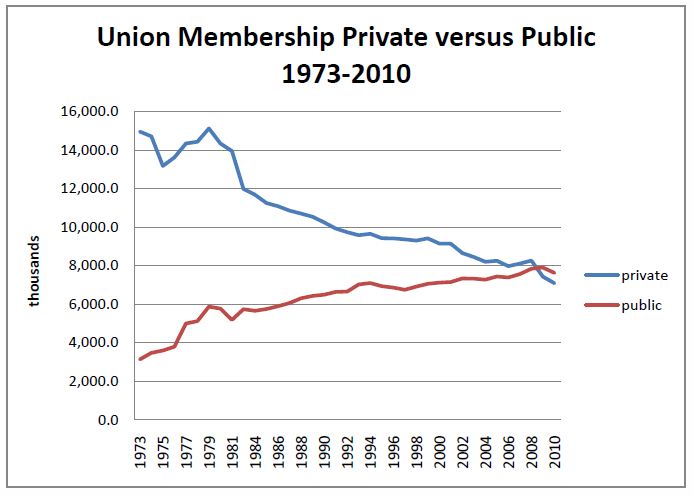
    Public service unions now constitute a majority of all union members. They accomplish their aims as much through the political process as through collective bargaining.


  • Metrorail’s Taxation without Representation

    Constitutional challenge could stop the train

    The Dulles Corridor Metrorail project has a way to go before it surpasses Boston’s Big Dig in the annals of the most ill-conceived, poorly managed public works projects of the modern era. But give it time. There is ample opportunity for things to go wrong.

    Last month, the Metropolitan Washington Airports Authority (MWAA), the entity given responsibility for building the Metro’s silver line to Dulles International Airport and beyond, voted to approve construction of an underground station at Dulles at a cost of some $330 million more than the above-ground alternative and also to require contractors to use union labor – despite the $6.6 billion project’s massive cost overruns and Virginia’s status as a right-to-work state. News of the decisions ignited a prairie fire of protest across Fairfax and Loudoun counties.

    Decrying the multijurisdictional MWAA’s action, Rep. Frank R. Wolf, Virginia Republican, has introduced legislation that would pack its board with a majority of Virginia appointees. Mr. Wolf’s response is understandable but he is missing the larger point. The core problem is not the quality of MWAA decisions nor that Virginia lacks sufficient representation on its board. It’s that neither the U.S. nor Virginia constitutions give MWAA the power to tax in the first place.

    That, at least, is the argument of a class-action lawsuit filed in April by two Northern Virginia citizens on behalf of roughly 300,000 Dulles Toll Road commuters to roll back the toll increases MWAA enacted to help pay for the rail construction. John B. Corr and John W. Grigsby, frequent users, have been “victim of the illegal exactions … since they began in 2005,” the suit contends. Of course, MWAA and its Virginia supporters don’t call the tolls a “tax.” But that’s exactly what they are.

    The federal government opened the Dulles Airport Access Road in 1962 to provide a speedy, toll-free link from Interstate 495 to the airport. As the Dulles Corridor developed, the commonwealth of Virginia constructed the Dulles Toll Road, flanking the access road on both sides, to serve growing local traffic. That 16-mile highway, which opened in 1984, was financed with Virginia bonds. Tolls were set by the Commonwealth Transportation Board.

    In 2005, the Kaine administration sealed an agreement whereby MWAA would take over management of the Metrorail-to-Dulles project and assume control over the Dulles Toll Road with the plan of diverting toll revenues to help pay for the rail project. If MWAA had been content to set rates at a level sufficient to maintain the toll road and pay for prudent expansions of capacity, then the tolls could be fairly described as a “user fee,” the lawsuit argues. Once MWAA set rates higher than needed to fund the road and began funneling those excess revenues toward an entirely different use, the construction of Dulles Metrorail, the rates become a tax, the suit argues.

    “Under the Virginia Constitution, the setting of rates or fees for a public service or facility is a legislative power that can be delegated to an officer or entity within state or local government only by the express authorization of the Virginia General Assembly,” the lawsuit contends. Gov. Tim Kaine never submitted his agreement with MWAA to the General Assembly for approval. Moreover, MWAA does not even qualify as an entity to which the General Assembly can bequeath taxing power. The private authority, says the suit, is “completely outside of the governments of the Commonwealth, or its counties, municipalities or other entities of local government.”

    The Kaine administration argues that the General Assembly did, in fact, authorize the diversion of toll revenues in the 1989 Bond Act, which provided for improvements to the Dulles Access Road corridor such as mass transit and “other capacity enhancing treatments.” But that authority was granted to the Commonwealth Transportation Board, not the MWAA. In any case, the delegation of authority to the unelected board was likewise unconstitutional, the lawsuit charges.

    The case will be heard in U.S. federal district court in Alexandria on May 26. A ruling for the plaintiffs, declaring the transfer to MWAA to be unconstitutional, would torpedo Metrorail-to-Dulles. Someone else would have to be found to manage the project but no one is standing in the wings. Presumably, the Dulles Toll Road would be transferred back to the state, which would be more reluctant than MWAA to jack up tolls to the $20 per trip in 2040 projected by MWAA’s consultants. With all the uncertainty, bond buyers would be reluctant to purchase MWAA-issued bonds to pay for the rail construction. Project financing would dry up, leading to more delays and, most likely, to more cost overruns.

    No, Metrorail-to-Dulles hasn’t attained the legendary status of the Big Dig yet. But give it time. Two or three weeks should tell the tale.

    This column was originally published in the Washington Times.


  • Don’t Stiff TIFs!

    When Jerry Brown took office as governor of California promising to balance the state’s insanely unbalanced budget, one of his top targets was the state’s 400 urban redevelopment agencies. Using Tax Increment Financing (TIF), these quasi-independent entities siphoned roughly $5.7 billion yearly in tax revenue away from schools and other tax entities. Eliminating the agencies, Brown argued, would help the state close its $28 billion budget deficit.

    While TIFs started first in California and proliferated fastest there, they are spreading across the country. And Randal O’Toole, a senior fellow with the Cato Institute, wants to stomp them out. With TIFs, local governments borrow money to finance development projects and repay the bonds with increased tax revenues generated by that project. It sounds like a win-win idea, but in “Crony Capitalism and Social Engineering: The Case against Tax-Increment Financing,” O’Toole argues that TIFs have been abused around the country and that state legislatures everywhere should repeal their TIF laws.

    I happen to be a big fan of TIFs when properly administered. I co-wrote a column, “TIFs: a Template for Development in the 2010s,” with my friend Ken Powell, an investment banker with Stone & Youngberg, the nation’s largest underwriter of TIF bonds. I have to concede that O’Toole makes a number of useful points. But I think it would be foolish to jettison this valuable re-development tool at a time when state and local governments are, and will continue to be, financially strapped.

    O’Toole levels several criticisms against TIFs. They:

    • Subsidize businesses that likely would have located in a locality or nearby anyway without the subsidy;
    • Capture funds that otherwise would have been allocated to schools, fire departments and other public purposes;
    • Promote the building of stadiums, convention centers and New Urbanism projects that would never fly without government subsidies; and
    • Give politicians a way to show favoritism to developers who repay the favor with big campaign donations.

    I have no doubt that these charges are true at various times and places across the country. But O’Toole makes no effort to present a balanced case. He focuses exclusively on the negative. With the right protections in place, the problems he cites need not arise. How can we ensure that TIFs are not abused here in Virginia?

    First, make Community Development Authorities (CDAs), the entities that create the special tax districts here in Virginia, totally transparent. Board meetings should be open to the public. CDAs should publish annual reports detailing their finances. The developer’s interests should be clearly spelled out. If we did that — gee, we already do — that would make TIF project financing more transparent than most government-funded projects!

    Second, require that all tax revenues be used to pay for public infrastructure — no direct subsidies for developers. Ideally, there should be a requirement that “public” improvements must truly benefit the public. In other words, paying for streetscapes in a mixed-use neighborhood would be OK, but paying for an access road that serves only the developer’s property would not.

    Third, put developers and bond holders on the hook for failed projects. If tax revenues fall short of what’s needed to support the debt service, bond holders can seize the developer’s property. If that’s not enough, bond holders are out of luck. As long as government doesn’t promise to make good on bad deals, bond holders will function as very good arbiters of risk. Simply put, they won’t invest in risky, speculative projects with weak economic underpinnings. If the bond holders balks, some deals won’t get done. Too bad. That’s the price of market discipline.

    Fourth, put a cap on the tax increment –50%, say — that can be applied to pay off the bonds. This would raise the hurdle for economic performance, but it also would ensure that the local government would gain additional tax revenues to offset the increased demand for services by businesses and residents of the CDA project.

    What O’Toole omits from his analysis is the fact that traditional methods for financing infrastructure all require taxes, too, and they often wind up subsidizing private developers. Sometimes the projects are big enough to warrant public scrutiny, but often the details — the dollars spent, what public money is spent on, government liability if projections aren’t met — are hidden from public view. If done right, TIFs can stimulate private investment, create more transparency and provide more accountability.


  • The Wonk Salon, May 18, 2011

    Gauging the Economic Impact of Federal Transportation Policy
    Rand Corporation
    The economic impact of federal investment in transportation infrastructure varies widely, depending upon context. Furthermore, most studies measure only benefits, neglecting to say if benefits exceed costs.

    Health Research Board Dispensed $734,000 in 2009
    Commonwealth Health Research Board, 2009 Annual Report
    State board sponsored eight research projects in Virginia, ranging from research into the molecular mechanisms of the auditory system to the mechanisms by which estrogen enhances the health of blood vessels and heart muscles.

    Examining the Health Impact of All Policies
    Robert Woods Johnson Foundation
    Because all is connected, all is one, the authors propose conducting Health Impact Assessments of major public policy decisions.


  • Return of the Outer Beltway?

    Apparently, Rail-to-Dulles is not enough to sate the Northern Virginia appetite for controversy. It looks like another battle royal over transportation and land use is brewing, this one centered on a proposal to declare a new Corridor of Statewide Significance (CoSS) that could pave the way for the controversial Outer Beltway.

    The issue surfaced in March when Doug Koelemay, once a regular contributor to the Bacon’s Rebellion newsletter, and another board member submitted the proposal during a regular meeting of the Commonwealth Transportation Board (CBT). Consideration of the motion was deferred to a meeting scheduled for tomorrow. Now environmental groups are mobilizing to block a CoSS designation until it has gone through the same process of “expert analysis, inter-agency collaboration, local consultation, and public input” that other corridors of statewide significance have gone through.

    I could find no explanation of the Corridor of State Significance on the CTB website. Environmentalist and smart-growth groups are portraying it as a bid to create the long-discussed Tri-County Parkway, which could be expanded into a longer Western Bypass. (See the press release issued by the Coalition for Smarter Growth.)

    Circumstantial evidence supporting that view comes from the McDonnell administration’s vagueness about plans to allocate $3 billion raised through borrowing for transportation projects. As noted in a previous smart-growth press release, $1.5 billion would go toward unspecified Public Private Transportation Act projects, while a separate infrastructure bank could tap $150 million in General Funds and another $250 million could be taken from maintenance accounts to subsidize low-interest loans to PPTA projects. That’s a lot of loose change.

    The smart growth groups contend that a north-south Outer Beltway (click on map for more legible image), long sought by Northern Virginia developers, would do little to relieve east-west travel congestion but would encourage development in areas lacking support infrastructure, making fiscal, environmental and congestion problems worse. The initiative also would divert funds from other projects that would address maintenance needs and bottlenecks in built-up areas of Northern Virginia.

    I have long been skeptical of Gov. McDonnell’s use of borrowed money to jump-start highway construction in Virginia. He is advancing a set of priorities assembled during the massive real estate boom of the 2000s when easy money was pushing growth and development in the Washington region ever outward. But times have changed. There is no more easy real-estate money, local governments are more fiscally strapped than ever, gasoline prices are rising and demographics are shifting in favor of development closer to the urban core. Growth patterns in the 2010s will shift decisively. The Commonwealth Transportation Board needs to overhaul its spending plans in light of those new realities. Pushing an outer beltway, or even the first segment of one, seems imprudent at this time.

    Of course, I have yet to hear the proposal, much less the justification for it, so I keep an open mind. But an Outer Beltway, if that in fact is what’s in store, has a very high hurdle to clear before I would be comfortable with it.


  • From Animal House to Animal College

    Back to one of my favorite themes: the higher education bubble. A majority of Americans (57%) say the higher education system in the United States fails to provide students with good value for the money, according to a new opinion survey by the Pew Research Center. An even larger majority (75%) says college is too expensive for most Americans to afford.

    Not surprisingly, the public’s views diverge from that of university presidents, six out of 10 of whom say the system of higher education is headed in the right direction. (Actually, a remarkable 38% say it is heading in the wrong direction.)

    If colleges deliver less value these days, it may be because, as 58% of college presidents believe, public high school students arrive at college less well prepared than their counterparts of a decade ago. Another 52% of presidents say college students today study less than their predecessors did a decade ago.

    Sad to say, both the public and the college presidents are probably right. Students are less prepared when they get to college and don’t work as hard when they get there — and they’re getting less value for their money.

    As if the survey couldn’t get any more depressing, the public is evenly divided between those who believe that students and their families should pay the largest share of the cost of a college education and those who think that the bulk of the cost should be borne by federal government, state government, private endowments or some combination of all three. I can’t help wondering if there’s an overlap between the students who study less and those who think someone else should pay for their education.


  • The Wonk Salon: May 17, 2011

    Preventing Fraud and Error in Medicare and Medicaid
    Center for American Progress
    Medicare and Medicaid waste $70 billion a year through fraud and payments made in error. Maybe it’s time to put a little more effort into payment integrity.

    How the Federal Government Can Help the States Deliver Better Education
    Rand Corporation
    Don’t impose uniform, top-down solutions. Stimulate the laboratory of democracy: Encourage states to experiment, measure results and disseminate best practices.


  • Paying Bills; Post-Recession

    Last Thursday when I got home, I noticed a funny thing on my phone. I had five telephone calls from a number “800-222-0300.” No voice mail messages were left. I called the number and got a recording that I was to call AT&T’s billing office for a matter regarding my service.

    I looked up the 800 number on Google. There were a lot of complaints about it, suggesting it was a physhing scam.

    Early the next morning, I went online at AT&T’s Website and saw that I had forgotten to pay a bill for $39.99. So I paid with with a credit card. Since I was on their Website I felt reasonably secure that the number was safe.

    Then the calls started again. One at 8:20 a.m., then 9:27 a.m., and then 1:44 p.m.

    So I called the 800 number and went through a phone tree. Finally, I got a real person named Andrea and asked why I was still getting calls when I had paid my bill. “We have no register of that,” she said. I replied that I was looking at an official receipt for the $39.99 on my computer screen. I asked for her supervisor. I got Melissa. “May I call you Peter?” she asked. I said no, that she could call me “Mr. Galuszka.” I did ask that they stop calling me, saying the bill had been paid. Melissa told me I would have to write a letter, not an e-mail, and post it to a post office box in Charleston, S.C.

    My anger stirred. Why did I have to do that? So, being a reporter, I sent an email to the AT&T flak in charge of blogs. Identifying myself, I asked what was going on and if the 800 number and the Charleston address were legit.

    The calls stopped. On Monday, I got a call from Steve Harrison with the office of the AT&T president in Kansas City. He was very apologetic about AT&T calling me. He said they would stop. I said I had been a customer for years and was at fault for misplacing my bill, but it was only a little late.

    I asked him why AT&T couldn’t just email me to alert me of a payment problem or other matter. “We’re not equipped to do that,” he said. I said that was odd since companies such as American Express can email and you both can go over the financial statement immediately. “It takes some time to post payments,” he said.

    AT&T? I wondered. The all-knowing, all-caring telephone company of yore?

    Mr. Harrison explained that in these hard times, lots of people fall behind on their bills. By making the recgular calls to them, they often connect with a customer service rep who can help with payment detaiuls or break up the payment into chunks to make it easier. I noted that this was a small bill easily corrected yet I had had eight calls in a little more than 24 hours . Wasn’t that excessive?

    He apologized again, but said it was the way AT&T had chosen to go.

    At least I got a call from the Office of the President. Must be the power of Bacon’s Rebellion.

    Peter Galuszka


  • Who Pays the Highest Property Taxes?


    Which of Virginia’s cities and counties levy the highest property taxes? And how do they compare to their high-taxing brethren in other states? Well, it depends partly on what you’re measuring.

    If you’re ranking the localities by the median property taxes paid per house, then it’s the city of Falls Church, hands down. The diminutive jurisdiction collected $6,012 per owner-occupied house on average between 2005 and 2009, according to newly published Tax Foundation data. Nobody comes close, not even Loudoun and Fairfax Counties, a laggardly No. 2 and No. 3.

    Switching the measure to property taxes paid as a percentage of home value gives the Big Tax award goes to the city of Manassas Park, where property taxes amount to 1.13% of the value of the house. (If it’s any consolation to home owners in Falls Church, they still rank No.2.)

    If you shift to property taxes paid as a percentage of income, then the Onerous Taxation trophy goes again to Falls Church, where the median tax consumes 4.94% of median household income.

    Well done, city councilmen of Falls Church, you have been exacting the most oppressive property taxes of any locality in Virginia — indeed, enough to rank the city No. 15 nationally in terms of median property tax paid, right up there with those New Jersey and New York counties — without inspiring riots in the streets. That’s no mean accomplishment. I hope your city services are worth the price your citizens pay.

    Check out how your city or county ranks, courtesy of the Tax Foundation, which has compiled the five-year average of property taxes on owner-occupied housing between 2005-2009 for 2,922 jurisdictions nationally. To view Virginia jurisdictions and play with the numbers, download the Bacon’s Rebellion spreadsheet. If you have trouble downloading the spreadsheet, read the pdf file.)


  • Disney Cashes in on SEALs

    Perhaps it was inevitable. Guess which giant American corporation stands to rake in dough by grabbing branding related to SEAL Team 6, the Navy commando unit based in Virginia Beach that killed Osama Bin Laden?

    Disney. Surprised? You shouldn’t be.

    It isn’t the first time that the California company that brought us Mickey Mouse has tried to cash in on tragic historical events. In the early 1990s, they tried to build a $650 million theme park near the Civil War battlefield near Manassas that would have dishonored war dead.

    Now, Disney has filed for three trademark applications to claim rights to the phrase “SEAL Team 6.” These would cover “entertainment and education services, “toys, games and playthings” and “clothing, footwear and headwear.”

    SEAL Team 6 is a special unit of the Navy SEALs that is based at Dam Neck in Virginia Beach and is tasked with handling anti-terrorist operations. The Team has seen extensive combat in Iraq and Afghanistan following the 9/11 attacks. Its members are credited with assaulting bin Laden’s stronghold in Pakistan and killing him.

    Peter Galuszka


  • How Much School Spending Makes It to the Classroom?

    Public education costs federal, state and local governments upward of $500 billion annually, up $354 billion 15 years ago. While spending increased nearly 50 percent, enrollment increased by just over 10 percent, reading and science scores held steady, and on-time graduation hovered at 70 percent. The question arises: Can we cut school spending without harming educational outcomes?

    School districts claim that funding cuts would require them to close schools and increase class sizes. But an issue brief published by the National Center for Policy Analysis (NCPA), “How Much Do Public Schools Spend on Teaching,” argues that roughly half of school spending never makes it to the classroom. Official counts of instructional spending typically exclude capital spending and sometimes lump in line items such as food service, property insurance, vehicle maintenance and refreshments for meetings with genuine classroom spending to calculate โ€œinstructionalโ€ spending.

    Concludes the author: โ€œInstead of cutting dollars spent in the classroom, state legislators should require clear accounting for how education tax dollars are spent, cap non-instructional spending and limit the growth of spending outside the classroom.โ€

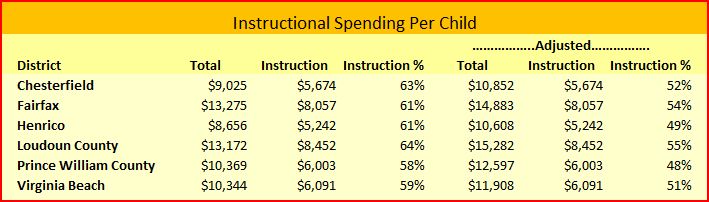
    The brief draws upon a study by the National Center for Educational Statistics that calculated instructional spending for the 100 largest school districts in the United States. Six of those giant schools systems are located in Virginia. (Can you spell “bureaucracy,” anyone?)

    Even by the standards of big school systems, Virginia districts did not perform especially well. Loudoun, Fairfax and Chesterfield counties devoted slightly higher percentages to instruction than the national norm, but Henrico and Prince William delivered less, and Virginia Beach matched the national average of the Top 100. (Click table for more legible image.) Clearly, there is room for improvement. New York City, for instance, devotes 70% of its educational dollars to classroom instruction. Do Virginia schools have that much more overhead?

    Bacon’s bottom line: The percentage of educational dollars funneled to classrooms has been an issue in Virginia. I don’t recall seeing any rankings of the state’s school systems, however. The NCPA’s call for transparency in accounting is a good one. Results should be reported for every school system in the state using the same accounting methodology. Then let the citizens judge whether they are getting value for their tax dollars.


  • How States Divvied up their Stimulus Funds

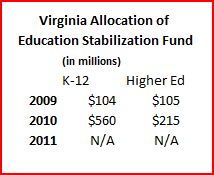
    The American Recovery and Reinvestment Act of 2009 provided nearly $48.6 billion in direct aid to states in the form of the State Fiscal Stabilization Fund. The program was designed to help states maintain support for public K-12 and higher education spending. A report published by the New America Foundation, “The State Fiscal Stabilization Fund and Higher Education Spending,” examines how the 50 states actually divvied up that money.

    โ€œOur findings show that K-12 education received the lionโ€™s share of Education Stabilization funds,” the authors conclude. “Still, these funds played a significant role in higher education funding in many states in 2009, 2010 and 2011. This suggests that states did not protect higher education from budget cuts during the economic downturn and in some cases made larger cuts to higher education than K-12 education.โ€

    On average, states allocated 78.9% of the funds to K-12, only 21.1% to higher ed. Virginia was something of an outlier, allocating 67.6% to schools and 32.4% to higher ed.

    Does this say something about the relative strength of Virginia’s higher ed lobby? Or does it signify that higher ed just needed the money more than K-12?


  • All Hail Deena Flinchum

    Bacon’s Rebellion contributor Deena Flinchum has hit the big-time. The Wall Street Journal printed her letter to the editor in the most prominent position of its editorial page today.

    Her letter supported a recent Journal editorial that took a hard line against proposed laws involving illegal emigration, noting recent efforts in Arizona and Utah. Flinchum unflinchingly states that any immigration reform should not include a tradeoff between “amnesty” for undocumented workers and tougher enforcement.

    “A quarter of a century after supporting the (1986 Immigration Reform and Contract Act) we are still waiting for the enforcement that is not only more accurate now but much easier to deliver than it was back then,” she wrote.

    The Flinchum missive was twined with another by Cecilia Wang of the ACLU and Linton Juaoquin of then National Immigration Law Center attacking the Journal editorial.

    To be sure, I do not agree personally with Deena or the Journal but it is great to see a fellow BR blogger out there smacking ’em in the big leagues.

    Peter Galuszka


  • The Wonk Salon: May 13-14, 2011

    Reducing Greenhouse Gas Emissions through Compact Development
    Urban Institute
    Compact development cuts down on driving. Cutting down on driving reduces emissions of greenhouse gases. Ergo, compact development reduces greenhouse gas emissions.

    Virginia Population Now 8% Hispanic
    Weldon Cooper Center
    The Hispanic population in Virginia nearly doubled in the 2000s and now accounts for nearly one in seven births in the state.

    New Evidence of Racial Bias in Capital Sentencing
    National Bureau of Economic Research
    The authors find that the probability of legal error found in Direct Appeal and Habeas Corpus is 3 percent and 9 percent higher for minority defendants who killed white victims than for those who killed minority victims.

    Building Streets for Everyone, Not Just Drivers

    Victoria Transportation Policy Institute
    “Complete streets” are designed with the needs of pedestrians, cyclists and the handicapped in mind, not just people who drive cars.