
Republicans — you can’t live with ’em, and you can’t live without ’em. Partisans of the elephant clan deem themselves faithful supporters of free market principles. And they are… until they encounter a concrete situation where those principles have to be applied. Then they revert as easily to government controls as the Dems do. I highlighted an example in my previous post about mandated insurance benefits. On a much larger scale, the same is true of transportation. The Rs support subsidies for roads and highways that would make a welfare queen blush, and they don’t even see the contradiction.
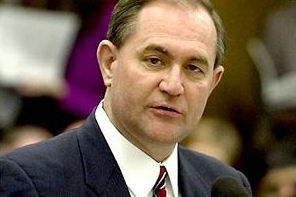 Ladies and gentlemen of the jury, I present to you Exhibit A, an op-ed written by former Gov. Jim Gilmore and published in Townhall.com. I’ve known Gilmore a very long time, and I like him personally. Also, he and I share very similar philosophies regarding the size and scope of government. He is a genuine small-government, low-tax fiscal conservative. But I take issue with the way he applies his principles to the transportation realm, and I urge him to re-think his position.
Gilmore uses the column to address a proposal originating from the Obama administration to implement a Vehicle Miles Driven (VMD) tax, which would “tax” motorists according to the number of miles they drive, presumably as an alternative to the soon-to-be antiquated gasoline tax. I share Gilmore’s concerns about the potential privacy issues entailed with installing technology that allows government to track an individual’s movements. Those concerns need to be addressed, or the VMD tax is a non-starter.
But Gilmore goes beyond privacy concerns to disapprove of the impact of such a tax. “The idea is … awful because beleaguered motorists are entering the summer driving season with $4 gas at the pump. Already, people are stretched to the limit economically. … People do not expect government to impose burdens and limitations on their freedom to drive and move about freely. Imposing a per-mile usage fee on vehicles impairs our fundamental right to move freely without inhibition.”
Key phrase: “the fundamental right to move freely without inhibition.” Gilmore expresses the views of many Republicans (and not a few Democrats) by referring to driving as a “right,” and implying, though not saying so outright, that “someone else” should pay for the maintenance and expansion of the road network.
Here’s the problem: It costs billions of dollars to build new roads and maintain them. The mainstay of road funding, the gasoline tax, has remained fixed since 1986. Consequently, the quality of Virginia’s road network is eroding, basic maintenance is going unfunded, and traffic congestion is increasing. As Republicans like to say in other contexts, you can’t get something for nothing. There is no free lunch. If we want better roads — and who doesn’t? — we need to find more money. Yes, yes, we can extend existing cash flows by conducting maintenance operations more efficiently, we can cut VDOT overhead and we can do a better job of prioritizing new road projects. We can flush idle funds out of forgotten accounts and we can re-write the highway funding formula more equitably to steer more money to where it is needed, like Northern Virginia. We need to spend every dollar wisely. But given the magnitude of the needs, we also need more money.
Republicans hate the idea of raising the gasoline tax (god forbid that anyone would even mention the VMD tax) on the grounds that Gilmore stated: Hard-pressed Americans just can’t afford to pay more. I hear that refrain over and over. Instead of taxing the people who use the roads, the Republican solution is to raise money in little bits and pieces through obscure fines and levies that people barely see. And by borrowing money. Thus, Gov. Bob McDonnell raised $2 billion for new road projects by borrowing the money… which has to be repaid from the General Fund. In other words, hard-pressed Virginians still have to pay back the money. They just don’t see where the money is coming from or where it is going. They are powerless to adapt their behavior in order to minimize the impact on their personal finances.
There is a maxim of economics that if you under-price the cost of something, people demand more of it. Thus, if the people who use the road network regard it as a free good and drive “without inhibition,” they drive more more than they would if they had to pay for their habit directly. Severing the connection between the use of roads and the paying for roads thus encourages to people to use roads more than they would otherwise, making traffic congestion worse. Democrats, for all economic illogic in other fields of governance, do grasp this economic reality. That’s why Obama’s VMD plan makes sense: It is based on a simple principle: The more you drive, the more you pay. You, not someone else, pay for what you use.
(I’m not a big Obama fan, in case anyone noticed. But that doesn’t mean I automatically discount every idea that comes out of his administration. The VMD idea is a good one.)
Conversely, when people pay more for a good or service, they use less of it. On the margin, if Virginians paid the full cost of building and maintaining roads, some would change their behavior. A few more would walk to work, a few more would ride bicycles or ride mass transit. A few more would carpool. When buying a new house, a few would select a location closer to where they work. The result would be a little less stress on the road network.
Now, I understand why Republican politicians stake out the position they do. They overwhelmingly represent voters who live in counties outside the urban core. Nearly all of their constituents drive cars, and I would wager that they drive more vehicle miles on a yearly basis than does the average Democrat, who is more likely to live in urban areas and have access to mass transit and other transportation alternatives. Therefore, making drivers pay the full cost of their preference for driving equates to making Republicans pay more for driving. Republican legislators don’t want to to cross their constituents! Free markets should be applied only when they harm Democratic constituents, it seems.
But the same logic that Republicans apply to subsidizing mass transit — without appropriate land use around the stations, it is wildly inefficient — applies to subsidizing roads. All transportation projects of whatever stripe should be prioritized and funded on a Return on Investment basis, and, to the greatest degree possible, paid for either by the people who use that infrastructure or who benefit from it through the higher property values created. Grandmothers who rarely step outside the house except to get their blue-hair rinse should not pay General Fund taxes for roads. The poor, single mother who takes the bus to work should not have to pay General Fund taxes for roads. The greenie zealot who rides his bicycle to the office should not have to pay General Fund taxes for roads. People who inconvenience themselves by carpooling or vanpooling should not have to pay the same General Fund taxes as the guy who insists upon driving solo.
Until Virginians abandon the idea that they have a “right” to drive roads at someone
else’s expense, there is no hope of building a transportation system for the 21st century. There simply isn’t enough money in the world to do it the way the Republicans would like to.
Leave a Reply
You must be logged in to post a comment.