• Return of the Outer Beltway?

    Apparently, Rail-to-Dulles is not enough to sate the Northern Virginia appetite for controversy. It looks like another battle royal over transportation and land use is brewing, this one centered on a proposal to declare a new Corridor of Statewide Significance (CoSS) that could pave the way for the controversial Outer Beltway.

    The issue surfaced in March when Doug Koelemay, once a regular contributor to the Bacon’s Rebellion newsletter, and another board member submitted the proposal during a regular meeting of the Commonwealth Transportation Board (CBT). Consideration of the motion was deferred to a meeting scheduled for tomorrow. Now environmental groups are mobilizing to block a CoSS designation until it has gone through the same process of “expert analysis, inter-agency collaboration, local consultation, and public input” that other corridors of statewide significance have gone through.

    I could find no explanation of the Corridor of State Significance on the CTB website. Environmentalist and smart-growth groups are portraying it as a bid to create the long-discussed Tri-County Parkway, which could be expanded into a longer Western Bypass. (See the press release issued by the Coalition for Smarter Growth.)

    Circumstantial evidence supporting that view comes from the McDonnell administration’s vagueness about plans to allocate $3 billion raised through borrowing for transportation projects. As noted in a previous smart-growth press release, $1.5 billion would go toward unspecified Public Private Transportation Act projects, while a separate infrastructure bank could tap $150 million in General Funds and another $250 million could be taken from maintenance accounts to subsidize low-interest loans to PPTA projects. That’s a lot of loose change.

    The smart growth groups contend that a north-south Outer Beltway (click on map for more legible image), long sought by Northern Virginia developers, would do little to relieve east-west travel congestion but would encourage development in areas lacking support infrastructure, making fiscal, environmental and congestion problems worse. The initiative also would divert funds from other projects that would address maintenance needs and bottlenecks in built-up areas of Northern Virginia.

    I have long been skeptical of Gov. McDonnell’s use of borrowed money to jump-start highway construction in Virginia. He is advancing a set of priorities assembled during the massive real estate boom of the 2000s when easy money was pushing growth and development in the Washington region ever outward. But times have changed. There is no more easy real-estate money, local governments are more fiscally strapped than ever, gasoline prices are rising and demographics are shifting in favor of development closer to the urban core. Growth patterns in the 2010s will shift decisively. The Commonwealth Transportation Board needs to overhaul its spending plans in light of those new realities. Pushing an outer beltway, or even the first segment of one, seems imprudent at this time.

    Of course, I have yet to hear the proposal, much less the justification for it, so I keep an open mind. But an Outer Beltway, if that in fact is what’s in store, has a very high hurdle to clear before I would be comfortable with it.


  • From Animal House to Animal College

    Back to one of my favorite themes: the higher education bubble. A majority of Americans (57%) say the higher education system in the United States fails to provide students with good value for the money, according to a new opinion survey by the Pew Research Center. An even larger majority (75%) says college is too expensive for most Americans to afford.

    Not surprisingly, the public’s views diverge from that of university presidents, six out of 10 of whom say the system of higher education is headed in the right direction. (Actually, a remarkable 38% say it is heading in the wrong direction.)

    If colleges deliver less value these days, it may be because, as 58% of college presidents believe, public high school students arrive at college less well prepared than their counterparts of a decade ago. Another 52% of presidents say college students today study less than their predecessors did a decade ago.

    Sad to say, both the public and the college presidents are probably right. Students are less prepared when they get to college and don’t work as hard when they get there — and they’re getting less value for their money.

    As if the survey couldn’t get any more depressing, the public is evenly divided between those who believe that students and their families should pay the largest share of the cost of a college education and those who think that the bulk of the cost should be borne by federal government, state government, private endowments or some combination of all three. I can’t help wondering if there’s an overlap between the students who study less and those who think someone else should pay for their education.


  • The Wonk Salon: May 17, 2011

    Preventing Fraud and Error in Medicare and Medicaid
    Center for American Progress
    Medicare and Medicaid waste $70 billion a year through fraud and payments made in error. Maybe it’s time to put a little more effort into payment integrity.

    How the Federal Government Can Help the States Deliver Better Education
    Rand Corporation
    Don’t impose uniform, top-down solutions. Stimulate the laboratory of democracy: Encourage states to experiment, measure results and disseminate best practices.


  • Paying Bills; Post-Recession

    Last Thursday when I got home, I noticed a funny thing on my phone. I had five telephone calls from a number “800-222-0300.” No voice mail messages were left. I called the number and got a recording that I was to call AT&T’s billing office for a matter regarding my service.

    I looked up the 800 number on Google. There were a lot of complaints about it, suggesting it was a physhing scam.

    Early the next morning, I went online at AT&T’s Website and saw that I had forgotten to pay a bill for $39.99. So I paid with with a credit card. Since I was on their Website I felt reasonably secure that the number was safe.

    Then the calls started again. One at 8:20 a.m., then 9:27 a.m., and then 1:44 p.m.

    So I called the 800 number and went through a phone tree. Finally, I got a real person named Andrea and asked why I was still getting calls when I had paid my bill. “We have no register of that,” she said. I replied that I was looking at an official receipt for the $39.99 on my computer screen. I asked for her supervisor. I got Melissa. “May I call you Peter?” she asked. I said no, that she could call me “Mr. Galuszka.” I did ask that they stop calling me, saying the bill had been paid. Melissa told me I would have to write a letter, not an e-mail, and post it to a post office box in Charleston, S.C.

    My anger stirred. Why did I have to do that? So, being a reporter, I sent an email to the AT&T flak in charge of blogs. Identifying myself, I asked what was going on and if the 800 number and the Charleston address were legit.

    The calls stopped. On Monday, I got a call from Steve Harrison with the office of the AT&T president in Kansas City. He was very apologetic about AT&T calling me. He said they would stop. I said I had been a customer for years and was at fault for misplacing my bill, but it was only a little late.

    I asked him why AT&T couldn’t just email me to alert me of a payment problem or other matter. “We’re not equipped to do that,” he said. I said that was odd since companies such as American Express can email and you both can go over the financial statement immediately. “It takes some time to post payments,” he said.

    AT&T? I wondered. The all-knowing, all-caring telephone company of yore?

    Mr. Harrison explained that in these hard times, lots of people fall behind on their bills. By making the recgular calls to them, they often connect with a customer service rep who can help with payment detaiuls or break up the payment into chunks to make it easier. I noted that this was a small bill easily corrected yet I had had eight calls in a little more than 24 hours . Wasn’t that excessive?

    He apologized again, but said it was the way AT&T had chosen to go.

    At least I got a call from the Office of the President. Must be the power of Bacon’s Rebellion.

    Peter Galuszka


  • Who Pays the Highest Property Taxes?


    Which of Virginia’s cities and counties levy the highest property taxes? And how do they compare to their high-taxing brethren in other states? Well, it depends partly on what you’re measuring.

    If you’re ranking the localities by the median property taxes paid per house, then it’s the city of Falls Church, hands down. The diminutive jurisdiction collected $6,012 per owner-occupied house on average between 2005 and 2009, according to newly published Tax Foundation data. Nobody comes close, not even Loudoun and Fairfax Counties, a laggardly No. 2 and No. 3.

    Switching the measure to property taxes paid as a percentage of home value gives the Big Tax award goes to the city of Manassas Park, where property taxes amount to 1.13% of the value of the house. (If it’s any consolation to home owners in Falls Church, they still rank No.2.)

    If you shift to property taxes paid as a percentage of income, then the Onerous Taxation trophy goes again to Falls Church, where the median tax consumes 4.94% of median household income.

    Well done, city councilmen of Falls Church, you have been exacting the most oppressive property taxes of any locality in Virginia — indeed, enough to rank the city No. 15 nationally in terms of median property tax paid, right up there with those New Jersey and New York counties — without inspiring riots in the streets. That’s no mean accomplishment. I hope your city services are worth the price your citizens pay.

    Check out how your city or county ranks, courtesy of the Tax Foundation, which has compiled the five-year average of property taxes on owner-occupied housing between 2005-2009 for 2,922 jurisdictions nationally. To view Virginia jurisdictions and play with the numbers, download the Bacon’s Rebellion spreadsheet. If you have trouble downloading the spreadsheet, read the pdf file.)


  • Disney Cashes in on SEALs

    Perhaps it was inevitable. Guess which giant American corporation stands to rake in dough by grabbing branding related to SEAL Team 6, the Navy commando unit based in Virginia Beach that killed Osama Bin Laden?

    Disney. Surprised? You shouldn’t be.

    It isn’t the first time that the California company that brought us Mickey Mouse has tried to cash in on tragic historical events. In the early 1990s, they tried to build a $650 million theme park near the Civil War battlefield near Manassas that would have dishonored war dead.

    Now, Disney has filed for three trademark applications to claim rights to the phrase “SEAL Team 6.” These would cover “entertainment and education services, “toys, games and playthings” and “clothing, footwear and headwear.”

    SEAL Team 6 is a special unit of the Navy SEALs that is based at Dam Neck in Virginia Beach and is tasked with handling anti-terrorist operations. The Team has seen extensive combat in Iraq and Afghanistan following the 9/11 attacks. Its members are credited with assaulting bin Laden’s stronghold in Pakistan and killing him.

    Peter Galuszka


  • How Much School Spending Makes It to the Classroom?

    Public education costs federal, state and local governments upward of $500 billion annually, up $354 billion 15 years ago. While spending increased nearly 50 percent, enrollment increased by just over 10 percent, reading and science scores held steady, and on-time graduation hovered at 70 percent. The question arises: Can we cut school spending without harming educational outcomes?

    School districts claim that funding cuts would require them to close schools and increase class sizes. But an issue brief published by the National Center for Policy Analysis (NCPA), “How Much Do Public Schools Spend on Teaching,” argues that roughly half of school spending never makes it to the classroom. Official counts of instructional spending typically exclude capital spending and sometimes lump in line items such as food service, property insurance, vehicle maintenance and refreshments for meetings with genuine classroom spending to calculate โ€œinstructionalโ€ spending.

    Concludes the author: โ€œInstead of cutting dollars spent in the classroom, state legislators should require clear accounting for how education tax dollars are spent, cap non-instructional spending and limit the growth of spending outside the classroom.โ€

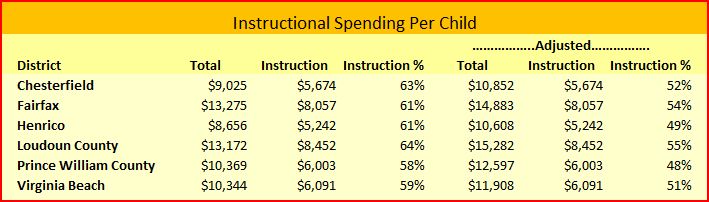
    The brief draws upon a study by the National Center for Educational Statistics that calculated instructional spending for the 100 largest school districts in the United States. Six of those giant schools systems are located in Virginia. (Can you spell “bureaucracy,” anyone?)

    Even by the standards of big school systems, Virginia districts did not perform especially well. Loudoun, Fairfax and Chesterfield counties devoted slightly higher percentages to instruction than the national norm, but Henrico and Prince William delivered less, and Virginia Beach matched the national average of the Top 100. (Click table for more legible image.) Clearly, there is room for improvement. New York City, for instance, devotes 70% of its educational dollars to classroom instruction. Do Virginia schools have that much more overhead?

    Bacon’s bottom line: The percentage of educational dollars funneled to classrooms has been an issue in Virginia. I don’t recall seeing any rankings of the state’s school systems, however. The NCPA’s call for transparency in accounting is a good one. Results should be reported for every school system in the state using the same accounting methodology. Then let the citizens judge whether they are getting value for their tax dollars.


  • How States Divvied up their Stimulus Funds

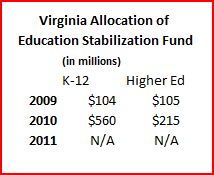
    The American Recovery and Reinvestment Act of 2009 provided nearly $48.6 billion in direct aid to states in the form of the State Fiscal Stabilization Fund. The program was designed to help states maintain support for public K-12 and higher education spending. A report published by the New America Foundation, “The State Fiscal Stabilization Fund and Higher Education Spending,” examines how the 50 states actually divvied up that money.

    โ€œOur findings show that K-12 education received the lionโ€™s share of Education Stabilization funds,” the authors conclude. “Still, these funds played a significant role in higher education funding in many states in 2009, 2010 and 2011. This suggests that states did not protect higher education from budget cuts during the economic downturn and in some cases made larger cuts to higher education than K-12 education.โ€

    On average, states allocated 78.9% of the funds to K-12, only 21.1% to higher ed. Virginia was something of an outlier, allocating 67.6% to schools and 32.4% to higher ed.

    Does this say something about the relative strength of Virginia’s higher ed lobby? Or does it signify that higher ed just needed the money more than K-12?


  • All Hail Deena Flinchum

    Bacon’s Rebellion contributor Deena Flinchum has hit the big-time. The Wall Street Journal printed her letter to the editor in the most prominent position of its editorial page today.

    Her letter supported a recent Journal editorial that took a hard line against proposed laws involving illegal emigration, noting recent efforts in Arizona and Utah. Flinchum unflinchingly states that any immigration reform should not include a tradeoff between “amnesty” for undocumented workers and tougher enforcement.

    “A quarter of a century after supporting the (1986 Immigration Reform and Contract Act) we are still waiting for the enforcement that is not only more accurate now but much easier to deliver than it was back then,” she wrote.

    The Flinchum missive was twined with another by Cecilia Wang of the ACLU and Linton Juaoquin of then National Immigration Law Center attacking the Journal editorial.

    To be sure, I do not agree personally with Deena or the Journal but it is great to see a fellow BR blogger out there smacking ’em in the big leagues.

    Peter Galuszka


  • The Wonk Salon: May 13-14, 2011

    Reducing Greenhouse Gas Emissions through Compact Development
    Urban Institute
    Compact development cuts down on driving. Cutting down on driving reduces emissions of greenhouse gases. Ergo, compact development reduces greenhouse gas emissions.

    Virginia Population Now 8% Hispanic
    Weldon Cooper Center
    The Hispanic population in Virginia nearly doubled in the 2000s and now accounts for nearly one in seven births in the state.

    New Evidence of Racial Bias in Capital Sentencing
    National Bureau of Economic Research
    The authors find that the probability of legal error found in Direct Appeal and Habeas Corpus is 3 percent and 9 percent higher for minority defendants who killed white victims than for those who killed minority victims.

    Building Streets for Everyone, Not Just Drivers

    Victoria Transportation Policy Institute
    “Complete streets” are designed with the needs of pedestrians, cyclists and the handicapped in mind, not just people who drive cars.


  • Virginia’s Nuclear Industry Takes a Hit

    Virginia’s once-promising nuclear industry is feeling the impacts of Japan’s reactor disaster which has dampened market demand for goods and services related to nuclear-powered generating plants.

    Construction delays have been announced at the $363 million Areva Newport News facility that would make large components for the nuclear power industry. In Pittsylvania County, support seems to be growing against a proposal to mine about 119 million pounds of uranium worth about $8 billion.

    The Old Dominion is a major center for the nuclear industry. French-owned Areva has its North American headquarters in Lynchburg where it provides maintenance crews and parts to service nuclear power stations throughout the U.S. Dominion Virginia Power operates four nuclear units in the state. A Newport News shipyard that has just been spun off to Huntingon Ingalls by Northrop Grumman is the only yard in the country that can make nuclear-powered surface ships.

    As worries over disasters at Three Mile Island and Chernobyl faded and concerns about climate change grew, Virginia seemed well-position to cash in on its civilian nuclear prowess.

    The meltdown March 11 at Japan’s Fukushima plant has changed all of that. Japan and Germany are limiting or phasing out their reliance on nuclear power although developing nations such as China, Mexico and Iran are pressing on.

    The market uncertainty has prompted Areva Newport News, owned by Areva and Huntington Ingalls, to announced May 9 that it was halting construction of its Newport News components facility which would employ 540. Company officials cited unfavorable market conditions but said that building could begin again if that changes. Construction had begun in 2009.
    Meanwhile, the new anti-nuclear atmosphere is giving a boost to the 41 groups and localities that oppose Virginia Uranium Inc.’s plans to mine uranium in Pittsylvania County and create 300 jobs. The state has banned uranium mining but the General Assembly make reconsider it in 2012. ” We are not willing to risk our health and our property values and our future for low-quality jobs with such a toxic result,” Naomi Hodge-Muse, president of the Martinsville-Henry chapter of the NAACP was quoted as saying.

    If advanced industrialized countries such as Germany and Japan start dissing nukes, then the uranium market will take a hit. Much of our supply comes from fissile product recycled from old U.S. and Soviet warheads and other countries such as Kazakhstan are moving ahead with supplies, making the Virginia product seem unnecessary.

    Peter Galuszka

  • The Wonk Salon, May 12, 2011

    Thinking Logically about Class Size
    Brookings Institution
    Smaller classes sizes make a bigger difference in some instances — for earlier grades and disadvantaged children — than in others. Spending on class-size initiatives should be targeted.

    Drive Less, Pay Less Insurance
    Victoria Transport Policy Institute
    Pay-As-You-Drive insurance reduces rates for motorists who drive less on the grounds that they are less likely to have accidents. PAYD also encourages people to drive less, thus promoting other goals such as energy efficiency and pollution reduction.

    More Transparency, Please, for State Tax Expenditures
    Center of Budget and Policy Priorities
    States allow billions of dollars of tax credits, deductions and exemptions that reduce tax revenue. These loopholes run on autopilot with little scrutiny. States should issue comprehensive annual “tax expenditure reports.” Virginia’s report is incomplete.

    Reducing Emergency Room Use for Non-Urgent Care
    Government Accountability Office
    Non-urgent care in an emergency room setting costs seven times as much as an appropriate setting. This report suggests strategies for reducing that cost.

    How Goes the Federal Investment in Health Care IT?
    James A. Baker III Institute for Public Policy
    Uncle Sam is investing $19 billion in health care IT in the hope that providers can boost productivity and improve quality. Progress is being made, though challenges remain.


  • Virginia’s Measures Measure Up

    In fiscal 2010, the states spent an estimated $131 billion on transportation. What return did they get on their investment? Most policy makers can’t tell you. That’s because most states have inadequate systems for setting goals and measuring performance, concludes a new report by the Pew Center for the States and the Rockefeller Foundation, “Measuring Transportation Investments: The Road to Results.”

    Fortunately, Virginia is an exception to the norm. The Old Dominion is one of only six states in the country (the others were Georgia, Maryland, Minnesota, Missouri and Oregon) that scored a rating of “leading the way” on all six criteria chosen by the authors: safety, jobs and commerce, mobility, access, environmental stewardship and infrastructure preservation.

    We Virginians may not have the road system we’d like but at least we have a better idea of how well or how poorly it’s measuring up than most other states do. Even so, our performance criteria and data quality are far from perfect. Even the “leaders” can improve by adopting best practices found in other states.

    Bacon’s bottom line: Every transportation project in the state should be rated and evaluated on the basis of standard performance criteria. Every project should have a projected Public Return on Investment. All projects should be prioritized based on their expected Public ROI. And the process should be made totally transparent to the public.


    Map code:
    Green states – leading the way
    Yellow states – mixed results
    Red states – trailing behind


  • The Wonk Salon: May 11, 2011

    How Elastic Is the Demand for Travel?
    Victoria Transport Policy Institute
    Recent studies suggest that the demand for particular modes of travel is becoming more elastic, or more sensitive to price. If so, transportation pricing reforms make sense.

    Solar Power: Reaching Grid Parity
    National Center for Policy Analysis
    Solar power is reaching “grid parity” with conventional fuels in Hawaii, but in the continental United States, given tighter environmental restrictions and more solar-technology breakthroughs, it could take until the end of the decade.


  • Finally, Fresh Thinking on the U.S. Economy

    Ever since the Great Recession, plenty has been written on the fate ofthe U.S. economy, as it naturally would be. Negative themes suddenly shot into the sky practically on the exact day Barack Obama, our firstAfrican-American president, was inaugurated. Many tomes were jeremiads painting very dark and dreary images of our future.

    We are enormously in debt. Our free-spending ways are our children’s ruination. America has lost its competitive edge. Innovation is in shambles. And on and on go the deficit freaks whose Calvinistic works scatter the tables at Barnes & Noble or online. Read them and see who can outdoom the other.

    So, it is a really nice respite to pick up “The Next American Economy, Blueprint for Real Recovery,” by international business journalist William J. Holstein (Walker & Company). Full disclosure: Bill has been a close friend of mine since the 1980s when we were working at BusinessWeek. I was on my way to Moscow and Bill, who had spent years covering China and was in Kabul when the Soviets invaded, was on the international desk in New York.

    Bill hits themes familiar to anyone who knows his previous work, especially his 1990 explanation of how Japan’s economic bureaucrats operate. The U.S. still thrives on creative effort, has plenty of brainpower and works best when it lets in people from many different countries with many ideas so they can work together. Foreign competition is not something to fear, but rather, embrace.

    As far as government policy, Bill leaves the tut-tutting about free market dogmatism to the libertarians, Baconauts and others. There is an obvious role for government help in terms of R&D funding, especially defense funding which has proved very successful. Local, state and federal governments have a role to boost geographic “clustering” of like industries, and coordinate an export offensive featuring high tech goods.

    The most interetsing part of the book is not the wonkery but the reporting. Rather than sit around in a basement, reading and regurgitating think tank reports, Bill gets into the field with a vengeance. He finds there’s a lot going on:

    Men originally from Venezuela and Taiwan get together to form a start-up structured around a new, self-organizing battery named the A123, which is lighter and powerful than previous batteries. Applications are endless, from Black & Decker tools to automobiles. With federal grant money from the SBA and Department of Energy, plus backing from MIT a firm named A123 took root, flourished and started to compete head on with strong Asian firms. By 2009, it had 1600 employees, a manufacturing plant in Michigan, and sales of $91 million.

    In Orlando, an Iranian immigrant with a doctorate from the University of Louisville ends up in Orlando to take part in the region’s efforts to become a “cluster” for computer simulation. In that effort, Orlando had a couple of things going for it. It’s not far from NASA’s huge Cape Kennedy space port. Big theme parks run by Disney and Universal employ lots of simulation experts to make the rides more thrilling. Tapping these labor pools, the cluster was established. Money, especially defense funds, started flowing in since the armed forces need simulation to train troops.

    Another immigrant, this time of Polish and Czech background, ends up in San Diego after medical school and intends to research cancer. Rather than toil in a school lab, he wants to start his own firm, which his local college resented (Some like MIT embrace professorial entrepreneurship). Long story short, the result was a genomics cluster that rivals Boston, the Maryland suburbs and the Bay Area.

    Corning, the glassmaker, has been around for decades and may seem oh so Rust Belt. But the firm is one of the few U.S. companies that spends up to 10 percent of its sales on R&D (other firms skimp on R&D in the recession wash-over and to cover next quarter’s earnings). Corning scientists kept wondering about a new type of glass that had applications as millions of cell phones, iPads and other small electronic devices need a new type of tough, scratch-resistance glass for their displays. They found it with Gorilla Glass, first made at a Corning plant in Danville with production later shifting to Kentucky.

    Like Virginia, North Carolina has been struggling to shift away from traditional manufacturing industries like tobacco, furniture and textiles. The state, which had the foresight to create the Research Triangle Park as early as the 1950s, came up with ways to combine state, federal and private resources to facilitate of Tar Heel-made niche products. One is nanotechnology tools from Raleigh. Another is a new type of software from the small, Eastern North Carolina city of Greenville that can be used around the world to keep up with the expiration dates of pharmaceuticals in storage.

    Holstein’s bottom line is that despite the naysayers, there’s plenty of brainpower and innovation potential that should help position the U.S. far ahead of the current economic disaster. Having broad experience overseas, he’s immune from the irrational fears many conservatives have that government involvement will turn them into zombies. He says CEOs have to constantly assess their company’s innovation and changing global conditions. Chinese labor costs, for instance, are under pressure and land in places like South Carolina is cheaper than suburban Shanghai so some U.S. firms are coming back home.

    But if they do, wonders Holstein, will they find an educated work force? There’s an area needing much work. Ditto immigration law since the current, emotional debate is enormously damaging to this nation of immigrants and the great, new ideas they bring here. My view is that it is absolutely pathetic that a place so rich in foreign born folks as Northern Virginia is also home to racist politicians like Corey A. Stewart and his immigrant bashing “Rule of Law” campaign.

    And to his credit, Bill doesn’t bore us with how much money we’re not going to have in 2030. Ugh!

    Peter Galuszka