• Good Mexicans and Bad Mexicans: It All Depends on Which Side of the Border They Live

    A deteriorating balance of trade with Mexico since enactment of NAFTA in 1994 has cost the U.S. economy 683,000 jobs and Virginia 13,100 jobs, asserts a new paper by the Economic Policy Institute, “Heading South: U.S.-Mexico trade and job displacement after NAFTA.

    Before the North American Free Trade Agreement, the U.S. enjoyed a small balance-of-trade surplus with Mexico. But massive U.S. investment into our south-of-the-border neighbor fueled the outsourcing of jobs and production, especially in the manufacturing sector. The lost jobs were distributed across the U.S., with California, Texas and Michigan being the hardest hit. Virginia was among the states experiencing a moderate impact.

    According to author Robert E. Scott’s calculations, Virginia gained 16,800 jobs from increased exports thanks to NAFTA but lost 30,000 jobs, for a net loss of 13,100. (See Table 4B.)

    Wow, it sounds like NAFTA was a raw deal for the U.S. Ross Perot was right when he said we’d all hear a “giant sucking sound” of jobs to Mexico…. Only one thing: Scott is telling only part of the story.

    The period between 1994 and 2010 saw a massive deterioration in the U.S. balance of trade with the entire world. We went from a foreign trade deficit in goods of $150 billion in 1994 to a deficit of $634 billion in 2010. We didn’t lose ground just with Mexico and Canada, we lost ground pretty much across the board.

    Some have made the argument that we would have lost more ground were it not for NAFTA. Jobs shipped to Mexico were jobs not shipped to China, Malaysia, Vietnam or other Asian export powerhouses as U.S. manufacturers chose a manufacturing platform close to the U.S. Given the realities of globalization, those jobs were goners regardless. But thanks to our free trade agreement with Mexico, Mexicans in turn bought a whole lot of stuff from the United States. Thus, while total U.S. exports increased 150% between 1994 and 2010, exports to Mexico increased 212%.

    What amuses me is how lefties think that competition with Mexican labor is ruinous to U.S. jobs when trade takes place across the U.S.-Mexican border. But when Mexicans come into the United States illegally and compete directly with U.S. workers, the impact on jobs and wages is dismissed as insignificant. Bashing Mexicans inside Mexico… OK. Bashing Mexicans living illegally inside the U.S…. racist! Go figure.

  • Black City/White Suburb Stereotype Fading Fast

    The stereotype of โ€œchocolate city and vanilla suburbsโ€ is fast eroding, argues William H. Frey in a new report, “Melting Pot Cities and Suburbs,” based on data from the 2010 United States census.

    Minorities, especially Hispanics, are fueling population growth in a wider array of places, including suburbs in all parts of the country. Meanwhile, โ€œblack flightโ€ from cities with large African-American populations is also changing the population mix of cities and suburbs. โ€œThese dynamics combined in the 2000s to produce more diverse โ€œmelting pot suburbsโ€ and increasingly multi-hued cities, stark changes from the binary race/place images of the past,โ€ Frey writes.

    Frey’s report does not provide a metro-by-metro breakdown. But the narrative and infographics do contain nuggets pertaining to the three Virginia metro areas, Washington, Hampton Roads and Richmond, that are included among the 100 largest metro areas covered by the study. Among the nuggets:

    Washington, D.C., was one of six individual cities that experienced an increase in the white share of population. The white share now stands at 35%, up 7% from a decade ago. Blacks comprise 50% of the population, down 9%. Hispanics and Asians grew their shares of the population by 1% each.

    The suburbs of the Washington metropolitan area turned “majority minority” over the decade, with the white share slipping to 50% of the population. The growth rate was most rapid for Hispanics (6%) and Asians (3%) but modest for African-Americans (1%).

    Extraordinarily, of the 20 exurban counties ranked by the rate of population growth, five are located on the fringes of the Richmond metro area — one out of four in the country! Even as white population growth slowed to a crawl nationally, whites predominated in these counties.

    • New Kent County: Grew 37% over the decade. Whites contributed 82% of that growth.
    • Louisa County: Grew 29% over the decade. Whites contributed 80% of that growth.
    • Caroline County: Grew 29% over the decade. Whites contributed 69% of that growth.
    • Goochland County: Grew 29% over the decade. Whites contributed 90% of that growth.
    • Powhatan County: Grew 25% over the decade. Whites contributed 90% of that growth.

    I’m not sure what that says about the white population of the Richmond region, but it certainly does confirm one thing I’ve warned about for years: Richmond is one of the fastest sprawling metro regions in the country.


  • The Wonk Salon, May 3, 2011

    Are Community Colleges the Future of Higher Ed?
    John William Pope Center for Higher Education Policy
    Community colleges, focused on instruction, deliver far more value than colleges and universities, which pursue multiple agendas.

    Cops + Professors = Better Law Enforcement
    Rand Corporation
    The Caruth Police Institute in Dallas: smarter policemen makes better crime fighters.

    Prison Inmates: Ideal Citizens (for a Gerrymander District)
    Demos
    Here’s a neat gerrymandering trick: Pack you district with prisons. Inmates can’t vote, meaning all the more influence for the rest of your constituents.

    Combining Law Enforcement with Social Services
    Urban Institute/Brookings Institution
    Suppress crime with law enforcement and attack root causes with social services.


  • Rail-to-Dulles Exposed: Subsidize the Rich and Plunder the Middle Class

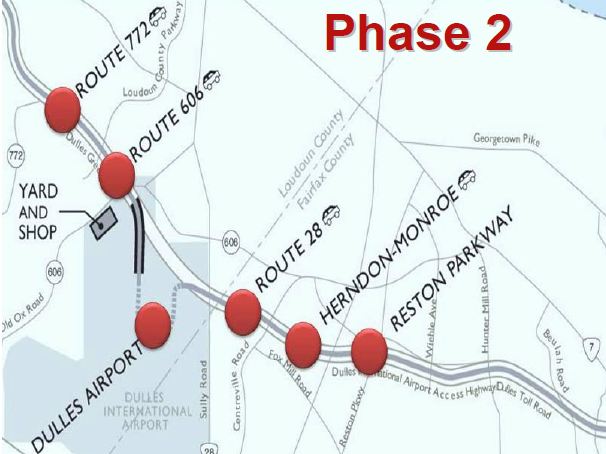
    Jamie Radtke, who is running for Jim Webb’s U.S. Senate seat, has criticized the Metropolitan Washington Airports Authority for recent decisions it has made relating to the Rail-to-Dulles heavy rail project. Specifically, the board approved an underground station that would cost millions of dollars more than an above-ground alternative and agreed that anyone bidding on the $3.8 billion second phase of the construction project would have to agree to use union labor.

    As Radtke rightfully pointed out in a Friday email blast, “This is an appalling example of arrogance from unelected officials with no accountability to the citizens.”

    I agree. I think that Virginians will come to rue the day that former Gov. Tim Kaine turned over responsibility for Rail-to-Dulles to the unelected MWAA, only a minority of whose board members are appointed by the Virginia governor. The MWAA suffers a clear conflict of interest on the project: It cannot possibly be expected to dispassionately represent its own interests as well as the interests of Virginia citizens.

    I will deal with the union issue in a later post. For now, I want to focus on the issue of the underground station. The issue, to my mind, isn’t whether an underground station is preferable to an above-ground station — of course it is — but the question of who pays for it.

    In a recent op-ed in the Washington Post, former MWAA Chair Mame Reily did a good job of justifying the underground station.

    Itโ€™s better for baggage-laden travelers, who will not have to trek 1,150 feet to an aboveground station to stand in steamy Washington summers or icy winter winds after long international flights. And itโ€™s better as an international gateway to Washington because it preserves the architectural vision of the masterful Eero Saarinen that has made Dulles a design icon worldwide. Washingtonโ€™s two airports, designed by world-class architects, are worthy of the capital of a great nation. For the airports authority to have decided to provide anything other than a first-rate rail connection at Dulles would have been shortsighted โ€” and soon regretted.

    If we’re going to spend in excess of $6.8 billion extending heavy rail from the existing Metro system to Dulles airport, it makes sense to do it right. At the same time, the MWAA deserves credit for seeking to shave costs from the original plan. The newly approved design will knock $330 off the previous version by revising the tunnel length and depth, using a different excavation method, and finding ways to cut costs relating to air conditioning and electricity. Moreover, the service life of an underground facility is expected to last twice that of an above-ground station.

    So, it’s not as if the MWAA is spending money cavalierly. But Reily ducked the critical issue in her op-ed. If the underground station is so vitally important to Dulles, why isn’t the airport authority paying for it? What Reily didn’t mention in her op-ed, nor did the MWAA in its press release, was that the Dulles station will still cost $912 million, even after the cost savings. None of the other stations, not even in densely urbanized Tysons Corner, will be build underground. No one can afford it! The return on investment isn’t there.

    Under current financing arrangements, Dulles is getting a sweet deal. The Dulles station accounts for 13.8% of the $6.6 billion total project cost (Phase 1 and Phase 2 combined). Yet the MWAA is contributing only 4.1% of the total funding, according to the formula negotiated by the participants. The costs are allocated as follows:

    Federal grants – 14.8%
    Commonwealth of Virginia – 3.0%
    Airports authority – 4.1%
    Loudoun County – 4.8%
    Fairfax County – 16.1%
    Dulles Toll Road – 57.2%

    Thus, the MWAA is paying roughly one-third of its proportionate cost, while most of the financial burden will be dumped on the users of the Dulles Toll Road who, by definition, aren’t even using the Metro.

    Such a meager share might be justifiable if Dulles airport had no capacity to raise a proportionate level of funds. But that’s hardly the case. Dulles is a massive business enterprise, generating revenues from terminal leases, airport concessions, landing fees and other sources. Its 2011 operating budget is $420 million. But its operating expenses are only $200 million. After $163 million in principal and interest payments on bonds, Dulles runs a “net remaining revenue” of $67 million, which is distributed between the airport and the airlines. (These numbers do not include Dulles Toll Road fees.)

    As one of the nation’s fastest-growing airports, Dulles has massive expansion plans. Its 2011 budget describes $4.1 billion in capital construction projects authorized for 2010-2016. That encompasses everything from roads, terminals and airfield improvements to cargo buildings, parking facilities, utility systems and… a $211 billion contribution to Dulles Rail.

    In other words, Dulles airport is not an impoverished entity desperately scraping up every nickle and dime it can find to pay its share of the heavy rail project. Its 4.1% share of Dulles Rail constitutes only 5% of its capital spending project through 2016! Yet for some reason, Northern Virginia commuters using the Dulles Toll Road are expected to fund 57.2% of the project even though they will not be using the Metro.

    Yes, the Dulles corridor needs a heavy rail line. Yes, someone has to pay for it. But why are middle-class road warriors expected to subsidize the Congressmen and business executives who wish to ride the Metro from downtown D.C., Pentagon City or Tysons Corner to a nice, air conditioned station located only a short walk from their destination? Why can’t the Congressmen and business executives who benefit from the facility, or their proxy the MWAA, pay for the convenience?

    As it stands now, the financial arrangements for Dulles Rail represent a massive transfer of wealth from middle-class commuters and small property owners to the elites that (a) own property adjacent to the Metro stations and (b) who frequently patronize Dulles airport to fly around the country. But that’s pretty much the story of America today, isn’t it? Plunder the middle class to benefit the moneyed and politically connected special interests, and then plunder taxpayers generally to assuage the elite’s guilt by transferring wealth to the poor. Jamie Radtke gets it. And Tim Kaine, if he runs for U.S. Senate, will have to answer for it.


  • Could the Right-Wing Be Wrong on Obama?

    The killing of terrorist Osama bin Laden is a major victory for President Barack Obama, showing, once again, that maybe he is ready for the presidency after all.

    The last phrase is facetious because all the pundits, especially on the right side of the aisle, constantly raise questions about his experience, his world view and even his citizenship.
    How quickly one forgets that his predecessor, George W. Bush, was in charge when U.S. forces missed Bin Laden in Tora Bora. He also launched an unnecessary war into Iraq based on faulty intelligence about Saddam Hussein’s weapons of mass destruction that turned out not to exist.
    The news today is undeniable. Even Fox News seems to be playing it straight. It is a major victory for the U.S. and for Obama.

    In time, the more delusional elements of the right wing will likely claim that Bin Laden is not dead after all. They still believe that Obama was not born in the U.s. and is not entitled to be U.S. president, Hawaii birth certificate notwithstanding.
    But these are the same people who believe that the $12 trillion swing from a budget surplus with adequate revenues when Bill Clinton left office to debt today. Two recessions were part of the problem, reports yesterday’s Washington Post, but Bush was responsible for more of the shift than Obama with his Iraq and Afghan Wars, Medicare drug shifts, and, of course, a $1.7 trillion loss in tax revenue due to tax cuts mostly for the rich. Obama is responsible for only about 6 percent of the shift from riches to rags (but not if you listen the James A. Bacon Jr. and his cabal).
    Not two weeks ago, the right-wingers were ripping Obama apart for supposedly mishandling popular uprisings against Middle East dictators. He was too soft, too incompetent, makes the wrong decisions. Apparently, Obama made the right one when he had the sense not to share intelligence about Bin Laden’s whereabouts with the Pakistanis.
    Imagine the uproar had the mission failed.
    Peter Galuszka

  • The Wonk Salon: May 2, 2011

    Obama’s New “Urban Manufacturing” Push
    The Urban Institute
    Federal policy needs to support state-regional initiatives to support Small Urban Manufacturing enterprises (SUMs), which are a major source of innovation and job creation.

    D.C. School Choice Works – with Caveats
    The Urban Institute
    School choice programs in Washington, D.C., do provide disadvantaged students options to improve their educations, but they also exacerbate student-quality disparities.

    Realignment: Shifting Responsibility and Power from State to Local Governments
    Public Policy Institute of California
    As part of his campaign to close the budget gap, Gov. Jerry Brown wants to shift responsibility and funding sources from state to local government. This report identifies key issues to be resolved.


  • Virginia: Home to War-Torn Refugees

    I have been fortunate to become friends with a remarkable young man, Awer Bul, who is a refugee from the southern Sudan. Born into the Dinka tribe, he was raised with a family of cattle herders. He remembers living happily and blissfully unaware of the outside world until the Sudanese civil war reached his village. His family tried to flee the violence but the fighting caught up. Mother, father and children were separated. Cattle, their main form of wealth, were stolen. Awer wound up living in a series of refugee camps in Uganda and Kenya. By a series of remarkable events, he wound up in Richmond, Virginia.

    Speaking very little English and having very little formal education, Awer was deposited as a teenager in J.R. Tucker High School in Henrico County. Within eight years, he had graduated from high school and Virginia Commonwealth University. Today, he works in retail while he pursues his painting, drawing upon traditional Dinka society for inspiration, and capturing video footage of other Sudanese “lost boys” to capture their stories and preserve memories of Dinka culture. He also is raising money to build schools and dig wells for villages back in the Sudan. (Visit Awer’s website to see his art, photos and videos.)

    By happenstance, Richmond is home to more than 100 Sudanese refugees. And to many Bosnian refugees. And Vietnamese, and Cambodian. I have come to know several of these people very well, and appreciate how hard they have worked to adapt to American ways and become contributing members of society. And I think of them as I read a new report by the Center for Immigration Studies, “Refugee Resettlement: A System badly in Need of Review,” by Don Barnett.

    The United States plans to admit 80,000 political refugees into the country in 2011, nearly three times the number accepted by the rest of the developed world combined. Barnett argues that the U.S. has surrendered control of refugee resettlement to the United Nations and non-governmental organizations (NGOs) that stand to benefit from the program.

    Refugeesโ€™ widespread use of welfare, subsidized housing, Medicaid and other programs โ€œeasily raises the cost of the domestic resettlement program to 10 times the official estimates of $1.1 billion annually.โ€ Moreover, many religious organizations and NGOs โ€œconsistently refuse to commit any of their own resources for the resettlement effort,โ€ turning the refugee program into an income stream and abandoning traditional charitable works that do not pay. Despite the fiscal impact on small towns, communities are rarely consulted about where the refugees are resettled. Barnett recommends setting a ceiling of 20,000 refugees per year.

    Among Barnett’s concerns is that the U.S. Refugee Admissions Program (USRAP) is bringing in people from groups that “have stated openly that they do not intend to assimilate into American culture.” Fortunately, the number of refugees admitted into Virginia seems to be small enough, and the refugees come from such a diversity of homelands, that there seems to be little prospect of them creating self-imposed ghettos.

    Believe it or not, Virginia has an Office of Newcomer Services that keeps track of the refugees settled in the commonwealth. According to an April 2011 report, Virginia had resettled 975 “refugees, asylees, Afghan and Iraqi special immigrant visa (SIV) holders, secondary migrants and victims of human trafficking” during the first six months of fiscal 2011. The immigrants came from 32 different countries. They came from Asia, the Middle East and Africa mostly, with a smattering from Cuba, the former Soviet Union and Latin America.

    Refugees settled all around the state: 30% in Northern Virginia, 18% in Hampton Roads, 14% in Richmond, 13% in Roanoke, 12% in Charlottesville, 9% in the Shenandoah Valley, and 3% in Fredericksburg.

    Refugees may pose a social-services burden upon their new communities for a while. But Virginia does not encourage a culture of dependency. All of the refugees that I have known personally — and I can think of nearly a dozen off-hand — have become productive members of society. Barnett may have a point, and the refugee program may be out of control. But from my limited, admittedly anecdotal, viewpoint, I have seen no evidence of it. The refugees I have met do not weaken American society, they strengthen it.


  • Is the Tax-Free Muni a Financial Dinosaur?

    Have tax-free municipal bonds outlived their usefulness? I would argue that they have.

    The tax exemption for municipal bonds has been around since 1913, when the federal income tax was established. Its purpose was to comply with the current thinking in constitutional law, which prohibited the federal government from taxing state or municipal financial instruments.

    However, the legal doctrine of “intergovernmental tax immunity” was steadily undermined over subsequent decades. In 1988, the Supreme Court declared it in 1988 to be “thoroughly repudiated.” The original premise for tax-free munis may have disappeared, but the vested interests benefiting from the exemption were so powerful that they defeated any effort to repeal the exemption.

    Now a new paper by the Center for American Progress, “Bring Back BABs,”argues that tax-free munis are an inefficient way for the federal government to help state and local governments raise money for capital expenditures. Authors Jordan Eizenga and Seth Hanlon categorize the tax exemption for municipal bonds as a โ€œtax expenditureโ€ representing a claim against federal government revenue. That implicit expenditure will amount to $230.4 billion over the 2012-2016 period. Moreover, the tax exemption is economically inefficient. An estimated 10 percent to 20 percent of the subsidy is captured by bond buyers in higher tax brackets at a cost to U.S. taxpayers of more than $6 billion per year.

    The authors’ preferred alternative is Build America Bonds, in which the federal government directly subsidizes state and local governments by paying a portion of the interest payments on the bonds. BABs were enacted in 2009 as part of the Obama administration’s recession-fighting strategy, but Congress let the program die at the end of 2010 on the grounds that the program was costing billions of dollars.

    Bacon’s bottom line: I say, end the municipal bond tax exemption and spike the BABs bonds. Let state and local governments pay the same price as everyone else for capital.

    Eizinga and Hanlon are right: the tax-free bond status is a hidden subsidy. People don’t notice it because it doesn’t represent a spending line item in the federal budget. Taxes not collected are difficult to measure, so the federal government’s commitment of resources is more or less invisible. If Americans want to achieve transparency in government spending, we need to get all such implicit spending commitments out in the open where people can see them and prioritize them. So, BABs are probably a better way to subsidize state-local governments than municipal bonds are.

    What the authors fail to do is make a case that state-local governments should enjoy a privileged access to financial markets. Without question, some bond-backed projects are worthwhile. But how many useless projects have been financed with munis that never would have seen the light of day without the tax exemption? All issuers of debt should compete on a level playing field.


  • About Obama’s Rich People…

    (As published in today’s Washington Times).

    I have a vision of hell. There are no pitchfork-wielding demons flitting about, no lava pools vomiting pitch, no goateed Lucifer polishing his horns. The devil is dressed in a button-down shirt and gray suit. He is a GS-12 official for the Internal Revenue Service (IRS) and his minions are tax preparers. When we meet our final reward, the punishment for our crimes is to undergo eternal audit.

    I speak of this not because I personally have had a lamentable encounter with the tax system, but because my 81-year-old mother has. She reads the Wall Street Journal, studies Barronโ€™s and passes the day with CNBC flickering in the background, yet she finds the tax code incomprehensible. So she pays roughly $900 a year for tax professionals to file her taxes for her. Two years ago, her certified public accountant made a mistake that would have cost her more than $800. This year, H&R Block made a careless error that would have cost her nearly $2,000.

    The tax system that shuttles citizens between the IRS, the Virginia Department of Taxation and the tax preparers is so convoluted that my mother at one point was reduced to tears as she tried to get the mess straightened out. In a meeting with one sympathetic state tax official, she broke down. โ€œDonโ€™t feel badly, he told her. โ€œI have people in here crying all the time.โ€

    Thatโ€™s what lovers of the leviathan state donโ€™t get. The tax system doesnโ€™t just take our money – it subjects us to endless torment.

    According to a 2010 report by the National Taxpayer Advocate, an IRS ombudsman, taxpayers and businesses spend about 6.1 million hours a year on their taxes at a cost of $163 billion. That doesnโ€™t include the economic cost of tax-avoidance behavior, in which taxpayers shift assets into less productive endeavors or take into account the dread, frustration and anger of the beleaguered citizen. The cost in anti-anxiety medications alone must be prohibitive.

    President Obama wants to increase the tax on โ€œthe rich,โ€ as if it were some monolithic class of oligarchs. But many of the so-called rich are just like Toots (yeah, I call my 81-year-old mother Toots) who was required to report a capital gain when Wyeth Pharmaceuticals was acquired by Pfizer in a stock-and-cash transaction last fall. If her holdings had been somewhat larger, she would have punched through the $250,000-a-year barrier that Mr. Obama lumps in with the โ€œmillionaires and billionairesโ€ who can โ€œafford to pay a little more.โ€

    Actually, Toots can ill afford to pay even โ€œa littleโ€ more because Federal Reserve policy, implemented with the full support of the Obama administration, has driven down the interest yield on her conservatively invested portfolio – all for the noble purpose of rebuilding the financial strength of the nationโ€™s banks. Thus, Wall Street financiers, who actually are rich, pay themselves big bonuses for profits they did little to earn, while the elderly suffer a deteriorating standard of living.

    More to the point, my motherโ€™s capital โ€œgainโ€ was largely bogus. One thousand dollars of her original investment grew over 34 years to $7,400, seemingly a handsome profit. But thanks to inflation, $1,000 in 1976 dollars is worth about $3,800 today. In other words, slightly more than half of the โ€œcapital gainโ€ was illusory, attributable to inflation. Adding insult to injury, that phantom gain pushed Toots into an income bracket that requires her to pay more for her pills this year under Medicare Part D and to pay a bigger contribution for Medicare Part B.

    Toots doesnโ€™t blame the government for the mistakes made by her tax preparers – not directly. But she canโ€™t help but wonder if the exploding complexity of the tax code might have had something to do with them. Tax preparers are inundated during tax season with people trying to beat the April 15 filing deadline, she says, and their jobs get only more complicated with each passing year.

    I often wonder why she experiences so many more of such torments than I do. Most likely, she says, itโ€™s because I work for a living and donโ€™t have the time to double-check behind everyone. If I paid more attention to my taxes, she insists, Iโ€™d be plucking out my eyeballs in frustration as well. I have to agree, I probably would.

    (Image credit: Washington Times)


  • Cuccinelli Strikes Again

    In two actions destined to set blood to boiling and jugular veins to bulging on the left, Attorney Ken Cuccinelli is once again resisting the overreach of the imperial, I mean, federal government.

    First, the Cooch has asked the U.S. Office of Surface Mining to back off its aggressive regulation of surface mining. The agency has expanded its regulatory role at the expense of the states, he asserts, even though Congress gave states primary responsibility when it passed the Surface Mining Control and Reclamation Act. The AG warned that he would litigate if the agency persists in overstepping its role.

    Second, Cuccinelli has joined the state of South Carolina in protesting a National Labor Relations Board complaint against the Boeing Company as an assault on Right to Work. Boeing had the audacity to build a non-union facility in South Carolina to manufacture its new Dreamliner planes. Rather than organize the South Carolina workers, the International Association of Machinists and Aerospace Workers went to the NLRB. Lafe Solomon, NLRB’s acting counsel, obligingly declared that Boeing’s move represented an unlawful “retaliation” against the union for previous strikes and blocked the company from opening its plant.

    If Solomon’s complaint is allowed to stand, it could give unions effective veto power over any company with union operations from setting up non-union operations in any right-to-work state, not just South Carolina. Cuccinelli sent a letter to the NLRB describing the complaint as โ€œan assault upon the constitutional right of free speech, and the ability of our states to create jobs and recruit industry.โ€ Solomon’s action, he added, seeks to destroy citizensโ€™ freedom from compulsion to join unions.

    While Cuccinelli is fighting to uphold the right to work, he ought to take a look at the recent decision by the Metropolitan Washington Airports Authority to require union labor for the second phase of the Rail-to-Dulles heavy rail project. That’s a little closer to home than Boeing and South Carolina.


  • The Wonk Salon: April 29, 2011

    The Benefits of Electric Power Competition
    National Center for Policy Analysis
    States that have fostered electric-power competition have seen more capital investment, more adaptability to shifts in demand and fuel costs, greater innovation in services offered, and greater use of renewable fuels. Last time I checked, Virginia was re-regulating the electric power industry!


  • Catastrophe Investing with Bob Pugh

    What if I’m right — what if Boomergeddon comes true and the U.S. government goes into default? How do you protect yourself? How do you preserve your wealth while all those about you are losing theirs?

    Even scarier, what if there’s a Japan-sized earthquake…. in California? What if a cyber-terrorist knocks out the electric grid? What if China collapses into civil war and disrupts global supply chains?

    Bob Pugh, the Insightful Investor, and I have all the answers! (Well, mostly Bob has the answers. I mainly dream up terrifying scenarios.) Listen to a podcast of Bob and me discussing catastrophe investing on his Internet radio show.

    Bob, who lives and works in Northern Virginia, has been producing his once-a-week radio show for a half a year now, and he’s built his audience up to 50,000 listeners per month. Chalk up another victory for new media!


  • Hospice Care and Hospital Stays in Virginia

    The publishers of the Dartmouth Atlas have seized upon an important insight: The cost of health care varies widely from region to region across the country, and higher costs are not always associated with superior outcomes. In its most recent report, the Dartmouth Institute plumbs one of the more vexing problems facing health care policymakers: the outlandish cost of caring for patients during the last few months of their lives.

    In “Trends and Variation in End-of-Life Care for Medicare Beneficiaries with Severe Chronic Illness,” the authors suggest that thanks to the spread of the hospice movement, fewer Medicare patients across the country are dying in hospitals and they are spending fewer days in hospitals in the last six months of their lives. Hospice care is beneficial to the patients and their families, and it eases the fiscal stress on the Medicare system.

    However, the intensity of medical care rose for those Americans who did wind up in hospitals. Increases were particularly sharp in two measures: the amount of physician labor per patient and in the number of patients who saw 10 or more physicians.

    The broad trends are interesting in themselves, but it is crucial to delve into the details for actionable insight. As the authors point out:

    Widespread regional variation persists in measures of end-of-life care. In 2007, the percentage of deaths in hospital varied by a factor of almost four across hospital referral regions, and the average number of hospice days per patient in the last six months of life varied by a factor of more than six.

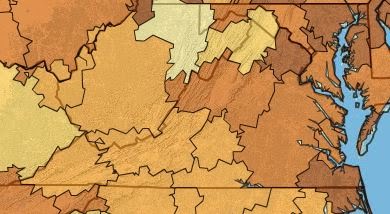
    So, how do we stack up in Virginia? First let’s look at the national map that shows the percentage of chronically ill patents who were treated by 10 or more physicians during the last six months of life:


    A quick glimpse shows that Virginia Medicare patients tend to use health care services somewhat more intensively than in other parts of the country. But there is variation within Virginia, too, as seen below. The two largest metro areas, Northern Virginia and Hampton Roads, are the most resource intensive, followed by the Richmond and Charlottesville hospital service areas, and lower rates in the less populated areas.
    The percentage of Virginians dying in hospitals likewise is higher than the national norm.

    Yet another map shows the variation in the average number of days spent in hospice care during the last six months of life. (Click on the map below to view a more legible image.) You’ll see that outside of Northern Virginia, hospice care has not made great inroads in Virginia compared to other parts of the country — although in another map, not shown here, Dartmouth shows that hospice care is clearly on the rise, though from a low base, in hospital service areas in the western part of the state.
    What are the barriers to hospice care in Virginia? Legal restrictions? Cultural resistance? Disinterest on the part of the medical community? The Dartmouth Atlas doesn’t answer those questions. But the project has done its job if it stimulates Virginians to do so.


  • The Wonk Salon: April 28, 2011

    For-Profits in Higher Ed: Delivering What Society Asks For
    American Enterprise Institute
    Don’t blame for-profit higher ed for low graduation rates and high student debt. Private colleges are doing what the federal government incentivizes them to do: Expand access and damn the consequences.

    Immigrant Children and the Path to Educational Success
    Urban Institute
    The discussion about education reform needs to take into account the special circumstances of young immigrant children, who comprise a growth percentage of the school population.

    Legalize Undocumented Workers, Don’t Deport Them
    Center for American Progress
    An Arizona-style “papers please” policy would devastate California’s economy but legalizing undocumented immigrants would energize it. The same logic (or illogic) holds true for Virginia.


  • Wytheville Community Makes the Cut (but Where are the Other Community Colleges?)

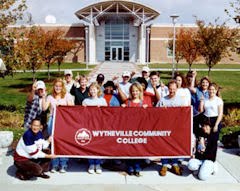
    Drawing upon on data relating to student success, the Aspen Institute has published a list of 120 community colleges across the nation that are eligible to compete for the Aspen Prize for Community College Excellence. Only one community college in Virginia made the cut. And it is (drum roll)….

    Wytheville Community College!

    That doesn’t say much about Virginia’s community college system as a whole. With a population of 7,750,000, Virginia is home to one out of 40 Americans. Proportional representation in the list of top community colleges suggests that we would have at least three represented.

    What, exactly, is being measured? Let me quote the Aspen Insitute:

    We looked at … graduation rates, retention rates, and the total number of degrees/certificates awarded relative to total enrollment, taking into account part-time students as well as full-time students. Using these measures, equal weight was given to overall performance, improvement, and performance by minority students. The selection process measured outcomes with a comprehensive set of data points that took into account the varied missions and populations served by community colleges.

    OK, there’s a touch-feely element to all of this. Aspen is not measuring the number of grads who go on to start their own IT start-ups, work for Wall Street or become millionaires. But it’s worth taking a look at the methodology, deciding if it measures something worthwhile and, if it does, ask why Virginia community colleges aren’t meeting Aspen’s standard of excellence.

    But don’t let that take anything away from Wytheville Community. Good going, guys!