• Our Immigrants Are Smarter than Your Immigrants

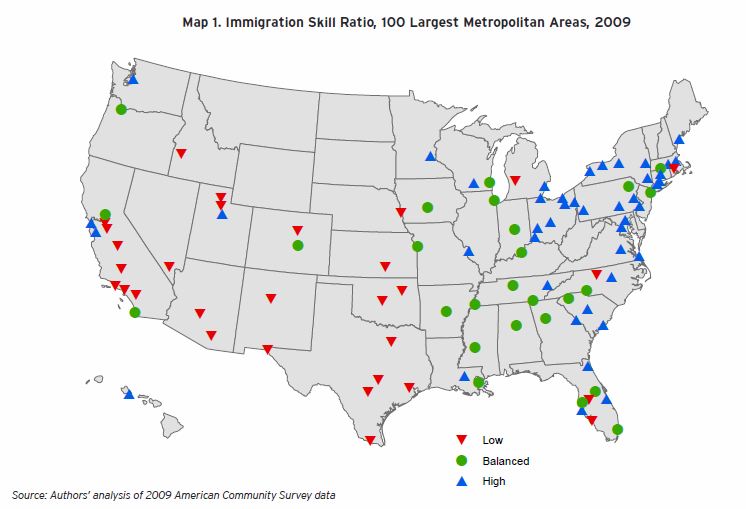
    Drawing upon 2009 U.S. Census data, the Brookings Institution has mapped out the ratio of high, moderate and low skilled immigrants in the nation’s 100 largest metropolitan areas. The good news for Virginia: All three of our major metros — Washington, Hampton Roads and Richmond — are among the 44 regions in which high-skill immigrants outnumbered low-skill immigrants.

    While the public stereotypes immigrants as being mostly low skilled (a stereotype that may be true in the case of illegal aliens), the share of working-age immigrants holding a bachelor’s degree has increased significantly since 1980 and now exceeds the share with less than a high school diploma.

    • Among Virginia metropolitan areas, Washington had the largest immigrant population in 2009 โ€” 1.1 million, representing 20% of the workforce. Some 375,000 of the immigrants are classified as โ€œhigh skilled.โ€
    • Hampton Roads had 98,000 immigrants, accounting for 5.8% of the population. Of those, 26,000 were classified as high skilled.
    • Richmond had 76,000 immigrants, representing 6.2% of the population. Of those, 22,000 were classified as high skilled.

    (Click on map for more legible image.)


  • The Wonk Salon, June 9, 2011

    Hard Child-Care Choices for Poor Working Families
    Urban Institute
    Problem: Poor, working parents have a hard time finding decent child care for their children. Solution: Increased federal funding for child-care assistance.

    Getting Buy-In for Medical Outcomes Reporting
    Robert Woods Johnson Foundation
    Making medical costs and outcomes data available to the public will drive the transformation of the health care sector. But first, Aligning Forces for Quality initiatives must develop appropriate metrics and persuade the public.

    How Business Can Drive Educational Reform
    Institute for a Competitive Workforce
    Public-private partnerships can help create change in American school systems. Businesses must remember that partnerships are a two-way street. They should press for accountability and results.


  • PSSST! Notice the Heat Outside?

    Holy Cuccinelli! In case you haven’t noticed, much of the U.S. is experiencing record summer heat and it’s only early June.

    A new study by Stanford University scientists say that hotter summers are something we’re going to have to get used to unless a lot more is done to limit atmospheric greenhouse gas concentrations.

    Middle latitudes in areas such as the U.S., China and Europe will see extreme summer shifts within 60 years unless steps are taken regarding global warming. Tropical areas in Africa, Asia and South America is will see “the permanent emergence of unprecedented summer heat,” the report says.

    Just to show the potential impact, in large parts of the globe, the coolest summers of the future will be hotter than the hottest summers previously. The Stanford scientists tracked 50 climate model experiments and ran computer simulations to come to their conclusions.

    Naturally, the climate change naysayers will likely say that the Stanford people are just an extension of the East Anglia scandal and should be ignored, or investigated for fraud and prosecuted.

    Maybe they should leave their air conditioning and step outside.

    Meanwhile, under pressure from business groups and conservatives, the U.S. does nothing to rein in carbon emissions. Any meaningful legislation has been scuttled. No carbon caps. No nothing.

    Just more accusations of fraud at the UN’s storage depot for climate change documents at a small British university. And, of course, Ken Cuccinelli and Bob Marshall with support from new, right-wing think tanks, continue to harass scientists who are saying humans have something to do with the changes.

    Maybe they better investigate Stanford, too. Another of its studies says that scientists alarmed about global warming tend to have higher academic qualifications than those who do not.

    Time to call the Cooch!

    Peter Galuszka


  • Bacon vs. the Utensils

    Sometimes, I worry about the aimless direction of our nation’s youth.Then along comes someone like Nicole Yoder and I feel reassured.

    One Saturday morning not long ago, Nicole’s father, long-time reader Keith Yoder, and her mother were discussing a Bacon’s Rebellion blog post at the breakfast table. (Perhaps I should be worrying about the aimless direction of adults as well.) Nine-year-old Nicole was fascinated by the term “Bacon’s Rebellion” and her fantasy took flight. This artwork was the result.

    Nicole, you may not realize it, not only is your rendering a fine piece of artwork but it is a brilliant piece of political allegory. The bacon strips represent the producer class of Virginia: the workers, the managers, the entrepreneurs — the backbone of society. The utensils represent the political class and special interests that feed upon the producer class. The bacon strips, you see, are tired of being eaten. The utensils want the bacon strips to just shut up and lay down. But the bacon strips are finally fighting back! That is exactly what Bacon’s Rebellion is all about. If I were your teacher, I would give you an “A” for this project.


  • The Dilemma of Discount Buses

    The tragic bus crash in Caroline County that left four dead May 31 raises several troubling points for travelers in Virginia and elsewhere.

    The first point, an obvious one, is that many of the cheap-fare buses that carry passengers from the downtowns of Southern cities to Chinatown in New York City are badly-regulated, fly-by-night operations that are dangerous.

    The second point, as an editorial in the Roanoke Times notes, is that the quick rise of such bus operations shows just how badly areas south of Washington, D.C. are being served with affordable and convenient inter-city transportation.

    Therein lies the contradiction. People want cheap transportation service. Entrepreneurial types, many Asian immigrants, are more than willing to provide it. Yet as deadly accidents occur, and regulations are tightened, so are operating costs, which negates the cheap fares that make the buses so attractive.

    So far this year, there have been at least 10 bus crashes resulting in 20 deaths and 130 injured people. After the Caroline County crash, Senators Jim Webb and Mark Warner called for tougher regulation, as they should.

    The Virginia accident apparently happened when the driver, who has been charged with four counts of involuntary manslaughter, fell asleep at the wheel, police say. As is typical for such bus operations, the driver left Greensboro, N.C. at 10:30 p.m. the night before bound for Chinatown and an early morning arrival.

    The federal Federal Motor Carrier Safety Administration was already considering shutting down Charlotte-based Sky Express, owner of the bus in the Caroline incident, before the wreck. The firm has been involved with four crashes involving injury or fatality and had been cited for letting fatigued drivers operate their buses on 46 prior occasions.

    The market for cheap-fare buses are typically people with low or fixed incomes. They can be immigrants visited relatives in New York, shuttle traders who got to New York or Philadelphia to buy goods for ethnic bodegas or restaurants or college kids who want to get to the Big Apple without paying much and are willing to catch the “China bus” at midnight in a downtown parking lot. There’s clearly a demand for the services that companies such as Sky Express provides.

    And there are few alternatives. Land use patterns especially in the areas south and west of Washington are car-centric and not everyone can afford a car. Or, if they are going to New York, parking is a big and expensive problem. Flying is out of the question. Many airlines shun smaller city routes like Greensboro or Richmond as they have ever since airlines were deregulated in the 1970s or charge exorbitant fares for short runs.

    Rail is a possibility. Amtrak was surprised at the robust ridership numbers it got after adding trains from Lynchburg to Charlottesville to Washington. But rail’s future is unsettled. The Obama Administration backs higher speed rail from D.D. to points south. North Carolina has already developed a decent in-state rail system to supplement Amtrak. Other than the Virginia Railway Express trains, Virginia’s passenger rail service is, in a word, lousy with on-time rates of about 50 percent. The administration of Gov. Robert F. McDonnell didn’t even apply for the latest round of federal higher speed rail funds, saying it couldn’t afford to meet the criteria. Conservative dogma shunning federal funding was a part of that decision.

    So, what we are going to get is more regulation which is badly needed. But it will make bus service less affordable to people who need it most. They have few to no alternatives.

    Peter Galuszka


  • Virginia: Home of the Mostly Free

    Good news and bad news from the Mercatus Center if you, like me, lean libertarian in your thinking. In Mercatus’ newly published “Freedom in the Fifty States,” which ranks the states on public policy affecting freedoms in the economic, social and personal spheres, Virginia ranks ninth most free in the country.

    Only ninth? In a state where the motto is “Thus Always to Tyrants?” Yes, only ninth. And we’re heading in the wrong direction. That ranking represents a decline of two slots since the last survey in 2007.

    But we can take some small consolation that we are less beholden to our political and bureaucratic overlords than most states on the East Coast. Remarkably, New Hampshire (motto: “Live Free or Die”) remains the freest state in the country — a beacon of light amidst the smothering Nanny State darkness all around it. Otherwise, the only other states east of the Mississippi that rank in the top 10 freest are Indiana and Virginia. Southern states tend to be free in the economic sphere, but more intrusive in the social and personal realms. Virgina follows that pattern, ranking 5th in economic freedom nationally but only 22 in personal freedom.

    Among the prime offenses in Virginia: aggressive asset-forfeiture laws, high liquor taxes, a high proportion of state/local employees in proportion to state spending, and extensive mandates for health insurance coverage.

    Mercatus’ analysis of Virginia is worth reproducing at some length:

    Virginia is, by our count, the freest state in the South. However, like the other states below the Mason-Dixon line, it fares better in terms of economic freedom (#5) than personal freedom (#22). The tax burden, government spending, and debt are all well below national averages. However, state and local government employment is essentially at the national average.

    Gun laws are decent, with much room for improvement. However, open carry is allowed. Marijuana laws are largely unreformed.

    Virginia is schizophrenic on education, requiring 13 years of mandatory schooling, including kindergarten attendance, and imposing significant standardized-testing and notification requirements on homeschoolers, but otherwise leaving both private and homeschools alone.

    The state has below average numbers of arrests for victimless crimes, and its drug law-enforcement rate is also quite respectable (especially among its Southern peers). However, Virginiaโ€™s asset-forfeiture laws could really be improved.

    As one might expect given its history with tobacco, Virginiaโ€™s cigarette tax is quite low and smoking is not banned in private workplaces. However, it does have some smoking restrictions. Moreover, its spirits tax rate is the third highest in the country. Labor laws are solid.

    Like Hawaii and Pennsylvania, Virginia has no form of community rating for health insurance. However, coverage mandates are extensive. Indeed, Virginia has more than just about any other state, adding significantly to the cost of insurance.

    Natural gas and cable have been โ€œderegulatedโ€ to the consumer. The state has one of the best liability systems in the country, and it has improved on eminent domain since the last edition of the index.


  • The Wonk Salon, June 8, 2011

    How to Rebuild the Institution of Marriage
    Heritage Foundation
    The institution of marriage, critical for raising healthy, productive children, is crumbling throughout the Western World. United States governments need to reform tax and welfare-policy penalties on marriage and promote stable homes instead.

    Natural Disasters Hard on Extended Households
    Rand Corporation
    Hurricane Katrina didn’t just demolish houses: It demolished families, especially the extended families of socioeconomically vulnerable inhabitants.


  • Is Kindergarten More than a Holding Pen for Toddlers?

    Does anyone remember former Gov. Tim Kaine’s push for universal pre-K childhood education in Virginia? I do. The aim was to level the disparities in educational outcomes by ensuring that “at risk” children enjoyed the same kind of early-childhood enrichment as their more privileged peers. It was a noble goal. As it turned out, budget constraints limited the scope of the initiative. But the dreams of Nanny Staters live on.

    Now comes research from Canada that calls into question the underlying assumption that pre-K is a good thing for the little tykes.

    In the early 1990s, the Canadian province of British Columbia conducted what social scientists call a โ€œnatural experiment.โ€ BC mandated a program called โ€œdual entryโ€ in which students would enter school at two different points in the school year rather than all at the same time. BC then abruptly canceled the program, with the result that some students were kept in Kindergarten for as few as 6 months while those only a few months younger were kept for 16 months. As a result, state the authors of a research paper, โ€œThe Long-Run Impacts of early Childhood Education: Evidence from a Failed Policy Experiment,” November-December children effectively started Kindergarten 4 months late while January-April students started 6 months early.

    The authors then tracked the subsequent educational achievement of the two age groups. In findings strikingly at odds with the prevailing sentiment that more early-childhood education is better, they concluded (my emphasis) that โ€œstarting Kindergarten one year late substantially reduces the probability of repeating the third grade, and meaningfully increases tenth grade math and reading scores. Effects are highest for low income students and males. Estimates suggest that entering kindergarten early may have a detrimental effect on future outcomes.โ€

    Further, the authors write:

    [The BC policy] approximate[s] the potential impact of introducing a pre-K program where one did not previously exist. Introducing such a program would increase time spent in school, which comes at the expense of time spent at home, and would also lower a student’s entry age and readiness. For both grade repetition and tenth grade test scores, the estimates imply poorer outcomes for children who participate in such a program.

    Will this research alter the thinking of people who believe as a matter of faith in the power of the state to cure the failings of dysfunctional families? No. But it may give pause to everyone else.


  • The Wonk Salon, June 7, 2011

    Foreclosure’s Forgotten Victims: The Children
    Urban Institute
    Families evicted through foreclosure often wind up in new school districts. Residential instability and school switching among children is associated with lower test scores.


  • Time to Measure “Educational Value Added”

    If a proven entrepreneur comes up with a great new dining concept, he has no problem finding the money to create a chain of restaurants. If a real estate developer discovers a profitable model for erecting shopping centers or residential communities, he can raise hundreds of millions of dollars to build more of the same. But public schools are different. Bad schools don’t go out of business, and good ones don’t grow.

    In the past decade or so, big-league philanthropists have tried to change that dynamic by underwriting promising charter schools with the goal of replicating their educational DNA and reproducing what works. We haven’t seen much of that in Virginia because only four charter schools operate in the state. But perhaps we could learn from the experience of other states.

    One thing we could learn from reading a new Cato Institute report, “The Other Lottery: Are Philanthropists Backing the Best Charter Schools,” is that the philanthropists may not be getting it right either. Focusing on California, which has the largest number of charter schools in the country, Andrew J. Coulson ranks charter school networks by performance in standardized tests (adjusted for student characteristics and peer effects) and the level of philanthropic support they generate. He finds that the three highest-performing networks rank 21st, 27th and 39th in terms of private grant funding out of 68 networks. โ€œThe results are discouraging. There is effectively no correlation between grant funding and charter network performance,โ€ he concludes. Philanthropic funding is like a lottery, with funds distributed randomly.

    Free markets work when failing business models go out of business and successful business models take their place. In public education, failing schools don’t go out of business — they get subsidized — and successful schools have no incentive, or means, to recreate what they do elsewhere. As a result, the system remains static and largely impervious to change. The beauty of charter schools is that they allow experimentation that would not occur otherwise. However, charter schools are hardly a panacea. Some charter experiments are successful, others are not.

    Research sponsored by foes of chartered schools suggests that on average, charter schools add no more value than traditional public schools. Putting the emphasis on average results obscures the fact that some charter schools are very good and others are failed experiments. The goal shouldn’t be to ban all charter schools, it should be to replicate the successes and retire the failures.

    The problem is the lack of a clearly defined “bottom line.” Businesses have a bottom line: Are they making a profit or not? Schools have no bottom line. How does one measure the success of a school? By standardized test scores? That’s not fair because students of diverse cultural and socio-economic backgrounds score differently for reasons that have nothing to do with the school. What schools need is a measure of educational achievement added, which adjusts for the background of its students and allows performance to be compared fairly. But even that is a tricky proposition, for the issues are so complex.

    Computing profits is not an easy thing to do. That’s why businesses have evolved Generally Accepted Accounting Procedures (GAAP). The educational system needs something similar, like Measures of Educational Value Added (MEVA), that has wide buy-in from educators and those who fund them.

    The existence of widely accepted metrics would allow philanthropists to base their funding decisions on more than personal relationships and self-serving data provided by school administrators desiring to look good. Such metrics also would allow state governments to compare the performance of school districts, school boards to compare the performance of schools and principals, and principals to compare the performance of teachers.

    Virginia was a leader in instituting standardized tests. Perhaps we could take the next step and become a leader in measuring educational value added.


  • June 4, 2011

    Integrating Community Colleges into Regional Economic Development
    Brookings Institution
    Regions should develop an integrated workforce and economic development strategy in which community colleges ensure a stable supply of skilled workers for employers.


  • How Land Use Regulation Contributed to the Housing Bubble and the Recession

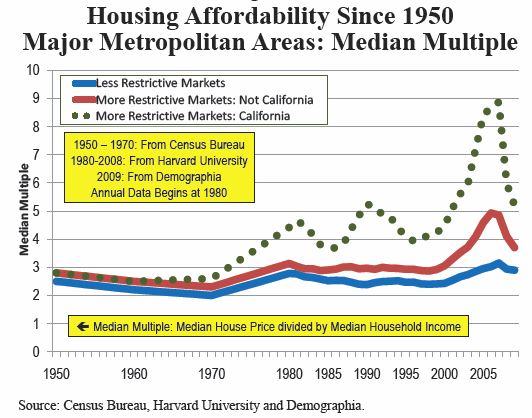
    There is general agreement that the housing bubble of the 2000s was fueled by a relaxation of mortgage loan standards that allowed many families to purchase homes they could not afford. Less well understood is that the housing bubble was not a โ€œmonolithic event,โ€ writes Wendell Cox in a National Center for Policy Analysis report, “The Housing Crash and Smart Growth.” The bubble varied widely by geography: Some markets saw extreme housing value increases, others saw very little at all.

    The key variable, Cox argues, was the extent to which land use regulations prevailed in different markets. By making it expensive to build new housing, regulations created scarcity that drove up house prices, which, when combined with looser lending standards, set off a speculative fever. โ€œAs the housing bubble developed,”he writes, “prescriptively regulated markets, including those in non-major metropolitan markets, accounted for 89% of the aggregate increase in house values. Conversely, 25 percent of homeowners lived in the responsively regulated markets, which accounted for just 11 percent of the aggregate value increases.โ€

    For the most part, Cox makes a sound case. It seems beyond dispute that (1) the intensity and cost of land use regulations varies widely from region to region, that (2) intrusive regulatory regimes make housing more scarce and/or more costly, and that (3) on average, regions where regulations were tightest saw the greatest increases in housing prices. The chart to the left tells the tale. (Click on chart to view more legible version.)

    I have one important bone to pick with Cox: the way he equates intrusive land use regulation with “smart growth.” The fact of the matter is, most heavy-handed land use regulation is the very opposite of smart growth. The dysfunctional human settlement patterns we have in Virginia (and much of the United States) are the direct result of zoning codes and comprehensive plans that mandate scattered, disconnected, low-density development in marked contravention of smart growth principles. Historically, these restrictions here in Virginia were the handiwork of anti-growth boards of supervisors who thought that they could reduce taxes and traffic congestion by smearing growth at low density over wide swaths of land and who resisted re-development in more compact, mixed-use configurations at higher densities.

    There is nothing inherently anti-growth about the smart growth movement, although anti-growth groups do often expropriate smart-growth rhetoric to advance their agendas. Further, I would add, “smart growth” comes in a variety of flavors, with some advocates eager to use the coercive power of government to impose their vision and others, like me, who are more inclined to rely upon market forces.

    With that significant caveat, I do agree with Cox’s conclusion that land use regulation has exacerbated housing scarcity and, accordingly, was an unappreciated contributor to the 2000-era housing boom-bust cycle that left our economy in tatters.

    Update: I hasten to add one more thought. Just as significant as the problem of metropolitan-wide overbuilding is the problem of maldistribution of the houses that are built. As EMR frequently reminds us, developers built too many houses in the wrong location within the region, typically on the metropolitan periphery. The price of those houses have declined the most.

  • The Film Subsidy Flim Flam

    The state of Virginia is spending $3.6 million in public funds and tax credits to lure the production of Steven Spielburg’s production of a movie about Abraham Lincoln to Richmond and Petersburg. State officials justify the subsidies on the grounds that it creates economic activity and jobs. But it may be an argument that fewer states are buying.

    Critics attack state tax credits for films on the grounds that the jobs created are mostly temporary positions, and they are often transplanted from other states. Moreover, a large portion of the benefit goes to the movie industry, not to local businesses or state coffers. In 2010, a record 40 states offered $1.4 billion in film and television tax incentives. But “2010 will likely stand as the peak year,” reports the Tax Foundation, “since many governors and legislators are ending their programs.”

    Eight states — Arizona, Arkansas, Idaho, Iowa, Kansas, Maine, New Jersey and Washington — have either ended, suspended or de-funded their film subsidies this year. Nine other states are scaling back their programs, studying cutbacks or have rejected efforts to expand their programs.

    Virginia is one the very few states to have increased its commitment to film subsidies.

    Hey, it’s fun to have movies filmed in town. I had a bit role as an extra in the filming of Gore Vidal’s Lincoln, starring Sam Waterston as Lincoln, about 23 years ago. (I survived the cutting-room floor. I played an office clerk, appearing in the background of a shot for a full two or three seconds.) But I don’t see any economic justification for the subsidies. Creating temporary film-production jobs does not contribute to long-term economic development, nor does it advance a strategically important industry. This is the kind of program we can do without as the nation slouches toward Boomergeddon.

    Update: I expanded this blog post for a column in Style Magazine. Read “Are we rolling out the red carpet for Spielberg’s ‘Lincoln’ — or are we bribing the producers to come here?”


  • The Wonk Salon, June 3, 2011

    Teacher-Leaders and Collaborative Teaching
    American Enterprise Institute
    Jack D. Dale, superintendent of the Fairfax County Public Schools system, lays out his vision for teacher-leaders and collaborative teaching, and describes a pilot project putting his principles into action.

    How Health IT Can Save the Healthcare System
    Bipartisan Policy Center
    There is a broad bipartisan consensus that health IT can enable desperately needed changes in the U.S. healthcare system, including new delivery models, payment reforms, prevention and wellness programs and insurance market reforms.

    Transforming Labor Relations in Pittsburgh Schools
    Aspen Institute
    Once upon a time, like two or three years ago, the Pittsburgh school system had “traditional, adversarial management-labor relations.” But a new spirit of cooperation reigns.


  • If You Build Prisons, Will they Come?

    News that Virginia is spending $700,000 a year to maintain a new but empty prison in Grayson County built at a cost of $105 million should be attracting the attention of budget cutters in the office of Gov. Robert F. McDonnell.

    The prison is one of 11 that have been shut down in the last few years because of a lack of prisoners. For whatever reason — the bad economy, demographic shifts or better policing — violent crime is down 5.5 percent nationally in the past year. In Richmond, once the
    nationโ€™s homicide capital per capita, crime is down 6.2 percent.

    So how did Virginians get stuck with so many unneeded prisons anyway?

    One place to look is George Allen, the former governor and senator who is now running for his old Senate seat. Back in 1993, Allen, a Republican, was running for governor behind Attorney General. Mary Sue Terry. So, Allen exploited what was seen as a very big issue back then — crime. Allen pressed the idea of making Virginia a tough-on-crime state, and he promised to end parole. And thatโ€™s what he did after he won the election. Plus, he led Virginia on a big prison expansion to handle the stateโ€™s fast-expanding prison population.

    Although the Grayson prison was built after Allen had moved on to the U.S. Senate, it is still part of his legacy.

    Peter Galuszka