• UVa Coughs up Mann Emails

    Del. Bob Marshall, R-Manassas, and the American Tradition Institute (ATI) won a circuit court order Tuesday ordering the University of Virginia to disgorge emails and other communications sent and received by Dr. Michael Mann, creator of the infamous “hockey stick” graph. The graph, which purported to show a dramatic spike in global temperatures in the late 20th century, provided vivid confirmation of the fears of many scientists that Global Warming is a real and accelerating phenomenon.

    Mann was one of the key players involved in the East Anglia Climate Research Unit scandal that did so much to discredit Global Warming alarmism a couple of years ago by showing how a small cadre of scientists manipulated data and used their clout to stifle opposing viewpoints from the U.N.’s supposedly definitive Intergovernmental Panel on Climate Change (IPCC) report. Now, Global Warming skeptics are hoping that Mann’s correspondence during his time as an environmental science professor at UVa will yield more embarrassing revelations.

    As ATI noted in its press release, “There … already appears — from records AT has received — to be additional information of the kind released in the ‘Climategate’ emails that originated from the Climatic Research Unit at East Anglia University.”

    UVa had stonewalled the release of the records for months, at one point denying that they even existed, and later insisting that ATI be charged in excess of $8,000 for copying and reproduction charges. The university also fought a parallel probe by Attorney General Ken Cuccinelli to gain access to the records in an investigation of possible fraud on Mann’s part in the use of state research funds.

    As of yesterday, ATI had received one fifth of the 9,000 pages that UVA says are responsive to ATI’s request. Most of what ATI has received so far is junk: “ads for Halloween costumes, public news releases from lay and scientific journals, and a few emails that were printed in computer code so as to be unintelligible in that form.” However, some material made it through UVa’s “filter,” stated ATI, which the institute will reveal to the public in the future.

    UVa has done itself no favors by its conduct in this matter. I am somewhat sympathetic to the university’s decision to fight Cuccinelli’s probe, which could be viewed as a politically motivated fishing expedition on the spurious grounds that Mann might have committed fraud in his use of state research funds. As sympathetic as I am to those who wish to expose Mann for committing intellectual fraud, not criminal fraud, I did fret that Cuccinelli’s action set a dangerous precedent for politicizing and criminalizing academic discourse.

    But releasing emails under Virginia’s Freedom of Information Act is a very different matter. The ATI is a private institute seeking information of a type that the University had released previously — specifically, the emails of Patrick Michaels, a Global Warming skeptic, under an FOIA request from a leftist group. The data will not be used to criminalize Mann but to expose any machinations in stifling opposing academic views that he might have been engaged in. Justice will be served, and it will be served in a way that does not involve the Attorney General’s office, which has no business being involved in a dispute of this nature.

    Now, I can only hope that UVa, my alma mater, does not become discredited by the ClimateGate scandal in the same way that East Anglia University in the United Kingdom has been. If administrators had simply handed over the emails, as they did in Michaels’ case, they would have avoided any taint if the emails contained scandalous content. But by trying to hush potential revelations, administrators will be seen as complicit with Mann and will be tarred along with him.


  • The Wonk Salon, May 25, 2011

    Reforming Virginia Health Care
    The Virginia Newsletter
    Federal health care reform will have a big impact on Virginia by 2014. Here’s what the state is doing to get ready for it.

    Reform the Healthcare Payments System
    Brookings Institution
    It is possible to tame rising healthcare costs without sacrificing quality: Change the payments system from a fee-for-service arrangement to one that rewards positive outcomes and incentivizes patients to seek health plans that offer value.

    The Funding of State and Local Pensions

    Center for Retirement Research
    Funding of state pension plans continued to deteriorate in 2010: The ratio of assets to liabilities fell to 77% and states made only 78% of needed payments. Meanwhile, states are making optimistic assumptions about future investment performance on existing assets.

    Asians in Virginia
    Weldon Cooper Center for Public Service
    As of 2010, Asians constituted 5.5% of Virginia’s populations. Asians are prospering here. Better educated than native-born citizens, they earn considerably more.

    U.S. Immigration Courts: An Exercise in Futility
    Center for Immigration Studies
    Federal immigration courts are a joke. Millions of immigrants never show up for trial. Judges are powerless. Unenforced removal orders now exceed 1.1 million.


  • Chart of the Day: Immigrant Assimilation by Birthplace

    Immigrants to the United States from Canada and the Philippines are the most assimilated of major immigrant groups, according to a new Manhattan Institute report, “Comparing Immigrant Assimilation in North America and Europe.” The report ranked populations based on measures of economic, cultural and civic assimilation.

    For the most part, the United States does a better job of assimilating immigrants than Europe, notes the author Jacob L. Vigdor, although Canada does the best job of all. Assimilation rates also vary within the U.S. by metropolitan area.

    Speaking of assimilating Asians, see the Weldon Cooper Center’s new statistical snapshot of the Asian population in Virginia. There are 400,000 Asians living in the state now, 5.5% of the population. Better educated than the native-born population, Asians also make significantly higher incomes.


  • A Reality Check for the “Jobs Governor”

    Just how successful is Bob McDonnell at being the “Jobs Governor?”

    The question gets more interesting week by week as Virginia struggles through the anemic recovery.
    Last week, the news was good. Some 213 new jobs were announced as International Paper reconfits its Franklin plant that it shut down with a loss of 1,000 jobs in 2009.This week, the news is bad. A major call center in Henry County will cut about 700 jobs by July.

    On so it goes. While McDonnell and his lieutenant governor, Bill “Jobs Guy” Bolling, scrounge jobs and trumpet their successes, others aren’t so upbeat, naturally, in a Democrat versus Republican kind of way.

    Democratic Delegate and General Assembly powerhouse Ward Armstrong of Henry County announced: “The McDonnell-Bolling Administration has been touting the creation of jobs throughout Southside and Southwest Virginia. But the Administration has not been able to create more jobs than have been lost. Unless that trend is changed, we will continue to go backwards.”

    Armstrong’s comment did not go over well with McDonnell’s staff, but it does point out just what a predicament parts of Virginia are in. There are two basic types of job losses. First are those related to the 2008-2009 recession. Second are those related to a much deeper-
    rooted problem involving Virginia’s transformation from old textile, furniture and tobacco jobs to more sustainable replacements.

    The sad story in Henry County actually covers both. In the early years of the last decade, places such as Danville and Martinsville were taking dramatic hits as huge, old-style textile plants such as Tultex and Dan River Mills laid off hundreds. Problem was, the replacement jobs came from firms such as StarTek, a Denver-based company that operates call centers around the country.

    Call centers are quick and easy to set up and don’t require all that much in worker retraining. But they are also the easiest and quickest to shut down when the economy goes bad. StarTek reported declining revenues of $5.2 millionin this year’s first quarter although it got a
    gross margin pop of 12.4 percent compared to 9.7 percent for the quarter the year before.

    It got that pop on the backs of workers. The firm laid off 69 at a Lynchburg call center in March and now 700 in Henry County.

    The International Paper plan to produce soft, wood-based pellets for insulation in baby diapers is good news, but it only brings back about one fifth of the original workforce. Terry McAuliffe, a Democratic politician, has plans for another company at the Franklin factory to employ some of the rest but it hasn’t happened yet.

    The bottom line here? Creating new jobs may be hard but they should be sustainable. And as blogger Norm Leahy writes in “The Score, the supposedly free-market-oriented McDonnell Administration is dipping into the age-old goodie basket of corporate socialism to aid firms.

    Bill Bolling, for instance, wrote recently In the Richmond Times-Dispatch, the ruling elite’s “Pravda,” that incentives were needed because states were hotly competing for jobs. Norm points out that, no, it’s not really states competing, it’s companies competing. And what one company gives, it can take away.

    McDonnell’s people loudly touted General Electric’s move to create 200 cyber security jobs in Henrico County. Somehow they didn’t mention the 200 jobs that GE has shed at a Winchester light bulb plant when it moved operations to Latin America.

    The state handed over $14 million in incentives for Northrop Grumman to move its HQ from Los Angeles to Northern Virginia, creating 300 jobs. But the same firm cut 700 jobs at Ft. Eustis and at its now sold off shipyard in Newport News. (I won’t mention the giant screwup with NG’s IT system for the state).

    Armstrong is right to ask for an overall tally of jobs.

    Peter Galuszka


  • “An Exercise in Economic Illiteracy”

    Over at the Score, Norm Leahy continues his battle against incentives or, as he calls it, “corporate welfare” by subjecting a recent op-ed piece by Lt. Gov. Bill Bolling to withering scrutiny. Read the blog post.

    There is so much to say on this topic, but I’ll let Norm carry the ball right now.


  • Cull the Deadwood from Higher Ed

    Where does one begin looking for deadwood to cut in higher education? The faculty, of course.

    Preferably, tenured faculty.

    Ideally, lazy, tenured faculty who are collecting paychecks while doing little actual teaching.

    A new study by the Center for College Affordability and Productivity examined teaching loads of faculty members at the University of Texas in Austin and found an extraordinary variation between professors. Conclude the authors:

    If the 80 percent of the faculty with the lowest teaching loads were to teach just half as much as the 20 percent with the highest loads, and if the savings were dedicated to tuition reduction, tuition could be cut by more than half (or, alternatively, state appropriations could be reduced even moreโ€”by as much as 75 percent).

    Some key findings:

    • 20% of UT Austin faculty are teaching 57% of student credit hours. They also generate 18% of the campusโ€™ research funding, suggesting that they are not jeopardizing their status as researchers by assuming such a high level of teaching responsibility.
    • The least productive 20% of faculty teach only 2% of all student credit hours and generate a small percentage of external research funding.
    • Nearly 100% of all research grant funds go to a small minority of faculty (20%).
    • Non-tenured track faculty teach a majority of undergraduate enrollments and 31% of graduate enrollments.

    If members of the General Assembly want to dig into the increasing unaffordability of public higher education in Virginia, a good place to start would be to explore the variation in teaching loads. Every institution has professors who more than carry their weight — and professors who, protected by their sinecures, significantly under-perform. Is the problem in Virginia as bad as it appears to be in Texas?

    If so, are we going to do something about it, or will we allow a protected class of professionals to coast while students load up on college debt and graduate as veritable indentured servants?


  • The Wonk Salon, May 24, 2011

    Cutting Women and Children First
    Center on Budget and Policy Priorities
    Proposed congressional cuts to the WIC nutrition program could deny benefits to between 325,000 and 475,000 eligible women, infants and children under five.


  • Bacon Down for the Count

    For what it’s worth: It appears that I can no longer post comments to my own blog. I get an “bX-rynfwe” message, whatever that is. Others who report that error message on Blogger’s forum appear to get no satisfaction. So, as much as I would like to respond to some comments, I am not able. Hopefully, the problem will go away as mysteriously as it appeared.

    Update: Larry Gross has reported that he cannot post comments either.


  • Who Is Dennis Martire?

    Who is Dennis L. Martire? For all the controversy over cost overruns in the Metrorail-to-Dulles project, his name has barely figured in media accounts. But he is the central figure in the decision by the Metropolitan Washington Airports Authority (MWAA) board to require a Project Labor Agreement (PLA) for Phase 2 of the multibillion-dollar construction project — a decision, critics say, that could add $300 million or more to the construction tab for the rail line.

    Martire, appointed to the MWAA board by Gov. Tim Kaine, is vice president and Mid-Atlantic Regional Manager of the Laborersโ€™ International Union of North America (LiUNA). Working out of an office in Reston, he runs a division that represents construction workers from Virginia to Pennsylvania. In line with official LiUNA policy, he also has been an active advocate of Project Labor Agreements (PLAs) for major construction projects.

    Under a PLA, the owner of a major capital project typically requires contractors to hire their workers from union hiring halls, contribute to union pensions, hire apprentices from union apprenticeship programs and abide by other measures that give union contractors an enormous advantage in the bidding process.

    Here’s the timeline: In 2006, then-Gov. Tim Kaine transferred authority for managing the Metrorail-to-Dulles project, along with the Dulles Toll Road, to MWAA. Three years later, in 2009, he announced the appointment of Martire to the MWAA board for a six-year term. At that time, Martire was a public advocate for PLAs, as evidenced in this document published in 2008. After joining the board, Martire became chairman of the Planning and Construction Committee.

    On April 6, 2011, the full MWAA board passed a resolution 11 to 2 requiring an estimated $2.5 billion to $3.5 billion worth of construction work on Phase 2 of Metrorail-to-Dulles to be subject to a PLA. One of the primary beneficiaries of the PLA likely will be LiUNA, Martire’s labor union, which represents lower-skilled laborers in big commercial construction jobs. LiUNA likely will collect hundreds of thousands or more in union dues as a direct result of the decision, and contractors and subs likely will pay millions of dollars into LiUNA’s union benefit plans.

    Final details of the PLA have not been published yet, however, and may not be until the RFP is released for bids, so it is impossible to know for sure what the document will require, says Ben Brubeck, director of labor and federal affairs for Associated Builders & Contractors, which has protested the PLA. Phase 1 of the Metrorail-to-Dulles project, which is currently under construction, is operating under a PLA agreement, which prime contractor Bechtel voluntarily entered into. But that agreement exempts “merit shop” (non-union) sub-contractors from its provisions. A draft of the Phase 2 PLA would would make the agreement mandatory, and it would provide no exemption for sub-contractors, Brubeck says. With those two provisions, the second PLA will be more pro-labor than the first — a remarkable union accomplishment in a Right to Work state.

    So, how did Matire come to Gov. Kaine’s attention? Why would the governor appoint someone with such an obvious vested interest to the MWAA board? Only Kaine can answer that last question with any certainty, but LiUNA’s track record as one of the biggest contributors to the Virginia Democratic Party surely entered into the calculus.

    According to the Virginia Public Access Project, the Laborers Mid-Atlantic Regional Organizing Coalition has donated $419,050 to candidates and political action committees since 2007 — overwhelmingly to Democratic candidates. Creigh Deeds, unsuccessful candidate for governor, scooped up $250,000. Moving Virginia Forward, Tim Kaine’s PAC, garnered $55,000. The Laborers International Union of North America kicked in another $200,000 to the Democratic Party of Virginia in 2008,

    Gov. Kaine, some may remember, wanted to appoint Danny LeBlanc, former chief of the Virginia AFL-CIO, to a cabinet-level position in his administration but was stymied by General Assembly Republicans who feared that the labor leader might undermine the state’s Right to Work law. Little did anyone imagine that Kaine would appoint Martire to MWAA or what the consequences would be. When Kaine announced the appointment, it seemed so routine that no one made note of it at the time. Only now, long after Kaine departed office, is the bill coming due. If critics are right in supposing that the PLA will add $300 million or more in project costs — not including the interest on long-term bonds — the citizens of Northern Virginia will be paying the price for a long time to come.

    Correction:
    I have amended this post to correct the statement that Martire’s appointment to chairman of MWAA’s Planning and Construction Committee “put him in a position to shepherd the PLA through the approval process.” In point of fact, the PLA worked its way through the Dulles Corridor Committee.


  • The Wonk Salon, May 23, 2011

    How to Get Effective Teachers in All Schools
    Center for American Progress
    The best teachers are distributed unevenly around the nation’s school systems. To reduce educational inequities, pay teachers more… and more equitably.

    Evaluating Patient-Centered Medical Homes
    The Urban Institute
    Patient Centered Medical Homes (PCMHs) are an emerging model for medical care. Lots of pilot projects are underway around the country. How do you assess different PCMHs to see how well they’re working?


  • Fix the Mix

    A “spatial mismatch” has emerged between the location of jobs and people in metropolitan America, argues a new Brookings Institution study, “Missed Opportunity: Transit and Jobs in Metropolitan America.”

    In a study of 371 mass transit providers in the nation’s 100 largest metropolitan areas, the authors find that nearly 70% of the residents of large metro areas live in neighborhoods with access to transit service of some kind. However, the typical metropolitan resident can reach only 30% of the jobs in their market via transit within 90 minutes. Access is particularly limited in Richmond, somewhat less so in Hampton Roads and superior in metropolitan Washington, according to data in the study.

    Transportation decision makers should make access to jobs an “explicit priority” in their spending and service decisions, the authors contend. “Metro leaders should coordinate strategies regarding land use, economic development and housing with transit decisions in order to ensure that transit reaches more people and more jobs efficiently.”

    Conceptually, Virginia regions have two broad options for reducing the jobs-people mismatch: extend existing transit service to areas now lacking it, with the likely consequence that they will run up larger operating deficits… Or change comprehensive plans and zoning policies to encourage a better balance of jobs, housing and amenities within areas already served by mass transit, thus generating more ridership and reducing the need for operating subsidies.

    Readers paying attention to Ed Risse’s call for “balanced” regions, communities and neighborhoods will immediately find this idea familiar. Ed’s critics deem the idea of achieving balance in more compact, walkable communities to be uncomfortably akin to social engineering. They forget, of course, that existing land use patterns are the result of social engineering as well, the difference being that social engineering since World War II has designed American communities around the goals of single-family home ownership and personal mobility by means of the automobile.

    I am agnostic as to whether automobiles are preferable to mass transit. Public preferences will change depending upon (a) the cost of gasoline, (b) the cost of automobile ownership, (c) the cost and convenience of mass transit, and (d) the general level of prosperity, among other factors. In other words, preferences will change according to circumstance. There is no single solution for all places and all times.

    How, then, do policy makers decide which is the best modal mix? They don’t. They let consumers make that decision — with one caveat, that they pay full locational costs associated with where they live and work. Roads and mass transit alike must pay their way through fares, tolls, user fees, and the capture of capture of increased property values created by the building of new transportation infrastructure. Create a level playing field and let the market decide. That’s not social engineering.

    According to the Brookings ranking of access to transit and employment, the Washington metro area scores in the Top 20 of the nation’s 100 largest regions, Richmond in the bottom 20, and Hampton Roads in the second-to-bottom 20. (Click on map for more legible image.)


  • Philip Morris and Alice in Wonderland

    It might seem like a simple question: Is it hard to quit smoking tobacco?

    For Philip Morris, past and present, it depends on what kind of barriers your corporate lawyers have erected.

    To Louis C. Camilleri, CEO of Philip Morris International, now conveniently based in Switzerland, the answer is no. While smoking is addictive, he admitted, “it is not that hard to quit.” Camilleri made the statement at PMI’s annual meeting in New York.

    Meanwhile, down in Richmond, at its annual meeting, Michael E. Szymancyk, CEO of Philip Morris USA, said that yes to both questions. “Because tobacco use is addictive and can be very difficult to quit, our tobacco companies help connect adult tobacco consumers who have decided to quit with cesssation information from public health authorities,” he told shareholders at Richmond’s convention center.

    Confused by this Alice in Wonderland doubletalk from what was once the world’s greatest cigarette maker? It’s just one of many contradictions.

    The two Philip Morris were split apart by corporate fiat and an army of corporate lawyers a few years back. The reason? The U.S. branch, now headquartered in Richmond, still makes cigarettes but tells you not to smoke them, yet it still makes a tidy profit by doing so. Last year, sales were $16.8 billion with net income of $3.8 billion.

    Philip Morris International, which sells tobacco products everywhere but the U.S, rakes in even more dough: $27 billion in sales and $7 billion in profit last year.

    The company split up was arranged to help block the U.S. version of Philip Morris from health-related lawsuits and for the American version to promote tobacco regulation by the Food and Drug Administration on terms favorable PM USA, in other words, in ways that lock in the dominant market share of its best-selling product, Marlboro brand cigarettes.

    While PM USA, now wonderfully separate, fights a holding action on U.S. soil, its one-time sister can hop sctoch the rest of the world selling even deadlier products. PMI has been testing a series of new โ€” some more potent โ€” tobacco products around the world.

    One is Marlboro Intense that was test-marketed in Turkey. A shorter version of the flagship smoke, Marlboro Intense has tobacco packed more densely so a smoker can get a quicker nicotine kick when time is of the essence โ€” say, eating out at a smoking-restricted restaurant or working in a smoke-free building. Another product, fatter cigarettes called Marlboro Wides, was test-marketed in Portugal in 2006. The following year, the company introduced Marlboro Mix 9, a high tar and nicotine cigarette, in Indonesia, where more than half of all males smoke daily.

    So, the, is it any surprise that Louis Camilleri, head of PMI, is going to say that it isn’t that hard to quit smoking while Szymanczyk says (oh, moan) that it is?

    The two companies are rich, well-run and deep-pocketed. Altria, owner of PM USA, buys favor by making major contributions to education, the arts, sports and culture. In Richmond, for instance, the decline or departure of a number of important companies has meant that just about two, electric utility Dominion and Altria, bankroll just about every community activity. And when the Virginia BioTechnology Research Park was floundering a few years back because it had little to show among its very large field of competing parks, newly-arrived Altria plopped down $350 million for a new research lab. Of course, they’re not about to tell you what goes on inside those lab walls.

    What’s still overdue, however, is a reckoning. The handwriting is on the wall for tobacco products, unless you are dealing with Third World types who live in smoking cultures and haven’t been elevated to the level of caring or understanding about health warnings. In this country, cigarette smoking is on the decline. U.S. tobacco farmers started going to through a major downsizing two decades ago. The days of making deadly products and then telling customers not to use them can’t last forever. Even smokeless tobacco has been shown to be dangerous as use disappoints its makers.

    It is “Oh So Richmond”, that the city (and the state) still bets on a losing horse. Not the first time, though. Look at 1861.

    Peter Galuszka


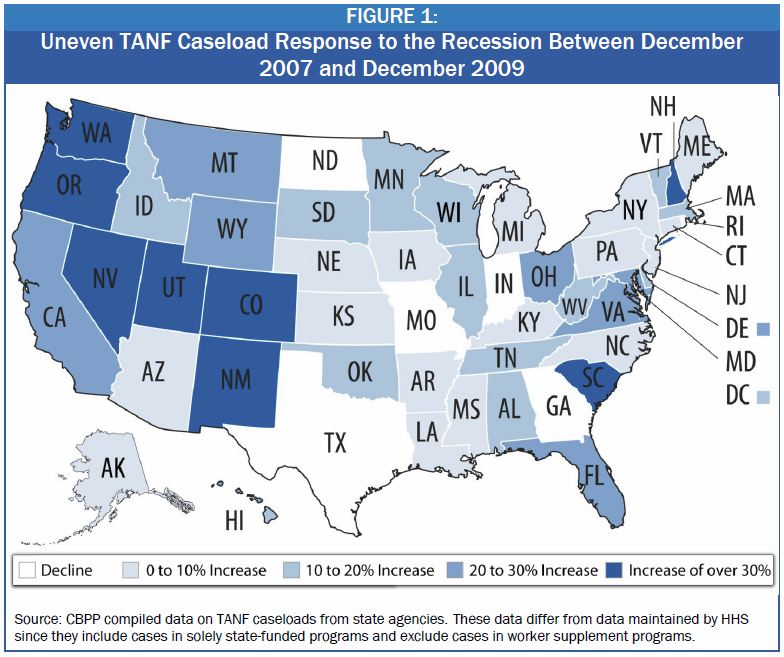
  • Infographic of the Day: TANF Caseload Increases

    Virginia saw a 20%+ increase in Temporary Assistance for Need Families (TANF) between 2007 and 2009. Some states are severely cutting back on their TANF programs, according to a report by the Center of Budget and Policy Priorities. Virginia is not mentioned as one of them.


  • The Wonk Salon: May 20, 2011

    The Redundancy in Federal Economic Development Programs
    Government Accountability Office
    Uncle Sam spends $6.5 billion a year on 80 economic development programs, most of which offer small business assistance. Bonus question: How much overlap is there between federal programs and Virginia’s Department of Business Assistance?

    Unintended Pregnancies Cost Taxpayers $11.3 Billion Yearly

    Brookings Institution
    And that counts only public spending on abortions, fetal losses, births and infant medical care.

    Comparing State Nutrient Trading Programs
    World Resources Institute
    Nutrient trading programs in the four Chesapeake Bay states should be harmonized to encourage more transactions between buyers and sellers in different states.


  • Why Does the IMF Have So Much Power, Anyway?

    The tale of Dominique Strauss Kahn would seem too lusty for an international thriller: The managing director of the International Monetary Fund and a member of the pampered Parisian elite is plucked from the first class section of an Air France jetliner just as it is about the leave the U.S. by New York cops who charge him with sexually assaulting a West African maid at his $3,000-a-night Sofitel hotel suite in Midtown Manhattan.

    Not even novelist Daniel Silva would go that far.

    But the situation is real. Strauss Kahn is in jail and has resigned his post in the IMF.

    That begs another question: just what is the IMF and what does it mean to us?

    It is a question I asked myself when I was Moscow bureau chief for BusinessWeek in the mid 1990s. I had been in that post before, in the 1980s, during the heady Gorbachev years and after a four-year job editing stories in New York on the international desk, I went back. The Communist system had fallen with breathtaking speed. Our adversary since 1945 had simply vanished without one nuclear warhead being detonated in anger.

    The historical upheaval was intriguing enough. But there was one more oddity. The most important foreign visitor to the Kremlin in those days was no longer the American president, in this case Bill Clinton. It was Michael Camdessus, another Frenchman who headed the IMF.

    The international and domestic media waited in earnest for Camdessus’s pronouncements after meeting with Russian President Boris Yeltsin and Prime Mininister Victor Chernomyrdin. Would the IMF approve another multi-billion tranche of funding to prop up the nascent but floundering Russian economy? What did the Russians agree to, in terms of shutting off their money printing presses and further tighting social spending, to meet with Camdessus’ blessing?

    The IMF was a creation of World War II designed to help facilitate a system of fixed exchange rates for global curencies so trade would not be impeded. That was a worthy post-war goal. A sister organization, the World Bank, was set up to help developing countries set up free markets and maybe democracies through bank loans. By tradition, the World Bank was always headed by an American and the IMF, by a European. Both organizations are headquartered in Washington and the U.S. government has heavily bankrolled both.

    Somehow along the way, the IMF’s role changed when the fixed exchange rate climate shifted in the 1970s. Without asking you or me, the IMF’s purpose suddenly shifted making short term loans to countries with sovereign debt issues, such as Greece now or Russia back in the 1990s.

    As travel and trade expanded and economices became more global, it seems that the IMF has been set up as some kind of new world government that average folk have no hand in electing. In the case of Russia, the IMF made decisions that affected, and, in fact, were enormously harmful, to ordinary Russians who woke up one day and found that the old Communist social system had gone away. The system had provided them with poor to middling cradle-to-grave services, usually doled out by state-owned enterprises.

    Suddenly the IMFers from INSEAD or Harvard were ordering the Russian government to clamp down on spending for their own people who had nowhere else to turn. It was as if a shadow, global and omnipotent government had suddenly taken control.

    I’ll never fogot what one young Soviet manager told me. He was a Party member who ended up at Harvard Busines School. He was shocked at how these glib, well-dressed foreigners stepped off the airplane at Sheremeteyevo and suddenly tossed millions of Russians even farther into poverty. While they struggled, and were confounded by a “voucher” system to privatize state-owned inudstries, a new class of oligarch sharpies took over. In time, the old “Siloviki” or power types from the KGB and Interior Ministries had regrouped as privatized power vendors and started running the oligarchs.

    So, we ended up with the Putins and the Medvedevs and it all comes to you thanks to the IMF.

    Strauss Kahn may be innocent, but the entire story is so strange that some elements are probably true. If they are, it reveals an overwhelming sense of arrogance, revealing that the real threat to liberty lies not in the White House or on Capitol Hill as many conservatives would have you believe. It could lie elsewhere.

    Peter Galuszka