• The Wonk Salon, June 21, 2011

    Virginia Rates A- in P&C Insurance
    Heartland Institute
    In marked contrast to the miserable performance of its schools (see previous post), Virginia rates an A- in the Heartland Institute’s ranking of the states by the freedom of its property and casualty insurance markets.

    Hawai’i’s P-3 Initiative: A First-Year Evaluation
    Rand Corporation
    Hawai’i’s P-3 initiative in two demonstration schools hopes to have all children reading by third grade. But the program is beset by lack of clarity about who does what and a lack of rewards for success or punishments for failure.

    State-Consumer Partnerships for Health Care
    National Academy for Health Policy
    The Southern Health Partners initiative, which includes Virginia, calls for closer ties between state officials and consumer advocates in devising state-level health care policy, especially in the creation of state health exchanges.

    Examining the Excise Tax
    Mercatus Center
    Excise taxes account for roughly 15% of states’ revenue. Virginia has relatively low excise taxes. The big revenue earner in the Old Dominion is the tax on gasoline, followed by insurance, alcohol, tobacco, public utilities and pari-mutuel betting.


  • How Bad Is the Virginia Educational System? Try This: Worst in the Country

    For the most part, Virginians are satisfied with their schools. There are pockets of excellence (the Thomas Jefferson School for Science and Technology in Fairfax County) and pockets of dysfunction (Petersburg city schools), but overall we do pretty well. Our educational achievements aren’t stellar, but they’re better than the national average. There is no groundswell for radically restructuring the educational system in the Old Dominion and there are few problems the political class believes that a little more money couldn’t solve.

    Now comes the 2010 State School Report Card published by the Heartland Institute, which should serve as a wake-up call. Nay, it should serve as a banging cowbell in our ears.

    Virginia didn’t merely rank below average in the analysis, which combined learning progress, fiscal efficiency and academic standards. It didn’t just rank in the bottom quintile. The Old Dominion tied with Arkansas for the bottom spot… dead last. Every member of the General Assembly, every school board member and every parent needs to read this report and then start raising holy hell.

    The abysmal performance of the Virginia educational system may not be readily apparent. After all, Virginia students outperform their peers nationally. But it is widely acknowledged that educational achievement is highly correlated to socioeconomic status, and Virginia ranks among the Top 10 states by income and among the bottom states by poverty. Given the demographic characteristics of the population, we would expect Virginia to out-perform other states by a wide margin. The real issue is what are the schools doing with the raw material handed them? What is (to borrow a phrase from a recent post), the schools’ educational value added?

    American students’ achievement scores on international test scores have stagnated even while the United States has pumped more money into education. Per-pupil spending has increased by more than 65% over the past 25 years in inflation-adjusted dollars. Meanwhile, achievement and money spent per pupil varies widely between the states. The purpose of this report is to identify the states that are achieving the most per dollar spent in the hope that other states might replicate whatever it is that they are doing right.

    Here is a synopsis of how the index is compiled.

    Learning. This sub-index is based on gains or loss in National Assessment of Educational Progress (NAEP) test scores for mathematics and reading between 2005 and 2009, measuring the progress of 4th graders in their march to 8th grade, or what the Institute calls time gain. The Institute also calculates a grade gain, which compares math and reading competency of 4th graders and 8th graders during the same year.

    Efficiency. This sub-index measures how much each state spends per student, adjusted for the state cost of living. The study examines cost per graduate, cost per student, cost per unit of learning gain over time, the cost of learning gain between grades, and the ratio of teachers to staff.

    Standards. This component incorporates a rating on how state proficiency scores compare to NAEP scores. “To the extent that a state claimed higher proficiency levels than the national test score results reveal,” the authors explain, “the state’s standard is taken as commensurately lower.” This index also includes a score based on a different methodology for calculating the rigor and content of a state’s math, reading and science standards.

    So, here’s how Virginia stacks up:

    Learning achievement … 43rd in the country

    Efficiency … 48th

    Standards … 32nd

    Overall .. 50th (tied with Arkansas)

    Unfortunately, say the authors, there is little empirical data to suggest why some states do well (Arizona scored first in the country) while others do badly. But they point to an index last updated in 2001 — the Education Freedom Index — for possible answers. This index measured the extent to which educational choice existed in a state, taking into account charter school options, subsidies for private-school choice, school choice within public school districts, and the regulatory environment for home schooling. By this measure a decade ago, Virginia ranked 44th in the country. (Interestingly, Arizona ranked No. 1.)

    In looking to explain Virginia’s dismal performance, consider: We have the fewest number of charter schools of any state in the country. We have zero vouchers. We have a highly centralized school system in which the state educational bureaucracy in Richmond dictates policies to local school boards. The only Educational Freedom measure by which we fare well, I believe, is the considerable latitude we give to home schooling. In other words, the Virginia school system is about as far removed from a market-based school system as anyone in the United States has managed to devise. It is less accountable to parents and more insulated from its failures. It is more hidebound, more rigid and more resistant to change than almost any other.

    The vast majority of widely touted educational “reform” initiatives in Virginia do no more than tinker at the margins. Our public dialog is bankrupt. Both the public and the politicians are in denial. There is no sign of meaningful change on the horizon. Fear for future generations.


  • The Wonk Salon, June 20, 2011

    Energy Star another Greenwashing Program?
    Government Accountability Office
    Undercover GAO investigators submit 15 phony products making outrageous energy efficiency claims, including “gasoline-powered alarm clock,” for certification. Most are approved. Conclusion, the program is ripe for fraud and abuse.

    Medicaid Expansion and the Physician Shortage
    National Bureau of Economic Research
    What happens when we expand Medicaid during a doctor shortage? Doctors spend less time with Medicaid patients.


  • One State, Eight Regions

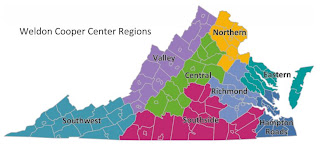
    Virginia is a surprisingly diverse state — not diverse in the multi-cultural sense, although that is increasingly true, but in the sense of having eight distinct regions. To provide a more accurate picture of how Virginia is changing, the Weldon Cooper Center for Public Service has published eight regional profiles based on the 2010 Census and American Community Survey. The researchers draw no broad conclusions, but the data makes interesting reading for public policy junkies. The eight regions include:

    Northern โ€ฆ 2,595,000 (32.4%)
    Hampton Roads โ€ฆ 1,641,000 (20.1%)
    Richmond โ€ฆ 1,167,000 (14.6%)
    Valley โ€ฆ 784,000 (9.8%)
    Central โ€ฆ 588,000 (7.3%)
    Southwest โ€ฆ 580,000 (7.2%)
    Southside โ€ฆ 505,000 (6.3%)
    Eastern โ€ฆ 141,000 (1.8%)

    Northern Virginia continued to dominate population growth during the 2000s, not only experiencing massive in-migration from other regions but undergoing a baby boom of sorts. Statewide, nearly six in every 10 births took place in Northern Virginia. The region gained more than half a million people, accounting for half the state’s growth.

    Hampton Roads, the state’s second largest metro area, was a mixed story demographically. The region gained 90,000 people during the decade but that was due only to its surplus of births over deaths. The region actually lost 25,000 people due to net out-migration.

    Richmond, the third largest metro area, gained 150,000 people during the decade, about one-third from births and two-thirds from net in-migration. The region saw significant percentage increases in its Asian and Hispanic populations, although whites and blacks still predominate.

    The Valley, which stretches from Roanoke to Winchester, experienced moderate population growth, about 75,000 people. Eighty percent came from in-migration, clustering mainly in the urban areas. Highland County, already the state’s least populated county, lost 200 people, or 8% of its population, during the decade.

    Central Virginia, which encompasses the central piedmont, gained 80,000 people over the decade, more than four-fifths of which was due to in-migration. Growth was concentrated around Lynchburg and Charlottesville.

    Southwest Virginia, which enjoys the distinction of being the “whitest” region demographically, added only 16,000 people during the 2000s. What’s remarkable is that the population grew at all, as the region had 3,500 more deaths than births. In-migration accounted for the difference. My hunch is that the bulk of the newcomers landed in Montgomery County, home to Virginia Tech.

    Southside Virginia also experienced a stagnant population. Deaths outnumbered births by 3,510, offset by modest in-migration for a net gain of 7,000 people. Given the economic hardships the region has experienced, it is remarkable that the region grew at all.

    Eastern Virginia, which includes the Eastern Shore, Middle Peninsula and Northern Neck, experienced negligible growth, about 500 people, during the decade. A trickle of in-migration (mostly retirees looking for Chesapeake Bay frontage, I’m guessing) offset the natural decrease of deaths over births.


  • Thanks, California, We’ll Take Your Cast-offs

    As California’s political class continues to demolish the Golden State’s business climate, private businesses are fleeing in record numbers. Virginia is one of the primary beneficiaries.

    Blogging as the “Business Relocation Coach,” Irvine, California-based Joseph Vranich has built a comprehensive database of corporate investment decisions based on public domain information, closure notices to the state and other sources. Last week he wrote that California was experiencing “the fastest rate of disinvestment events” since he put his tracking system into place three year ago.

    So far in 2011, through June 16, he had recorded 129 disinvestment events, compared to 51 during a comparable period last year. “Based on the legislature’s recent rejection of business-friendly legislation and Sacramento’s implementation of additional regulations, signs are that California’s hostility towards business will only worsen,”Vranich writes.

    He continues: “California is such fertile ground that representatives for economic development agencies are visiting companies to dissect our high taxes, extreme regulatory environment and other expenses to show annual savings of 20 and 40 percent after an out-of-state-move.”

    The top destinations of California businesses: (1) Texas, (2) Arizona, (3) Colorado, (4) Nevada and Utah tied, and (5) Virginia and North Carolina tied.

    I have written repeatedly over the years that Virginia should not build its economic development efforts on the platform of industrial recruitment alone — we need to develop our capacity to launch and grow home-grown enterprises. California’s fabled ability to nurture start-up companies will replace many of the businesses that are fleeing. The state can bleed for a long time without dying. But outside of privileged pockets like Silicon Valley and Hollywood, which have so much wealth and talent that they may be indestructible, state policies are laying waste to the economy. Virginia will happily welcome California’s refugees.


  • The Rail-to-Dulles PLA: a “Perception of Impropriety”

    Speaking of the Rail-to-Dulles project, it’s nice to see that I’m not alone in focusing on the Project Labor Agreement (PLA) that would require the prime contractor of Phase 2 to hire a union workforce, or the role of Dennis Martire, vice president of the Laborers’ International Union of America (LiUNA) in shepherding the requirement through the Metropolitan Washington Airports Authority (MWAA).

    Del. Tim Hugo, R-Fairfax, wonders if Martire violated the MWAA board of directors’ code of ethics by voting on a resolution that would likely benefit his labor union, reports the Reston Patch. Hugo has asked Attorney General Ken Cuccinelli to investigate whether his vote violated the code.

    Reporter Dan Telvock also interviewed Judy Nadler, a senior fellow in government ethics at Santa Clara University. She did not opine on whether Martire’s vote constituted a conflict of interest, but she did say that “a reasonable person” could argue that it was. “The perception of impropriety is as damaging as an actual impropriety.”


  • Scary New Idea: Pay for Rail-to-Dulles with State-Issued Bonds

    Here’s a terrifying idea: Make the Rail-to-Dulles heavy rail project cheaper to finance by letting the Commonwealth of Virginia issue its bonds. With its AAA credit rating, the commonwealth recently paid 4% interest rates on transportation bonds that it issued earlier this year. That’s a lot cheaper than the 7% to 7.5% the Metropolitan Washington Airports Authority (MWAA) would pay with its BBB rating.

    Issuing state bonds would save hundreds of million of dollars in interest payments and significantly reduce the money that would have to be raised from travelers along the Dulles Toll Road, argues John B. Wood, CEO of Telos Corporation in Ashburn and chairman of Loudoun County’s economic development commission. (Read his column in Leesburg Today.) “While Virginia does not have a legal obligation to back the MWAA’s bonds for rail development, it does have a moral obligation to do so-which in some ways is stronger.”

    Just one little problem. Issuing some $3 billion in bonds to pay for Rail-to-Dulles, a regional project, would crowd out Virginia’s ability to issue bonds for statewide priorities — schools, higher ed, parks, general transportation — without jeopardizing that very same AAA credit rating. We’re skating pretty close to our maximum borrowing capacity as it is.

    As for the state’s “moral obligation” to the project, my reaction is, “What moral obligation?” The question is very simple: Who pays for Rail-to-Dulles? The parties that benefit directly from the heavy rail line or the general public? Before we put the citizens of the commonwealth on the hook for the project, let’s (1) re-think the $300 million decision to build an underground station at Dulles airport, (2) drop the requirement for a union workforce, which potentially could cost another $300 million, (3) slap tolls on the toll-free Dulles Access Road, (4) get MWAA to pony up its fair share of the project, and (5) extract a reasonable share of the value created for property owners whose is located adjacent to the proposed Metro stops.

    If the parties that benefit the most from Rail-to-Dulles aren’t willing to curtail their appetites and pay for the project, how dare they assert that anyone else has a “moral authority” to pay for it?


  • The Wonk Salon, June 17, 2011

    Schools Trying to Create a Health Environment but Have Long Way to Go
    Robert Wood Johnson Foundation
    Schools have gotten the message they need to provide better nutrition to their pupils, but most kids still have access to pizza, fries, soft drinks and other junk food.

    Transportation in an Age of Fiscal Austerity
    Bipartisan Policy Center
    How federal transportation policy can subsist on $40 billion a year: set smarter priorities, consolidate programs, leverage state and private funds.

    Coordinating Child Services
    National Academy for State Health Policy
    A five-state collaborative is testing new models for coordinating social services targeting children across departmental silos. The goal: Reduce delays and avoid duplication of services.

    Causes of Civic Ignorance
    American Enterprise Institute
    Everybody bemoans the civic ignorance of American youth but no one agrees about what schools need to emphasize. There are sharp divides between Republicans and Democrats, and between teachers and citizens at large.


  • June In Paris, Courtesy of Virginia Uranium

    Virginia Uranium Inc., a tiny Chatham-based firm that wants to mine uranium in south central Virginia near Gretna, is flying more than a dozen state legislators to France to drum up momentum to end the state’s ban on uranium mining in next year’s General Assembly.

    The lobbying effort includes all-expenses paid and three days off in Paris so the legislators can visit a closed uranium mine in the city of Bessines in western France where uranium was extracted for a half a century before shutting down in the late 1990s.

    Virginia Uranium’s chutzpah is stunning. The four-year-old firm, led by a former Army and Foreign Service officer with no experience in the nuclear industry, had invited all 140 state legislators and most wisely declined. Legislators taking the trip this week include L. Scott Lingamfelter (R-Prince William), Del. Mark D. Sickles (D-Fairfax), Sen. Mamie E. Locke (D-Hampton), and Del. William R. Janis (R- Goochland.) Sickles told The Washington Post that he is paying his own airfare and lodging.

    The pitch, in a word, stinks. If state legislators want to educate themselves about uranium mining, that’s commendable. But signing up for $10,000 or more in free travel expenses, although allowable under Virginia law, raises big questions about their integrity.

    There’s something fishy as well about Virginia Uranium. Walter Coles, whose family owns Coles Hill, a uranium-rich farm dating back to the 18th century, runs the company with another local family represented by Henry Bowen of Sehva. The properties they own near Gretna and Chatham could have 110 million pounds of uranium.

    It isn’t the first time that companies have sought the Coles uranium tract. Marline Uranium Corp., a subsidiary of Marline Oil Company, started exploring the Coles property in 1977, announced a big uranium find in 1982 after drilling 210 holes. Yet the plan was stymied by uncertainties about the global uranium market and strong opposition from environmental groups. Cities in Hampton Roads also raised pointed questions because they get much of their drinking water from big lakes just downstream of the property.

    Coles and his team have no experience in either the nuclear industry or minerals mining. A graduate of Fork Union Military Academy and the Citadel, Coles worked for a furniture company before serving with the Army in Vietnam. He later spent 30 years working for the U.S. Agency for International Development specializing in privatization and land reform programs for the State Department. None of the other members of Virginia Uranium’s board has any mining or nuclear experience either. Most are lawyers or investment bankers.

    The firm raised $2.38 million of a targeted $4 million in equity financing earlier this year, according to a filing with the U.S. Securities & Exchange Commission. That was just a few weeks before a tsunami inundated the Fukushima Daiichi nuclear power station in Japan causing the worst nuclear disaster since Chernobyl.

    The disaster raised questions about the future of global nuclear power and the need for uranium. Germany, for instance, has announced that it will be shutting down all of its commercial nuclear power stations within a decade or so.

    Add it all up and one wonders what is going on down in Chatham, or for that matter, in the bars and restaurants and hotel rooms of Paris.

    Peter Galuszka


  • Can Sean Connaughton Keep Rolling Along?

    Virginia Transportation Secretary Sean Connaughton is popping up everywhere. He has successfully pushed a plan to add $3 billion in road construction money that he just borrowed on the capital markets. He’s in Sunday’s Washington Post telling us how his boss, Gov. Robert McDonnell, really has passenger rail at heart even if he won’t go after federal money to boost that prospect. And, he’s pushing along with public-private plans for a new U.S. 460 linking Interstate 95 to Tidewater and for the Coalfield Expressway near Kentucky and West Virginia.

    Indeed, Connaughton might be the rare bright bulb in McDonnell’s Administration that has been dogged by failures such as privatizing liquor stores and getting offshore oil drilling pumping.

    The former Navy and Coast Guard officer was chairman of the board of supervisors in Prince William County and spearheaded a drive to have the county build its own roads after feeling stiffed by VDOT.

    Connaughton pushed forward with getting nearly $3 billion in additional road construction money for 2012-2017 by taking advantage of the dirt cheap interest rates available in private capital markets. That will be part of a $10.6 billon construction program that should push ahead 900 projects including roads, rail and bicycles. It is a 36 pecent increase in funding over the previous funding timeframe.

    Still, the plan has its critics, including Stewart Schwartz of the Coalition for Smarter Growth who laments that the spending plan duns maintenance needs and comes when other sources of revenues, such as gasoline taxes, are weakening. Schwartz also questions Connaughton’s pushing an outer beltway in the Northern Virginia suburbs as if sticking another exurban-sprawl highway will somehow alleviate NOVA’s already horrid congestion on the existing Beltway and I-95.

    On rail, Connaughton tried to put a happy face on McDonnell’s refusal to seek about $2 billion available for higher speed rail after Republican Gov. Rick Scott of Florida declined funding for an Orlando to Tampa higher speed rail route.

    Connaughton claims that Virginia couldn’t meet a required deadline for an environmental impact statement — a less than credible excuse — so not applying for the money was the smart thing to do. Rest assured, he tries to tell us, that McDonnell is really a choo-choo guy at heart since he has pushed along popular Amtrak routes from Lynchburg and Richmond to Washington. Too bad he got his facts wrong. The Lynchburg trains were done during the administration of Democratic Gov. Tim Kaine.

    And Connaughton doesn’t reveal that one reason McDonnell dissed the Obama rail money is because he wants to join the steady GOP chorus now warning us of the perils of deficit spending, something they didn’t bother to do when George W. Bush was president. Oh well.

    Like most conservatives and Democrats, too, Connaughton really pushes public-private partnership deals which would help the U.S. 460 plan and the Coalfields road. Schwartz and smart growthers say that the 460 plan is unneeded and will just spur questionable growth patterns through the peanut lands of Surry and Southampton Counties.

    Ditto the Coalfields Expressway, although I personally have been out that way a lot recently and can understand why better roads are essential. Once one goes west of U.S. 19, it suddenly takes forever to get anywhere, such as a hospital emergency room. I ought to know, because I lived just west of U.S. 19 in West Virginia when I was a boy.

    As far as Connaughton, one has to say he is seizing the initiative. It may not please everyone, but it’s a lot better than McDonnell claiming he’s getting a budget surplus through smoke and mirrors stunts such as delaying state pension fund payments.

    Peter Galuszka


  • Supercomputers for Southside

    Now this gets my attention! As a follow-up to my recent post, “The Brutal Facts Facing Southside and Southwest Virginia,” let me bring to your attention today’s press release from the governor’s office announcing the creation of a Center for Applied High Performance Computing in Danville.

    Noblis, a non-profit scientific organization, and Cray, Inc., a manufacturer of supercomputers, will invest $2.5 million to establish the center. The mission will be to promote development of high-performance applications to solve “problems of national importance,” help small businesses innovate using high-performance computing applications, and train the next generation of developers, among other goals.

    At least for a time, the Center will be the only non-federal lab or university to house a next-generation Cray XMT. “This kind of high-performance technology research center is truly transformational for the City of Danville and the Commonwealth of Virginia,” said Gov. Bob McDonnell.

    On the plus side, this is exactly the kind of transformational initiative Southside Virginia needs to pole vault out of its manufacturing-centric mill town economy to a Knowledge Economy economic base. So, congratulations to Danville.

    On the other hand, one cannot help but question the economics of this initiative. The $2.5 million in private investment will be matched by $4 million in public investment — $1 million from the Governor’s Opportunity Fund and $3 million from the Virginia Tobacco Indemnification and Community Revitalization Fund. When $1 of public investment leverages less than $1 in private investment, the state is not getting much of a return on its investment.

    A question: Who will staff this center? Is anyone in Southside Virginia trained to operate the Cray XMT supercomputer? Does anyone have the know-how to write the equations and functions required to solve “complex national problems”? Or will that talent have to be imported from outside the region? Assuming that the Center is to serve as the nucleus of a growing industry, does Danville have what it takes to recruit and retain high-caliber IT talent?

    I worry that this initiative may never become self supporting and will require a steady transfusion of outside funding. I hope I’m wrong. There’s nothing I would like more to see than Danville defying the odds and transforming itself into a mini-technology center.


  • Suck It Up Exxon, Your Profits Are Pitiful Compared to Higher Ed Profits

    Higher education is a highly profitable business. That applies not only to “for-profit” colleges like the University of Phoenix, which reported a 30% operating profit margin in the first quarter of 2011, but the so-called “nonprofits.”

    How can a nonprofit have a profit? Economically speaking, as Vance H. Fried with the Cato Institute argues in a new policy analysis, “Federal Higher Education Policy and the Profitable Nonprofits,” when a nonprofit’s revenue exceeds the cost of providing a service, in this case undergraduate education, it’s a profit.That profit does not show up in the financial report of your alma mater because profits are recorded as expenses. “Nonprofit schools,” he writes, “take their profits from undergraduate education … in the form of spending on some combination of research, graduate education, low-demand majors, low faculty teaching loads, excess compensation, and featherbedding.”

    Fried sees two types of profit. The first consists of payments to college insiders that do not increase college outputs: excess compensation and featherbedding primarily. The second is subsidies for missions unrelated to undergraduate education, such as graduate education and research.

    How, then, does one gauge the profitability of a nonprofit university? One is the “build up” method, which starts with a blank piece of paper and creates a detailed pro forma statement of operating costs for a hypothetical institution. In one exercise, creating the fictional 3,200-student College of Entrepreneurship and Leadership in Society entailed operating costs of $6,705 per pupil.

    A second approach utilizes real data reported by colleges in several states. Actual costs for an undergraduate education range from $7,080 in Florida and $7,980 in Illinois to $11,040 in Ohio. If we assume costs averaging $8,000 per student, says Fried, tuition revenues alone imply a profit of $5,500 per student at undergraduate institutions. When donations and endowment income are added, profits jump to $12,800 per student. As Fried wryly notes, “That’s more than a 60 percent profit margin per student — double the margin of for-profit Phoenix.” (By point of comparison, oil giant Exxon Mobil’s profit margin was 9.6% in the most recent quarter.)

    While public institutions charge lower tuition than private colleges, they also enjoy substantial state support. Here’s a question for Virginia policy makers. What is the purpose of public support? Presumably, it’s to make an undergraduate education more affordable for Virginia residents. The objective is not supporting graduate programs or even subsidizing university R&D, as desirable as those things may be.

    If Fried’s analysis is correct, and if we use $8,000 as a benchmark cost of providing an undergraduate education, then undergraduate students in public Virginia universities are a ginormous profit center. According to the State Council of Higher Education in Virginia, tuition and mandatory fees in 2010-2011 for undergraduate student amounted to $8,830 at senior institutions (and considerably less in community colleges) on average. That doesn’t include state support, which covers 55% of what universities say it costs to educate an undergrad. These rough numbers suggest that undergraduate tuition and state assistance are subsidizing salaries, administrative bloat, low faculty teaching ratios, graduate education, R&D, economic development and other extraneous missions to the tune of $9,000 a year.

    Maybe Fried’s assumptions aren’t quite accurate — maybe the subsidy is less than $9,000 a year. Maybe it’s mission critical for Virginia universities to support national-caliber graduate schools and research programs. Maybe the state would support those endeavors if called upon to do so. The problem is a lack of transparency. Citizens and policy makers don’t know how much it costs to educate an undergraduate student, and we don’t know how much money is being captured for the benefit of other campus interests.

    It’s time we find out. It’s time we find out how badly the sheeple are getting sheared.


  • The Wonk Salon, June 16, 2011

    How Uncle Sam Can Drive Education Reform at the Local Level
    Center for American Progress
    Congress should reauthorize the Elementary and Secondary Education Act to make the federal government a stronger catalyst for reform of local school systems.

    Save Southern Forests by Taxing on Basis of Current Use, not Market Value
    World Resources Institute
    Rising property taxes resulting from encroaching development push private owners of forest land into selling property to pay their tax bills. Taxing on the basis of current use, not market value, would ease the pressure.

    Fighting Organized Retail Crime
    Government Accountability Office
    Retail chains are collaborating with online marketplaces like e-Bay and law enforcement authorities to combat organized shoplifting and fencing.

    Doing More with Less in Special Education

    American Enterprise Institute
    Special education spending has risen to an unsustainable 21% of total education spending. Educators need to re-think they way the approach special ed, especially labor-intensive but ineffectual teaching models.


  • The Invisible Parking Glut

    There is one very important benefit to building roads and parking spaces: They facilitate travel by automobile. Cars are a wonderful convenience. The personal mobility afforded by automobiles ranks so high in the list of fundamental human desires that people in developing countries around the world purchase cars as soon as they can afford them. Automobility is one of the great blessings of contemporary civilization.

    But there are hidden costs to building all that impervious surface, and Todd Litman with the Victoria Transport Policy Institute has cataloged most of them. Roads and parking add to the cost of land, public facilities and private housing stock. They create “suburban sprawl,” or disaggregated, low-density development, which leads to excessive gasoline consumption and carbon emissions. They increase waste water run off, add to water pollution, reduce open space and create urban heat-island effects. And the list goes on.

    What especially gripes Litman in an article published in Environmental Practice, “Why and How to Reduce the Amount of Land Paved for Roads and Parking Facilities,” is that the excess supply of paved surface is the result of conscious government policy.

    The optimal amount of roads and parking is the amount, Litman argues, that “could be financed if travelers had reasonable transport options … and paid all direct and indirect roadway costs [and parking costs] through user fees.” Mandating parking spaces reduces the incentive for employers to explore alternative solutions — arranging to use a nearby church’s parking lot during weekdays, for instance, or encouraging employees to ride share.

    Most current planning policies are predicated upon the axiom that it is desirable to maximize road and parking supply. “Most communities have zoning codes that require generous minimum parking and roadway supply,” Litman writes. As a result of over supply, “many parking facilities are frequently under-used.”

    Litman enumerates several strategies that would enable communities to reduce the acreage of impervious surface. He covers the gamut from better streetscaping to setting prices for paid parking, from parking taxes to improved facility design. They are all ideas worthy of consideration.

    What Litman inexplicably does not list is a recommendation for getting local governments out of the business of mandating parking requirements in the first place. Wal-Mart executives know how many parking spaces to place around their stores — they don’t need local zoning boards telling them their business. Let office-park tenants trade off the cost of “free” parking (which isn’t free, but bundled into the price of their rent) with the cost of implementing a Transportation Demand Management Plan. Let market prices allocate scarce parking and transport assets. Unleash human creativity.

    Litman contends that the space set aside for impervious space can be reduced by 20% to 40% by applying cost-effective transport and parking-management strategies. In turn, shrinking asphalt acreage by that amount would allow offices, stores and houses to be located closer together, making more destinations accessible by foot, bike or mass transit. Always remember: “Sprawl” is not the result of untrammeled markets and insufficient planning. It is the result of too much and the wrong kind of planning.


  • The Wonk Salon, June 15, 2011

    Proposed EPA Clean-Air Rules Expensive, but Worth It
    Bipartisan Policy Center
    A slew of regulations under consideration by the Environmental Protection Agency will require significant investments in the electric power system but the benefits to the environment and public health exceed the compliance costs.

    The Role of Research Universities and Labs in Manufacturing Competitiveness
    Council on Competitiveness
    To stay competitive, U.S. industries need to increase their innovative edge by building economic ecosystems that include universities and research labs in the process of researching and commercializing new technologies and products.

    Beware Medical Studies that Focus on Race
    Center for American Progress
    Considerable medical research uses race as a criteria for studying disparities in medical outcomes. But “race” is a social construct, not a scientific one. The research preoccupation with race can perpetuate harmful assumptions about racial groups.

