• Federal Transportation Policy: A Net Destroyer of National Wealth?

    by James A. Bacon

    “The U.S. highway trust fund is broke,” declares a new report, “Road to Recovery,” published by the Carnegie Endowment for International Peace. If you include deferred maintenance, the U.S. surface transportation system added between $103 billion and $175 billion annually to the national deficit in recent years.

    The United States is one of only aย  few countries in the world where revenues raised to support the federal transportation system do not cover costs. Revenues represent only 62% of surface transportation expenditures — compared to 100% or more among all other members of the Organization for Economic Cooperation and Development. And that doesn’t even take into account the U.S.’s bad habit of deferring maintenance, which can increase upkeep to as much as $800,000 per lane-mile over the life of the road.

    The report makes another important point: “The rate of economic return from investment in highway infrastructure in the United States has been approaching the long-term interest rate (cost of capital) since the 1990s. Once the rate of economic return meets the long-term interest rate, it becomes equally beneficial to keep invested capital in the private sector, a clear signal that those investments could be without merit. At that point, the system no longer delivers the benefits necessary to justify public funds.” (Click on graph below for more legible image.)
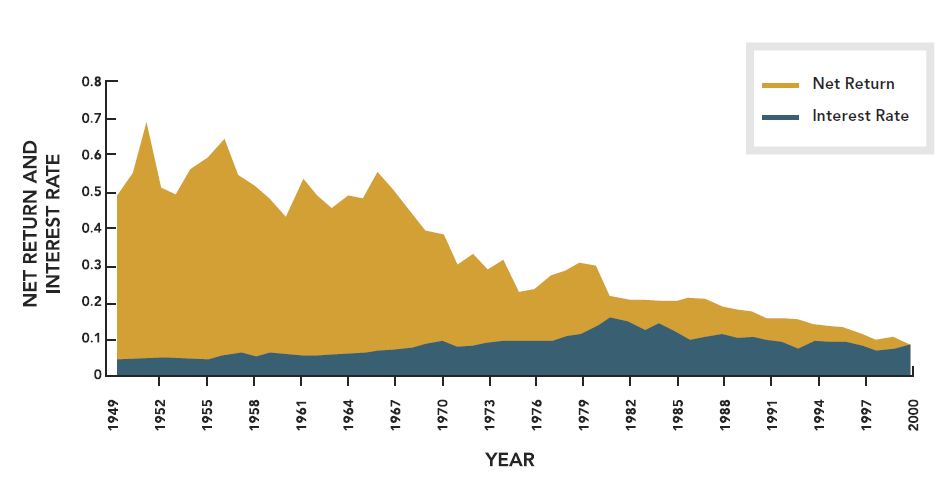
    Net ROI in transportation compared to long-term interest rates

    Put in the starkest of terms, the U.S. is spending too much on new road/highway construction and too little on maintenance. The Carnegie report doesn’t put the point quite this baldly, but it’s entirely possible that the federal government’s transportation policies could represent a net destroyer of national wealth!

    Such madness should come as no surprise. As the report also says, “While the country suffers the effects of an increasingly degraded and under-performing transportation system, investment decisions on the nation’s transportation system haveย  become increasingly unfocused, short-term and highly politicized.” In 1987, President Ronald Reagan vetoed a transportation funding bill because it contained 100 earmarks. In 2005, President George W. Bush signed a funding bill containing 6,229 earmarks.

    How, then, do we fix this broken-down system? The authors advocate assessing a 5% ad valorem tax on oilย  production and imports when the world oil price is rising and a tax on retail gasoline sales when the world oil price is falling. The idea has some merits, although I’m not entirely persuaded. What fascinates me most is the report’s discussion of the true cost of federal transportation policy.

    The authors tote up the following when calculating how much the U.S. is underfunding its transportation system (figures are from the “high” scenario): $85 million in deferred maintenance, $20 billion in federal General Fundsubsidies, $40 billion in hidden budgetary costs paid by agencies other than the U.S. Department of Transportation, a $29 billion productivity loss from sub-optimal investment, and interest payments on debt from General Fund expenditures.

    What concerns me most — because it is a problem that Virginia shares — is deferred maintenance. States the report:

    Studies have found that spending $5 million on preventive maintenance can save $100 million to $500 million in rehabilitation and reconstruction costs. Although postponing maintenance may appear inescapable given the current shortfall of transportation funds, this deferred maintenance will cost America dearly; projections place its cost at a staggering $5 trillion by 2035 (in 2010 dollars). It is estimated that it would cost three times the transportation systemโ€™s $1.4 trillion present asset value to replace it if it were not kept in a state of good repair.

    In case you missed it, I refer you to my recent discussion of life cycle budgeting, which encompasses both the up-front capital costs of transportation projects and long-term maintenance costs. The Commonwealth Transportation Board is scheduled to discuss “local maintenance programs” in its upcoming meeting this Wednesday. I will be interested to see how presenters frame the issue.


  • The Wonk Salon, August 29, 2011

    Only 10 Years Old and Homeland Security Needs an Overhaul
    Heritage Foundation
    George H.W. Bush made 43 FEMA disaster declarations. Barack Obama has issued 144 in the first six months of 2011. America has over-federalized disaster response in a way that threatens the resiliency of the nation’s communities.

    Less Educated Workers Still Losing Jobs
    Urban Institute
    For high school drop-outs, the recession never ended. Since the economic recovery began, a net 10%ย  of Americans without high school diplomas have lost their jobs.


  • Metro Washington Foreclosure Rates: A Tale of Two Trends

    This map published by the Urban Institute’s “Washington, D.C. Metropolitan Foreclosure Monitor” displays foreclosure rates across the Washington metro area. The data appear to reflect two broad trends.

    First, the foreclosure rate increases with the distance from the metropolitan core. Arlington has the lowest foreclosure rate in the region, followed by Alexandria and Fairfax County. Likewise, the affluent, largely white, zip codes in northwestern Washington, D.C., also have a very low foreclosure rate. Outlying jurisdictions such as Spotsylvania and Warren counties in Virginia, Charles County in Maryland and Jefferson County in West Virginia have among the highest foreclosure rates. This reflects the fact that property values have held up better in the urban core than in the metropolitan periphery.

    Which brings us to the second observation. The major exception to the preceding rule is that zip codes dominated by African-Americans —ย  eastern Washington, D.C., and “suburban” Prince George’s County, Md. — have a much higher foreclosure rate.

    Why would African-Americans suffer from a higher foreclosure rate? I offer a hypothesis, which I will quickly retract should conflicting data be brought to my attention. The hypothesis is this: When housing prices were zooming higher in the 2000s, banks shoveled out money for real estate loans most recklessly for sub-prime loans. Less affluent Americans, who were disproportionately African-American, bought into real estate near the top of the market and, thanks to the collapse in lending standards, were less able to keep up their mortgage payments when the economy, and housing prices, collapsed.

    — James A. Bacon


  • Hurricane? That Means It’s Party Time!

    You’ve got to feel sorry for the Weather Channel’s Eric Fisher — Virginia Beach residents just aren’t taking Hurricane Irene seriously. Woo hoo!

    Reminds me of the old joke: What are the most common last words of the American redneck?

    “Hey, ya’ll, watch this!”


  • Gasp! Are Health Care Costs Actually Moderating?

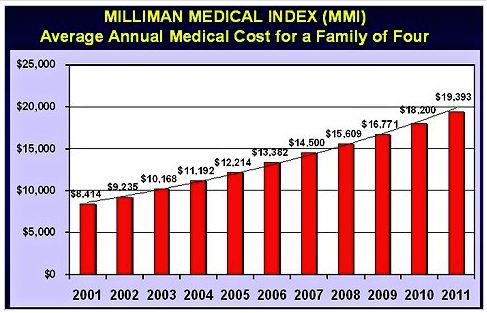
    Chart credit: Uwe E. Reinhardt on the New York Times Economix blog.

    In a world that offers precious little in the way of good news these days, a ray of sunshine has broken through the clouds: Health care costs, which have relentlessly outpaced the general cost of living for decades now, appear to be moderating.

    After exploding by an average of 9.7% annually through the 2000s, Medicare spending is rising at a rate of less than 4%, according to Maggie Mahar, a blogger for the Century Foundation, a left-of-center think tank. The marked slowdown has been in evidence for 18 months now, she says.

    The logical question is this: Does this represent a temporary blip in health care inflation or is it the result of fundamental changes in the health care sector? Mahar makes the argument that it may represent a fundamental shift. She doesn’t credit Obamacare directly, for its major cost-saving measures are not scheduled to go into effect until 2014. But she quotes former White House health care adviser Dr. Zeke Emanuel as attributing the slowdown to providers anticipating Obamacare. Writes Mahar:

    In the past, Medicare has rewarded providers for โ€œVolume,โ€ by paying them fee-for-service. But the Affordable Care Act contains financial carrots and sticks that reward doctors and hospitals for โ€œValueโ€– better outcomes at a lower price–while penalizing those that โ€œdo moreโ€ without improving patient outcomes. โ€œEither we get volume under control, or prices paid both by private insurers and by Medicare will drop,โ€ says Emanuel. โ€œHospitals know this. This is why they want to make their systems more efficient.โ€

    Interesting theory. My initial reaction is to be skeptical. First, it strikes me as wishful thinking by defenders of the leviathan state. Second, it seems to be at odds with the data in the chart above published by lefty health care economist Uwe Reinhardt. And third, the explanation for moderating costs, if costs truly are moderating, could just as likely be a general decline in the medical-care demand curve brought on by theย  the recession and slow recovery. But I don’t have the data at the moment to comment one way or another.

    Whatever the explanation, the trend bears watching. I want to believe! Out-of-control health care inflation lies at the heart of long-term projections showing the U.S. heading toward a Boomergeddon scenario. If the Medicare spending per patient stays subdued, Uncle Sam has more breathing room than I thought to get federal finances in order. As a bonus, the presumed spillover to Medicaid will take a lot of pressure off Virginia’s state budgets.

    I’ll start asking my contactsย  in the health care sector what they think and report back to you.


  • The Wonk Salon, August 26, 2011

    How California Is Losing Its Edge in Film Production
    Milken Institute
    California is losing film production to other states, along with thousands of jobs? The solution? Tax breaks, lots of tax breaks.

    Experienced Principals Flee Low-Achievement Schools
    National Bureau of Economic Research
    Turnover of principals is higher in schools with low achieving students. Then the inability to retain experienced principals… contributes to low achievement in schools.

    The Unpersuasive Case against Voter ID Laws
    Heritage Institute
    Less than 1/10 of one percent of Americans are unable to vote due to the lack of an ID. How does that stack up against the percentage that vote illegally?

    The Subtle Discrimination against Gays in Financial Aid Applications
    Center for American Progress
    Financial aid applications can be biased if applicants can’t include gay spouses, children or dependents as part of their application. And don’t get me started about homeless gays!

    The Case for Charter Colleges in Early Childhood Education
    Brookings Institution
    Improve early childhood educating by improving the quality of early childhood educators. Improve educators by creating charter colleges dedicated to excellence in early childhood ed.

    Evaluating Safe Start for Kids
    Rand Corporation
    Sixty-one percent of American children were exposed to violence in the pastย  year, says Rand Corporation. Really? What kind of violence? Cartoons? Fox News? MSNBC?


  • Chart of the Day: Growth in High-Income Taxpayers

    The Tax Foundation has conducted an interesting exercise: tracking the growth in the number of high-income tax payers (making more than $200,000 per year) between 1999 and 2009 and adjusting for growth in the number of taxpayers generally. North Dakota made the top of the list, presumably benefiting from the natural resource boom in the state, while Alaska ranked second. And No. 3? Why, that would be Virginia, followed by Maryland and Washington, D.C.

    That should not come as a surprise to anyone who has been following reports that Washington-region localities dominate the list of richest jurisdictions in the country when ranked by average household income. What the Tax Foundation data tells us is that a surge in the number of taxpayers making more than $200,000 a year — or “millionaires and billionaires,” as our president refers to them — accounts for much of that prosperity.

    Moral of the story: Rent seeking is fast becoming the most lucrative economic activity in the United States. (Ritual aside: Yes, Groveton, I know you make your money in the private sector. But you are not like most Northern Virginians.)

    — James A. Bacon


  • The Wonk Salon, August 25, 2011

    Effect of Medicaid Managed Care Varies by State
    National Bureau of Economic Research
    States have turned to managed care to help restrain Medicaid spending. In Virginia the percentage of Medicaid recipients enrolled in a managed care plan was zero in 1991 and 45% by 2003.

    States Can Force Employers to Use E-Verify
    Heritage Foundation
    A little-noted Supreme Court ruling has upheld an Arizona law allowing states to force employers to use the E-Verify system and revoke the business licenses of employers that knowingly hire illegal immigrants.


  • Vive La France!

    By Peter Galuszka

    The French, who often come up with the sine qua non many situations, have done it again.
    Like the U.S., the French face a troubled economy and a bloated budget. They face credit ratings downgrades. So, the wily ones have decided to slap on an extra tax on sugary soda, alcohol and tobacco. They may also add extra taxes to their super-rich (no problem from me there).

    Sugary soft drinks are enormously profitable for their makers such as the Coca-Cola Company and Pepsico. They are also a major cause of obesity in our young and old. Don’t get me wrong. I love soft drinks. I just returned from a trip to DC and my car air conditioner was out. So, once home, I popped open a can of Coke. But this was a little, itty-bitty can, not the 64-ounce monsters you can get at WaWa or 7-11.

    I don’t smoke, so I troubles me not if they tax cigarettes many times what they do now. Virginia’s tax rates are rather low for a product that kills 400,000 Americans each year and will annihilate 1 billion globally during this century, according to the World Health Organization.

    Alcohol: ditto. I have cut back although I do enjoy a couple of fingers of decent bourbon at the end of a long day. I am willing to pay extra for it.

    The French have no problem with vices. So, they understand that it is perfectly OK to tax them extra in tough times. I think they will get something like $16 billion for soft drinks alone, but I could be wrong. It is also OK by me, as Warren Buffett says, to tax the ultra-rich. How much alpha can you stand from your hedge fund anyway?

    And it’s a lot better than getting your budget straight on the backs of the poor. That’s what Gov. Bob McDonnell is doing to get his $545 million surplus. He’s cheating our kids out of textbooks and school buses. The Medicaid poor get fewer payments for their hospitals, nursing homes and personal assistants. I guess the rich, who face no such cuts, are more worthy. And, next time you are in a car wreck, the EMT might be a couple of minutes late thanks to McDonnell’s cuts of emergency equipment.

    This may not go well withย assorted Baconauts and Boomergeddons. But what does Jim Bacon know anyway? He probably can’t even make a decent souffle!


  • Bacon’s Buzzword of the Day: Life Cycle Budgeting

    The Springfield Mixing Bowl

    by James A. Bacon

    One of the big problems Virginia and other states have in reining in the cost of government is nonsensical accounting. Here in our great commonwealth, the General Assembly draws up spending plans in two-year increments called biennial budgets. Because the investment time horizon does not extend beyond two years, decision makers fail to consider the life-cycle costs for roads, highways, rail, ports, buildings, water, sewerย and other infrastructure.

    For most infrastructure investments, there are three components of cost: (1) the up-front capital costs and (2) maintenance and operating costs, and (3) the expected life of the asset, after which it must be replaced. From what I can tell — and someone please correct me if I’m wrong — the thinking of Virginia budgeters at both the state and local levels traditionally has not not extended beyond the up-front capital costs. Politicians’ interest lapses after the ribbon cutting, when theย hosannahs fade away.

    The problem is national in scope. Consider this statement from a group of cement contractors that has been pushing life-cycle analysis in Washington and in Virginia:

    Federal and local governments have used accounting gimmicks to hide the real cost of building and maintaining infrastructure projects to sneak budgets past taxpayers or gain political points. As a result, our infrastructure is crumbling. Current plans to repair and rebuild it are short-sighted, stop-gap measures that capture only a fraction of the cost. No one wins when we budget infrastructure projects this way. By refusing to make a thoughtful, serious investment in these projects, decision-makers leave us roads, bridges, and transit systems that are quicker to crumble, more expensive to maintain, and chronically over budget. When it comes to infrastructure, how much longer are we willing to pay more and get less?

    The cement manufacturers call for governments to adopt transparent, life-cycle analysis that shows taxpayers the true and full cost of projects โ€“ including construction and maintenance โ€“ so taxpayer dollars can be allocated more efficiently (which presumably means buying more cement).

    The concept of life-cycle costs has found a somewhat receptive audience in the Old Dominion. This year, the General Assembly enacted HB 1965 that allows local planning commissionsย to “prepare andย revise annually a capital improvement program based on the comprehensive plan of the locality for a period not to exceed the ensuing five years. … The capital improvement program shallย include the commission’s recommendations, and estimates of cost of the facilities and life cycle costs,ย including any road improvement and any transportation improvement … andย the means of financingย them.”

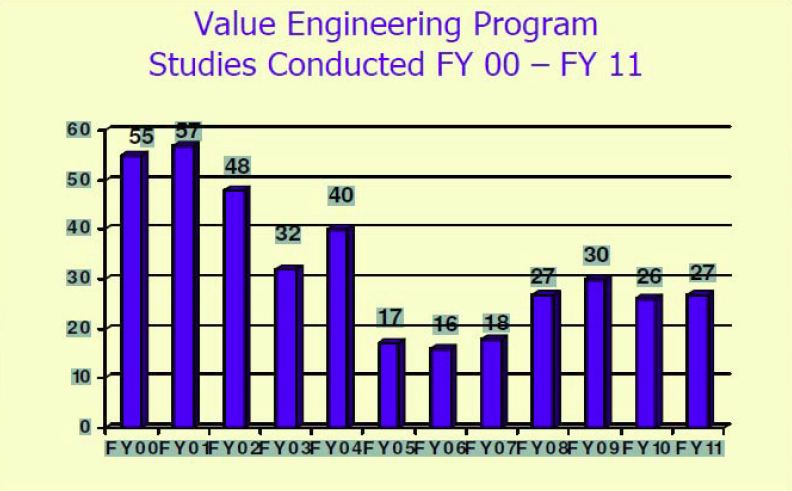
    Number of VDOT value engineering studies since Fiscal 2000

    In a recent presentation to the Commonwealth Transportation Board, State Construction Engineer Mark E. Cacamis described the Virginia Department of Transportation’s commitment to “value engineering,”ย which incorporates life-cycle analysis into a larger, multi-disciplinary process to save money and improve functionality of state road projects. The good news: VDOT has saved $600 million in avoided costs since 1990. The bad news:ย the number of value engineering studies and savings have ย trailed off in the past six to seven years.

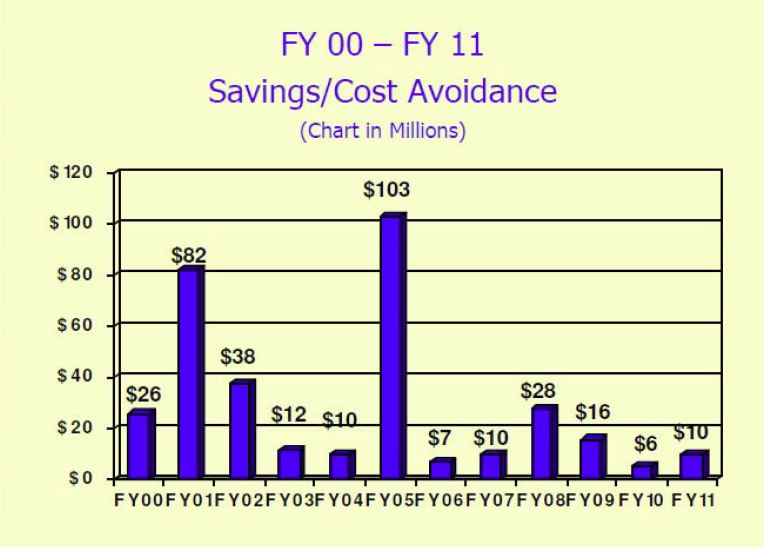
    Value engineering avoided costs since Fiscal 2000

    In Fiscal 2004, VDOT conducted 40 studies resulting in a hefty $103 million in cost savings in Fiscal 2005. The number of studies declined significantly thereafter, and savings over the next six years totaled only $77 million. The avoided costs are a drop in the bucket compared to the backlog of VDOT’s maintenance needs,ย  but the value-engineering program does appear to represent an opportunity to save a few bucks. A million here, a million there, and pretty soon it adds up!


  • Occupational Licensing and the Earnings Gap

    by James A. Bacon

    Many reasons are proffered for the increasing earnings gap in the United States, running the gamut from globalization and automation to the breakdown of the family and the failures of the education system. Here’s another contributor to throw into the pot: the steady rise of occupational licensing.

    Think of occupational licensing as the white collar’s answer to labor unions. Licensed occupations don’t engage in collective bargaining or go on strikes, but they do lobby statehouses around the country to erect barriers to entry in their profession, thus restricting competition and enabling members of the profession to maintain higher earnings than they could in a more open labor market.

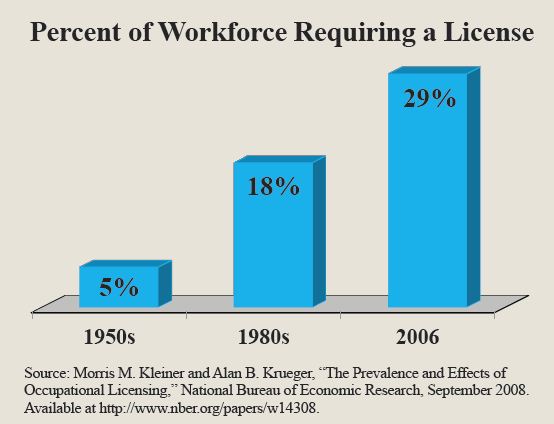
    Occupational licensing has risen in direct proportion to which trade unionism has declined. In 1950, only 5% of the United States workforce belonged to occupations requiring a license. In 2006, 29% of the workforce did. (Click on chart for more legible image.) Additionally, licensing requirements have tended to become more restrictive over time.

    Occupations include almost every profession associated with health care and extend to work as obscure as African hair braiding and Asian eyebrow threading, writes Courtney O’Sullivan in an issue brief for the National Center for Policy Analysis. She concludes: “Many jobs could be performed by unlicensed individuals at a lower cost, without sacrificing safety or quality. Licensing decreases the rate of job growth by an average of 20 percent and costs the economy an estimated $34.8 billion to $41.7 billion per year, in 2000 dollars, reports the Reason Foundation.”

    Cosmetologists defending their occupational turf doesn’t contribute measurably to the wealth gap but physicians, lawyers, physical therapists, optometrists and other higher-end professions defending their turf does. Just one more example of how the rich and privileged wield the coercive power of government to stay rich and privileged.


  • Virginia Earthquake Devastation


    Thanks to everyone for their outpouring of support regarding the devastating 5.8-level earthquake in Virginia. We shall prevail.

    — James A. Bacon

    (Hat tip to jmckinley’s posterous.)


  • Education’s Deep-Rooted Culture of Lax Standards

    by James A. Bacon

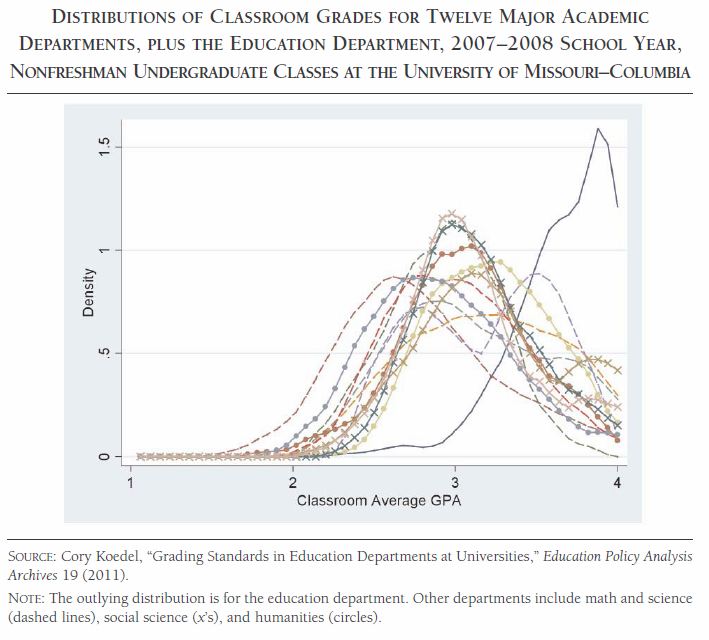
    Grade inflation and other indicators of lax standards are deeply rooted in the educational culture — starting in education school and continuing in the professional workplace. Grades handed out in university education departments are consistently higher than in other disciplines, finds Cory Koedel in a paper published by the American Enterprise Institute. Likewise, K-12 teachers receive overwhelmingly positive professional evaluations.

    In “Grade Inflation for Education Majors and Low Standards for Teachers: When Everyone Makes the Grade,” Koedel shows the grading “curve” for 12 major academic departments at the University of Missouri-Columbia. The grade distribution resembles a bell-shaped curve for all departments — except education, where it looks like an upward-sloping line. (Click on the graph to the left for details.)

    Ruling out possible explanations for the discrepancy such as smaller college class sizes or smarter students, Koedel traces the problem to an inefficient labor market for teachers. Disciplines such as engineering or business have an incentive to maintain grading standards and produce better qualified graduates — if standards fall, businesses will recruit fewer students, which would lower demand for the programs. By contrast, he writes, “The education sector is notoriously ineffective at identifying high- and low-quality workers, making it difficult for the labor market to penalize students from education departments that produce low-quality teachers.”

    And why is that? Because there is no competitive market to hold public schools and school districts accountable. Koedel again: “If a school hires mediocre teachers and produces mediocre outputs year after year, there is no mechanism to meaningfully penalize the school or its workers.”

    Koedel doesn’t make this point, but I suspect it is valid: In organizations insulated from market discipline, internal politics dominates decision making. Giving good grades and positive evaluations to teachers makes everyone feel good and dampens political turmoil.ย  Overlay the organizational incentives with the permissive therapeutic culture of the self-esteem movement and you get the lax standards that pervades American education today.

    Koedel suggests that university administrators can start changing the culture of laxity by imposing tougher standards on education schools, while state and local governments can develop metrics to hold principals and teachers accountable for performance.

    But nothing will happen until the public starts demanding higher standards. Here in Virginia, 37 institutions of higher learning offer education programs. A good first step to start changing the culture of permissiveness would be to conduct a Koedel-style study at Virginia’s larger education schools, comparing the grading curves for education programs versus those of other disciplines. The results, I suspect, would be eye opening.


  • On a Roll

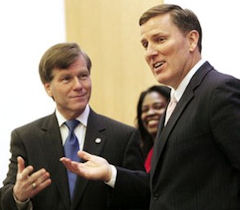
    Newly elected Gov. Bob McDonnell introduces his new transportation secretary, Sean Connaughton. Photo credit: Times-Dispatch

    The McDonnell administration soon will unleash $8 billion in new transportation spending on Virginia. But not everyone is convinced that borrowing billions for highway mega-projects is a wise use of the commonwealth’s money.


    By James A. Bacon

    When Gov. Bob McDonnell took office in January 2010 with the promise to โ€œget Virginia moving again,โ€ his grand plans for addressing Virginiaโ€™s chronic transportation woes got off to a wobbly start. The General Assembly shot down his idea to raise money by privatizing the stateโ€™s ABC stores. After the Gulf spill, the Obama administration roped off Virginiaโ€™s offshore oil and gas resources, which McDonnell had counted on to generate royalties for transportation funding. And no one warmed to his proposal to erect tolls on the North Carolina border of Interstates 85 and 95.

    Making matters worse, the new governor uncovered a mess at the Virginia Department of Transportation (VDOT) that took months to sort through. As the McDonnell team dug into VDOT finances, it found that maintenance work on state roads had fallen way behind schedule and money for construction was piling up unused in scattered project accounts.

    โ€œWe were dealing with a whole organization and structure and funding that were in crisis,โ€ said Secretary of Transportation Sean Connaughton in an interview with Baconโ€™s Rebellion. โ€œThey had lost control of their cash flow. We were trying to understand why we were putting dollars into one side of the machine and projects werenโ€™t coming out the other end.โ€

    The administration has since sorted out VDOTโ€™s accounting, putting hundreds of millions of idle dollars to work, and now is focused on raising billions of new dollars through a combination of debt and private-sector investment. The state has accelerated the sale of previously authorized Capital Project Revenue (CPR) bonds — $2.3 billion will be issued during McDonnellโ€™s four-year tenure โ€“ authorized another $1.1 billion in GARVEE bonds backed by future federal transportation grants, scrounged up nearly $300 million for an โ€œinfrastructure bank,โ€ and created an office dedicated to forging public-private partnerships. The potential exists to leverage the $3.4 billion in bond proceeds into as much as $4 billion in private investment. Add the idle funds uncovered in the VDOT audit and the total could approach $8 billion.

    Despite the early setbacks, McDonnellโ€™s transportation strategy is finally yielding tangible results. In recent months, Connaughton has put several long-delayed mega-projects on the fast track, such as a $2 billion expansion of the Mid-Town Tunnel linking Norfolk and Portsmouth, $1.8 billion to rebuild U.S. 460 between Petersburg and Suffolk, and the $200 million Charlottesville Bypass.

    Some in the business community love it. The McDonnell team has โ€œput VDOTโ€™s house in orderโ€ and injected considerable capital into the system, says Jeff Southerd, executive vice president of the Virginia Transportation Construction Alliance. Virginiaโ€™s large-scale borrowing does not worry him. โ€œYouโ€™ve got a triple A rating. When youโ€™ve got low interest rates and projects ready to go, itโ€™s a proper alignment of the planets to raise money.โ€ Read more.


  • All Shook Up

    By Peter Galuszka

    Today’s earthquake near Mineral should shake up a lot of thinking.


    All sorts of things happened about 10 minutes to 2 p.m. The Pentagon was evacuated. Airplanes up and down the East Coast were put on ground hold. A stairwell in Richmond is said to have collapsed.

    As for me, I was sitting under a pine tree in Nottoway County. I had had meetings in Richmond in the morning and then a doctor’s visit (good result) and I decided to take my trusty, 11-year-old German Shepherd for a midday break.

    We drove to Fort Pickett near Blackstone and sat in the shade of a pine tree watching paratroopers jump from a lumbering C-130 transport plane. A few hundred feet away were two sea-grey Navy Seahawk helicopters. One started its jet engines. Then the ground started to tremble, and tremble and tremble. I was amazed the jet turbine could shake things so. It lasted a good 30 seconds. The pine needles shook. I actually thought how amazing that these few World War II era hangers could last so long, given all the shaking from planes and helicopters.

    It wasn’t until 10 minutes later when I heard it was a 5.9 earthquake centered, as they usually are, near Mineral. It’s the same approximate location of an earlier quake in 2003. I had been on the phone for a work matter with a colleague and she said, “Gee, I have to stop drinking so much coffee.”

    The U.S. East Coast is not as prepared as the West Coast is for earthquakes. We’ve had some — notably in Charleston S.C. Dominion’s two North Anna reactors are near the epicenter and word is that they lost power but diesel generators shut them down safely. I also learned that North Anna is designed only to handle a 5.9 to 6.1 level quake. We’re already there.

    Years ago, when North Anna was proposed, environmentalists endured some rather nasty attacks from then-Virginia Electric Power Co. for suggesting that it might be a bad idea to locate nukes near a fault. The fault is ancient and never active, Vepco’s then-aggressive flaks insisted. You know how it is. Anyone who dares question Big Business is tarred as negative, regressive and un-American. Don’t believe me? Read this blog.

    Granted, a 5.9 level quake is nothing like the 9.0 level one that struck Fukushima, Japan, causing the worst nuclear disaster since Chernobyl earlier this year. That quake turned the growing popularity of commercial nuclear power on its head. Germany will now get rids of its reactors over the next 20 years. Still, Southside politicians and farm owners want Virginia to become a locus of uranium mining near Chatham.

    There’s plenty to think about. And who knows? Maybe the Baconauts and Fox “fair and balanced” News will try to afix blame on Barack Obama. Why not? They are blaming him for everything else.