• Killing Virginia’s Golden Goose

    By Peter Galuszka

    Will Virginia end up killing the goose that has laid its golden egg?

    With apologies to Aesop, it is the most pressing economic question the Old Dominion faces. The golden egg, of course, is the federal government whose jobs continually prop up the state work rolls and help the flow of state and local taxes.

    Chock-a-block with military bases from Virginia Beach to the Pentagon,ย ย  the CIA, civil servants galore and the headquarters of the Federal Aviation Administration, Virginia ranks No. 3 after the District of Columbia and Alaska in the percentage of workers who get their paychecks from government. That’s just direct employment. The state also is the No. 2 defense contractor after California. Newport News Shipbuilding, the only shipyard capable of building nuclear-powered surface vessels, is a big Navy contractor, employing 19,000 workers,ย  the most of any company in the state. Northern Virginia is dotted with information technology firms feeding off the federal government that helped give us such useful things as the Internet.

    Taken together, federal jobs have helped the state weather the worst recession since the 1930s. Federal work is the biggest factor in helping the state maintain an unemployment rate of 6.1 percent, far better than its southern sisters and among the top ten lowest in the U.S.

    There’s one big problem with this miraculous goose and its golden egg, however. Some folks want to kill it in the name of fiscal austerity, which is Tea Party-driven fad of the moment. Pushed by the Tea Party, the state’s top Republicans such as U.S. Rep. Eric Cantor are on a cutting spree. They love the attention they got playing a perilous game of chicken over adopting federal budget ceilings that resulted partly in the U.S. losingย  its pristine credit rating from a major ratings agency.

    Gov. Robert F. McDonnell also wants to get on board with federal job cuts. He’s already sliced the state budget by increasing school class sizes and stopping payments to hospitals, nursing homes and assistants who help sick people on Medicaid. By also deferring payments to the state pension fund, McDonnell has claimed a budget surplus in horrific times, setting himself up for a possible run as a Republican vice presidential candidate in 2012. The new chairman of the Republican Governor’s Association is now lecturing President Barack Obama to follow his tight-wad example.

    “The Governor does believe we must cut spending in Washington, D.C. and we need to do it in a significant and serious manner,” McDonnell spokesman J. Martin Tucker told me, adding that McDonnell knows that such cuts could “have a significant impact” on the state. To ease the pain, McDonnell is proposing putting $30 million from his upcoming budget “surplus” into a special fund that could be used to replace some of the lost state tax revenue if federal jobs take hits. Another step is to expand the role of “Jobs Guy” Lt. Gov. Bill Bolling and his employment commission to create even more jobs to make up for federal cuts.

    There are a few problems with the approach. For one, $30 million is chicken feed to replace a golden egg. It’s pin money in an $80 billion budget and a $545 million surplus — a point even McDonnell acknowledges. Secondly, there are serious questions about how successful McDonnell has actually been in creating jobs.

    The McDonnell Administration claims it has created 45,600 net new jobs since it took office in 2010. The state Democratic Party has claimed that the actual number of jobs the state — 3.6 million or so — is the same as it was when the recession supposedly ended in June 2009. Brian Coy, Democratic Party spokesman, has said that the number of Virginians with a job was 3.8 million. In June of this year, it was 3.9 million, but when population growth in the state is factored, the percentage of its working population employed, 64.3 percent, is about the same when McDonnell took office. Also problematic is the fact that the state lost 14,600 jobs in June, according to the U.S. Dept. of Labor, and 47,800 jobs in July, according to the Virginia Employment Commission.

    Such data trip wires make McDonnell’s job growth claims more modest than he wants you to believe. Even if the administration’s claims are true that it saw an overall increase of 53,784 jobs since it took office, that’s far shy of the nearly 1 million jobs directly related to government work in the state. It doesn’t include the labor forces of private contractors under government contract that could be cut, especially in defense.

    Even “Jobs Guy” Bill Bolling’s magic can’t come anywhere close to replacing numbers like those. The bitter truth is that if the budget hawks get their way, Virginia is in for a much rougher time, and will be a much tougher place to live in, than any politician is willing to admit.

    First published in Style Weekly

  • Paperwork, Solar Panels and Job Creation

    by James A. Bacon

    So… according to today’s reports, the U.S. economy failed to produce any jobs in August and unemployment remains stuck at 9.1%. Why would that be? Is it still all George Bush’s fault? Are we dealing with the lingering after-effects of the Japanese tsunami? Or could Obama administration policies be somehow to blame? I present two random data points that I came across this morning: one regarding the impact of excessive regulation and the other the non-impact of Obama’s stimulus spending.

    Small business owners say that regulations issued by the O Team is stifling job creation. “There are more than 4,200 new environmental, financial, labor and other regulations pending at the federal level today, which are causing uncertainty and ultimately harming small businesses and their ability to create jobs,” says former U.S. Senator Blanche Lincoln, who chairs the Small Businesses For Sensible Regulations initiative, an initiative of the National Federation of Independent Businesses. “This is simply unsustainable in our struggling economy.โ€

    According to a report conducted for the Small Business Administrationโ€™s office of advocacy last year, government regulations cost $1.75 trillion a year in a $15 trillion-a-year economy. Over the last five years, there has been a 60 percent increase in pending federal regulations that are defined as โ€œmajorโ€ or โ€œeconomically significantโ€ โ€“ costing the economy $100 million or more. Even if those numbers are exaggerated, as lefty think tanks say they are, the actual number is still huge.

    In the video above, Mike Bucci, a former Capital One employee-turned-Richmond-entrepreneur, tells how new paperwork requirements have hindered the expansion of his new business. The way I figure it, small business owners have a better handle on what they’re dealing with than the White House spinmeisters, very few of whom have ever had to meet payroll.

    Meanwhile, President Obama’s soon-to-be-announced jobs plan is expected to call for cranking up stimulus spending — without calling it stimulus spending. He will call it investing in “innovative infrastructure ideas” to put people back to work, such as more money for green jobs. The crash of solar-panel manufacturer Solyndra, recipient of some $500 million in federalย  backing, apparently has not dissuaded the Big O from the conviction that he can do a better job of picking winners and losers than the U.S. venture capital sector can.

    In a mundane example closer to home, Wall Street Journal contributor Stephen Moore writes about the dispensation of $300,000 under the 2009 stimulus bill to install solar paneling on the roof of a library in Arlington County:

    Arlington officials boast the project will save $14,000 in annual electricity costs, but the solar panels have a life span of no more than 10 t0 15 years. So the feds spent $300,000 to shave at most $150,000 off the net present value of Arlington’s electric bills.

    I don’t blame Arlington County. Hey, if someone is handing out money, why not take it? But that is lousy national economic policy. The American economy might have received a fleeting, $300,000 jolt from the construction of those solar panels, but it got an offsetting $300,000 jolt to the national debt — adding incrementally to the uncertainty and insecurity associated with the debt. Moreover, that “investment” didn’t create economic value, it destroyed economic value. More “investments” like that will drive the economy deeper into a hole.

    Dear Lord, please deliver us from those who would save us.


  • IG of the Day: Virginia’s “Other” Debt

    (Click on Information Graphic for more legible image.)

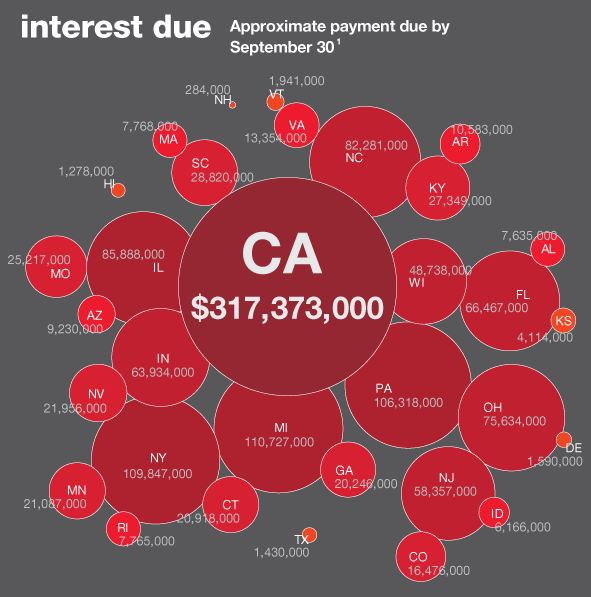
    Every politically sentient Virginian knows that the state Constitution prohibits the state from borrowing money to cover operating expenses of government. Everyone knows that the General Assembly snuck around that restriction by under-funding payments to the Virginia Retirement System, effectively borrowing from the state employees’ pension. Less widely known is that the state, or, more exactly, the state’s unemployment fund, has borrowed $568 million from the federal government to keep up with unemployment payments.

    The state has about a year and a half to pay that money back. According to the Washington Times, it may have to borrow $251 million to make those payments.

    If it’s any consolation, many other states are deeply in hock as well. California is $8.5 billion in debt, Michigan $3.1 billion and New York $2.8 billion, according to the Pew Center for the States. On the other hand four states — Hawaii, Massachusetts, New Hampshire and Texas — have paid off their federal loans.

    How’s that AAA bond rating looking?

    — James A. Bacon


  • The Wonk Salon, September 2, 2011

    Analyzing the Analysis of Traffic Congestion Costs
    Victoria Transport Policy Institute
    Current methods for calculating the cost of traffic congestion and the benefits of congestion mitigation tend to exaggerate both costs and benefits.

    Promoting Digital Learning in Kentucky
    Bluegrass Policy Institute
    Operating Kentucky’s Barren Academy, an all-virtual program for kids at risk of dropping out, incurs only 37% of the expense of traditional educational programs. How do we get more of that?

    School Funding Remains Below 2008 Levels in Many States
    Center on Budget and Policy Priorities
    Ten states, including Virginia, have cut state-level support to K-12 education by 10% or more since FY 2008.


  • The Wonk Salon, September 1, 2011

    Big Labor vs. the Taxpayers – A New Index
    Competitive Enterprise Institute
    In a ranking of union power in the 50 states, Virginia comes out 11th “best,” as in, least hospitable to unions. Turns out, there’s no ban on Project Labor Agreements nor a requirement for a secret ballot in union elections.

    Coming Up: Consumer-Operated Health Plans
    Urban Institute
    Tired of greedy insurance companies ripping you off with over-priced health plans? Start your own. Obamacare will subsidize you. Just be fore-warned: It may not be as easy as it looks.


  • Grumpy Old Men

    By Peter Galuszka

    Here I was, sitting in a strip mall Panera, waiting for the next electric socket to open up.

    It was the aftermath of Hurricane Irene and I had been without electricity since 4:35 p.m. Saturday. I have a home office, so having no power can be deadly. Plenty of other people had the same problem, so we all hightailed it to Panera to borrow their power and local wifi so we could be in business (sort of).

    It was there that I pondered the government role in disasters. Let’s see. Dominion (free market-private) was knocked out by a storm not as bad as Isabelle in 2003. So I hadย  no power. I went to Lowe’s (free market-private) to get some 6 volt batteries so my camp light would work at night. But Lowe’s was sold out. I had planned to go to the Chesterfield Public Library (public) to use their wifi but they were closed and if I recall budget cuts would keep them closed for a little while. So, I was at Panera (free market-private) waiting in line like the old USSR just so I could see if American Airlines (free-market-private) was flying that day so I could make it to Texas for a long-awaited business appointment.

    My turn finally came. Just for fun, I tripped over to Bacon’s Rebellion to see what the boys were up to. I wish I hadn’t.

    There’s Ole Norm Leahy giving us a completely pointless history lesson on what Grover Cleveland had to say about the federal government helping out in disasters. Essentially, not their problem, you should be on your own, relying on the magic of the free market.

    Next there’s James A. Bacon quoting some right wing outfit saying that the first Bush declared disasters areas 43 times, then Clinton more, then W’ more,ย  then Obama (the most).ย I spent a few long moments watching the steam float from my coffee wondering what the hell Bacon’s point was. Then his fuzzy math became obvious: “43+89+130+340 = Obama’s a socialist!”

    Considering all the hassle I had had that day because of the non-functioning of PRIVATE, FOR-PROFIT entities, I didn’t get just annoyed. I got pissed. Actually, the federal government DID work in Irene.

    At least American Airlines worked and I got to Texas. The next day, work concluded, I had a couple of hours to kill. So I turned my shiny yellow Camaro I had rented and headed west through the scrappy, live oak-saturatedย and ultra-dry Hill Country to visit the LBJ ranch. Texas has been in the middle of and intense drought. Local columnists love to point out how conservatives still insist that it has absolutely nothing to do with humans and global warming.

    LBJ’s first fight was trying to get the Hill Country electrified. This was back in the day that some sort of public or semi-public effort or cooperative was necessary in remote and poor areas that for-profit firms would not touch. Has to do the market, you see. And then I went through all of the exhibits about LBJ — Civil Rights Act, Medicare, Medicaid, Voting Rights Act. If Obama’s a socialist, then Johnson was Vladimir Lenin.

    Anyway, I made it home the next day. And guess what? Still no electricity (Dominion–free market-private).


  • High Maintenance

    Maintenance is consuming Virginiaโ€™s transportation budget,ย  and members of a Commonwealth Transportation Board subcommittee agree that the state should change should the way it does business. But urban-rural differences could make it hard to reach agreement.

    By James A. Bacon

    The commonwealth of Virginia spends roughly $1.4 billion per year to maintain its road system but that massive sum has yet to pay off with smoother roads and sturdier bridges. According to a 2009 report, VDOT rated 31% of the stateโ€™s 98,000 miles of secondary road as deficient, a marked deterioration over the previous decade, and tagged 9% of the stateโ€™s 19,400 bridges and culverts the same. The Old Dominion doesn’t just lack sufficient funds to expand its transportation network, it barely has enough to keep up what it’s got.

    Meeting for the first time in Richmond Wednesday, a subcommittee of the Commonwealth Transportation Board began reviewing how the state allocates its maintenance dollars. Its object: Determine if the money can be more effectively spent or more equitably distributed.

    Although most of the session was devoted to reviewing background material, subcommittee members raised a number of issues that will shape the agenda in a follow-up meeting next month. Urban CBT members made clear their interest in revising VDOT formulas for allocating maintenance funds, which are based on the number of lane-miles of road in the state system. They raised the possibility of distributing funds on the basis of entirely different criteria, such as need, as measured by the condition of roads and bridges, or where investments can generate the highest economic return.

    Shep Miller

    In a session where all members were actively engaged in the discussion, it was W. Sheppard Miller, a Norfolk businessman appointed to the board as an urban at-large member, who most forcefully made the case for an overhaul of the allocation formulas. If he could reinvent the maintenance allocation formula from scratch, Miller asked, why would he create one anything like the one Virginia has now? The current formula, which spreads money around the state irrespective of need or economic payoff, results in a system in which roads in some parts of the state are maintained in superb condition while roads in other areas are deteriorating.

    โ€œDoes it make sense from a business perspective?” he asked. “I want to invest my scarce maintenance dollars where they give me the greatest return. If Iโ€™ve got four bedrooms in my house and one room needs to be painted, Iโ€™m not going to paint one wall in each room!

    Miller argued that the lane-mile count is only one among several relevant metrics for prioritizing the allocation of dollars among state highway districts, where VDOT maintains the roads, and cities, towns and two counties (Arlington and Henrico), which maintain their own roads. โ€œWhatโ€™s the cost of having a poor secondary road system?โ€ he asked. โ€œIs the cost greater around Dulles than Farmville? If Rt. 15 through Prince Edward County isnโ€™t in good shape, whatโ€™s the impact on the commonwealth, as opposed to a road through Dulles [airport] or to Hampton Roads? Some lane miles are more important [economically] than others. If Iโ€™m in a hurricane and my generator goes out, Iโ€™m not so concerned about the light in my attic. Iโ€™m very concerned about my refrigerator.โ€

    Gary Garczynski, a Woodbridge developer and at-large urban member, backed Millerโ€™s line of thinking. Allocation formulas must be equitable, he conceded, โ€œbut youโ€™ve got to take into account the economic impact on the commonwealth. Whatโ€™s going to deliver the greatest economic impact for the good of all of the citizens?โ€

    The two rural at-large members, James Keen from Vansant in Southwestern Virginia and Allen Louderback from Luray in the Shenandoah Valley, did not contest the point but they did offer different perspectives. “We need to look at ways to enhance revenues,” Keen said. Louderback cited the rapid growth in the number of lane-miles in fast-growth counties, which resulted in them increasing their shares of the maintenance pot while leaving smaller shares for others. Developers routinely turn over secondary roads inside their subdivisions to the state to maintain. “We can’t keep adding things. Maybe we shouldnt.”

    Read more.


  • Bacon’s New Favorite Acronym: MBUF

    by James A. Bacon

    As the U.S. automobile fleet shifts to higher mile-per-gallon vehicles and, eventually, to electric cars, the gasoline tax will become increasingly outmoded as a revenue source for transportation. No serious person disagrees. The question is: What do we replace it with? Another report, this one from the Center for Transportation Studies at the University of Minnesota, makes the case for MBUFs (Mileage-Based User Fees).

    In “From Fuel Taxes to Mileage-Based User Fees: Rationale, Technology, and Transitional Issues,” the authors base their argument on the basis of efficiency, equity, revenue adequacy and environmental sustainability.ย  Their main hang-up is feasibility — how the fee should be administered. I find the arguments based on efficiency and equity to be the most persuasive and will address each.

    The case for efficiency is strong. The authors, who hail from the university’s Department of Applied Economics, display impeccable economic logic when they write:

    For a tax to encourage efficient user behavior, it should send the right price signals to drivers so that only those drivers who value the use of the road above the cost they impose will use it. … Fuel taxes send weak price signals to drivers and thus lead to inefficient overuse of the highways. This is the result of users underpaying for system use, and users being unaware of what they do pay in fuel taxes. Overuse, in turn, leads to high levels of congestion, emissions, and may result in less-optimal modal use in term of efficiency. In addition to sending weak price signals, fuel taxes fail to provide proper price signals to public officials and investors and thus may direct investment away from the more economically worthwhile projects. Finally, fuel taxes have little connection to land use, and fail to discourage urban sprawl or support livability principles.

    Excessive congestion… Over-investment in roads and highways… Misallocation of capital to economically unjustifiable projects… In sum, a funding arrangement that only politicians could love!

    The study also argues that MBUFs are more equitable. When originally implemented a half century ago, the federal gasoline tax was an effective user fee. But the tax will meet the user-pays-and-benefits principle less equitably than in the pastย  “as those with newer cars pay increasingly less in fuel taxes per mile traveled than drivers with similar, but older and less fuel-efficient vehicles, even if both types of vehicle owners travel the same distance and impose the same cost on the highway system.” All-electric vehicles, which pay no gasoline tax, will be getting a totally free ride. In a related note, the authors argues that the gas tax is regressive, hurting lower-income Americans harder, because affluent Americans are more likely to shift to hybrids and fuel-efficient vehicles that consume less fuel and pay less in the gasoline tax.

    The authors also contend that the motor fuels tax is failing on grounds of fiscal adequacy and environmental sustainability, but I find their arguments less plausible. The problems they cite are not inherent in the nature of the tax but in the fact that politicians have been unwilling to increase the tax as its value is eroded by inflation and increased fuel economy. If politicians are unwilling to increase the gasoline tax to a level sufficient to cover costs, what assurance is there that they would set a mileage-based user fee at a level sufficient to cover costs? None at all.

    The main advantage of the fuel tax over an MBUF systemย  is ease and expense of administration. But those savings are measured in the hundreds of millions of dollars while the loss of economic efficiency is measured in the billions of dollars. Virginia should start laying the groundwork for a transition to MBUFs immediately. It will take years of debate to choose the right technologies and hash out the inevitable privacy issues. We cannot wait until the gasoline tax collapses to begin that process. There is no time like now.


  • Innovation in the Transportation Realm

    ULTra station at Heathrow Airport

    by James A. Bacon

    If anything can possibly save the United States from looming fiscal, economic and environmental calamity it is the human species’ remarkable capacity for innovation. Innovation has been sparse in the transportation arena, one of the major subjects of study here on Bacon’s Rebellion, but not entirely absent. Today’s post focuses on two innovations — one, the concept of urban light transport, which combines elements of autonomous vehicles with mass transit, and the other, the concept of “neighbor-to-neighbor” car sharing.

    The Urban Light Transport (ULTra) system consists of small, lightweight, computer-driven electric vehicles running on slender, special-purpose guideways. Passengers board four-seat vehicles that can go anywhere on the system at any time, providing far more flexibility than mass transit. Working as circulator for office parks, airports, universities, and other major activity centers, ULTra makes carpooling, Metro, and bus more effective, by solving the “last mile problem.”

    ULTra PRT, a Bristol, U.K.-based designer of the systems, has installed one at London’s Heathrow Airport with 2.4 miles of guideway, three stations and 21 cars. The companyย  is engaged in detailed planning for another system in the Golden Temple tourist center in Northern India, and has entered into a feasibility study with Kane Realty Corporation for application in the North Hills mixed-use project in Raleigh, N.C.

    Approximate system concept. Red, green, and blue segments roughly follow the three shuttle bus circulator routes shown in the Tysons Strawman report.

    The idea has even been examined as an alternative to circulating bus systems in Tysons Corner. (Click on map for more legible image.) The proposed system purports to be faster than cars or buses. A Personal Rapid Transit between the Freddie Mac headquarters and the proposed Metro Stop #2 would take three minutes (including a 20-second wait time). Driving would take 7 minutes, while a circulator bus would take 15 minutes.

    The big question, of course, is how much would it cost? Building a system capable of serving most of Tysons would cost many millions. Would Tyson’s well-heeled corporate citizens be willing to pay sufficient fares for the benefit of convenience? I have no idea, but it’s worth looking into. (The ULTra PRT website refers to a 2009 Virginia legislative study, “Viability of PRT for Virginia.”) Ed Risse is a big fan of PRT – indeed, he pointed me to the ULTra PRT website. Perhaps he can expound on the bare details I have provided here.

    Now, for another example of innovation — one that requires virtually nothing in the way of capital investment. Relay Rides, based in Boston, improves on the idea of the Zip Car, which allows people to rent automobiles by the hour on those rare occasions in which they need them. I’ll just let Relay Rides tell its own story:

    It was a dark and stormy night… also known as “Winter” in Boston. Our Founder Shelby Clark was biking through what seemed like miles and miles of a horrible blizzard: wind blowing every which way, snow seemingly being blown upside-down, nasty stuff! All this just to get to the nearest “shared car” while thousands of other cars sat idle? Why couldn’t those cars, some clearly sitting parked for days, be available to borrow? Eureka! From that snow-driven delirium, RelayRides was born…

    Today, RelayRides connects people who need a car with vehicle owners whose rides would otherwise just be sitting idle. Just need to run a few errands? Why deal with car ownership or the hassle of traditional carsharing when RelayRides lets you borrow your neighbors’ cars from as low as $5/hr? Or if you own a car, don’t just let it sit around when you could be making up to $7,000/year loaning it out safely and securely.

    Brilliant! The average cost of car ownership runs around $715 monthly; the average cost to Relay Ride members runs around $100. As a bonus, the company contends, the average shared car takes 14 other cars off the road. Does Relay Rides have a sustainable business model? I don’t know, but it is only one of several enterprises — WhipCar (in the U.K.), Spride Share and Getaround that offer essentially the same service. Obviously, someone thinks it holds promise.

    If the idea proves feasible in the long run, it will do two great things: (1) save people from the enormous expensive of owning a car they need only occasionally, and (2) take cars off roads and parking spaces, relieving congestion for everyone else. The idea will pay really big dividends when developers and urban planners begin designing communities that integrate neighbor-to-neighbor car sharing from the beginning. (Hat tip to Ray Hyde.)


  • Paying for disaster relief

    by Norm Leahy

    Rep. Eric Cantor is taking a bit of heat for saying that any federal monies spent on disaster relief in the wake of Hurricane Irene should be offset with spending cuts elsewhere in the budget.

    But consider the quotes in Anita’s piece, both from Rep. Cantor and from the group criticizing him, Virginia Organizing. First up, the hard-nosed Mr. Cantor:

    โ€œThe federal government does have a role in situations like this. When there’s a disaster thereโ€™s an appropriate federal role and we will find the monies,โ€ Cantor said. โ€œBut we’ve had discussions about these things before and those monies will be offset with appropriate savings or cost-cutting elsewhere in order to meet the priority of the federal governmentโ€™s role in a situation like this.โ€

    Which earned this retort from Virginia Organizing:

    โ€œWe have truly reached a new low in American politics if Rep. Cantor is willing to use disaster relief as a political bargaining chip,โ€™โ€™ said Jay Johnson, a board member of Virginia Organizing. โ€œDisaster relief is a necessary function of government and not something to be bartered with. …We are the richest nation in the world and should be able to respond to disasters with more dignity than someone bartering for a couch on Craigslist.โ€

    Each side plays to type, but at bottom, both assume that the federal government has a role in disaster relief.

    But does it?

    For the truly hard-nosed, the answer is “no.” The federal government is no more responsible for paying for clean-up than it is for offering grants to cowboy poets. But so feeble has our notion of what is and is not the federal government’s proper sphere, that we assume — left, right and center — that our impoverished Uncle on the Potomac will arrive on the scene with cash, supplies and perhaps even a few second hand, formaldehyde-tainted trailers.

    Once upon a time in America, the idea of the federal government providing any disaster assistance at all was highly suspect. Jack Balkin, writing after the Katrina disaster in 2005, unearthed a gem from President Grover Cleveland, who vetoed a bill allowing the Department of Agriculture to distribute free seeds to drought-stricken areas of Texas. In his veto message, Cleveland wrote:

    I can find no warrant for such an appropriation in the Constitution, and I do not believe that the power and duty of the General Government ought to be extended to the relief of individual suffering which is in no manner properly related to the public service [as with veterans, for example] or benefit. A prevalent tendency to disregard the limited mission of [national] power and duty should, I think, be steadfastly resisted, to the end that the lesson should be constantly enforced that though the people support the Government the Government should not support the people.

    Cleveland’s reading of the Constitution is no longer in fashion (if it ever really was). As the Cantor quote above shows, even today’s most rock-ribbed conservatives are comfortable with an expansive reading of federal power. So…how can we possibly bridge the divide between Cantor’s desire to offset federal disaster relief spending with Virginia Organizing’s belief that any offsets are evil?

    Aside from ditching the grants to cowboy poets, which wouldn’t do much, Sen. Tom Coburn’s ongoing series of pork reports offer millions of dollars of savings that could be funneled to disaster relief…if that’s where the worthies decide the money is better spent (rather than, say, on the feds’ buying additional limousines).

    Coburn has found and continues to find so much frivolous federal spending that reaching Mr. Cantor’s offset goal is neither as difficult, nefarious or Craiglist-like as Virginia Organizing believes it to be.

    Unless they really like the idea of having more federal limousines scurrying around the countryside…


  • The Wonk Salon, August 30, 2011

    Issues to Consider with Health Insurance Exchanges
    National Governors Association
    Time is running out to design state health insurance exchanges. Lawmakers should give particular attention to maintaining continuity of coverage between Medicaid, CHIP and the exchanges.

    How Maryland Is Working to Reduce Racial Disparities in Health Care
    Healthcare Cost and Utilization Project

    Maryland has set up a Health Care Reform Coordinating Council to implement the goals of the Affordable Care Act relating to disparities in health care for racial and ethnic minorities.

    Seeking Cost Effectiveness in Police Recruiting
    Rand Corporation
    Since the recession, police departments have been deluged with applications but their budgets for processing job seekers have been cut. This report draws upon the LAPD experience on what works and what doesn’t.

    How Insurers Are Responding to Medical Loss Ratio Rules
    Government Accountability Office
    What happens when Obamacare tells insurance companies how much they can spend on non-premium payments? Most insurers cut their brokerage fees. Some withdraw from market niches or entire states.

    EITC Unfair to Childless Poor People
    Center for an Urban Future
    It’s an iron law of welfare economics: When you establish arbitrary cut-offs for participating in a program, there’s always someone on the other side of that cut-off who looks like they’ve been gypped.


  • Federal Transportation Policy: A Net Destroyer of National Wealth?

    by James A. Bacon

    “The U.S. highway trust fund is broke,” declares a new report, “Road to Recovery,” published by the Carnegie Endowment for International Peace. If you include deferred maintenance, the U.S. surface transportation system added between $103 billion and $175 billion annually to the national deficit in recent years.

    The United States is one of only aย  few countries in the world where revenues raised to support the federal transportation system do not cover costs. Revenues represent only 62% of surface transportation expenditures — compared to 100% or more among all other members of the Organization for Economic Cooperation and Development. And that doesn’t even take into account the U.S.’s bad habit of deferring maintenance, which can increase upkeep to as much as $800,000 per lane-mile over the life of the road.

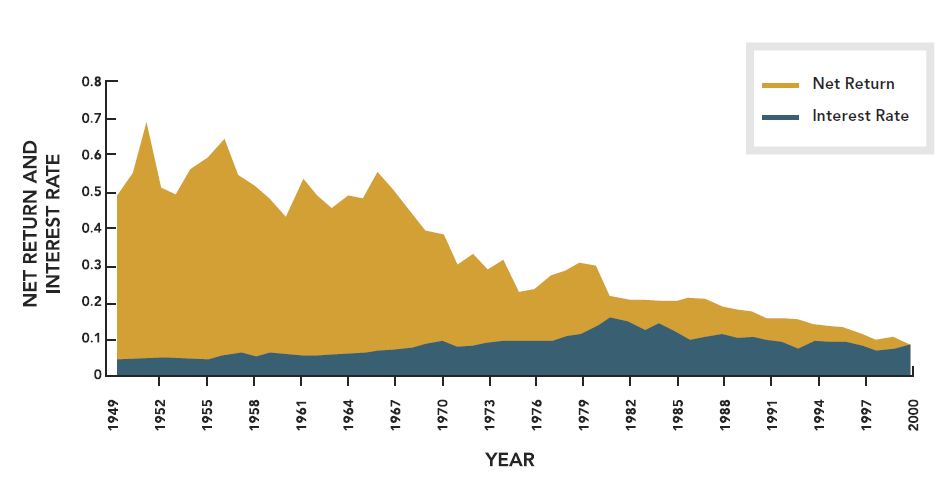
    The report makes another important point: “The rate of economic return from investment in highway infrastructure in the United States has been approaching the long-term interest rate (cost of capital) since the 1990s. Once the rate of economic return meets the long-term interest rate, it becomes equally beneficial to keep invested capital in the private sector, a clear signal that those investments could be without merit. At that point, the system no longer delivers the benefits necessary to justify public funds.” (Click on graph below for more legible image.)

    Net ROI in transportation compared to long-term interest rates

    Put in the starkest of terms, the U.S. is spending too much on new road/highway construction and too little on maintenance. The Carnegie report doesn’t put the point quite this baldly, but it’s entirely possible that the federal government’s transportation policies could represent a net destroyer of national wealth!

    Such madness should come as no surprise. As the report also says, “While the country suffers the effects of an increasingly degraded and under-performing transportation system, investment decisions on the nation’s transportation system haveย  become increasingly unfocused, short-term and highly politicized.” In 1987, President Ronald Reagan vetoed a transportation funding bill because it contained 100 earmarks. In 2005, President George W. Bush signed a funding bill containing 6,229 earmarks.

    How, then, do we fix this broken-down system? The authors advocate assessing a 5% ad valorem tax on oilย  production and imports when the world oil price is rising and a tax on retail gasoline sales when the world oil price is falling. The idea has some merits, although I’m not entirely persuaded. What fascinates me most is the report’s discussion of the true cost of federal transportation policy.

    The authors tote up the following when calculating how much the U.S. is underfunding its transportation system (figures are from the “high” scenario): $85 million in deferred maintenance, $20 billion in federal General Fundsubsidies, $40 billion in hidden budgetary costs paid by agencies other than the U.S. Department of Transportation, a $29 billion productivity loss from sub-optimal investment, and interest payments on debt from General Fund expenditures.

    What concerns me most — because it is a problem that Virginia shares — is deferred maintenance. States the report:

    Studies have found that spending $5 million on preventive maintenance can save $100 million to $500 million in rehabilitation and reconstruction costs. Although postponing maintenance may appear inescapable given the current shortfall of transportation funds, this deferred maintenance will cost America dearly; projections place its cost at a staggering $5 trillion by 2035 (in 2010 dollars). It is estimated that it would cost three times the transportation systemโ€™s $1.4 trillion present asset value to replace it if it were not kept in a state of good repair.

    In case you missed it, I refer you to my recent discussion of life cycle budgeting, which encompasses both the up-front capital costs of transportation projects and long-term maintenance costs. The Commonwealth Transportation Board is scheduled to discuss “local maintenance programs” in its upcoming meeting this Wednesday. I will be interested to see how presenters frame the issue.


  • The Wonk Salon, August 29, 2011

    Only 10 Years Old and Homeland Security Needs an Overhaul
    Heritage Foundation
    George H.W. Bush made 43 FEMA disaster declarations. Barack Obama has issued 144 in the first six months of 2011. America has over-federalized disaster response in a way that threatens the resiliency of the nation’s communities.

    Less Educated Workers Still Losing Jobs
    Urban Institute
    For high school drop-outs, the recession never ended. Since the economic recovery began, a net 10%ย  of Americans without high school diplomas have lost their jobs.


  • Metro Washington Foreclosure Rates: A Tale of Two Trends

    This map published by the Urban Institute’s “Washington, D.C. Metropolitan Foreclosure Monitor” displays foreclosure rates across the Washington metro area. The data appear to reflect two broad trends.

    First, the foreclosure rate increases with the distance from the metropolitan core. Arlington has the lowest foreclosure rate in the region, followed by Alexandria and Fairfax County. Likewise, the affluent, largely white, zip codes in northwestern Washington, D.C., also have a very low foreclosure rate. Outlying jurisdictions such as Spotsylvania and Warren counties in Virginia, Charles County in Maryland and Jefferson County in West Virginia have among the highest foreclosure rates. This reflects the fact that property values have held up better in the urban core than in the metropolitan periphery.

    Which brings us to the second observation. The major exception to the preceding rule is that zip codes dominated by African-Americans —ย  eastern Washington, D.C., and “suburban” Prince George’s County, Md. — have a much higher foreclosure rate.

    Why would African-Americans suffer from a higher foreclosure rate? I offer a hypothesis, which I will quickly retract should conflicting data be brought to my attention. The hypothesis is this: When housing prices were zooming higher in the 2000s, banks shoveled out money for real estate loans most recklessly for sub-prime loans. Less affluent Americans, who were disproportionately African-American, bought into real estate near the top of the market and, thanks to the collapse in lending standards, were less able to keep up their mortgage payments when the economy, and housing prices, collapsed.

    — James A. Bacon


  • Hurricane? That Means It’s Party Time!

    You’ve got to feel sorry for the Weather Channel’s Eric Fisher — Virginia Beach residents just aren’t taking Hurricane Irene seriously. Woo hoo!

    Reminds me of the old joke: What are the most common last words of the American redneck?

    “Hey, ya’ll, watch this!”