Virginia’s property taxes increased (as a ratio of the median real estate tax to median home value) by 4.5% between 2009 and 2010. Thirty-three states saw property taxes rise at a faster rate. North Dakota and Indiana were the only states to see their rates fall. (Click on map for more legible image.)
According to the Gallup organization, dissatisfaction with the way the nation is being government has reached a new high, along with mistrust of Congress and contempt for public officials generally. Fifty-seven percent have no confidence in the federal government to solve domestic problems. Forty-nine percent believe the federal government has become so large and powerful that “it poses an immediate threat to the rights and freedoms of ordinary citizens.”
The Beatles penned their famous song, “Revolution,” in 1968, a few years before the Watergate scandal inspired a wave of distrust in government. Dissatisfaction during that era of turmoil peaked at 66%. Today, the figure stands at 81%. The institutional configuration that has governed the country since World War II is on the verge of collapse. The people get it. Our rulers have too much invested in the status quo to bring about fundamental change. If people thought a revolution was looming then…
The Obama administration has successfully painted House Republicans as mad, uncompromising Tea Partiers willing to push the federal government to default in pursuit of their extremist agenda. Of course, when Republicans cave on major spending issues, like the transportation bill, we hear little about it. This column was penned by an observer of the Washington scene whose sponsoring organization found it too embarrassing to publish. We run it here. — JAB
From left: Transportation Secretary Ray LaHood, Chamber of Commerce COO David Chavern and President Barack Obama. Photo credit: UPI
by Publius
Flanked by the leaders of the U.S. Chamber of Commerce and the AFL–CIO, President Obama in late August urged Congress to pass a “clean” extension of the surface transportation bill and a “clean” extension of the FAA bill “to give workers and communities across America the confidence that vital construction projects won’t come to a halt.” Joining this august assemblage were two federal employees who, confronting the temporary loss of a job, were on the podium to serve as White House hostages.
Two weeks later the leadership of the House of Representatives obliged the President by doing what he requested, and in the process effectively canceled one of the House Republican’s most significant initiatives to restrain spending and limit the scope of government.
Until that fateful Tuesday vote, the House was on track to make serious reductions in, and significant reforms to, the existing highway legislation that was enacted in 2005 under the leadership of former Transportation Committee Chairman Don Young. Instead, the House ignored its many pending reforms and spending limits and joined the President in embracing and extending for six more months what many analysts consider to be one of the worst pieces of legislation ever signed into law. Called SAFETEA-LU, that law was 2,000 pages long, and included 7,000 earmarks, including the infamous “Bridges to Nowhere.” SAFETEA-LU expired in 2009, but the absence of a replacement has led to several extensions of it since then, the most recent of which was set to expire at the end of September.
In the months leading up the expiration date the House majority had made many impressive changes in transportation spending and policy in ways that were well within the spirit of the new majority’s commitment to change the culture of Washington. The House Budget Committee recommended, and the House endorsed, significant cuts in transportation spending with a focus on wasteful rail programs. The appropriations committee incorporated these targets into their bill, and the Transportation and Infrastructure Committee produced an impressive five year re-authorization plan that cut spending by $50 billion compared to SAFETEA-LU’s totals.
All this progress, however, was cast to the wind when the House leadership did as the President requested and extended for six months – at higher levels of spending than the House had already agreed to for FY 2012 – the remnants of SAFETEA-LU. As was the case with the earlier dispute over the re-authorization of FAA and the effort to eliminate egregious subsidies for a handful of privileged passengers and sweet-heart contracts for unions, both sides held the program hostage in their effort to advance policy. But as past conflicts demonstrate, the President and his congressional allies were prepared to shoot the hostages. The Republicans were not.
One way to view this sorry outcome is that some Republicans are losing their will to fight for their policies against a determined President, his union supporters, and a do-nothing Senate. With recent fights on the debt limit and the FAA extension leading to uncertain outcomes, House Republicans seem farmisht from the relentless combat common to revolutions.
They also seem worried about the president’s embrace of the jobs issue, however wrong he may be about it. In demanding a clean bill, the President argued that 4,000 workers would be furloughed if Congress didn’t deliver. Congress did deliver, suggesting that it too may now believe that jobs come from more federal spending. If so, we have come full circle from President Reagan’s policies and are frighteningly close to 1971 Republican attitudes when President Richard M. Nixon said that “I am now a Keynesian in economics.”
Congress will be facing many more such fiscal challenges over the next few months, and some will be more intense than the highway extension they just gave up on. It won’t be easy, but many of the new members came to Washington to shake things up, and voters still expect that they will “Stiffen the sinews, summon up the blood,” reverse this sorry setback, and get America back on the road to fiscal sanity. We’ll all be watching.
Many Parole Programs Still Winging It Urban Institute
Evidence-based practices are making inroads in state correctional programs that oversee the release of 500,000 prisoners a year into the population. But many programs still appear to be flying by the seat of their pants.
Want to Avoid Flood Damage? Elevate Your Stinkin’ House! Rand Corporation
Want to avoid flood damage in New Orleans? Tip one: Move your stinkin’ house to a higher elevation! Tip two: If you refuse to do that, prop our stinkin’ house up on cinderblocks!!
The Virginian-Pilot is on board with an expansion of Norfolk’s short, costly and scandal-plagued light rail line. But in a fine display of Babbittry, we’re not supposed to pay attention to the scandals, cost overruns, delays and such. Those petty concerns only get in the way of progress. And how to pay for it all? The paper manages to mention, in passing, that money for such an expansion may be hard to come by. But that’s a secondary consideration compared to the planning that needs to take place now for an even bigger, more costly system.
But before the planners, great and small, get too excited about adding on to their train set, Randal O’Toole has a few things about the existing rails that ought to be kept in mind. I’ll quote his post in its entirety:
Norfolk Virginia finally opened its light-rail line, and ridership “exceeds expectations” at 5,600 riders a day. Considering they run 212 trains a weekday, that’s just over 26 passengers per train. How many 40-passenger buses would have been needed to handle all that traffic?
Of course, the rail line exceeded expectations in many other ways as well. The 7.4-mile line was originally expected to cost less than $200 million. The final cost was at least $120 million over that. It was also supposed to be open for business in 2008. They exceeded that expectation as well. The original projection was for 10,500 weekday riders by 2021. They’ll have to double ridership to meet that. A lot of city and transit officials also expected the rail line would be a feather in their caps. Instead, they were lucky not to be tarred and feathered when they were run out of town over cost overruns.
Despite the underestimated costs and inflated ridership numbers, the Federal Transit Administration gave Norfolk light rail a “not recommended” rating in 2004. Too bad the agency changed its mind (or had its mind changed for it by Virginia’s congressional delegation). They could have saved taxpayers a lot of money on a truly wasteful project. But that’s the story of all light rail in a nutshell.
It’s also the theme of a classic Simpsons episode — “Marge v. the Monorail,” which gave the world this snappy tune. The mob (or in this case, the Pilot) has spoken!
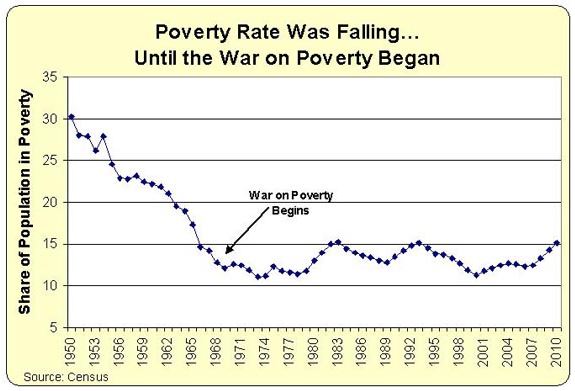
Poverty in the United States declined dramatically in the Post World War II era until 1970 or so, and then it plateaued. In other words, poverty fell until the federal government declared war on it. Then the very institutions that the welfare state erected to ameliorate poverty ended up perpetuating poverty. (Source for the chart: the Cato Institute.) If you’re looking for an explanation of the yawning income gap, this is part of the story. The enervating effects of welfare reduce the incentive for the poor to increase their income. Talk about a high tax bracket! When benefits like the Earned Income Tax Credit, food stamps, housing assistance, Medicaid and more are peeled back as a poor household earns more money, it’s remarkable that people work as hard as they do! — JAB
It is axiom of the smart growth movement that, although fear of crime may predominate in the popular mentality, motor vehicle crashes represent every bit as much of a threat to peoples’ safety and well being. Because accidents are more likely to occur in the countryside and the ‘burbs (my term for human settlement patterns that are characterized by segregated land uses, low density and disconnected development), people are arguably less safe than if they lived in urban areas that are traditionally thought to be hotbeds of crime.
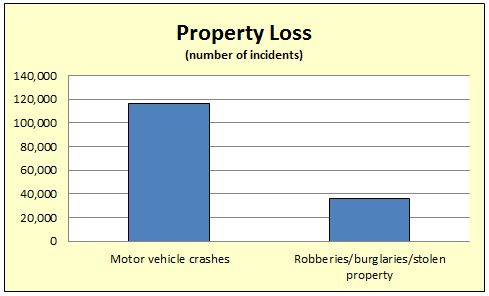
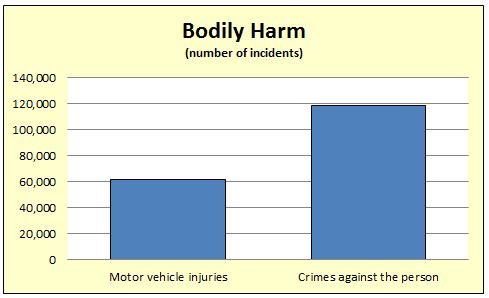
Just for yucks, I pulled 2010 data from the Division of Motor Vehicles and the State Police’s “Crime in Virginia 2010” report. Here, for your viewing pleasure, I compare the impact of crashes vs. crime upon public safety.
First, let’s compare the number of incidents involving property loss: motor vehicle crashes on the one hand and robberies, burglaries and stolen property on the other. It’s not even close. Automobile accidents are a much more frequent occurrence. (Click on charts for more legible image.)
Next, let’s take a look at the number of incidents involving bodily harm: the number of people injured in traffic accidents versus the number of people reported as victims of violent crimes (including murder, manslaughter, kidnapping, abduction, sex offenses and assault). In this case, you are more likely to be a victim of a violent crime than to be in injured in a traffic accident. However, it is important to note that the vast majority of these offenses consist of “assaults,” and that the overwhelming majority of “assaults” consist of “simple assaults” or threats in which the victim suffers no “obvious severe or aggravated bodily injury involving apparent broken bones, loss of teeth, possible internal injury, severe laceration or loss of consciousness.” I’m not a lawyer, so I may be mistaken about this, but if someone shoves you and you fall over, that’s an assault.
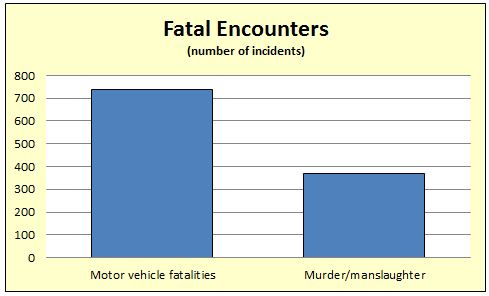
Finally, take a gander at fatal encounters: motor vehicle fatalities versus . homicides and manslaughter. Virginians are twice as likely to die in an automobile accident as to be killed in a crime. Furthermore — and I say this in the belief, perhaps mistaken, that relatively few Bacon’s Rebellion readers are selling crack or operating meth labs, and thus are less likely to consort with people who settle their disputes with guns, knives and blow torches — law-abiding citizens are way more likely to die from being hit by a random car than to be murdered by an anonymous criminal.
So, there you have it. The statistics speak for themselves. If you live in the country or the ‘burbs, you’re not nearly as safe as you think.
Update: Ed Risse reminds me of the detailed work on this subject conducted by Bill Lucy at the University of Virginia. (Heck, I probably blogged about it.) See a summary of his findings here.
The Impact of Minimum Wage on Somoa, Marianas Government Accountability Office
Increases in the minimum wage have devastated the tuna cannery industry in Somoa but has been less of a factor in the tourism-based economy of the Northern Mariana Islands.
L.A. Gang Reduction Program Is Helping Urban Institute
A drop in gang-related crime was evident before the Gang Reduction and Youth Development Program was launched, but the program appears to have accelerated the decline.
The Declining Impact of Extreme Weather Events Reason Foundation
Global warming be damned. Aggregate mortality due to all extreme weather events globally — droughts, storms, floods and extreme heat — has declined by 90% over the past century in spite of a four-fold rise in population.
Empower States to Regulate Gas Drilling Heritage Foundation
The feds should not hamper development of the country’s plentiful natural gas reserves. Let the states deal with environmental issues.
Creating Jobs by Conserving Public Lands Center for American Progress
Conservation of public lands supports 388,000 jobs in recreation, tourism, renewable energy, restoration and landscape restoration.
A design-build approach worked beautifully on the 495 Beltway widening, Connaughton says.
The McDonnell administration hopes that VDOT’s “design-build” approach to highway engineering will advance projects more quickly and save millions of dollars. But public accountability may suffer.
By James A. Bacon
Transportation Secretary Sean Connaughton liked this story so much that he told it twice this week during the September meeting of the Commonwealth Transportation Board in Portsmouth. When Virginia Department of Transportation (VDOT) engineers conducted the initial design for the I-495 Beltway, he said, they estimated that the project would cost $3 billion. But when Transurban, the Australia-based toll road builder/operator, took a crack at the same design challenge, the cost dropped to $1.5 million. What’s more, said Connaughton, “They added four lanes; we would have added only two.”
One big difference between the two designs was that VDOT envisioned the necessity of acquiring more than 600 houses and commercial buildings while Transurban figured out how to build the project with a much smaller footprint, saving hundreds of millions of dollars in right-of-way acquisition costs.
And that is why Connaughton is a big believer in “design-build” contracts. He wasn’t knocking the professionalism of the VDOT engineers. But he did make the argument that soliciting a design from a private-sector group like Transurban could yield fresh, creative thinking on how to design a project more economically.
Under the McDonnell administration there will be more design-build contracts in Virginia’s transportation future, a philosophical shift that represents a big change in how VDOT manages road projects and how it interacts with the public. Design-build offers the potential to cut the cost of big-figure mega-projects. But because the projects move so much faster, the approach also threatens to reduce meaningful public involvement. Indeed, the controversial Charlottesville Bypass, which is being rushed to bids, may be a case in point.
Traditionally, VDOT used the “design-bid-build” approach to designing and building roads. It was a linear process, Charlie Kilpatrick, chief deputy commissioner, explained to the CTB. Projects moved sequentially from one phase to the next, a process that could take years. The contracts were very “prescriptive,” with the quantity of materials specified precisely. Contractors liked it because it was low-risk. If there were overruns in the quantity of materials, VDOT would pay for them. The process had all been worked out, and everyone was comfortable with it.
The design-build approach transfers much of the risk to the contractors but gives them more flexibility in solving problems. Contractors, who typically partner with engineering firms, are required to meet broad specifications and guidelines but have considerable latitude in figuring out how to meet them. If they miscalculate the volume of materials required, they are liable for the overrun. An advantage of the process is the ability to run many of the design and construction phases concurrently. Construction could be underway on one section of the project even while engineers were designing another section. In theory, completing projects more quickly cuts construction costs.
Another reason VDOT is resorting to design-build projects right now is that the department has largely run out of off-the-shelf project designs. In the past, VDOT engineers would do rough designs entailing about 30% of the work in order to develop cost estimates and move quickly to take advantage of unexpected funding opportunities. When the 2007 recession hit, VDOT curtailed its engineering work in an effort to cut costs. Later, when the Obama administration started distributing highway construction dollars under the American Recovery and Reinvestment Act (the so-called “stimulus” bill), VDOT drew down its off-the-shelf plans. Now, said Virginia Highway Commissioner Gregory A. Whirley, the cupboard is almost bare. VDOT’s updated strategic plan calls for setting aside 10% to 15% of the state’s construction program budget for preliminary engineering in order to beef up its project inventory. Until then, the department will use more design-build, in effect outsourcing the design to engineering-construction firms and partnerships.
James A. Davis, former president of Shenandoah University in Winchester, said Virginia’s higher education sector went through a similar transition two decades ago. Colleges and contractors were comfortable with the design-bid-build process and were reluctant to change. “You have to be very clear about the specifications,” he told the board. “It’s a very different management process. It’s more creative, and you don’t know until you reach 90% [project completion] what the final cost will be.”
Despite the anxieties, design-build did cut the construction time of college buildings dramatically and saved considerable money. It’s largely standard for the higher ed sector today.
On the other hand, as Davis conceded, highway projects are typically more complex than college buildings. Also, he might have added, highways have a far greater impact on the public than college buildings do.
“How do we reconcile this with our obligation to consult with taxpayers?” asked James E. Rich, the Culpeper District representative on the CTB, who opposed the Charlottesville Bypass. It wasn’t an academic question. Read more.
Comparing Public- Vs. Private-Sector Compensation: Private Wins by a Hair Boston Center for Retirement Research
Private-sector workers earn about 9.5% more than state-local government workers with comparable skills. If benefits are included, total compensation is just about equal on a national level.
Immigration Assimilation: It Takes Two to Tango Center for American Progress
Historically, Americans have put the burden on immigrants to assimilate, emphasizing the learning of English and naturalization. But there is much that communities can do to hasten the process.
Make Government Data Machine Readable Cato Institute
How to make government more transparent: Make government data machine discoverable and machine-readable.
Want More People on Food Stamps? Eliminate the Fingerprinting Requirement Public Policy Institute of California
Apparently, not enough people are applying for food stamps in California. Eliminating the fingerprinting requirement could increase participation by 7%. No guarantees, though, that the some of the new enrollment won’t be fraudulent.
Helping Patients Share in Decision Making New America Foundation
Every medical procedures involves tradeoffs between benefits and risks. It’s a good thing for patients to be involved in making the decisions. State legislatures should revise their informed-consent laws to help make it happen.
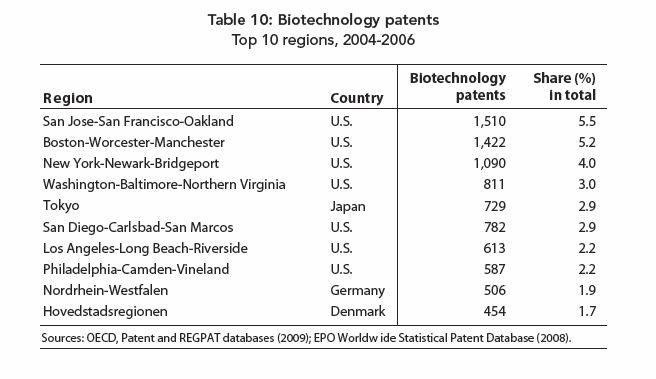
How about that? The Washington metropolitan region has emerged as the No. 4 biotech region in the world based on the number of biotech patents between 2004 and 2006, according to a new Milken Institute report, “The Global Biomedical Industry: Preserving U.S. Leadership.” (Click on chart for more legible image.)
Of course, it’s one thing to create intellectual property, another thing to commercialize it and yet another to build job-creating growth companies. The availability of venture capital is a major competitive advantage for the U.S. biotech sector, says the Milken Institute report, but the authors did not provide data on the availability of venture capital in different regions. Most likely, there is a large gap between Silicon Valley and Boston on the one hand and the Washington-Baltimore-Northern Virginia region (and everyone else) on the other. Regardless, the concentration of human capital suggests at least one potential growth generator to replace the federal government, which inevitably will sputter as Congress gets serious about controlling spending.
The metro-wide figures are undoubtedly skewed by the presence of Johns Hopkins, the largest medical research university in the nation, on the Maryland side of the Potomac. Still, Northern Virginia has a number of strong biotech assets. This sector bears watching.
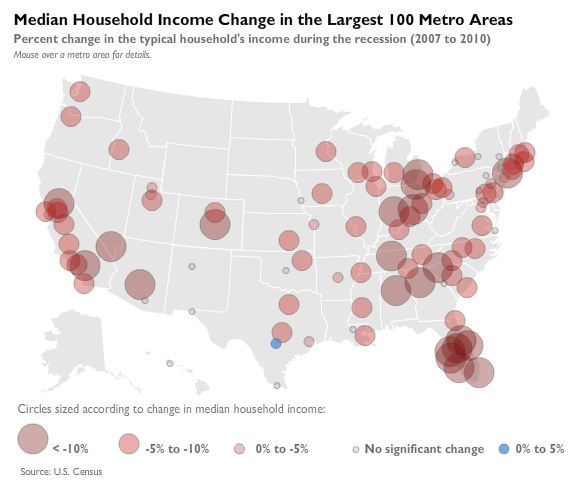
Ouch. My home metro of Richmond is looking pretty bad, with an increase in poverty in the 5% to 10% range. Good to see that Hampton Roads is holding its own. — JAB
Phew! Between the flow of stories from three days worth of Commonwealth Transportation Board meetings and the eruption of the Cville Bypass cost-estimate controversy, its been crazy here at the Rebellion. I’ve got a couple more stories to file from the CTB conclave and a couple of press releases to attend to but, frankly, I need a break from transportation. I will leave you with some random facts presented at the CTB meeting yesterday and then turn to other subjects.
Number of potholes patched by the Virginia Department of Transportation in fiscal 2011: 108,203.
Acres of grass along state roads and highways mowed: 159,000.
Number of stranded motorists assisted by safety service patrols: 53,300.
Dead animals removed from state roads: 12,000 … at a cost of $3.9 million, working out to an average of $325 per critter.
Fears of repeating another Solyndra or Fannie Mae/Freddie Mac fiasco shadowed discussions of an innovative Virginia Transportation Infrastructure Bank (VTIB) at the Commonwealth Transportation Board meeting today.
Funds from the VTIB, which will be capitalized initially with $283 million, will help finance transportation projects that might not otherwise be built. Initially, the bank will provide loan guarantees or pledges against other types of financial leverage. Repayments of principal and interest will be reinvested in new projects. Eventually, the bank may provide outright grants.
The infrastructure bank is a centerpiece of the McDonnell administration’s strategy to jump-start construction of transportation projects in Virginia. The administration plans to borrow $3.4 billion during its four-year term, a sum it hopes to leverage through toll-financed public-private partnerships. The infrastructure bank will chip in resources to help close deals for projects large and small, drawing upon revenue streams as diverse as developer proffers or leases from airport hangars. “If you’ve got a good financial adviser, you can turn one dollar into three or four dollars,” Transportation Secretary Sean Connaughton told the board.
Talk of leverage and loan guarantees was disconcerting to some members, however. “Do we have the safeguards in place to make sure this doesn’t turn into another Solyndra?” asked James E. Rich, the Culpeper District representative, referring to the solar-panel manufacturer that recently went belly up after the Obama administration guaranteed $535 million in the company’s debt.
John Lawson, chief financial officer of the Virginia Department of Transportation, outlined how the infrastructure bank would work. The Virginia Resources Authority (VRA) will administer the bank, while the CTB will set policies and have the final say over project approvals. The bank is expected to lend or grant money mainly to local governments or authorities, but private companies working under a public-private partnership agreement also are eligible. Loans will be amortized over as many as 35 years; principal payment can be delayed for five years after substantial project completion. Interest rates will be pegged to the rate paid by AAA government entities, but lower rates may be negotiated.
The VTIB will rate projects by 18 scoring criteria, such as project readiness, impact on air quality, safety enhancements and the recipient’s credit worthiness.
Of all the criteria, creditworthiness of the recipient is the most critical, asserted Cord A. Sterling, the Fredericksburg District representative. Other scores could be perfect, but a weak credit ranking should be an automatic disqualifier, he said.
“This is not Fannie Mae or Freddie Mac selling bundled loans,” insisted Connaughton. For the most part, the CTB will be considering projects that it has already voted to include in the Six-Year Improvement Plan. “This is just one tool in the tool chest.” In a worst case scenario, if the loan recipient goes under, said Connaughton, Virginia ends up with the underlying transportation asset — something it would have paid to build anyway.
Also, said the transportation secretary, the Virginia Resources Authority, which will help run the bank, has the financial savvy to sniff out the dubious financings. The VRA has issued $4.2 billion of dollars of loans for 875 scandal-free projects ranging from government buildings and solid-waste projects to brownfield remediation and oyster restoration.
The first project could well originate in Chesapeake, said Connaughton, with a nod to representatives from the Hampton Roads city in the audience. Not all projects will be for roads and highways, he added. He has already received inquiries for “ports” and “space,” the last presumably referring to the Wallops Island space-launch facility. “You’ll see loans for things you’ve never seen before.”
Connaughton said he would like to get the first projects financed before the General Assembly reconvenes in January, but he will be running on a tight schedule. Board members refused to sign on before details of the bank were published and the public had a chance to provide input. The next opportunity to vote on acceptance will be in December.
This article was written thanks to a sponsorship by the Piedmont Environmental Council.
Virginia Highway Commissioner Gregory A. Whirley is sticking with his $197 million estimate for how much money it will take to complete the Charlottesville Bypass, although he acknowledges that the final bids could come in above or below that number. The estimate was called into question yesterday by the Charlottesville Albemarle Transportation Coalition (CATCO), a citizens group that had found a much higher estimate in a Freedom of Information Act request. (See the previous post for details.)
Addressing an article in Charlottesville Tomorrow that detailed the CATCO findings, Whirley explained to the Commonwealth Transportation Board today how the estimate was derived. The original estimate came from the Culpeper District staff. An engineer in the central office staff got wind of the estimate, thought it was too low and developed his own estimate. But the engineer was basing his estimate on an outdated design, the VDOT chief said. The thinking at the district level had evolved on how to cut costs, he said, so he stuck with the district estimate.
The central-office estimate inflated costs in two major ways, Whirley said. First, the engineer used used old plans for the interchanges at both ends of the bypass that the district staff thinks can be significantly simplified. Second, it assumes that the construction crew will have to remove large volumes of rock and dirt. But the excavation costs can be cut significantly by elevating the highway. “I reviewed it (the central-office estimate),” he told the CTB. “I felt that the Culpeper district engineering estimate was closer to the project we planned to build.”
Whirley also noted that even the Culpeper estimate is not based on the final design. VDOT is issuing a design-build RFP, which means that bidding firms will execute the final design with the goal of bringing down costs even more. The hope, says Whirley, is that the winning contractor will “bring his creativity to the table and just maybe find a better way.”
James E. Rich, the Culpeper District representative on the CTB, expressed umbrage at the fact that VDOT had not informed the board of the full range of estimates before it voted to allocate $197 million to complete the project. “I feel left out of the process. I don’t want to have to FOIA the department” to get a full briefing on transportation projects in his district. Rich said that he still is not confident that the board has access to the correct financial and technical data.
Transportation Secretary Connaughton acknowledged that VDOT needs to complete a “cultural shift” in how it approaches costs. He’s seen too many instances of the department gold-plating projects, spending far more money than necessary. But he predicted that the Charlottesville Bypass bids would come back “dramatically less” than the official estimate. He also assured CTB members that no final decision will be made without their participation. “The board will be given the opportunity to say if we should go forward with this project.”
This article was written thanks to a sponsorship of the Piedmont Environmental Council.
The year: 2075. The American colonies on the Moon are getting restless under Washington’s tyrannical rule….
This second edition of “Dust Mites” has a snazzy new cover, includes helpful lunar maps, and is 5,000 words tighter than the original. The sequel, “Trogs,” is scheduled for publication this summer.
Advertisement
Advertisement
Advertisement
Advertisement
About
Bacon’s Rebellion is Virginia’s leading politically non-aligned portal for news, opinions and analysis about state, regional and local public policy. Read more about us here.
Fund the Rebellion
Shake up the status quo! Your contributions will be used to pay for faster download speeds and grow readership. Make a one-time donation by credit card or contribute a small sum monthly.
Can’t wait until tomorrow
For your Bacon’s Rebellion fix?
Enter your email address to receive immediate notifications of new posts by email.
SUBSCRIBE
Search Bacon’s Rebellion
Categories
Archives
The Jefferson Council
Protecting Thomas Jefferson’s Legacy at the University of Virginia
Forgot Your Password?
Shoot me an email and I’ll generate a new password for you.

 Source: The Tax Foundation



 by James A. Bacon