• A Pivot Point in China-American Trade… and What It Means to Virginia

    U.S. 460 at dawn

    Here is a whisper of good news for anyone who is worried by the hollowing out of America’s manufacturing economy: The mass migration of industrial production from the United States to China seems to be slowing. Indeed, some jobs are trickling back home.

    In a Saturday article, the Wall Street Journal highlighted the opening of a furniture factory in Lincolnton, N.C., a rare event for an industry that been devastated by outsourcing. Furniture made in China and sold in the U.S. once had a 50% price advantage. But soaring Chinese wages and higher shipping costs have scrambled the economic calculus. Bruce Cochrane, whose family made furniture for five generations before abandoning manufacturing in 1996, sees a pivot point in the economics of outsourcing. He figures he can compete in the U.S. by using state-of-the-art saws, routers and other machinery that will nearly double the productivity of his American workers.

    The Boston Consulting Group has identified seven industries where some production geared to the U.S. market is likely to shift back to the United States: transportation goods, computers and electronics, fabricated metals, machinery, plastics and rubber, appliances and furniture. The strengthening of the yuan and pressure from retailers for shorter turnaround times and smaller inventories are other reasons cited for abandoning the long supply chain to China.

    This comes as good news for the estimated 3.8 million Americans (800,000 in manufacturing and 3 million in service-sector support) who could find jobs as a result. Hopefully, some of those jobs will pop up here in Virginia. But it should give pause to public policy mavens in the Old Dominion who propose to invest hundreds of millions of dollars on highway infrastructure predicated on the assumption that the decades-long boom in container traffic from the Far East will continue unabated. I refer specifically to the construction of a new U.S. 460 between Petersburg and Suffolk in a public-private partnership seeded with state funds.

    Transportation Secretary Sean Connaughton anticipates a surge in truck traffic out of Hampton Roads when the completion of the Panama Canal widening in three years allows giant post-Panamax vessels to sail directly from China to the East Coast, bypassing the West Coast ports. As it happens, the opening of the upgraded Panama Canal overlaps the Boston Consulting Group’s time frame for the tipping of competitive manufacturing advantage from China back to the U.S. (See “The Panama Canal, U.S. 460 and the Public Fisc.”)

    How will these cross-cutting economic currents affect Hampton Roads? I don’t pretend to know. Connaughton may prove to be prescient in his expectation that container traffic out of Norfolk and Portsmouth will surge. But the fact is, nobody knows for sure.

    The question then arises, how much risk is the state willing to assume in the funding of the U.S. 460 project, the cost of which could run as high as $2 billion? It is clear that tolls alone will not cover the cost of building the 55-mile, limited-access highway. The Virginia Department of Transportation has committed to a $500 million subsidy to design and build the project.

    If the private consortia bidding on the project believed so much in the market opportunity that they were willing to invest their own capital, then the McDonnell administration should move heaven and earth to help make the project happen. But that’s not the case. Private investors are not willing to assume that risk. That worries me. Further, I see no sign that any third party, whether a newspaper or citizens group, is giving the project the outside scrutiny that it warrants. That worries me, too.

    — JAB


  • Does More Education Really Equal Greater Economic Output?

    by James A. Bacon

    Identify the person who said this quote: “In Virginia, one of the key goals of Governor Bob McDonnellโ€™s Top Jobs higher education legislation is to increase the number of degrees earned by Virginians by 100,000 over the next 15 years. Why? Because more education equals greater economic output and better quality of life for all citizens.”

    That statement could have come from any of hundreds of members of Virginia’s political class, for it reflects a near-universal consensus. The blind faith in “more education” regardless of circumstances is common to Democrats, Republicans, Greens and just about everyone other than a few hard-nosed cynics of a libertarian bent… like myself. This particular quote came from Teresa A. Sullivan, president of the University of Virginia, writing in the current edition of the Virginia News Letter (which just happens to be a UVa publication).

    In “Higher Education as an Engine of the American Economy,” Sullivan makes a number of points that are worth keeping top of mind as Virginians think about how to prosper in a globally competitive knowledge economy. Universities educate the next generation of citizens. They are centers of R&D. They are magnets for the creative class. They are important players in the ecosystem of business and technological innovation. In sum, it’s difficult to imagine any state or metropolitan region prosper in the absence of strong, vibrant universities. Writes Sullivan:

    “Perhaps more than ever, we need our universities to function well and to receive adequate support because universities are uniquely well suited to tackle the big, complex problems we are facing as a society such as climate change, disease control, economic turmoil, and other multi-faceted problems. University researchers and scholars are able to work across disciplines and to draw connections between their areas of expertise to arrive at solutions for these complex problems. Universities are built around a spirit of collaboration that todayโ€™s problems demand.”

    All very true. But as the national economy hurtles toward Boomergeddon, threatening to drag Virginia with it, we no longer have the luxury of writing anyone a blank check based on bromides and generalities. Yes, we need to support our colleges and universities. But, no, we don’tย  blindly accept the proposition that “more education equals greater economic output and better quality of life for all citizens.”

    In a utopian world, everyone who wants to go to college could do so. But we live in the real world, a world in which millions of Americans are raised in a culture of poverty that does not venerate learning. We live in a world in which children are subjected to an educational system so dysfunctional that they longer they are exposed to it, the worse they perform in international tests. We live in a world in which a significant percentage of college students are intellectually too ill equipped to gain any benefit from their courses. Given the ubiquity of remedial classes and a disgracefully high college drop-out rate, it appears that we have already shot way past the optimal enrollment in our universities already.

    Should we really be enrolling 100,000 more students in Virginia universities? I suspect not. Instead of pouring more money into universities on the vacuousย  grounds that “more education equals more economic output,” we should be investing resources — or, better yet, restructuring our K-12 educational institutions — so they properly prepare more young people for the rigors of college before they go to college. It’s hard for university presidents to turn down more money from state government. But citizen-taxpayers should demand a higher order of critical analysis.


  • Five Miles Away, a World Apart

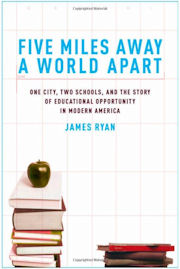
    University of Virginia Law Professor James Ryan is attracting a lot of attention with his new book, “Five Miles Away, a World Apart,” which looks at the issue of school desegregation through the prism of two schools divided by a municipal boundary: predominantly white Douglas Southall Freeman High School in Henrico County and predominantly black Thomas Jefferson (Tee Jay) High School in the City of Richmond. โ€œThe line that separates Tee-Jay and Freeman,” he writes, “represents the most important boundary in public education: the boundary between city and suburban schools.โ€

    A former law clerk for Supreme Court Justice William Rehnquist, Ryan is not easily pigeonholed ideologically. He is deeply concerned about the inequities created by unequal educational opportunity, believes in an integrated society…ย  and supports vouchers as a means of empowering parents with school choice. He concludes that a lack of money is not what ails inner-city schools — they often are better funded. What low-income students need is to rub elbows with their more affluent peers on the theory that they will absorb the middle-class ethos of higher expectations, parental involvement and harder academic application that leads to educational achievement.

    Richard Kahlenburg, a senior fellow with the Century Foundation, writes a mostly positive review for the New Republic. Amy L. Wax, a University of Pennsylvania law professor, writes a mostly critical review for the Hoover Institution. I haven’t read the book so I can’t comment upon it.ย  Although the book was written for a national audience, I live in the Freeman school district. I also suffer from the historical amnesia — how, exactly, did things get this way? — that most afflicts most Richmonders. Hopefully, I’ll get around to reporting back on this book.

    — JAB


  • The Wonk Salon, October 8, 2011

    Open Source IT Architecture in Houston
    James A. Baker Institute
    It’s time for Houston to move from expensive, proprietary IT platforms an open source architecture. Among other initiatives, the city should develop a wiki platform to capture institutional knowledge.

    Uh, Oh, Our Water Infrastructure Is Decaying, Too
    Economic Policy Institute
    Rebuilding America’s decaying water/waste water infrastructure would cost $188 billion but it could create 1.9 million jobs and be incredibly cool. Green roofs, permeable pavements and bioswales, anyone?

    Minority College Instructors Improve Minority Student Performance
    National Bureau of Economic Research
    Minority students in community colleges perform better when taught by instructors of similar race. Better roll models… decreased threat of “stereotype threats”…


  • Leveraging Dollars with Data

    A data warehousing project coming online in late 2012 will help Virginia lawmakers forge education policy based upon hard data instead of anecdote and ideology.

    By ย James A. Bacon

    Tod Massa is big man with big ideas. His goal is to build a โ€œLongitudinal Data System” (LDS) that will track the progress of Virginians from pre- Kindergarten through high school, into college and then through their working lives. With a bear-like frame and a broad, bearded face, he speaks passionately about the potential of the $17.5 million project to โ€œfundamentally transformโ€ education and workforce-development policy in the Old Dominion.

    When crafting policy, law makers rely upon anecdote and hunch, ideology and politics, and patchy, often-inconclusive research. The state has lots of data but it resides in different silos so itโ€™s of limited use. The Department of Education (DOE) maintains data on K-12 students such as enrollment, graduation rates and test scores. The State Council for Higher Education in Virginia (SCHEV) keeps track of college enrollments, degrees earned and financial aid. The Virginia Employment Commission has access to employment and wage/salary data. But none of the silos connect.

    The DOE can’t tell, for instance, how many graduates of a particular high school went on to earn a college degree, much less how much they earned when they entered the workforce. By December 2012, however, the LDS will link the separate databases, allowing analysts to get definitive answers to that type of question. If it can dispel the uncertainty that fogs so much debate over education and workforce development, a modest investment in data warehousing will pay for itself hundreds of times over.

    โ€œItโ€™s an exciting time in higher education and state government,โ€ says Massa. Virginia, like other states, has been engaging too long in โ€œdrive-by school improvements,โ€ he says, spending vast sums of money to little effect. Soon it will be possible to answer many questions not with a survey, not with a sample, but with hard data on what is. Pet theories from all across the ideological spectrum will bite the dust and a more effective educational system will emerge.

    As director of policy research and data warehousing for SCHEV, Massa represents one of three key agencies that are collaborating on the project. Virginia, he says, is one of 20 states participating in a federal initiative funded under the American Recovery and Reinvestment Act (widely known as the โ€œstimulusโ€ bill). What will be distinctive about Virginiaโ€™s linked databases is a mechanism for โ€œde-identifyingโ€ individual identities in the database. Names, social security numbers and other tags will be stripped out and replaced with numerical codes. In the Old Dominion, he insists, it will be โ€œclose to impossibleโ€ for anyone’s privacy to be violated.

    A top priority in educational policy right now is to measure how effectively teachers, principals and schools educate students. Virginiaโ€™s LDS will allow analysts to track, among many other things, how well a teacherโ€™s students perform in standardized test scores. That kind of study has been accomplished on a small scale before, but Virginia will be able to roll it out statewide. Such data can be used, with appropriate adjustments for those who teach more challenging students, as the basis for rewarding good teachers and weeding out bad ones.

    The list of questions is endless. Whatโ€™s the payoff from investing in universal pre-K? Are college grads earning enough to pay back their student loans? Are certain majors valued more highly in the workplace?

    Peter Blake, interim SCHEV director, gives another hypothetical example: Should the state channel its financial support for higher ed into undergraduate programs or should it support graduate schools, even though they cater extensively to out-of-state residents? One way to approach that question is to find out how many graduate students at Virginia colleges and universities end up getting employed in Virginia and how much money they earn. It might be easier to justify state support, he says, if it can be shown that grad schools contribute to the build-up of Virginiaโ€™s human capital.

    Massa envisions researchers rummaging through the data and looking for patterns and outliers. For example, only 30% to 50% of the students attending Virginia community colleges complete a degree (with an in-state institution) within 10 years. But the figure for Richard Bland College, a two-year college in Petersburg, is 77%. Why is that? Is there something unique about the student population, or is the college doing something different? Perhaps other community colleges can learn from its example.

    What really gets Massa stoked is the idea of letting scholars and members of the public use the data to generate their own findings. Qualified researchers will be given access to all the data under contract and, he hopes, a broad selection of the data will be made accessible to anyone with a Web browser.ย  He sees citizens being able to build their own data dashboards, create reports and publicize their findings. โ€œI want the data shared,โ€ he declares. Ninety percent of the citizen analysis may be worthless โ€“ but 10% might be spun into public-policy gold.


  • The Demographics of College Athletics

    I was poking around the National College Athletic Association website looking for a university-by-university breakdown on how much money college athletics lose. I never could find that but I did stumble across a report on ethnicity and college sports. Click here (and scroll to page 12) to view a breakdown of participation in 30 college sports by ethnicity. It’s a fascinating sociological profile.

    In the spirit of healing racial divides, let me point out that black and white Americans have more in common than they realize: They’re much bigger fans of football and basketball than Hispanics, Asians or American Indians. Indeed, blacks and whites are far more likely to participate in college athletics than other ethnicities. (This may or may not be a good thing when it comes to academic achievement, but that’s another issue.)

    Which sports are most closely identified with a particular race, in that the ethnicity is over-represented in that sport? I’m glad you asked.

    The whitest sports are skiing (90.9% of male student-athletes are white), lacrosse (90.2%) and golf (87.1%). The skiing thing makes sense, given the sport’s Nordic origins. But lacrosse? Hey, the Iroquois invented the sport, and American-Indians account for only 0.3% of male college lacrosse players. Maybe it ‘s because lacrosse has become identified with preppies.

    The blackest sports are basketball (37.8% of male basketball players are black), football (28.1%) and outdoor track (20.2%). The two college sports where you wont’ see any black men…. badminton and equestrian.

    The most Hispanic of sports is NOT baseball (only 4.1% of male college baseball players are Hispanic). Nope. The big sports for Hispanic men in college athletics are volleyball (14.4%), water polo (5.8%) and soccer (5.5%).

    How about Asians? Their big sport is… fencing (7.9%)! Not a surprise, actually, if you consider the long tradition in Chinese and Japanese cultures of the sword-fighting martial arts. Then comes gymnastics (6.1%) and tennis (4.1%).

    As for American-Indians, let’s just say that Jim Thorpe was an outlier. American-Indians aren’t much of a factor in college athletics. For males, the biggest sport is water polo, where they account for 0.7% of student athletes.

    (Note: Female participation rates tracks male participation in most sports fairly closely.)

    — JAB

    P.S. In case you wondered about sports profitability, in 2010, Division I college sports generated only 74.1% of the revenue needed to support their programs. The rest came from student fees and institutional support. For the typical (median) school, men’s football generated a profit of $3.1 million, men’s basketball made $790,000 in profit and everything else lost money. If I ever find the numbers for Virginia institutions, I will publish them.


  • The Wonk Salon, October 7, 2011

    Refining the Role of Charter Education in America
    Center for American Progress
    There are 5,000 charter schools in the United States but waiting lists indicate a demand for more. Congress should encourage the states to open more charter schools while also holding them accountable.

    How Technology Can Transform Education
    Brookings Institution
    Imagine a system in which teachers take on the role of coaches, students learn at their own pace, technology tracks student progress, and schools are judged based on the outcomes they produce.

    Everything’s Big in Texas… Except School Choice
    Texas Public Policy Foundation
    Texas has made strides towards school in choice in the past decade but the Lone Star State has a long way to go before it becomes a leader in education reform.

    How Are New Orleans Charter Schools Working Out?
    Rand Corporation
    Hurricane Katrina wiped out the old New Orleans public school system. Charter schools have flourished since then. Parents with children in charter schoolsย  experience greater satisfaction.

    How to Squeeze $2 Trillion out of Future Health Care Costs
    Urban Institute
    Obamacare did not begin to exhaust all the cost-containment ideas for health care. Start by capping the tax break for health care insurance, doing a better job of coordinating care, and enacting malpractice reform.


  • Occupying Richmond

    by Norm Leahy

    On or about October 15th, the “Occupy [insert city name]” phenomenon intends to make its Richmond debut. The nascent group has quite a large Facebook presence — larger than what the tea parties were able to muster at their height back in 2009 — and reading through the postings provides an education in online organizing. It’s also a sometimes hilarious, sometimes depressing, trip through the fever swamps.

    There are a few earnest folks trying to herd the cats into Richmond’s Monroe Park this weekend for an organizational meeting to help determine why they intend to conduct an occupation and where that occupation will take place. Early on, it was supposed to be near the Federal Reserve building in downtown — completing the echo of the tea party protests held near there in 2009 and 2010. Or maybe it won’t be there. In one of the Facebook posts, we learn:

    Kanawha Plaza has not been decided by consensus as our place of occupation. We will, however, reach a modified consensus at our next *full* General Assembly meeting on October 15th; Monroe Park, 4pm. Come back to stay informed on additional General Assembly/Working Group meetings that arise between now and then. This is our time, let’s seize it in solidarity.

    The resulting discussion would make Monty Python proud.

    Yet under the conflicting visions, incompatible agendas and vague ideas, there’s no denying that, like the tea partiers before them, this potential gathering has a problem with what they see as an unaccountable force lording it over the rest of us. It must be stopped.

    But what is this force? Is it the Federal Reserve that insists on propping up a system that has become rotten? Is it the financial institutions that were rescued from an abyss of their own making with taxpayer dollars? Or is it the larger corporate world, parts of which are increasingly wed to, and dependent upon, government for their livelihoods?

    It seems to be all of these things — but we’ll have to wait for the reports of the working groups to be sure.

    Until those minutes are read, these would-be occupiers do seem to have a lot in common with elements of the tea party movement. Those earlier protesters had no love for the bailouts, the Fed or government giveaways to corporations. But the similarities tend to blur after that.

    The tea partiers, in general, wanted and continue to advocate for less government. If the list of grievances published by the occupiers of Wall Street offers any guide to what this new order of protesters wants, it’s more government and less (much less) of what they see as corporate over-reach. Consider:

    They have poisoned the food supply through negligence, and undermined the farming system through monopolization.

    They have profited off of the torture, confinement, and cruel treatment of countless animals, and actively hide these practices.

    They have continuously sought to strip employees of the right to negotiate for better pay and safer working conditions.

    They have held students hostage with tens of thousands of dollars of debt on education, which is itself a human right.

    They have consistently outsourced labor and used that outsourcing as leverage to cut workersโ€™ healthcare and pay.

    They have influenced the courts to achieve the same rights as people, with none of the culpability or responsibility.

    They have spent millions of dollars on legal teams that look for ways to get them out of contracts in regards to health insurance.

    They have sold our privacy as a commodity.

    And so on. The irony, intentional or not, is that not a few of these grievances are the result not of corporate greed, but individual choice. Holding students hostage to loan debt? Sorry, you (or your folks) singed for those loans. We can debate — and often have here at the Rebellion — the costs of higher education. The beef these folks have is with the schools, not corporations. And also with themselves, for choosing to sign on the dotted line.

    Have evil corporations sold your privacy down the river for their gain? Undoubtedly some have. That would include Facebook, the platform these folks use to organize. But also remember — Facebook and others can only sell that which you give them. Want to take back your privacy? Here’s small tip: never fill out warranty cards. Their real function is to build a marketing database, not to give you better service.

    But let’s also hope that these protesters understand that what they, the tea parties and others rail against is not new. Whether it was the king and his ministers, the Bank of the United States, the Freemasons, Demon Rum, the railroads, the gold standard, war profiteers, the Red Menace or any other vague, faceless, utterly nefarious entities, bad economic times breed discontent. Even it what some consider the best of times, there are those who seethe below the surface, hoping for revolution.

    It’s the American way. And it usually results in folks getting the bile out of their systems and then going back to their own thing until the next perceived crisis rears its head.


  • Transportation Construction Funds to Run Out in Five Years

    Virginia's Incredible Shrinking Construction Budget

    Virginia will run out of state money to build new roads in about five years, Transportation Secretary Sean Connaughton told the Chamber of Commerce’s newly established transportation committee Wednesday. Eroding motor fuels taxes and high maintenance costs are consuming the transportation budget. (Read the Times-Dispatch story here.)

    The state’s dilemma is familiar to readers of the Bacon’s Rebellion blog. (Seeย  “The Crossover Conundrum.”) Most of the information detailed in the T-D article has been reported here already. But writer Peter Bacque did find a few new wrinkles — most notably the astounding fact that funds for new construction will be gone in five years. I don’t remember anyone making that point at the last Commonwealth Transportation Board meeting.

    The other nugget is this: The McDonnell administration, wrote Bacque, is “considering seeking additional revenue sources dedicated to maintenance.”

    What revenue sources would those be? More tolls? Connaughton has already rolled out his proposal for tolls on Interstate 95. An increase in the gas tax? Connaughton gave no hint of such a thing at the September CTB meeting.

    I am torn. Clearly, the fiscal situation is unsustainable. Virginia needs more money to build a transportation system capable of carrying the state through the 21st century. Trouble is, there is no system for coordinating transportation investments with land use decisions, nor is there a methodology for prioritizing projects on the basis of Return on Investment (measuring payback in terms of congestion mitigated, improved safety, economic development and environmental impact). Many Virginians believe that funding decisions are made on the basis of ideological and political considerations, not to benefit to the taxpaying public. Until trust is restored, there will be limited support for higher taxes and fees.

    — JAB


  • The Wonk Salon, October 6, 2011

    Non-Precinct Voting on the Rise
    Baker Institute
    Non-precinct voting (either early in person or by mail) has been on the rise over the past 15 years and could become a majority of all voting as Americans place a greater emphasis on convenience.

    Hunger Costs America $168 Billion a Year
    Center for American Progress
    Add up all the costs of hunger — illness, lost productivity, charity and impact on education — and the “hunger bill” for Americaย  is $167.5 billion a year. The bill for Virginia is $3.13 billion.

    Strengthening Career Pathways for D.C. Youth
    Brookings Institution
    Too many D.C. youth are quitting their education before completing high school or college degrees. Let’s set a goal for 90% of D.C. youth to earn post-secondary credentials and find work by age 24!

    Revitalizing Community Journalism
    Aspen Institute
    As the distribution of news migrates from a top-down model to a distributed model, the journalism profession needs to reinvent itself. Donate generously to Bacon’s Rebellion. (Nah, they didn’t really say that — but they should have.)


  • The Wonk Salon, October 5, 2011

    Yes, Private Universities Are Subsidized, Too
    American Enterprise Institute
    State aid? Chump change. When you factor in not-for-profit status and student loans, elite private colleges and universities receive greater public support than public institutions.

    ESAs: Another Path to School Choice
    Heritage Foundation
    Educational Savings Accounts (ESAs) offer several advantages over other forms of school choice, including the flexibility of allowing families to spend the money on tuition, tutoring, textbooks and virtual classes.

    What to Do about “Dual Eligibles”
    Urban Institute
    Nine million Americans are eligible for both Medicare and Medicaid, creating an incentive for states to shift Medicaid patients, whom they help pay for, to the Medicare program, which Uncle Sam pays for — a trend that may undermine care for vulnerable populations.

    Benchmark Assessments Do Help Math Achievement
    American Institutes for Research
    A study of 59 schools in Indiana found that the mClass and Acuity benchmark assessments had a measurably positive impact on student achievement in grades 3 through 8.


  • The Wonk Salon, October 4, 2011

    Yelp, Here Comes ILP (Intelligence-Led Policing)
    Rand Corporation
    Law enforcement has evolved from political policing to professional policing to community-based policing, and it’s morphing again — to Intelligence-Led Policing, which relies heavily upon database analysis.

    Rebuilding Wisconsin’s Interstates with Tolls
    Reason Foundation/Wisconsin Policy Research Institute
    Over the next 30 years, Wisconsin’s Interstate system will exceed its 50- to 60-year life span. Modernizing it will cost $26.2 billion, way more money than Wisconsin has. Thirty-year bonds backed by tolls could pay for most of the reconstruction.


  • Should Dominion Virginia Power Spin Off its Nukes?

    Over the past two years, Dominion Virginia Power has experienced 14 unplanned shutdowns of its four nuclear reactors, by the Times-Dispatch’s counting. Is it time for the power company to consider spinning off its nukes or selling them to someone who can do a better job of running them?

    I ask that question after encountering a new study by Lucas W. Davis and Catherine Wolfram, “Deregulation, Consolidation and Efficiency: Evidence from U.S. Nuclear Power,” published by the National Bureau of Economic Research. Here’s the argument they make:

    For four decades all nuclear power reactors in the United States were owned by regulated utilities. Few utilities owned more than one or two reactors and utilities received a rate of return on their capital investments that was largely disconnected from operating efficiency. Beginning in the late 1990s electricity markets in many states were deregulated and 48 of the nationโ€™s 103 nuclear power reactors were sold to independent power producers selling power in competitive wholesale markets. These divestitures have led to substantial market consolidation and today the three largest companies control more than oneโ€third of all U.S. nuclear capacity.

    … We find that deregulation and consolidation are associated with a 10 percent increase in operating efficiency, achieved primarily by reducing the frequency and duration of reactor outages. Efficiency gains were experienced broadly across reactors of different types, manufacturers, and vintages, with the largest increases in the spring and fall during the peak months for refueling.

    The resulting increase in electricity production exceeds 40 billion kilowatt hours annually, valued at $2.5 billion annually at current prices. “This increase is almost pure efficiency gain, achieved without building a single new plant or constructing a single additional mile of transmission capacity,” the authors note. The increased electricity output, they add, displaces mostly coalโ€ and naturalโ€gasโ€ fired power, implying an annual decrease of 38 million metric tons of carbon dioxide emissions.

    I was always under the impression that Dominion ran its nukes pretty well, so that 10% efficiency gain may not apply here. But we won’t know for sure if we don’t ask. Such a gain, if possible, would delay the need to add more power-generating capacity, thus keeping a lid on electric rates. Lower CO2 emissions are a bonus that environmentalists should love. Perhaps the State Corporation Commission should look into it.

    — JAB


  • High Speed Rail’s End

    by Norm Leahy

    The latest issue of Ken Orski’s “Innovation News Briefs,” delivers a blow to the hopes of those who thought that, one day, high speed trains would zip between Washington, DC and pokey old Richmond:

    By including only a token $100 million for high-speed rail as a “placeholder” in their FY 2012 budget recommendations (a sum that is likely to be further cut in the House-Senate negotiations on the FY 2012 appropriations), Senate appropriators have done more than merely declare a temporary slowdown in the high-speed rail program. They have effectively given a vote of “no confidence” to President Obamaโ€™s signature infrastructure initiative. Along with their House counterparts who had denied the program any new money, the Senate lawmakers have sent a bipartisan signal that Congress has no appetite for pouring more money into a venture that many lawmakers have come to view as a poster child for wasteful government spending.

    That doesn’t mean the feds aren’t trying to spend whatever monies they still have at their disposal. Quite the contrary:

    In the meantime, the Department of Transportation has rushed to distribute the balance of the authorized HSR dollars, lest Congress decides to rescind any funds that remain unobligated. Continuing its practice of scattering money far and wide rather than focusing it on one or two worthwhile projects, the Federal Railroad Administration approved in September over $ 480 million worth of planning, engineering and construction grants “to improve high-speed and intercity passenger rail service” in 11 states. The beneficiaries are New York, Texas, New England (Maine, Vermont, Rhode Island, Connecticut), North Carolina, Virginia, Washington State, Oregon and Pennsylvania. The awards range from $149 million to New York State to as little as $13 million to the state of Oregon, and they average under $40 million per individual grant. It remains to be seen how quickly the recipient states will put these funds to workโ€” and what kind of service improvements these grants will bring about.

    Probably not much. As BR’s own Peter Galuszka noted in this Style Weekly piece from 2010, bringing the rails that run through Richmond and the preferred Main Street Station site up to high speed snuff would cost anywhere between $122 million and $600 million. The $44 million federal grant given to Virginia is reserved for “environmental analysis and preliminary engineering.”

    In other words, the trains won’t be getting faster, but there will be a few more studies published.


  • Restraining State Spending through Governance Reform

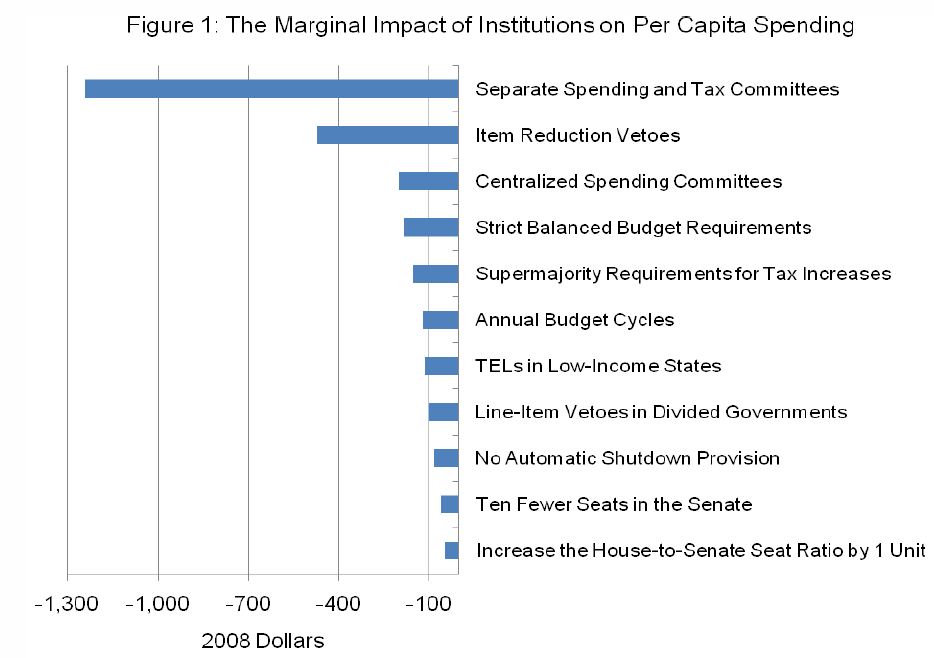
    Fiscal policy is on an unsustainable path at all levels of government. While reformers should look for ways to reduce spending on particular budget items, tomorrowโ€™s legislatures may easily reverse these cuts, argue Matthew Mitchell and Nick Tuszynski with George Mason University’s Mercatus Center. By contrast, they write, “a change in the rules that govern the political processโ€”the ‘institutions’ that shape a budgetโ€”can have a lasting effect on spending for years to come.”

    In a new paper, “Institutions and State Spending: An Overview,” the two scholars survey the literature to ascertain which institutional characteristics of state governance are associated with the lowest rates of spending growth. The clear winners: (1) separate spending and tax committees in the state legislature and (2) item reduction vetoes. Other commonly touted measures such as line-item vetoes and tax-and-expenditure (TEL) limits do have an effect but that effect is modest.

    In 2008, state and local expenditures per capita averaged $5,708 across the country. States that embraced the institutions of governance listed above enjoyed lower per capita spending by the stated amounts. (Click on chart for more legible image.)

    If only Mitchell and Tuszynski would tell us which institutions are in effect in Virginia, we’d know where to get started!

    — JAB