• Virginia: A Beacon of Job Opportunity for African Americans?

    Even before the recession, many Midwestern African-American communities were in distress, writes Algernon Austin with the Economic Policy Institute in “High Black Unemployment Widespread across Nation’s Metropolitan Areas.” Black unemployment was especially high in rust belt cities like Detroit, Cleveland and Milwaukee. By contrast, he notes, blacks fared relatively well in Sun Belt metro areas such as Tampa, Miami and Las Vegas.

    And in which of the 31 metro areas surveyed did blacks do the very best of all? Let’s see. The Washington metro area ranked 29th in black unemployment in 2007, with a rate of 4.8%. Richmond ranked 30th, with 4.7% black unemployment. And Hampton Roads ranked 31st, or the lowest of all, with 4.1% black unemployment. Virginia metros grabbed the three lowest slots! Say what you will about Virginia’s Scrooge-like social safety net and allegedly retrograde social attitudes, but when times were good, blacks enjoyed greater employment opportunities than in the supposedly progressive states of the Midwest and Northeast.

    What happened when the recession hit and unemployment soared? African-Americans were harder hit than other Americans; arguably, they were the most vulnerable because they were the least equipped with skills and education. Even so, they still were better off in Virginia than they were elsewhere in the country.

    Of the 31 metro areas surveyed, Richmond ranked 28th in black unemployment, with a rate of 10.6%. Then came Washington in the 29th spot with 9.6% black unemployment. New Orleans snuck into the 30th spot. But Hampton Roads still stood out as the metro area with the lowest rate of black unemployment: 8.5%.

    To some degree, low black unemployment rates in Virginia metros reflect the fact that unemployment generally is and has been lower in Virginia than elsewhere in the country. Delving a little deeper, Austin compiled one other measure of interest: the black-to-white unemployment ratio. By that measure, Virginia doesn’t score as well.

    With a black-to-white unemployment ratio of 2.0 — meaning that blacks were two times more likely to be unemployed than whites — the Washington metro region ranked 13th in the country in 2010 (tied with four other regions). Richmond ranked 20th with a ratio of 1.8. But Hampton Roads was still looking good, tied with Kansas City and New Orleans with a ratio of 1.3 for the lowest black-to-white unemployment ratio in the country.

    All things considered — overall economic health and a low black-to-white employment ratio — Hampton Roads would seem to be a beacon of employment opportunity for African Americans. Basket cases like Detroit and Milwaukee garner a lot of attention for African American economic hardship. Maybe someone should look at Hampton Roads as a case study in African American opportunity.

    — JAB


  • A Step in the Right Direction

    Land use — the missing piece?

    This just in… The Virginia Department of Rail and Public Transportation (DRPT) will conduct a “Super NoVa” study of commuting patterns to help determine transit and transportation demand management (TDM) enhancements for Northern Virginia. The study will disregard jurisdictional boundaries, and it will extend beyond the traditional definition of “Northern Virginia” to encompass the entire commuting shed of the Washington area, including points as far west as the Shenandoah Valley and as far south as Culpeper and Caroline counties.

    The study will evaluate existing and future population and employment centers to identify potential transit and TDM improvements that will increase mobility and provide greater transportation choice in the northern part of Virginia, states a press release from the governor’s office. The study will produce concrete recommendations with a strategic regional focus.

    โ€œEvery locality in Northern Virginia faces transportation challenges and most have developed jurisdictionally specific projects to address those challenges,โ€ said Secretary of Transportation Sean Connaughton. โ€œWe must broaden our focus and find the most cost-effective transit and TDM services that have the biggest impact on a region-wide basis. The Super NOVA study will help us do that.โ€

    Here’s what’s good about the study. First, it is taking a labor-market view instead of jurisdictional, planning-district or even metropolitan-area view. That means the findings will better reflect economic reality. Second, the Department of Transportation is expanding its focus beyond building roads, it’s main preoccupation until now, to include not only transit but transportation demand management. Both are important steps forward.

    Here’s what’s lacking: Judging from the press release, the study will not make the land-use connection. Talking about transportation without understanding its interplay with human settlement patterns is like describing how to bake a cake with flour, sugar and eggs… with no reference how to mix them with milk and water. As described, the study will take existing human settlement patterns as a given and endeavor to fashion transportation policies to serve them. But human settlement patterns are dysfunctional and unsustainable throughout much of the Washington metropolitan area, especially in peripheral counties, and probably cannot be served economically with the resources Virginia has available.

    But it’s too early to judge the study. If it concludes that much of the Northern Virginia commuting shed is impossible to serve with mass transit in the absence of dramatic changes in human settlement patterns, then it could prove to be well worth the effort. Here’s hoping that the authors take an extra-wide view of their task.

    — JAB


  • More Bad News — and Bad Advice — from the 2011 Urban Mobility Report

    by James A. Bacon

    The recession may have provided a temporary respite in traffic congestion — people tend to drive less when they’re not working, and trucks move less freight — but the picture will worsen rapidly when economic recovery takes hold. So say the authors of the 2011 Urban Mobility Report published by the Texas Transportation Institute.

    The national picture will play out in Virginia’s three metropolitan areas included in the study. The congestion relief provided by the recession for the Washington, Hampton Roads and Richmond regions has largely evaporated already. The picture is especially bleak for Richmond, once one of the least congested of the nation’s largest metro areas, whose ranking in the national congestion standings continues to rise.

    The Urban Mobility Report is simultaneously a highly useful exercise in documenting the cost of traffic congestion in the United States and a disturbing part of the problem. On the one hand, the range of data it collects is the most extensive and authoritative anywhere and, for all of its limitations, it remains the best gauge we have for measuring congestion and its costs. On the other hand, the authors persist in the belief that a Texas-styled approach of building more roads will get us out of the mess we have created.

    To be sure, the authors advocate a “balanced” approach that includes investing in mass transit, traffic management strategies such as signal coordination and rapid crash removal, and demand management strategies like telecommuting and flexible work hours. And they add, “Land use and development patterns can play a positive role, as well.” But the report perpetuates the belief that regions can build their way out of their congestion woes. โ€œIf you invest in roads and transit, you get better service and access to more jobs,โ€ says co-author Tim Lomax. โ€œGenerally speaking, mobility investments in congested areas have a high return rate.โ€

    Lomax offers no evidence to justify that last statement. The truth is, many projects are driven by political considerations in the total absence of Return on Investment analysis. Moreover, the complex interplay between transportation and human settlement patterns means that the rate of return is exceedingly difficult to ascertain even if some one tried to perform an analysis. Yes, Virgina does need to invest more in transportation. The trick is figuring out which investments to make. Dumping billions of dollars into “doing something” on the grounds that it’s better than doing nothing could, in fact, be worse than doing nothing if we put money into the wrong projects.

    With those caveats, let’s look at the picture in Virginia’s largest metro regions…

    Washington metro area: 68% of the region’s arterial and interstate lane-miles and 84% of vehicle miles traveled (VMT) are congested during periods of peak travel. (“Rush hour” lasts seven hours each day.) The cumulative delay per person is 74 hours yearly and the cost per commuter in time and fuel is $1,495.

    Virginia Beach metro area: 44% of the region’s arterial and interstate lane-miles and 50% of VMT are congested during periods of peak travel. (Rush hour lasts four hours each day.) The cumulative delay per person is 34 hours yearly and the cost per commuter in time and fuel is $654.

    Richmond metro area: 36% of the region’s arterial and interstate lane-miles and 33% of VMT are congested during periods of peak travel. (Rush hour lasts 2.5 hours each day.) The cumulative delay per person is 20 hours yearly and the cost per commuter in time and fuel is $375.

    To me, the big story is the continually worsening situation in the Richmond region. No one needs to tell Northern Virginians and Hampton Roadsters that they have huge traffic problems but, except in spot locations, congestion has yet to become a major concern of Richmonders. Accordingly, Richmond political and civic leaders perpetuate dysfunctional human settlement patterns. But congestion is steadily worsening and will become a major problem in the foreseeable future. In 2005, Richmond was ranked 88th among 101 metro areas by the cost of congestion per commuter. In 2010, it ranked 68th. The number of congested lane-miles has increased from 30% five years ago to 36% in 2010. The percentage of vehicle miles driven increased from 28% to 33%.

    And why is that? The Richmond region is sprawling faster than almost any other region in Virginia, opening up more land for development, building at lower densities and perpetuating the pod form of development with disconnected and segregated cul de sacs, office parks and shopping centers. While our civic leaders focus on panaceas like high-speed passenger links to Raleigh and Washington, they remain blissfully unaware as builders and developers, working within the parameters set by government, pour billions of dollars into outmoded human settlement patterns. Will we be the last region in America to wake up and see how we are suffocating our future?


  • Update to “Bedeviled and Becalmed”

    Alert reader “Too Many Taxes” brings to my attention the sponsorship of House Bill 1198ย  by Del. James M. LeMunyon, R-Chantilly, in the past session of the General Assembly. The bill would have required state transportation agencies to “evaluate all significant transportation projects in and near the Northern Virginia Transportation District, including both highway and mass transit projects, and provide an objective, quantitative rating for each project according to (i) the total amount of reduction in traffic congestion regionally and, separately, (ii) the amount of reduction in traffic congestion expected to be achieved per dollar cost of the project.”

    The bill would have been even more useful if it had applied the requirement statewide to all projects over a certain size, and if it had required the state to document the impact of transportation projects on accidents, economic development, the environment and public safety. According to TMT, the bill sailed through the House but died in the Senate Finance Committee.

    If someone knows why, please let us know — post a comment!


  • Bedeviled and Becalmed

    The Commonwealth Transportation Board seems adrift, unsure how to cope with shrinking resources. Here’s a place to start: Fund projects that provide the greatest Return on Investment and focus on the nexus between transportation and land use.

    by James A. Bacon

    Last week Transportation Secretary Sean Connaughton held a strategic planning session with the Commonwealth Transportation Board, the state entity that sets policy and funding priorities for Virginiaโ€™s transportation system. The dilemma: Given the relentless erosion of the motor fuels tax that leaves Virginia fewer and fewer resources to meet its transportation needs, what can the commonwealth do differently to run the system more efficiently and equitably?

    In a series of presentations, Virginia Department of Transportation (VDOT) and Department of Rail and Public Transportation (DRPT) staff described McDonnell administration initiatives such as the creation of a state infrastructure bank, new cash-management policies and a shift to design-build contracts. Exploring big-picture ideas, the board heard from Jonathan L. Gifford, a George Mason University professor who laid out options for devolving responsibility for secondary roads to the counties and from a subcommittee that had looked into ways of making the maintenance system work better.

    The two-day retreat in Portsmouth covered a lot of ground and provided a lot of valuable data, but it didnโ€™t elicit much in the way of guidance from the board. From my perspective as an observer on the sidelines, frankly, it seemed as if board members were overwhelmed by the enormity of the challenge. While several board members expressed the opinion that the transportation system needs more money, no one saw fit to propose a resolution urging the General Assembly to raise taxes or fees. The session ended abruptly and inconclusively with no decisions made or votes cast.

    One possible reason for the irresolution is that the two most vital topics affecting transportation in Virginia were not on the agenda. There was no thought given to the idea of rationalizing the system for allocating scarce resources according to Return on Investment criteria, as any multibillion-dollar corporation might do. And there was exceedingly little thought given to the nexus between transportation and land use.

    While Virginia transportation departments may conduct project-ROI analysis on an episodic basis, several flaws in the CTB’s decision-making process seem evident. First, ROI analysis, even when performed, is not presented in a way that helps the board compare the merits of one project versus another. Second, no agreed-upon methodology exists for conducting an ROI analysis that is valid for roads, rail, transit, ports and airports. Thirdly, no unified database of all projects approved or under consideration exists so that ROI can be ranked across transportation mode. And fourthly, there is no process for re-prioritizing projects based upon new economic realities; once projects enter VDOT’s Six-Year Improvement Plan, they are extremely difficult to dislodge.

    If I had served on the CTB, I would have urged Secretary Connaughton to convene a working group comprised of stakeholders from all transportation modes and supplemented by paid academic experts from, say, the Texas Transportation Institute and the Victoria Transportation Policy Institute. The goal would be to develop a methodology for calculating Return on Investment on transportation projects of all types. Such a methodology would include placing an economic value upon traffic congestion mitigated, safety enhanced, economic development and environmental impact.

    Congestion mitigation would take into account the number of hours of travel time saved and the value of that time for motorists and freight. Safety would encompass the value of reduced traffic accidents, injuries and fatalities. Economic development would incorporate gains in the number of jobs, personal income and tax revenues while distinguishing between primary job creators such as manufacturing or professional services, which bring income into a region, and secondary job creators, such as housing and retail, which largely track population and income growth. Finally, the methodology would take into consideration the effect of increased or reduced emissions from fossil fuel consumption, storm water runoff and air quality upon the environment and public health.

    Until CTB board members are given such information, they are fumbling in the dark. With no ROI analysis to draw upon, they base decisions largely upon preconceived ideas, politics and what they are spoon fed by administrators. As a result, the allocation of resources is sub-optimal.

    The other elephant in the room is the transportation-land use nexus. The McDonnell administration currently views that policy pachyderm through the prism of โ€œcorridors of statewide significance,โ€ in which local governments make land use decisions that effectively treat state highways as main streets. VDOT is moving slowly but surely toward a policy of more aggressive enforcement of โ€œaccess management,โ€ which rationalizes local traffic access to state highways. At the same time, the commonwealth is back-pedaling on the questions of subdivision connectivity and VDOT traffic-impact analysis for major development proposals. Read more.


  • The Wonk Salon, September 30-October 1

    Paring the Texas Prison Population
    Texas Public Policy Institute
    Believe it or not, Texans don’t execute all their prison inmates! Since 2005 the state has worked to reduce the size of its inmate population by providing more intermediate sanctions for parole offenders and funding more prison alternatives.

    Time to Revise Back-Loaded Teacher Pensions
    Center for American Progress
    Most teacher pensions, which give disproportionate rewards to teachers who have taught a long time in the same state, aren’t as effective as they could be at motivating people to enter the profession. Restructure pensions to provide a more even accumulation of benefits.

    Using Report Cards on Ethnic Health Disparities
    Healthcare Cost and Utilization Project
    Report cards that assign letter grades based on race/ethnicity-specific measures are one method that states can use to document and provoke action on data related to racial and ethnic health and health care disparities.


  • The Crossover Conundrum

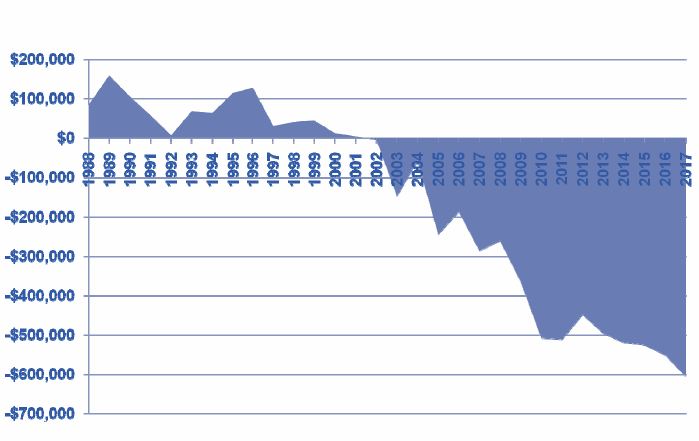
    History of Crossover (in $1,000s)

    by James A. Bacon

    Once upon a time, the Highway Maintenance Operations Fund was flush with cash. Between 1986 and 2002, the Virginia Department of Transportation was able to transfer millions of dollars from the HMOF into the Transportation Trust Fund, which pays for new construction projects.

    Those days are long gone. In Fiscal Year 2002, the Commonwealth Transportation Board approved the first transfer from the highway construction fund, $3.6 million, to the maintenance fund — a practice known as crossover. Since FY 2008, crossover transfers have averaged $418 million annually. Transfers are projected to increase to $600 million yearly byย  2017.

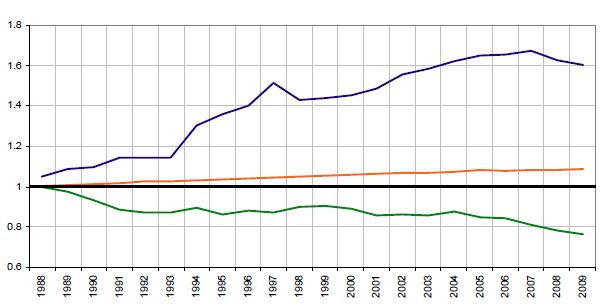
    Growth trends: vehicle miles traveled (blue), lane miles (orange) and motor fuel tax revenues (green) in 1988 dollars.

    Basically, there are two reasons why crossover is necessary, Jose Gomez, director of the Virginia Center for Transportation Innovation and Research, told the CTB during a strategic planning session in Portsmouth last week. First, revenues from the motor fuels tax has been steadily eroded by inflation in theย  price of asphalt and other construction materials. And second, Virginia’s highway system is aging and requires increasing maintenance resources to keep up.

    Here are some of the scary numbers he presented:

    • 1,116 lane-miles of interstate highways are in poor condition.
    • 5,032 lane-miles of primary highways are in poor condition.
    • 27,166 lane-miles of secondary roads are in poor condition, or 34% of the secondary system
    • 1,730 bridges are structurally deficient

    Looking ahead, 4,600 structures are in danger of becoming structurally deficient within the next five years, and an increase in Vehicle Miles Traveled (only temporarily in abeyance since the recession) will add to the wear and tear on the system.

    For solutions, Gomez didn’t have much to offer. Eliminating the practice of taking subdivision streets into the secondary road system would save about $1 million yearly, he said. But even after 10 years, that would save only $10 million a year, a tiny fraction of the sum needed. Another option is devolution: transferring responsibility for secondary roads to localities. But politically, that’s a non-starter because localities are convinced that VDOT will not provide them with enough money to maintain the roads properly, much less to whittle down the backlog of bad pavement and structurally unsound bridges. Until VDOT can afford to pay more, it will be stuck with the secondary roads.

    There was widespread sentiment among CTB members that the transportation system simply needs more money, but that belief was coupled with an acknowledgment that their job was to work with the resources they had, no matter how meager. Concrete ideas were in short supply. In fact, about the only proposal of any kindย  came from L. Aubrey Layne, Jr., an executive with Great Atlantic Management in Virginia Beach, who asked, “Do we have the ability to shrink the system?”

    No, came the answer from Rick Walton, VDOT’s chief of policy and the environment. The state cannot abandon a road unless it can show that a public necessity no longer exists. As long as a single family depends upon a road, it’s practically impossible to shut the road down.

    The strategy session ended without any meaningful proposals to emerge from the group. But Transportation Secretary Sean Connaughton closed with an important point. “If people admit it or not, we’ve … de facto devolved the system.”ย  If counties want to build more secondary roads, they’ll have to foot the tab themselves. “There has to be a major reform of the program.” What that reform might be, he did not say.

    This article was made possible by a sponsorship of the Piedmont Environmental Council.


  • Virginia Student Performance: Mediocre by International Standards

    by James A. Bacon

    How well are Virginia’s public schools preparing students for competition in a global marketplace increasingly dominated by the knowledge economy? Most people would say pretty well. Sure, there are pockets of dysfunction in inner cities and poor, rural counties but our suburban schools do pretty well… especially in Northern Virginia where local governments are willing to tax heavily to invest in higher quality education.

    How well does that perception stand up to reality? Not very well, according to a new report, “When the Best Is Mediocre,” published by Education Next. Instead of subjecting a city or county’s educational achievement numbers to national comparison, the Global Report Card (GRC) subjects it to a comparison with other developed countries with roughly comparable levels of development and wealth.

    “Even the most elite suburban school districts often produce results that are mediocre when compared with those of our international peers,” write Jay P. Greene and Josh B. McGee. “Our best school districts may look excellent alongside large urban districts, the comparison state accountability systems encourage, but that measure provides false comfort. Americaโ€™s elite suburban students are increasingly competing with students outside the United States for economic opportunities, and a meaningful assessment of student achievement requires a global, not a local, comparison.”

    There are a handful of U.S. school districts where excellence prevails. The average student in the Pelham school district in Massachusetts, for instance, stands at the 95th percentile in math internationally. But most districts show a mediocre performance , if not an outright dismal one.

    Let’s take Fairfax County as an example. Although the county does have challenges, including a large English as Second Language population, it has some of the best schools in the country and is widely perceived as one of the best school districts in the state. The average student in Fairfax County would perform better than 62% of the students in the United States in math tests — but better than only 49% of students internationally. In Henrico, the affluent suburban county where I live, the average student would out-perform 59% of students nationally but only 47% internationally.

    The average student in the city of Petersburg, serving a mostly poor and minority student body, would outperform only 26% of students internationally. No surprise there. But in Loudoun County, one of the wealthiest jurisdictions in the entire country, the average student would out-perform only 51%. (For the most part, Virginia schools perform somewhat better in international comparisons on reading scores than math — but math is the language of science, engineering and technology so critical for international competitiveness.)

    Use this interactive feature to compare your school district to state, national and international averages.

    It’s time that Virginia gets serious about school reform. We understand the implications for global competitiveness. We talk about the problem a lot. Then we tinker at the margins. Nothing serious is happening. We are already failing the current generation of young people in this state. Are we destined to fail the next one as well?


  • New Front in War on Rising Medical Costs: Hospital Readmissions

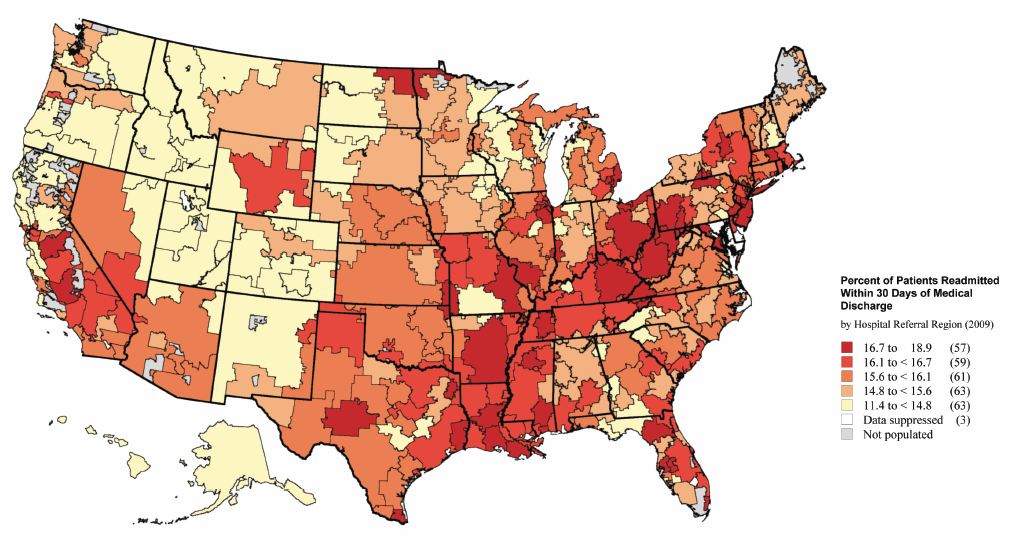
    Percentage of patients readmitted within 30 days of hospital discharge, by hospital referral region.

    by James A. Bacon

    In an effort to rein in runaway health care costs, policy wonks are paying close attention these days to a key metric of hospital quality and productivity: hospital readmissions. If too many patients are readmitted to the hospital shortly after they are discharged, it’s a sign that something could be wrong. Perhaps some patients are being released too early. Perhaps there is a disconnect in follow-up care with doctors outside the hospital.

    In an examination of the records of 10.7 million hospital discharges for Medicare patients, researchers with the Dartmouth Atlas Project found wide variations in 30-day readmission rates across regions and academic medical centers. More than half of Medicare patients discharged home do not see a primary care clinician within two weeks of leaving the hospital. “The report highlights widespread and systematic failures in coordinating care for patients after they leave the hospital,” said David C. Goodman, lead author of the study. “Irrespective of the cause, unnecessary hospital readmissions lead to more tests and treatments, more time away from home and family, and higher health care costs.”

    Centers for Medicare & Medicaid Services has estimated the cost of avoidable readmissions at more than $17 billion a year in a Medicare budget that exceeds $500 billion yearly. Despite the focus on readmissions in recent years, Dartmouth Atlas researchers see little progress being made in this metric.

    As you can see in the map above (click to view the map in more detail), Virginia hospitals are far from the worst offenders in the country. But they have ample room for improvement. Compare the performance locally with that of Utah, Idaho, Colorado, Oregon and New Mexico. In one of the few productivity-oriented cost control provisions to emerge from Obamacare, Medicare will start in 2013 to reduce reimbursements to hospitals deemed to have an excessive number of readmissions. That should concentrate administrators’ minds wonderfully on the need for coordinated care. It’s not clear, however, that the problem resides entirely with the hospitals. Do physicians bear any responsibility? Do patients or their caretakers? Could this be a job best tackled by the entire medical community?

    Stay tuned. As the cost of health care insurance takes an ever bigger bite out of business budgets and family pocketbooks, hospital readmissions is a problem that Virginians policy makers will have to grapple with.


  • Wilder’s Last Hurrah?

    By Peter Galuszka

    Doug Wilder has always marched to a different drummer.

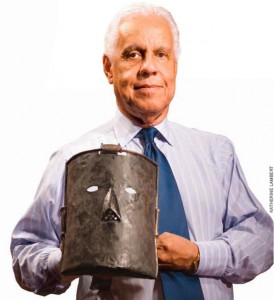
    A major force in Virginia politics, he became the state’s first black state senator in 1969, the first black lieutenant governor in 1985 andย  then the nation’s first elected black governor in 1989. In the last post, he defied fellow Democrats by slashing state spending by $2 billion and not raising taxes.

    His independent ways carried over when he was mayor of Richmond and got into a cat fight with the School Board that cost $1 million in fees when he forced them out of their offices in City Hall. More recently, he has been a totally unpredictable political kingmaker — a Democrat but hardly a reliable one.

    So it’s somewhat typical, and also a bit sad, that he has stumbled so badly on his National Slavery Museum near Fredericksburg. The project that he started in 2002 filed for Chapter 11 bankruptcy on Sept. 22 and has tossed Wilder into a really big mess. The project has $2.3 million in unsecured debts, $215,000 in unpaid local taxes and a $5.1 million court judgment won by architect C.C. Pei, the son of famed architect I.E. Pei who designed the East Wing of the National Gallery of Art on the Mall.

    Wilder has responded to the bankruptcy in his usual fashion. He won’t talk to the public or reporters. No apologies. Nothing.

    To be sure, museums about slavery seem to be a hard sell, which is pathetic considering that we’re in the sesquicentennial of the Civil War and slavery was such a crucial and awful part of this country’s history. In Cincinnati, for instance, the National Underground Railroad Freedom Center started out with high hopes about a decade ago. By 2008, however, poor attendance forced it to cut its budget by $5 million and cut 30 percent of its staff. It also shifted its emphasis away from the underground railroad to more modern issues such as trading female sex slaves.

    This may well be the last hurrah for the aging and controversial Wilder.


  • Overhauling Mental Health Delivery for Medicaid Patients

    I will go to any lengths to get you to read this post, even if it means including totally gratuitous material like this photo of Holly Madison and her heavily insured breasts.

    by James A. Bacon

    Michael Martz is the guy that the Times-Dispatch assigns to important-but-boring stories about the nuts and bolts of state governance like utility regulation, health care exchanges and state retirement benefits. Today he highlights a McDonnell administration initiative for reforming (zzzzz) the way the state administers (Zzzzz) Medicaid-reimbursed (ZZZzzzzzz) mental health services (ZZZZZZ! Snort! zzzzz…)

    It’s an important story. But, unless you’re directly involved in the mental health system, you’re not likely to click away from today’s Huffington Post story about the $1 million insurance policy that Holly Madison (pictured above) has taken on her breasts just so you could read about the state’s proposed new service delivery systems. (Come to think of it, if you did click away from the story about Holly Madison, you could be certified as legally insane in 14 different states.) Martz deserves credit for doing the yeoman’s work of explaining the state’s effort to make the system work better. As he explains:

    The proposed new system would attempt to reduce the costs of the services to the Medicaid program by moving away from the traditional “fee for service” model to one that ultimately would have a private entity coordinating care for a contractual fee โ€” and the risk that comes with it.

    “The overall goal of the project is to improve the value of behavioral health services purchased by the Commonwealth of Virginia without compromising access to behavior health services for vulnerable populations,” said Cynthia B. Jones, state Medicaid director, in a memo to service providers last week.

    One source of concern is that a third party contractor will add another layer of management and cost. But Secretary of Health and Human Resources Bill Hazel said the proposed coordinated care system would be different from the kind of managed care that most people are familiar with.”Managed care was all about the price,” he said. “It was the gatekeeper whose job was to say ‘no.’ … We want to ensure that individuals are getting the care they need in the appropriate setting when it’s needed.”

    I have no idea whether this new arrangement will work, but we can’t continue doing what we’ve been doing. In stark contrast to Holly Madison and her bountiful assets, Virginia doesn’t have the money to throw at mental health. We have to experiment with new ways of delivering services and incentivizing providers and patients until we find something that works better. At least the McDonnell administration is trying.


  • The Wonk Salon, September 29, 2011

    Alcohol Wholesalers Seek to Preserve Regulatory Fiefdoms
    Competitive Enterprise Institute
    Alcohol wholesalers run to Congress to preserve regulatory fiefdoms eroded by a recent court case. Count on a Republican to craft the anti-free market legislation.

    Foreign Teachers: Exploited and Exploiters
    Center for Immigration Studies
    The importation of teachers from the Philippines under temporary worker programs is rife with abuse. Many teachers are exploited by local school boards. At the same time, they cheat on their taxes. It ain’t a pretty picture.

    How Medical Debt Threatens Family Stability
    New America Foundation
    Sixteen percent of American households are being dunned for medical payments. Obamacare will help. And states can help by asking hospitals not to report medical debts with credit agencies.

    Why the High Cost of Public Sector Employees Comes as a Surprise
    Mercatus Center
    States get blindsided by the cost of public employees because they make unrealistic actuarial assumptions and they do a lousy job of making information available to the public.


  • Why College Students Aren’t Graduating

    More information on the college drop-out crisis comes from a study just published by Complete College America: “Time is the Enemy: The surprising truth about why todayโ€™s college students arenโ€™t graduatingโ€ฆ And What Needs to Change.” Based on data from 33 states (including Virginia), the study finds that 75% of college students are juggling school, jobs and sometimes family, and that part-time students rarely graduate. On average, students are taking too many credits and taking longer than necessary to complete. And, for the most part, remediation courses are “broken.” They do not work.

    Peter Blake, interim executive director of the State Council of Higher Education for Virginia, put a positive spin on the data for the Times-Dispatch:

    Virginia’s on-time graduation rate for a four-year degree was second among the 33 states, and the state ranked first for its six-year graduation rate. The state also did well with underrepresented populations in higher education. … Virginia was first in the six-year graduation rate for full-time Hispanic students, and second for both African-American students and for recipients of Pell Grants, which aid those with the most need.

    View the state-by-state data, including Virginia’s, here.

    While the Old Dominion may fare well by some measures, the trend lines are much the same as for other states. If there’s one easily digested bottom line from the study, it’s this: State systems of higher education need to focus less on enrollment and more on degree completions. At present, colleges and universities are rewarded for the number of students signed up for classes, not the number who graduate – much less the number who graduate on time. The result is excess public support for higher education and years (and money) wasted by the students. Virginia is no exception. The time for change is now!

    — JAB


  • Warner Backs another Potomac Crossing

    American Legion Bridge

    by James A. Bacon

    It looks like the Outer Washington Beltway, which would connect with Maryland by means of a bridge across the Potomac River, is not just an idea being pushed by the McDonnell administration. Sen. Mark Warner declared on the Kojo Nnamdi radio show that he supports a new bridge himself.

    Tom Sherwood, an NBC reporter and Currents Newspapers columnist, quoted John “Til” Hazel, one of Northern Virginia’s more prominent developers, to the effect that the American Legion Bridge is crowded and due to get 50,000 more vehicles the next 10 or 15 years. Did Warner, he asked, see a need for new bridges across the Potomac?

    “Yes, yes,” said Warner. “We can’t keep funneling all the traffic into, you know, these few choke points across the river. But the money won’t be easy to find, he conceded. As governor he campaigned in support of a funding source for Northern Virginia transportation in the form of a half-cent regional sales tax, he said, but “I got my tail beat.” Now state transportation funds are “close to bankrupt,” the senator noted, and the federal Highway Trust Fund “is broke as well.”

    But the need is there. “Infrastructure, which used to be a competitive advantage for our country, infrastructure, which, in the Capitol region, helped us grow, now is becoming a choke point and is going to kill the golden goose where the jobs are, whether it’s in Montgomery County, PG County or out in Northern Virginia, in the Dulles courthouse square.” People have been talking for 10 to 15 years and the progress, he said, “has been, at best, incremental.”

    Northern Virginia’s power brokers, whether Republican or Democratic in their partisan loyalties, likely will line up behind the Outer Beltway — sometimes referred to as the “techway” — while the smart growth movement assuredly will oppose the mega-project. The Coalition for Smarter Growth makes two main points: (1) the Outer Beltway and bridge will do little to alleviate traffic congestion, and (2) the money would be better spent on easing existing congestion hotspots.

    I have no problem with building a Bypass as long as those who use it and benefit from it also pay for it. I see that as unlikely. The pattern in Virginia is to tax (or toll) the general public on amorphous grounds like “economic development” and “quality of life” to pay for projects that the power brokers crave but don’t want to pay for — like the Rail-to-Dulles METRO project.

    It will be interesting to see if the smart growth guys can revitalize the same informal alliance with fiscally conservative populists, like those who helped defeat the NoVa sales tax increase last time, to oppose the Outer Beltway project which appears to be regaining momentum.


  • The Wonk Salon, September 27, 2011

    Mapping Infant Mortality
    Healthcare Cost and Utilization Project
    A study of infant geographic patterns in infant mortality indicate that inequities in birth outcomes exist mostly in communities where there is low education attainment, a significant African American population, and high poverty rates.

    Expanding Health Coverage to Low-Income Families
    Urban Institute
    Implementing the Basic Health Plan option under Obamacare, with a modified cost-sharing approach, would provide coverage for an additional 120,000 Virginians — two out of three who are eligible.

    Why Are Urban Charter Schools So Successful? They Offer a “No Excuses” Approach to Education
    National Bureau of Economic Research
    The effectiveness of urban lottery-sample charter schools can be traced to their “distinctive pedagogical features” — their embrace of the No Excuses approach to education.

    Improving Medicaid Delivery and Quality
    Kaiser Family Foundation
    Medicaid administration varies widely across the 50 states. Many are experimenting with new delivery models, trying new payments systems and utilizing Health Information Technology.

    Helping Families Save for College
    New America Foundation
    The City of San Francisco is opening college savings accounts for 1,000 Kindergartners and seeding each account with $50. Just having the accounts makes families more likely to save.

    Fostering Ties between Foster Children and Incarcerated Parents
    Government Accountability Office
    In 2009 some 14,000 children entered foster care due to the incarceration of their parents. States are using a variety of strategies to support the family ties.