• VDOT Revisits Land Use

    Proposed new regulations would reform โ€“ or undermine, depending upon your point of view — a keystone 2007 law designed to limit the negative impact of local land use decisions upon state roads.

    Subdivision stub outs — sometimes they work better in theory than in practice.

    By James A. Bacon

    In 2007 members of the General Assembly were struck by a revelation: There were ways to address the problem of traffic congestion in Virginia that did not entail building expensive new roads and highways. Gridlock arises not only from a growing population and increasing traffic load but from poor planning and design. Accordingly, the legislature enacted a sweeping overhaul of state law regulating the interface of transportation and land use.

    Provisions of the law required traffic impact analysis for new development, greater street connectivity between new subdivisions and tighter regulation of public access to state highways. The bipartisan action was widely regarded one of the signature achievements of the Kaine administration.

    This year the General Assembly passed a law directing the Virginia Department of Transportation (VDOT) to review the legislation and enact new regulations as needed.ย  A VDOT advisory committee has recommended several changes, which await approval either by the Virginia Highway Commissioner or the Commonwealth Transportation Board.

    The revisions represent a victory for the real estate industry. Two measures โ€“ one that would reduce the size of rezoning projects required to conduct a Traffic Impact Analysis, and another that would modify regulations requiring new subdivisions to connect with one another โ€“ stand out as particularly important. The two provisions will relieve developers and home builders of significant regulatory costs while still preserving the intent of the original law, maintains Mike Toalson, executive vice president of the Home Builders Association of Virginia.

    But smart growth activists say the proposed new regulations will dilute the effectiveness of what had been one of the most progressive efforts in the country to coordinate transportation and land use. Stewart Schwartz, executive director of the Coalition for Smarter Growth, described the 2007 law as an effort to stem the growing and unaffordable list of transportation projects requested by local government and passed up to the General Assembly.

    โ€œWe will never have enough funds to build the quantity of infrastructure created by patterns of development that have been increasingly used since World War II,โ€ Schwartz wrote to Virginia Highway Commissioner Gregory Whirley. โ€œBy preserving the throughput of our highway network through better access management, by measuring traffic impact and applying creative solutions to reduce demand, and by increasing local street connectivity to reduce demand and traffic on our overburdened arterial roadways, we can save the tax payers of Virginia huge sums of money that would otherwise be required for new highways, the widening of dozens of arterials, and the addition of dozens of new interchanges.โ€

    The idea behind the regulations, says Trip Pollard, senior attorney with the Southern Environmental Law Center, is to look before you leap. โ€œYes, there is a cost, but itโ€™s a very reasonable cost.โ€ The proposed revisions โ€œare not the end of the world,โ€ he concedes, and Virginia still will be better off than five years ago. โ€œBut weโ€™re losing a lot here. โ€ฆ If you donโ€™t address transportation and land use, youโ€™ll end up with sprawl and congestion.โ€

    The revisions address three broad areas: traffic impact statements, secondary street acceptance requirements and access management regulations. (View VDOT’s video presentation of the regulatory changes here.)

    Continue reading.


  • The Wonk Salon, October 14, 2011

    Immigrant Demographic Trends in the 2000s
    Brookings Institution
    The foreign-born population in the United States grew by 8.8 million in the 2000s. Immigrants are somewhat more likely to live in the suburbs, to be educated, to reside here a decade or more, and to get naturalized.

    Immigrant Access to Social Services
    Urban Institute
    Even though immigrants are more likely than native-born Americans to be poor, they enrolls in social services programs at a lower rate. Eligibility requirements vary widely across the 50 states.

    The “Growth Model” of School Accountability
    Education Sector
    The Obama administration is pushing a new metric for rating schools: how well they improve student achievement. Growth models appear to be an idea whose time has come.


  • Low-Skilled Workers Take It on the Chin

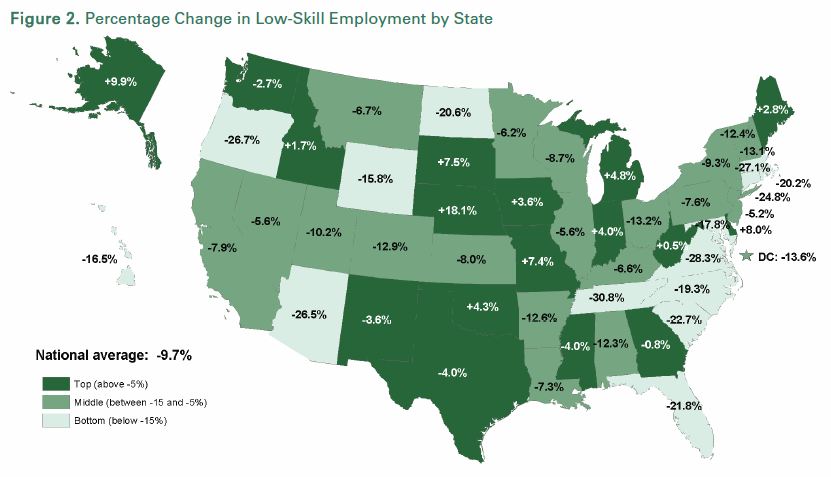
    Percentage change in low-skilled employment by state, 2007 to 2010/2011.

    OK, I was wrong (sort of). Now I’m fessing up. So, get over it.

    While the labor market has deteriorated markedly since the onset of the Great Recession, job losses for low-skilled workers have been especially devastating. And nowhere in the country (literally, nowhere, except in Tennessee) have low-skilled workers been more likely to lose jobs than in Virginia. According to the calculations of the Urban Institute’s Josh Mitchell in “Where It Really Hurts,” Virginia lost 2.7% of its jobs between 2007 and 2010/2011. But the number of low-skilled job declined 28.3%! That compares to a national average of a 9.7% decline in low-skilled jobs.

    Let me be the first to say (before anyone obnoxiously points it out to me) that this data is consistent with the claim made by the Commonwealth Institute, which I dissed a couple of days back in “Virginia’s Skewed Prosperity,” that the wage gap in Virginia has been getting worse. In “Unbalanced, Unequal and Undercut,” CI argued that highly educated workers have prospered while job losses in middle-wage industries have hurt employment opportunities for middle-class Virginians.

    The Urban Institute data supports CI’s assertion that employment in low wage occupations in Virginia has been clobbered and that the gap between high- and low-wage workers continues to grow. I still maintain, as I did in my review, that the statewide wage gap is exaggerated by the growth in population and incomes in Northern Virginia, thus obscuring economic dynamics within individual metropolitan areas. But I repent for saying that the CI study created “a terribly misleading impression.” Overall, CI got it right.

    — JAB


  • Yet Another Mongolian Crossroads

    By Peter Galuszka

    (Third in a series)

    ULAN BAATOUR, Mongolia — Flying into this capital city nestled among treeless, light brown mountains brought back memories of a grimy, industrial Soviet city from 30 years ago. Along the tarmac are rows of cannibalized Antonov 2 biplanes used as crop dusters after World War II along with ubiquitous MI-8 helicopter workhorses.

    The airport parking lot is also a blast from the past. As we struggle with our bags, Mongolian cab drivers scream at us for our business. My Russian-born wife springs into action. By turns playing one cabbie against the other and tough bargaining, besides touching off at least one fist-fight, she gets our fare down from 50,000 tegreg ($30)ย  to 15,000 tegreg (about $12)ย  in exactly 14 minutes — a masterful performance.

    Downtown is a mix of Soviet and new destiny. The sidewalks are cracked lumps of ankle-twisting concrete. Local pedestrians will shove you out of the way. Mongolian drivers are hyper-aggressive, challenging other drivers to showdowns that can be measured in millimeters. Yet against the gels, yurts and Stalinesque buildings are scores of construction gantries providing testimony to Mongolia’s newest crossroads.

    Freed abruptly from its decades’ long role as the Soviet Union’s 16th republica, Mongolia is struggling to position itself between a still-ambitious Russia and a fast-growing China’s with a ravenous appetite for raw materials. Mongolia needs foreign investment badly but has to shake off its bad reputation for lawlessness, corruption and a poor to non-existent infrastructure. As an attraction it has huge reserves of copper, gold and coal.

    The best-known Mongolian, of course, is Genghis Khan, who conquered most of the Eurasian landmass in the 12th century. On the bright side, he brought a sense of law and order to his new empire, introducing such inventions as the diplomatic passport. But G.K. & Sons were among history’s most vicious killers. Their 12th century body county, taken together and adjusted for world population, would be about double that of all the people Hitler, Stalin and Mao slaughtered in the mid 20th century.

    Mongolia has long been feared and abused by both China and Russia. It became a country in 1924 after the Manchus fell apart, but the Soviets were quick to force their influence. To makeย the point with his typical subtlety, Josef Stalin included Mongolia in his 1937 ย purges by accusing Mongolian Communist leader Gendel of collaborating withย  Chinese nationalists and the Japanese.

    The result was the arrest of 56,000 and the execution of 20,000 to 30,000 Mongolians, about 40 percent of the population. The horrible event is marked at the Victims of Political Persecution Memorial Museum tucked away in a hard-to-find part of downtown that is being torn up for new skyscrapers to house foreign consulting, banking, mining and construction firms.

    The museum is not for the squeamish. One exhibit shows the skulls (see
    photo)ย  of some of those executed. They were lined up precisely so one bullet would shatter the skulls of three or four victims. This particular batch of skulls shown in the photo was found in a mass grave in a remote part of Mongolian discovered in 2003.

    Not everything in Ulan Baatour is horrible.ย  Nearby is a museum of Buddhism with wildly creative art and there are plenty of monks around. Historically, Ulan Baatour (or “U.B.” in local parlance) rivals Tibet as a Buddhist religious hot spot.

    Meanwhile, Mongolians are trying to take corrective steps for a better future. At a conference on foreign investment that I attended, Bayaratsetsev Jigmiddash, a legal advisor to the Mongolian government, says that progressives are working on as many as seven separate laws to upgrade the country’s courts and judiciary systems. Key reforms include creating a conflict of interest code for judges to follow and to require them to list their assets and bank statements, she says.

    There’s more to be done on the infrastructure front. Despite its strategic location between two rich countries, Mongolia is stuck with ancient Soviet-style railroads and equipment. General Electric is said to be interested in building new locomotives capable of withstanding minus 50 degree temperatures and sandstorms. Likewise, the highway system is primitive or just doesn’t exist where needed. Many major highways have no repair shops or gas stations. About 40 percent of the truck fleet is obsolete.

    It’s a classic chicken-or-egg problem. Foreigners won’t invest without rule of law. Without investment, there won’t be rule of law. As one wag suggested, one place to start educating Mongolians about what being modern means is on the highways where no one seems to understand what a rule or a law is or how to brake for pedestrians.


  • How Did Virginia Do on the Latest Educational Report Card? You Don’t Want to Ask

    The results are out for the 16th edition of the American Legislative Exchange Council’s Report Card on American Education. Virginia fares reasonably well on academic achievement — 12th best in the nation. (Just remember that 12th best in the United States isn’t very high compared to international norms.) And that’s the highlight. Alas, the Old Dominion earns no more than a C- for its reform efforts.

    Among the very few pieces of good news, Virginia showed gains for low-income children in the federal National Assessment of Educational Progress (NAEP) test between 2003 and 2009. On the negative side, only 38% of all 4th graders met NAEP’s “proficiency” standards for reading.

    ALEC’s grade for reform reflects the organization’s policy priorities: enacting higher academic and proficiency standards, promoting charter schools and school choice, not over-regulating home schooling, encouraging online earning, and devising policies for retaining good teachers and removing bad ones.

    Why the low public policy score? Virginia’s academic standards rate a D+, there is very little school choice, and policies for improving the overall caliber of teachers is weak. About the best that could be said about educational reform in Virginia is that it rates a “c” for moderate levels of home school regulation and for retaining effective teachers.

    See Virginia’s profile here. — JAB


  • Everybody’s a Winna in the Federal Highway Sweepstakes!

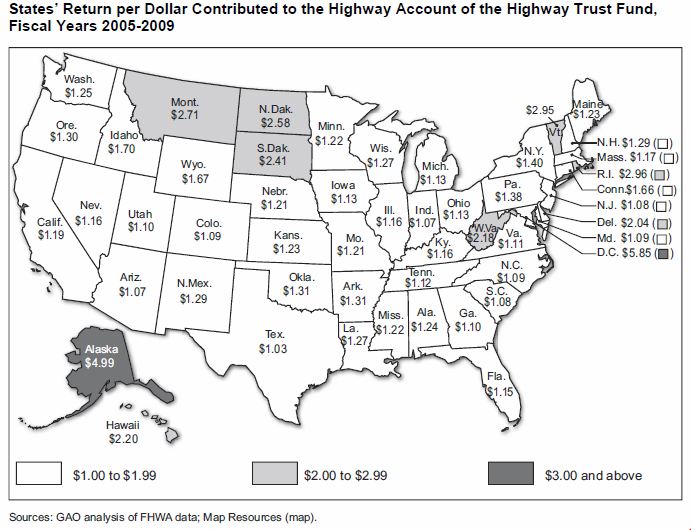
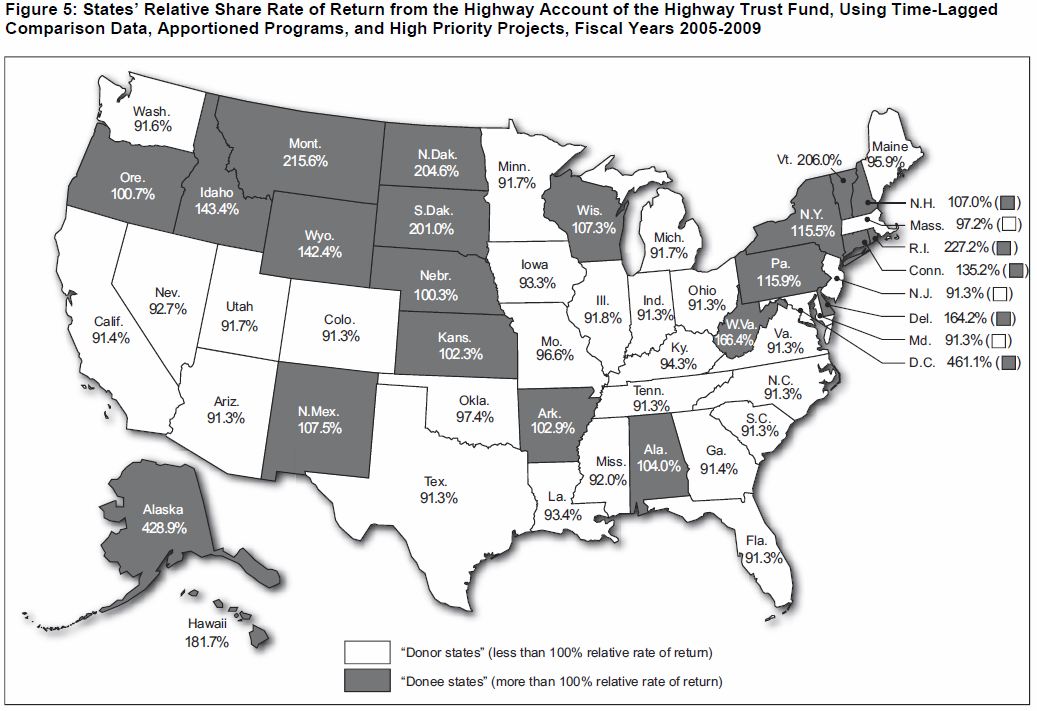
    Click on map for more legible image.

    There’s good news and bad news in a new Government Accountability Office (GAO) report on the Highway Trust Fund. Thanks to a $30 billion injection from the federal Fund since FY 2008, every state in the union has collected more from the federal Highway Trust Fund than its citizens contributed in motor fuels taxes. Yippee!

    Trouble is, sooner or later Congress will get its act together and start looking for places to cut the deficit and a good place to start whacking is the subsidy to the Highway Trust Fund. It’s looking increasingly likely that the feds will revert to its previous, long-held policy of dispensing no more money than they bring in from the motor fuels tax. When that happens, most states will go underwater. Virginians will dive so deep that we’ll have to slap on SCUBA tanks.

    As it happens, the Old Dominion is one of ten states that share the distinction of receiving only 91.3% of the national norm of federal highway dollars. Hey, Northern Virginia, you think you’re getting reamed by Richmond? Look across the Potomac! — JAB


  • The Wonk Salon, October 13, 2011

    How Government Stifles Innovation in Education
    American Enterprise Institute
    In areas from health care to green energy, government actively seeks to engage the private sector in fostering innovation. Not so in education.

    Diagnostic Math Testing Helps Boost Student Achievement
    Public Policy Institute of California
    The mandatory Mathematics Diagnostic Testing Project, which provides timely feedback on student progress that teachers can use, help boost standardized math test scores. The tests can be used to place students in appropriate math classes and spot those who need summer school.

    “No Excuses” Helps Close the Education Gap
    National Bureau of Economic Research
    “No Excuses” charter schools in Houston, which increase instructional time and create a culture of high expectations, have a significant impact on students’ math achievement and a measurable impact on reading.

    Power Flux
    Aspen Institute
    So much change, so many questions, for the electric power industry. Is consumer demand heading up or down? Are shale gas supplies here to stay? What’s the EPA up to? What does the Fukushima disaster mean for nuclear power? And what about China?


  • China’s Very Fast Trains

    By Peter Galuszka

    (second in a series)

    SHANGHAI — ย As the soggy countryside zipped past, my eyes were fixed on the speedometer of the maglev train hurtling towards Shanghai Pudong ย International Airport. The instrument hanging over a passenger door shot up from 150 kilometer per hour, to 247 kph and finally to 300 kph or about 187 miles per hour.

    The ultra-fast, eight-year-old line got us from the city limits to the airport in all of seven minutes. It can go evenย  faster– 268 mph. And as we started to slow down during this exciting run, I thought back to Virginia and all the silly hullabaloo over getting creaky old Washington Metro to Dulles International Airport.

    The thought was a bit of a downer. At Dulles, the official international airport of the capital of what is supposed to be the most influential country in the world, you can’t even think about infrastructure improvements without a series of peanut vendor arguments from the right wing. They include whose ox gets gored to pay for Dulles rail and whether the Metropolitan Washington ย Airport Authority has (gasp!) a labor union official on its board of directors.

    Here in China, they don’t mess around with such nonsense. If they want to do something, they do it, or build it. It is a Communist country with plenty of industrial policy so they just fund it. Of course, they have the money to put into an ultra-modern rail system built by Germany’s Siemens and that is admittedly a problem in the U.S. But the Chinese, unlike Americans, are looking ahead to what’s needed and are not sticking their heads in the sands to worry about whether their grand schemes have the dogmatic imprimatur of the American Enterprise or Cato Institutes.

    The Chinese think big. To get an idea just how big,ย  consider my experience at the Beijing Capital International Airport. My wife and I checked into a hotel near the airport for an early morning flight and had some hours to kill in the center of the capital. Later that evening, we took the airport express train back to the airport and the hotel.

    Mind you, the Beijing Airport is a truly monstrous destination. Conde Nast Traveler named it the world’s best airport in 2009. But the three terminals are far from each other to accommodate the latest in airline size, notably the bulbous Airbus 380 that can hold 555 passengers.

    We got onto the airport express train for the 25 minute trip to the airport. As we pulled into Terminal 3, the most recent addition, I told my wife, “We don’t want this one, we want Terminal 2.” So, we stayed on. I had expected a brief ride. Instead, the train gained speed for two minutes, five and then eight. My wife was glowering at me, imagining this to be yet another in a long series of screw ups during our ย nearly quarter century history together. “I hope we don’t end up all the way back downtown and have to come out again,” she exclaimed, her eyes narrowing. Imagine my relief when the announcer said, “Terminal 2 next.”

    Big, indeed. If these project and the litmus test for the future, then Americans are truly going to be left behind if they buy into the short-sighted, skinflint philosophies that have been popular ever since Barack Obama was inaugurated.


  • Is Congestion Really Getting Worse? Maybe Not.

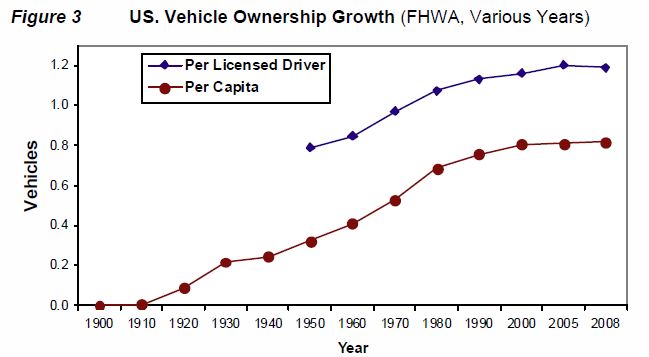
    Click on graph for more legible image.

    A couple of weeks back I reviewed the 2011 Urban Mobility Report (see post), findingย  credence in its measures of traffic congestion but seeing little value in its public policy solutions. My criticism were mild compared to the scathing critique by Todd Litman, head of the Victoria Transportation Policy Institute, who found the study worse than useless. You can read his withering attack here.

    One argument that intrigued me was his contention that congestion has not been intensifying over the past several years, as the Urban Mobility report suggests. If anything, people are driving less and congestion is easing. Writes Litman: “U.S. vehicle travel peaked in 2003, and contrary to the UMRโ€™s assumptions, there is no evidence that total vehicle travel will grow significantly in the future, due to demographic and economic trends that are reducing per capita vehicle travel in the U.S. and other developed countries.”

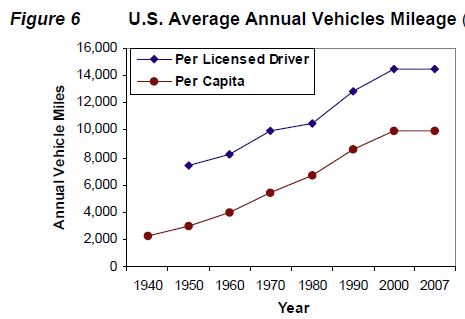
    In a recent report, “The Future Isn’t What It Used to Be,” Litman shows how key trends that drove the increase in Vehicle Miles Driven are leveling off. Look at the chart at the top of this post, which shows the growth in U.S. vehicle ownership. The numbers started leveling off before the 2007 recession. That’s because among affluent and middle-class Americans, nearly every person with a driver’s license now has his or her own car. A steady increase in the number of drivers had propelled Vehicle Miles Traveled for decades. Now that everyone has a car, that impetus has lost its momentum. (There may be a pent-up demand for automobiles among lower-income Americans but tighter credit conditions and wage stagnation makes it difficult for them to join the ranks of auto owners.)

    Click on chart for more legible image.

    Further, Litman points out that as aging Baby Boomers reach retirement, they will drive less. Factor in the end of cheap fuel prices, a residential real estate crash that hit hardest in exurbia where people drive greater distances, the continued migration to metro areas from rural counties where people also tend to drive longer distances, the increasing disinclination of young people to buy cars, the rise of telework and a number of other reasons, it’s no wonder that Americans are driving less. Indeed, about the only major factor pushing VMT numbers up is a growing population.

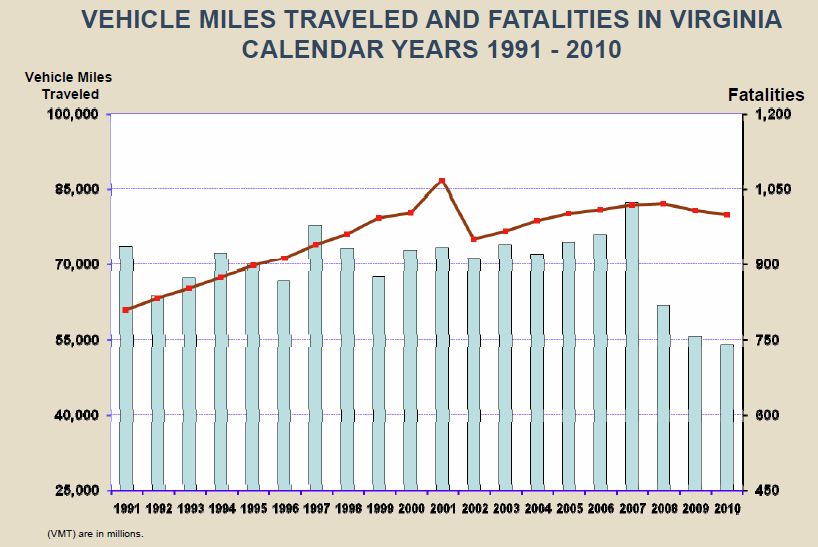
    Virginia VMT. Source: Division of Motor Vehicles

    Of course composite numbers at the national level can obscure a lot of cross-cutting trends. The decline in VMT has been less pronounced in Virginia, not surprising given the faster-than-average population growth and stronger-than-average economy here.ย  Even so, after peaking in 2008, VMT dipped in 2009 and 2010. It would be really interesting to view the numbers by transportation district or, even better, by metropolitan area. I would expect to see that VMT remained strong in Northern Virginia but that the Rest of Virginia tracked the rest of the country. If that conjecture is correct, it would call into question the need to sustain a large road/highway construction program anywhere outside Northern Virginia. And even in NoVa, one could argue,ย  new construction there would best be channeled into projects like retrofitting Tysons Corner transportation system than blazing new paths through undeveloped countryside.

    At the very least Litman’s argument calls into question the extrapolation of past trends indefinitely into the future. The public policy apparatus of Virginia is operating on the premise that VMT will continue growing at historical rates. But if that premise is unfounded, so may be the justification for many of the transportation projects on the books.


  • Too Bad We’re Not Dead Last

    Public officialdom in Virginia has been increasingly focused on Virginia’s heavy dependence upon the federal government for economic activity and employment. As the Joint Legislative Audit and Review Commission pointed out in its “Review of State Spending: 2011 Update,” Virginia ranked second among the states in total federal spending per capita.

    In federal FY 2009 the federal government spent $155.6 billion in Virginia (up from $118.5 billion the previous year). “The largest share of federal spending in Virginia ($82 billion or 47%),ย  states the report, “was for procurement of goods and services, including services provided by federal contractors based in Virginia. When federal spending starts declining, as inevitably it will, there goes the ol’ economic base.

    If there’s a silver lining, it’s that Virginia’s state budget is less dependent upon federal grants. States the JLARC report: “Since federal FY 1995, Virginia has ranked between 47th and 50th among the states in terms of per capita receipt of federal grant awards. In FY 2009, Virginia ranked 49th.”

    Forty-ninth is pretty good, although I say we should aim for dead last.

    — JAB


  • The Wonk Salon, October 12, 2011

    State Spending Still Outpacing Inflation, Population Growth
    Joint Legislative Audit and Review Commission
    Despite the recession, state spending over the past 10 years has outpaced inflation and population growth by a wide margin. General Fund spending hasn’t kept up — the growth comes from Non-General Fund spending.

    Medicaid Errors Costs the State $ Tens of Millions
    Joint Legislative Audit and Review Commission
    Improper eligibility determinations may have cost Virginia’s Medicaid program between $18 million to $263 million in FY 2009. Outright fraud cost only $6.1 million.

    Rural Telecommunications Creates Jobs
    Manhattan Institute
    Rural telecommunications operations have a direct economic impact in Virginia of $241 million and an indirect impact of $118 million.

    Housing Voucher Recipients Go Suburban
    Brookings Institution
    When people get housing vouchers, where do they choose to live? Surprise, surprise, half of them choose to live in the suburbs.

    Rethinking Teacher Retirement
    American Enterprise Institute
    Schools recruit 300,000 teachers a year — about one in five new college graduates. No wonder it’s hard finding qualified teachers. How about hiring more older, mature second-career teachers?


  • The Old Boy’s Still Around

    By Peter Galuszka

    (first of a series)

    BEIJING, China — Red and gold emblems flap around Tiananmen Square in celebration of 62 years of the People’s Republic of China. This holiday, the sprawling square area is thronged with Chinese families of all ages on this warm and sunny fall afternoon.

    I am here on a book research trip that will take me into three Asian nations. Of the three, China holds the spotlight as the coming thing. It’s been the coming thing since the 1980s when Deng Xiaoping turned more than three decades of Maoist central planning on its head and started market reforms. A combination ofย  pent-up entrepreneurial zeal that’s part of the Chinese DNA and a huge, young population soon sparked double-digit GDP growth rates that started to slow from 11.9 percent in 2010 to 9.7 percent only this year.

    The results are stunning. The capital boasts of new buildings, clean streets, an efficient subway system, and luxury stores andย restaurants. Growth is concentrated in coastal areas, such as Guangzhou and Shanghai where I stopped first to pick up my wife who is spending the year teaching there. Conventional wisdom has it that with its wealth and growth levels, China is fast eclipsing the United States as the world’s leading power — a view that my otherwise pleasant French Canadian seat mate mentioned as many as five times on the flight over from the states.

    Shanghai is likewise a shiny jewel of Chinese modernity, shinier even than Beijing. Its riverfront skyscrapers soar high. Everywhere, gigantic flat screen televisions and LED lights flash out new light architecture. One example of this almost obscene longing for western-style commercialism is Wu Jiao Chang, a square that just got a new subway stop last year. At least four huge, multi-level shopping malls surround the square. Its focal point is a passenger rail line running through the center that has cladding shaped like a giant dirigible covered by thousands of tiny, color-coordinated flashing LED lights.

    “People in Shanghai don’t seem to want anything more than eat, shop and have their hair done,” my wife says. Her words echo those of French philosopher Jean Paul-Sartre who once said: “Hell is all the people at a Shanghai department store at the same time.”

    The mass-overconsumption so complained about on this blog is in full throttle in China’s big cities. Does it mean true modernity and western values? Not at all.

    For an example, let’s go back to Beijing. We stayed at a no-star Chinese hotel near the massive airport because we had an earlier morning flight and couldn’t handle morning traffic. It wasn’t anything we couldn’t handle after years in the former Soviet Union, but it was tucked away in what you might think of as the real China. Garbage lay on the steps of the little eateries and hair dressers in a little strip mall that seemed destined soon for bulldozers. I needed the Internet to get in touch with Expedia.

    I ended up in an “Internet cafe” up the dirty stairs of a building. The room was filled with 60 or more terminals with young Chinese playing Net games at some. But you don’t just sit down and boot up. You have to go to the bar where a man examines your passport and writes down all pertinent information for the police. The Net is tightly restricted since the Communist government fears the kind of Twitter-based backlash that this year brought down regimes in Egypt and Tunisia and probably Libya.

    I sat down at an ancient Acer desktop with a keyboard that has been through several iterations of rebuilding. The keys are alternately black and red. It’s slow and pokey. A scary thought goes through my head: Do I want to put my Expedia personal data on this? Hell no.

    I remember a Wall Street Journal story from earlier this year reporting that Chinese governments officials allegedly hacked hundreds of Google email accounts. The hacking was tracked to the People Liberation Army’s technical reconnaissance bureaus in the city of Jinan. This Big Brother approach is reminder of just how much China hasn’t changed, despite the glittering lights.


  • Virginia’s Skewed Prosperity

    by James A. Bacon

    In its latest study, “Unbalanced, Unequal and Undercut: The State of Working Virginia,” the Commonwealth Institute (CI) has picked a timely topic,ย  conducted some excellent research, displayed some fascinating Virginia-specific data…. and created a terribly misleading impression.

    The center-left think tank reports that wages in Virginia have rebounded from the recession more robustly than in other states. Median individual wages increased to $17.83 an hour in 2010, roughly 11% above the national average and the 8th highest of any state. Moreover, since the start of the downturn in 2007, median wages have increased by about 5% in real terms — the fourth highest increase in the nation.

    The good news… Virginia wages are rising faster

    Why has Virginia out-performed the nation? That might make interesting reading. But CI chooses to pursue a different story line: how the gap between high- and low-wage workers in the Old Dominion is wide and getting wider. In 2010, the top 10% of wage earners in Virginia earned about 5.7 times the wages of the bottom 10% — the widest gap of any state, save New Jersey.

    The bad news… Income gains are going to the highest paid workers

    Moreover, while wages may be picking up in the current business cycle, almost all the gains are going to people with more education and in higher-paying industries. “Between 1980 and 2010, the real wages of the top 10 percent of workers in Virginia increased by more than 52 percent,” write the authors. “Median wages, on the other hand, grew by just over half that much (27 percent) โ€” and wages for the bottom 10 percent of workers increased by just fiveย  percent.”

    Clearly, when viewed as a statewide phenomenon, the wage gap is alive and well in Virginia. But what does it all mean? Here’s what CI says:

    The nature of these imbalances represent major setbacks for large segments of working Virginia, creating significant and growing distance between poverty and prosperity in the state. While it is encouraging that Virginia is adding more high-wage jobs, the high concentration of job losses in mid-wage industries since the start of the recession presents real challenges for Virginiaโ€™s middle class workers and should inform the discussion around what policies to implement in order to expand this critical segment of Virginiaโ€™s economy.

    Maybe, maybe not. As CI also notes, average weekly wages vary widely across Virginia — from aย  high of $1,264 in Northern Virginia to a low of $611 in Danville. Moreover, wages have been recovering significantly faster in Northern Virginia than in the rest of the state (excepting only the Winchester and Bristol metropolitan statistical areas). As CI concedes, Northern Virginia with its huge and wealthy population “distorts” the statewide average weekly wage.

    I would put it differently: It is silly to look at Virginia as a single, unified labor market and bemoan the income disparities within it. A huge amount of the statewide disparity — and the increase in that disparity — can be attributed to different regional income dynamics. Northern Virginia is one of the highest-income regions of the entire country. No other Virginia region comes close. At the same time, Northern Virginia is also the most expensive region in Virginia in which to live. Adjusted for cost of living, the disparity in living standard between NoVa and Danville is significantly less than two to one. But CI’s metrics don’t account for cost of living.

    CI could have emphasized a very different narrative: Northern Virginia, where incomes (and the cost of living) is highest, is creating more jobs than other regions of the state. Because these jobs tend to require higher levels of education and more demanding technical skills, they pay more. As a result, the growing statewide disparity in incomes is to some considerable degree explained by Northern Virginia’s success, not a growing disparity within regions. Is Northern Virginia’s triumph a bad thing for downstate Virginians? It’s not as if the region’s prosperity comes at the Rest of Virginia’s expense. In fact, NoVa contributes disproportionately to the cost of running state government. RoVa residents have every reason to be thankful.

    The Commonwealth Institute study is well worth perusing. It contains loads of data useful for understanding the wealth gap in Virginia, such as it is. Just don’t get sucked into its woe-is-me worldview.


  • Restructuring the Gas Tax

    by James A. Bacon

    Virginia’s 17.5-cent tax on motor fuels is like an over-the-hill ball player. Back in 1986, when the rate was last set, the tax could run, leap and throw like a champ. These days, it wheezes just walking around the block.

    With each passing year, the gas tax is less able to fulfill its task of paying for the maintenance and construction of Virginia’s roads and highways. Within five years, Transportation Secretary Sean Connaughton has warned, there won’t be enough gas tax revenue to pay for new construction. Beyond that five-year time frame, one can only presume, gas tax revenues won’t even cover proper maintenance. As maintenance is deferred, the deterioration of roads, bridges and highways will accelerate, requiring even more money to fix. Unless something changes, Virginia’s highway infrastructure will slip into a death spiral.

    The obvious solution is to raise the motor fuels tax. Trouble is, the tax is widely loathed. Voters perceive, with some justification, their tax dollars funding mega projects that benefit developers, ideologically driven money-losers like mass transit, or roads to nowhere that please powerful politicos. Until that distrust is dispelled, it will be exceedingly difficult to persuade the electorate to increase the tax.

    What I propose here is far from a complete transportation financing solutionย  but it would accomplish two things. First, it would fully fund Virginia’s road maintenance program far into the future, which the current arrangement will not. Second, it could be sold to the public. My proposal would not raise revenue for new construction — that would have to come from somewhere else. But citizens would be assured that the state’s massive investment in streets, roads and highways would be kept in top condition.

    As I see it, the motor fuels would be adjusted annually to ensure enough revenue to accomplish three goals: (1) service state transportation debt, (2) provide state matching funds for federal highway projects and (3) fully fund the maintenance of state and local roads and highways. If more money is needed to accomplish those three goals, the tax ticks up; if less is needed, the tax inches back down. That’s it. When citizens gas up their cars at the pump, they will know that their gas tax is paying to maintain the roads they drive on — not to enrich some politicians’ developer buddy — and that they are paying in proportion to which they add wear and tear to the system.

    I can’t imagine how this would get push back from taxpayers. No one contests the need to meet the state’s debt obligations. Very few would dispute the desirability of raising enough money to qualify for hundreds of millions of dollars yearly in federal highway grants (for which Virginians have already paid through the federal motor fuels tax). And not even the most hardened taxaphobes could object to maintaining the existing transportation network by means of a user fee like the gas tax.

    As an aside, I would suggest re-balancing the share paid by heavy trucks and ordinary motorists. Every analysis I have seen suggests that heavy trucks in Virginia pay less than it takes to offset the disproportionate pounding they dish out to state roads. If trucks paid their full freight, so to speak, automobile drivers would pay a slightly smaller share and might, until maintenance costs inevitably marched higher, enjoy a momentary reduction in the tax rate.

    The floating gas tax would accomplish one other important goal: finance the devolution of secondary road maintenance to the counties. Nearly everyone agrees that secondary roads should be the responsibility of local governments to build and maintain. Why? Because county supervisors make land use decisions that create the demand for those roads. If local officials think that paying for those roads is VDOT’s problem, not theirs, they will make very different decisions than if they are held accountable for dealing with traffic congestion themselves. Pushing counties into coordinating land use and transportation will lead to better decision making for each.

    The state has offered county governments the opportunity to take control of their own road maintenance but none have agreed (other than Arlington and Henrico Counties, which opted out of the current system back in the 1930s). The reason is basic: Counties don’t think that VDOT will pay the full cost of ongoing road maintenance, much less enough to work down the backlog of roads and bridges in disrepair. Therefore, the gas tax would have to be set at a level sufficient to induce counties to assume responsibility for their secondary roads.

    How, then, would Virginia pay for new transportation projects? There still would be buckets of bucks to draw upon: federal transportation dollars, tolls, public-private partnerships, proffers, impact fees and special tax districts, not to revenue streams from the sales tax, the motor vehicle sales tax, motor vehicle registration fees and miscellaneous sources.

    Floating the motor fuels tax as I have suggested won’t create more money for new construction. But given the mood of the electorate, positioning the tax as a user fee may be the only way to persuade taxpayers to inject more money into the system. In the years ahead, it will be no small accomplishment to preserve what we’ve already got.


  • Making the GOP Case for a Gas Tax Increase

    Michael S. Bronzini

    by James A. Bacon

    For years, Republican politicians in Virginia have held firm in their opposition to higher taxes, even if those taxes, like the levy onย  motor fuels, can be construed as user fees. But the ground seems to be shifting.ย  A study published September and underwritten by former Gov. Jim Gilmore’s Free Congress Foundation stops just short of endorsing an increase in taxes/user fees to upgrade the nation’s surface transportation system. This comes at a time that the McDonnell administration says it is โ€œconsidering seeking additional revenue sources” to maintain state roads and highways.”

    In his paper, “Surface Transportation: The Case for Growth,” Michael S. Bronzini, an engineering professor at George Mason University, argues that investments in surface transportation promote economic output and productivity, that public investment has been lagging needs for several decades, and that the private sector is unable on its own to meet the need for regionally and nationally interconnected networks of transportation services.

    “While some gains can be made through better use of existing revenue, rehabilitating the existing system and investing in our future will require spending that is tens of $billions per year above recent levels,” Bronzini writes. “It may be time to recognize that investing in surface transportation is one of the most productive uses of tax revenue, hence citizens should expect their legislators to accord this high priority.”

    Bronzini cites a number of sources to make the case that investments in roads, highways, transit, railroads and maritime systems have a “provable link” to economic development. Most notably, transportation infrastructure lowers production costs, permitting more output and a higher GDP than otherwise would occur.ย  Investment in non-local roads between 1950 and 1980 yielded annual cost savings to industry of 24 cents for each dollar of investment. The rates of return were significantly higher than returns to private capital and the long-term interest rate.

    (Bronzini cites a Rand Corporation study in support of this argument, but he mentions only in passing Rand’s conclusion that the returns have been declining steadily over time and have reached a point by 1980 at which point it is was debatable whether additional investment in road and highway represented a net social gain or loss.)

    Bronzini points to a February study by Stephen S. Fuller, also of George Mason, that calculated the economic impact of constructing 16 proposed mega projects as public-private partnerships backed by tolls. The projects, ranging from the Third Crossing in Hampton Roads to the Coalfields Expressway, would cost a total of $30 billion but create a $4 billion gain to State Domestic Product, including 57,000 jobs and $2.9 billion in personal earnings. Two years’ of added economic growth attributable to the mega projects would equal the state’s financial contribution.

    In making the caseย  for higher levels of government investment (he can’t bring himself to say higher taxes), Bronzini argues that real (inflation-adjusted) highway spending per mile has fallen by 50% since the federal Highway Trust Fund was established in the late 1950s, that the number of miles traveled by automobiles and trucks has roughly doubled, and that half the lane-miles on federally funded roads are in various stages of decrepitude. “An ever-expanding backlog of investment needs is the price of our failure to maintain funding levels — and the cost of these investments grows as we delay.”

    Bronzini discusses the motor fuels tax, which can be construed as a “user fee” on the grounds that “the more you drive, the more you pay.” Increasing the tax is one way to deal with the funding shortfall, he suggests.ย  An increase in the fuel tax of 10 cents per gallon would amount to $5 per month per vehicle, or $9 per month per households. He warns, however, that the motor fuels tax are not a stable, long-term funding source as cars get more miles to the gallon, and that an alternative such as a Vehicle Miles Traveled fee may have to be considered.

    Two things are missing from Bronzini’s analysis. First is the recognition that not all projects are created equal. Some provide a better return on investment than others. He avoids drawing the obvious conclusion that there needs to be a mechanism for separating economically viable projects from the boondoggles Secondly, he shuns any discussion of human settlement patterns. The economic payback of transportation improvements is inseparably tied to the balance, or lack of it, of land uses served by the improvements as well as the density and connectivity of development. A case can be made that the motor fuels tax should be raised to a level that can pay for properly maintaining existing infrastructure. But at present, no sound methodology exists for determining where funds for new construction can be most effectively deployed. Until we develop that methodology, the discussion of how much money we need to raise in taxes and user fees is getting the carriage before the horse.