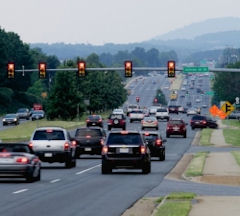
Spending $197 million to complete construction of the Charlottesville Bypass would do nothing to improve traffic congestion along the bypassed three-mile stretch of U.S. 29 north of Charlottesville, and it would induce development and traffic growth north of the South Fork of the Rivanna River, making traffic conditions there worse than they are already.
Those are among the conclusions of a review of official Virginia Department of Transportation traffic forecasts for the Charlottesville Bypass by Norman Marshall, a Vermont-based traffic engineering consultant hired by the Southern Environmental Law Center. The SELC issued a press release and released Marshall’s report earlier this afternoon.
Marshall based his analysis on a 1990 VDOT report on the grounds that, despite its flaws, the research was more comprehensive and authoritative than more recent updates. Even if the bypass is built, the Level of Service on the bypassed portion of U.S. 29 would remain an F, Marshall notes. Thus, the putative benefits of the project would accrue not to local drivers but to thru traffic — trucks and motorists passing through the Charlottesville area to another destination.
What the 1990 VDOT study doesn’t take into account is the phenomenon of “induced demand,” says Marshall. The bypass would tie into U.S. 29 just north of the South Fork of the Rivanna River, an area that has seen considerable development since the study. There are already nine traffic lights on a 6-mile stretch north of the river with proposals for three more. In 2003, Albemarle County approved construction of another 3,000 residential units plus 3 million square feet of commercial space in that area, much of which has yet to be built. In the meantime, there is increasing development further north in Greene County, where many people live and use U.S. 29 to drive to work in Charlottesville.
Writes Marshall: “If the 29 bypass makes travel to and from areas in Albemarle and Greene Counties in the greater Route 29 corridor more accessible, it will encourage both residential and commercial development in those areas. This increased development will cause increased traffic volumes, again partially offsetting any benefit of the project.”
Marshall says that VDOT should analyze alternative investments, such as grade-separated intersections at Rio Road, Hydraulic Road and Greenbrier Drive as well as other other elements listed in the Places29 master plan.
I have asked VDOT for a response, which I will append to this post if I receive one.
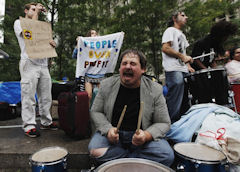
It’s tear gas and bean bags in Oakland. Cops in Atlanta. And now, the time has come to OCCUPY BACON’S REBELLION!
We must do this to protest the indulgences and sense of entitlement that the libertarians who write here present. They are strict and pure capitalists — the worst kind. They must be protested and now that the Occupy movement is more popular than the Tea Baggers, the time is now.
Here is why we must do this:
Too much verbiage is spent defending the “haves” and disparaging the “have nots.”
There are too many peanut vendor comments talking about petty corruption by cab drivers when CEOs rake off millions.
All government is seen as bad in an automatic and knee jerk fashion.
Too many arguments start from a point that assumes we all live in upper middle class houses in Richmond’s West End or in Great Falls.
Too much complaining about government spending and big deficits while shouting down any attempt to resolve the problems by RAISING taxes.
Too much reliance on cuts, cuts, cuts.
Too much love for the so-called “Creative Class.”
We still don’t know who Groveton really is.
The chief blogmaster drives a Mercedes that is periwinkle blue.
Enough is enough. We don’t have to take this. Occupy! Now!
Occupy Wall Street — raising a false consciousness?
by James A. Bacon
While the United States economy has grown over the past three decades, there is a widespread belief, reflected most recently in the Occupy Wall Street movement, that the poor get poorer while the rich get richer. While the rich may be getting richer, the poor are not getting poorer. The widespread belief that they are is based upon the stagnation in earned income among the poor — as in, income reported to the Internal Revenue Service for the purpose of paying taxes. Such analysis is totally divorced from reality. It ignores two things: (1) unreported income from the cash economy, and (2) massive income transfers through federal anti-poverty programs.
By its nature, the cash economy is difficult to measure. But by all estimates it is huge. Write Friedrich Schneider and Dominik Enste in a 2002 International Monetary Fund report (not funded by the Koch brothers, by the way):
A factory worker has a second job driving an unlicensed taxi at night; a plumber fixes a broken water pipe for a client, gets paid in cash but doesn’t declare his earnings to the tax collector; a drug dealer brokers a sale with a prospective customer on a street corner. These are all examples of the underground or shadow economy—activities, both legal and illegal, that add up to trillions of dollars a year that take place “off the books,” out of the gaze of taxmen and government statisticians.
Citing a survey that dated back to 1999, shadow economies ranged in size from 77% of the real economy in some developing nations to roughly 10% in the United States. Most shadow-economy income goes to people who would be classified as poor, working class or in some cases middle class. By contrast, the salaries, dividends, capital gains and other sources of income for millionaires and billionaires is all reported to the IRS. It’s an open question whether the shadow economy has grown or shrunk over the past three decades, but any analysis that excludes this source of income exaggerates the scope of the income gap.
Another source of income excluded from conventional analysis is government transfer payments, which include $488 billion for non-taxable Medicare benefits in the Fiscal 2012 budget, plus $989 million for other mandatory spending programs, much, if not most, of which are means tested. (And that doesn’t even include the Earned Income Tax Credit, which costs the government $50 billion a year, nor state contributions to Medicaid.)
If consumption, not income, is measured, the poor and middle class have fared much better over the past three decades. In a new American Enterprise Institute paper, “The Material Well-Being of the Poor and the Middle Class Since 1980,” Bruce D. Meyer and James X. Sullivan adjust for government transfer payments as well as long-term biases in the Consumer Price Index. They conclude:
Our results paint a picture of widespread improvement over the last thirty years in the material well-being of American families. Improvement is seen in the middle of the distribution and among those near the bottom. After appropriately accounting for inflation, taxes, and noncash benefits, we show that median income rose by more than 50 percent over the past three decades. This increase is considerably greater than the gains implied by official statistics—official median income rose by only 14 percent between 1980 and 2009.
One can take issue with their methodology. Using an alternative measure of inflation is particularly tricky. What cannot be argued with is that acknowledging the existence of income transfers totally changes the picture. To decry a growing income gap while excluding two of the largest sources of income for poor people — shadow economy earnings and government transfers — is foolish. Throw in the failure to adjust for regional differences in cost of living, which Meyer and Sullivan overlook but I discuss here, and it is evident that most of what is written on the topic is utterly meaningless.
Does that mean that the earnings gap is not a problem? I’m not saying that. Perhaps the income gap is getting wider. But that fact has yet to be demonstrated. In fact, the evidence just presented suggests otherwise. I am not persuaded by pundits who cite the same IRS data, no matter how often they repeat it, nor am I moved by scruffy, ill-informed ideologues who camp on the public squares of major cities and blame the capitalist system.
There are problems galore with our society, such as dislocations caused by the end of the Era of Indebtedness and Mass Consumption, the impending fiscal calamity of the federal government and slowing economic growth caused by the government-directed mis-allocation of resources, not to mention dysfunctional human settlement patterns, environmental degradation, rising health care costs and inadequate schools. Those problems are real, they are well documented, and they engender much of the frustration expressed by the Tea Party and the Occupy Wall Street movements. Let’s focus on real problems, not statistical figments of our imagining.
Custom Education through Online Learning Goldwater Institute
Students sitting in rows, teachers lecturing in front of blackboards… Teaching hasn’t changed much in the past century. The growth of online learning solutions changes the conversation from choosing a school to choosing individual services that specifically meet a student’s needs.
Do Special Programs for the Gift Really Work? Education Next
Two studies of a large, urban school district in the Southwestern United States suggest that Gifted & Talented programs do little to improve educational achievement.
Curse those greedy rich people! They’re making way too much money, not paying their fair share in taxes and grinding the noses of the peasants into the dirt. The wealth gap just gets worse and worse. If only we could close it, life for the “99%” would get so much better!
Wait… What’s that, you say? The top 1%’s share of national income peaked in 2007 and has declined at least two years running? Well, that’s certainly good news. According to newly released Internal Revenue Service data, the top 1% of tax returns earned only 16.9% of the national income — down from 20% the year before.
As the Tax Foundation writes in a new paper, “Summary of Latest Federal Individual Income Tax Data“: “Overall, these data on high-income tax returns appear to confirm that the continued economic stagnation had the same diminishing effect on income inequality that most recessions have, and that it occurred for the same reason: a sharp decline in income at the high end.”
I feel more equal now. I just don’t feel any better off.
On a related subject, the top 1% paid 36.7% of all income taxes. By contrast, at the bottom end of the scale, 59 million tax returns in 2009 either paid no federal income taxes or actually received checks in the mail through the Earned Income Tax Credit (EITC).
All of which raises an interesting point. Has anyone considered that one reason the reported earnings of the bottom quintile of wage earners has stagnated so much over the years (See “The Great Divergence“) is that after accounting for all the means-tested welfare programs — EITC, Temporary Assistance for Needy Families, food stamps, Medicaid, disability, child health and nutrition, public housing and rent assistance, unemployment insurance and whatever else I’ve left out — it’s self-defeating to go out and get a job?
Why bust your butt behind a 7 Eleven cash register making $10 an hour if 50%, 60% or, who knows, even more of every dollar you earn translates into lost benefits? I would love to see a study that shows the effective tax rate, in terms of lost benefits, faced by America’s poor. Then I’d like to see another study on the incentive the tax rate creates for the poor to report less income — thus accentuating the income gap and creating cries for even more wealth transfers. The full story of the income gap has yet to be told.
There are many things wrong with higher education today, and Bacon’s Rebellion will continue to bird-dog the colleges and universities here in the commonwealth. As much criticism as I dish out, it’s only fair to give praise when praise is due. Virginia public institutions, for all their warts, fare very well in the Princeton Review’s 100 Best Value Colleges for 2011.
The Princeton Review, which publishes in conjunction with USA Today, highlights 50 private and 50 public four-year institutions “that provide high-quality academics at a reasonable price, either by controlling costs or offsetting them with stellar financial packages.”
The University of Virginia ranks No. 1 among public institutions and William & Mary makes No. 7. James Madison and Virginia Tech also make the list of best value publics, although no rank is given. Among private institutions, the University of Richmond makes the cut. If you’re looking for an affordable, quality education at a public university, you can’t do better than the Old Dominion.
States Must Do More to Improve the Quality of Teachers Center for American Progress
Principals account for a quarter of a school’s total impact on student learning. States can do a better job of ensuring the quality of their schools’ principals.
No Price Transparency in Health Care Government Accountability Office
Try asking your doctor for the price of a diabetes screening. The answer will be, “It depends”…. assuming he can legally provide that information at all. Without price transparency, the market for medical services cannot function properly.
Well, blow me away. Alex Madrigal, senior editor at the Atlantic, is touting Richmond as a regional center of innovation. “Richmond is blossoming into a tech hub thanks to a great research university, a big creative agency, and cheap, beautiful real estate,” reads the sub-head of the first in a series of articles.
The quality of life is high, real estate prices are reasonable and “the stock of homes is beautiful.” He credits Virginia Commonwealth University and the Martin Agency as being critical nodes in the innovation system. (I would add Capital One, which has recruited many talented people to the region, many of whom leave and start their own enterprises.)
Madrigal seems taken with the wealth of great urban neighborhoods and the old industrial buildings renovated into apartments, offices and cool start-up space. I eagerly await his upcoming posts.
Ninety-four percent of the 600 Virginia residents polled by a Roanoke College professor believe in God, 87% believe in heaven, and… 47.9% believe pets are admitted into the Pearly Gates. (Read the poll results here.)
Wow, I am really out of step! I don’t want to start a theological hissing contest, but I have to ask a question about this finding: “A strong majority of Virginia residents (80%) believe in life after death. Even more (87%) believe in heaven.”
Am I missing something here? How can you believe in heaven and not believe in life after death, as 7% of Virginians apparently do? Doesn’t the former presuppose the latter? … Ooh, ooh, I’ve got it. Seven percent of the population must believe that there’s a heaven for pets but not for people!
Under the provisions of Patient Protection and Affordable Care Act, the 50 states must set up health insurance “exchanges,” marketplaces where individuals and small businesses will find it easier to acquire coverage, by 2013. If they don’t, the federal government will step in and set up the exchanges for them.
Gov. Bob McDonnell is no fan of Obamacare, but the law is the law… and he’d rather Virginia run its health care exchange than let the U.S. Department of Health and Human Services do it. And Virginia legislators agree.
“Virginia can and should set up its own health-care exchange,” said Del. Terry G. Kilgore, R-Scott, chairman of the House Commerce and Labor Committee, as quoted by the Times-Dispatch.
The purpose of the health care exchanges is to fill gaps in the health insurance marketplace that make it prohibitive for individuals and small businesses to obtain health care coverage. One critical component of the exchanges — a requirement that everyone either obtain coverage or pay a penalty — is under legal attack, however, and probably won’t be considered by the U.S. Supreme Court until next year. Because the exchanges will rely upon the participation of healthy people to keep rates down, they likely would go into a death spiral if the Supremes invalidate the mandatory coverage.
That creates tremendous uncertainty for state officials. The Times-Dispatch reports that the legislature is awaiting an overdue report from the governor’s Health Care Reform Initiative Advisory Council before making key decisions about how to craft the law. Another big question is whom to put in charge of the exchanges. There is some sentiment to make it a responsibility of the Bureau of Insurance under the State Corporation Commission.
Just remember: Health exchanges are a government-engineered solution to flaws that government that created in the first place. The problem arises from the fact that health care insurance obtained through employers is tax deductible, whereas insurance that individuals purchase on the open marketplace is not. Thus, the entire medical insurance industry is organized around selling insurance to employers, not the ultimate customer — in contrast, say, to the auto insurance industry. Inserting employers between insurers and patients sets into motion a whole train of dysfunctional and expensive behaviors too lengthy to detail here.
Needless to say, however the exchanges are crafted, they will be imperfect, and there will be cries for further fixes. State government undoubtedly will be more responsive than the federal government, so the pragmatism of McDonnell, Kilgore and others is probably justified.
The Case for Baseline Budgets Center for Budget and Policy Priorities A “current services baseline” budget shows what government spending would look like after inflation, economic growth and population increases, showing the impact of policy changes with greater clarity. Virginia is one of 28 states that does not use this form of budgeting.
California’s Experiments with eGovernment New America Foundation
Report potholes, broken sidewalks, graffiti and barking dogs on your smart phone! Make city data accessible to the public online! California municipalities use information technology to make government more transparent and accountable.
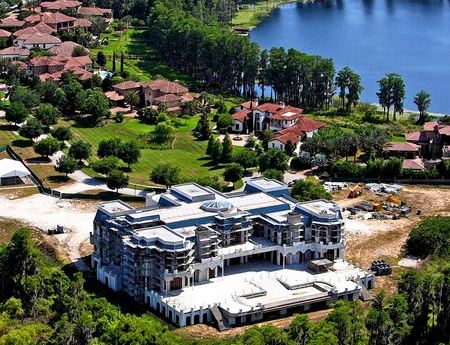
Poor Jaqueline Siegel. She’s another victim of the credit crunch. Her steel- and wood-frame Florida home remains unfinished. As she stands on the deck of her Florida room, she wipes away tears as she speaks to a Wall Street Journal writer. “Maybe it will still work out,” she says. “It always does, right?”
It’s not a sob story that many Americans can relate to. Ms. Siegel’s dream house is a monument to conspicuous consumption: 90,000 square feet (believed to be the largest private home in the United States), a 7,200-square-foot ballroom, a bowling alley, five kitchens, 23 bathrooms, 13 bedrooms, two elevators, two movie theaters, a 20-car garage and artificial, 80-foot waterfall. When her husband’s business, Westgate Resorts, got slammed by the recession, the couple had to pay off about $1 billion in notes they had personally guaranteed. The house had to go. It’s now on the market for $75 million.
Jacqueline and David Siegel belong to what writer Robert Frank calls the “High-Beta Rich,” a comparison to high-beta stocks that rise and fall in value with great volatility. The new mega-rich, who often engage in conspicuous consumption, are often only one crisis away from financial ruin, Frank observes. The Siegels managed to downsize quickly enough to stay solvent, but they had to lay off 14 of their 15 housekeepers and their chef, and enroll their children in public school. Waaah!
But many like them go belly up. Americans who live atop the economic ziggurat today are not a stable group. As Frank writes:
Though often described as a permanent plutocracy, this elite actually moves through a revolving door of riches, with some of today’s nouveau riche becoming tomorrow’s fallen kings. Only 27% of America’s 400 top earners have made the list more than one year since 1994, one study shows.
It wasn’t always this way. For decades after World War II, the top one-percenters were the most steady line on the income and wealth charts. They gained less during good times and lost less during contractions than the rest of America. Suddenly, in 1982, the wealthiest broke away from the rest of the economy and formed their own virtual country. Their incomes began soaring higher during good times. The top 1% of earners more than doubled their share of national income, to 20% as of 2008. Looking at another measure, the richest 1% increased their share of wealth from just over 20% to more than 33%.
Those surges were often accompanied by mini-crashes, even though the direction over time was always up. A top 1% that had once been models of financial sobriety set off on a wild ride of economic binges.
As Frank rightly observes, this new class of high-beta rich doesn’t conform nicely to ideological stereotypes. It certainly doesn’t fit the conservative stereotype of vast wealth as the reward for years of hard work and thrift. Many of America’s great fortunes are fueled by huge indebtedness and good luck, not real wealth creation (think Donald Trump). Nor does it fit the liberal notion that America is dominated by a new “ruling class” or plutocracy. One year people are rich, next year they’re not.
As we think about using tax policy to get “millionaires and billionaires” pay their “fair share,” it’s useful to remember that only one quarter or so of the taxpayers in the top 1% remain there year after year. For most Americans who break into that illustrious club, it’s a temporary stay. American society is still very, very fluid.
You can say what you want about embattled President Barack Obama, but the fact is that he’s had a number of foreign policy successes.
Here are a few:
After years of failure, Al Qaeda leader Osama bin Laden was finally surrounded and killed by U.S. special forces — something the Bush Administration failed to do for seven years.
Despite Republican complaints, Obama and Secretary of State Hillary Clinton followed a thoughtful and patient course that supported insurgents in Libya and select NATO airstrikes. Now Muamar al-Gaddafi, a brutal dictator who has been a thorn in the side for four decades, is dead and Libya holds the promise of transforming into a modern democracy.
The U.S. did not stand in the way of the twitter movements in other countries such as Tunisia and Egypt.
The heavy-handed, arrogant policies and personalities of Donald Rumsfeld and Dick Cheney made Washington a pariah amongst its traditional allies. Obama and Clinton have changed that.
As announced today, Obama will return U.S. troops in Iraq home by the end of the year. Some 4,400 of them were killed along with 100,000 civilians in a war that was not necessary since no Weapons of Mass Destruction were ever found and the Bush Administration lied about evidence that they existed.
Greatly reducing U.S. presence in Iraq will greatly alleviate budget and spending pressure — something conservatives are loath to admit when it involves Bush’s wars.
To give credit where due, George W. Bush did turn things around in Iraq with “The Surge.” And Obama’s had a very rough time on the economic front in part because of his lack of experience and also because of the utter lack of cooperation from the likes of John Boehner and Eric Cantor. But his foreign policy successes cannot be denied no matter how hard the conservatives may try to twist facts and perceptions.
Headline from the Pilot Online: “Group urges McDonnell to crack down on dangerous animals”
No, no one is urging the governor to rein in the General Assembly.
In the wake of the big-game scare in Ohio earlier this week, the Humane Society of the United States wants Gov. Bob McDonnell to toughen the sale and possession of dangerous wild animals within the state.
Virginia has virtually no restrictions on the possession of primates, warns Debbie Leahy, a captive wildlife regulatory specialist.
School Choice in Texas: Making Progress but Could Be Better Texas Public Policy Foundation
Texas has made strides toward greater school choice in recent years but the state needs to make significant policy changes before it becomes a leader in education reform.
TANF and Child Welfare Programs Need Better Coordination Government Accountability Office
In 2010, one third of the children received Temporary Assistance for Needy families lived with non-parent caregivers, often grandparents. Better coordination is needed between TANF and child welfare services.
What’s Wrong with Kansas? Public Schools. Kansas Policy Institute
Kansas needs to reinvent its public schools to provide more choice by moving away from large, uniform mega-schools to smaller, specialized schools that can accommodate particular learning styles.
Wind Power Not Cost Effective at Cutting CO2 Emissions Manhattan Institute
Meeting the goal of generating 20% of U.S. electric power with wind by 2030 would cost roughly $850 billion. Compared on the basis of cost per ton of CO2 emissions reduced, that’s three times as costly as the European Union’s emissions trading scheme.
The year: 2075. The American colonies on the Moon are getting restless under Washington’s tyrannical rule….
This second edition of “Dust Mites” has a snazzy new cover, includes helpful lunar maps, and is 5,000 words tighter than the original. The sequel, “Trogs,” is scheduled for publication this summer.
Advertisement
Advertisement
Advertisement
Advertisement
About
Bacon’s Rebellion is Virginia’s leading politically non-aligned portal for news, opinions and analysis about state, regional and local public policy. Read more about us here.
Fund the Rebellion
Shake up the status quo! Your contributions will be used to pay for faster download speeds and grow readership. Make a one-time donation by credit card or contribute a small sum monthly.
Can’t wait until tomorrow
For your Bacon’s Rebellion fix?
Enter your email address to receive immediate notifications of new posts by email.
SUBSCRIBE
Search Bacon’s Rebellion
Categories
Archives
The Jefferson Council
Protecting Thomas Jefferson’s Legacy at the University of Virginia
Forgot Your Password?
Shoot me an email and I’ll generate a new password for you.

 Spending $197 million to complete construction of the Charlottesville Bypass would do nothing to improve traffic congestion along the bypassed three-mile stretch of U.S. 29 north of Charlottesville, and it would induce development and traffic growth north of the South Fork of the Rivanna River, making traffic conditions there worse than they are already.