• Elephants Triumphant

    by James A. Bacon

    It was a long, hard fight but the Elephant Clan seemingly has won control over all the levers of power of state government — adding a tenuous control of the state Senate and a bigger majority in the House of Delegates to its three statewide offices. Awaiting vote recounts, the elephants aren’t trumpeting their victory yet. But the rest of us can begin to ask, what will the Republicans do with their untrammeled power?

    The GOP has the greatest opportunity in modern history to transform Virginia’s indispensable but increasingly antiquated institutions around the principles of small-but-effective government, fiscal responsibility and a free economy. Will the Rs seize the once-in-a-lifetime chance to enact fundamental reform that will propel the commonwealth into the 21st century? Or will they engage in an orgy of culture-wars legislating that turns off swing voters? Or, worse yet, will they emulate the disastrous 2000s-era K-Street strategy of cozying up to the moneyed special interests with an eye to bankrolling the next election cycle?

    Only time will tell. But as a Republican-leaning independent, I desperately hope that the Rs forego their natural instinct to pursue symbolic culture-war silliness, avoid the temptation to align themselves with the special interests, and start digging into the hard work of making government more effective and more economical. That means a lot more than balancing the budget without raising taxes, although that will be an ample challenge in itself. I see six broad strategic imperatives where the Elephant Clan can make its mark on Virginia for years to come:

    • Bullet proof the budget. Hard times are coming for a state whose economy is as dependent upon the federal government as it is. When federal spending crashes, we will be hard-pressed to maintain our AAA bond rating. We need to make every conservative budget assumption it’s possible to make, cut extraneous spending to focus on core services, and pay down debt and liabilities.
    • Reinvent K-12 education. Bust up the monopoly of the public schools, increase parental choice and foster experimentation and innovation. We can no longer afford to support a 19th-century school system to teach our children what they need to compete in a 21st-century economy.
    • Hold higher education more accountable.ย  Although Virginia’s public colleges are leaner and more affordable than most, they are still too expensive. We must make college more affordable without sacrificing excellence.
    • Build a market-based health care system. The health care industry in Virginia is dysfunctional, just as it is across most of America. Insofar as federal laws allow, repeal antiquated regulations, empower patients as consumers and spur market-based innovation in health care delivery models with the goals of bringing down costs and improving quality.
    • Re-think economic development. State government has not altered its approach to economic development since the 1960s. There’s a lot more to “creating jobs” than putting money into corporate recruitment and tourism. While Virginia may be a good place to do business, it lags in indicators of creativity and innovation, the true wellsprings of wealth creation.
    • Reform transportation and land use. If Virginians want to reduce the cost of government and improve the quality of life at the level of local government, they need to re-think their dysfunctional human settlement patterns and the zoning and transportation policies that cement them into place. One place to start: Insist that Virginians pay their full locational costs, starting with funding new transportation projects on a user-pays basis.

    The United States is is entering a perilous time. The world order that has prevailed since World War II is collapsing. The welfare state is disintegrating. The debt- and consumption-driven economy is faltering and the wealth gap is growing. Our state-level institutions are failing us. The time to start reinventing those institutions is now. If we do, Virginia can survive the storm to come and prosper in the years that follow.

    Update: The GOP is now putting its spin on the election. A communique from the state GOP’s Garren Shipley makes a couple of key points. First, the Elephant Clan majority in the House, at 68 seats, is the largest in history. Second, it wasn’t due to gerrymandering. Sixty-one percent of voters cast ballots for GOP candidates statewide in House elections, compared to 33% for the Dems. Fifty-seven percent of voters cast ballots for GOP Senate candidates, versus 41% for Dems. Indeed, if gerrymandering was a factor, it was in the ability of the the Donkey Clan to retain 20 Senate seats. Assigning seats in proportion to votes would have given the donkeys only 17 seats.

  • The Wonk Salon, November 10, 2011

    Teacher Evaluations: No More “Culture of Nice
    American Enterprise Institute
    Something’s wrong with teacher evaluation systems that rate 97% of all teachers satisfactory or good. It’s time to find ways to rate the quality of the teaching, not the quality of the teacher.

    How to Recruit More Minority Teachers
    Center for American Progress
    Minority students comprise 40.7% of all students in the classroom but only 14.6% of all teachers. Because teachers can be positive role models for students, school systems should expend greater effort recruiting and retaining minorities.

    Florida’s Patient-Centered Medicaid Reform Saves Millions
    Heritage Foundation
    If Florida’s patient-centered Medicaid reforms were replicated nationally, Medicaid programs could save up to $28.6 billion annually. The secret: Increase patient choice of health plans.

    More Strife Inevitable with Public Employee Unions
    Manhattan Institute
    The interests of taxpayers, public employee unions and welfare state beneficiaries are fundamentally opposed. There are three broad options to dealing with the conflict: (1) restructure union pay and benefits, (2)ย  cut spending, or (3) raise taxes. Take your pick.

    Stronger Fathers, Stronger Families
    Urban Institute
    The New York “Strengthening Families Through Stronger Fathers initiative program focused on creating better employment opportunities for non-custodial fathers. The result: Participants increased earnings by 22% and child support payments by 38%.


  • The New Buzz Word at VDOT: Design-Build

    by James A. Bacon

    The Charlottesville Bypass isn’t the only big transportation project that Gov. Bob McDonnell intends to advance through the “design-build” method of project delivery. The governor has just announced that the Virginia Department of Transportation will use the approach for nine other projects.

    The design-build procurement method streamlines project delivery by assigning responsibility for the design and construction of a project to a single entity. The design-build team constructs the project while design is still under way, greatly reducing the overall time necessary for completion. In theory, the approach will enable VDOT to award contracts quicker, speed construction and generate cost savings compared to traditional methods, in which VDOT designed projects before putting them out to bid.

    “By using design-build to speed our nearly $4 billion transportation investment to construction,” McDonnell said in a press release issued this morning, “Virginians will be able to experience transportation relief faster and we will create transportation industry jobs during this difficult economy.โ€

    The switch from a “design-bid-build” process to a “design-build” method will represent a major change in the way VDOT does business. The move reflects the belief of Transportation Secretary Sean T. Connaughton that VDOT has over-engineered many projects in the past, making road-building projects more costly than necessary. Design-build incentivizes private-sector bidders to use their creativity to reduce the cost of projects and win the bids.

    Smart Growth critics are leery of the design-build approach, however, on the grounds that it will limit public input and make VDOT even less responsive to citizens than it already is. The $245 million Charlottesville Bypass will be an important test case in how the process works. The McDonnell administration is counting on the private-sector bidders to find ways to bring down the cost of the project, which central office engineers had warned could run way over budget. Foes fear that public input will be ignored.

    In addition to the 6.2-mile Charlottesville Bypass on U.S. 29 just north of Charlottesville, the governor announced that the following design-build projects have been or will be issued before December 2011:

    • Interstate 581/Valley View Interchange Phase II: estimated cost of $63.9 million.
    • Interstate 66 Active Traffic Management: estimated cost of $33.8 million.
    • Interstate 64 Exit 91 Interchange Improvements: estimated cost of $43.7 million.
    • Interstate 64 Zion Crossroads Interchange Improvement: Estimated cost of $8.8 million.

    These projects are scheduled for 2012:

    • Interstate 66 Widening to Route 15: estimated cost of $78.1 million.
    • Interstate 64 Widening and Improvements to Route 623 Interchange: estimated cost of $35.8 million.
    • Interstate 395 HOV Ramp at Seminary Road: estimated cost of $80 million.
    • Virginia Capital Trail Charles City County and New Market Heights Trail: estimated cost of $11.9 million.
    • Route 5 Virginia Capital Trail Varina Phase: estimated cost of $9.5 million.

    Update: Morgan Butler with the Southern Environmental Law Center has just issued a response: โ€œItโ€™s commendable that the Governor wants to save the state money, but using the design-build approach for complex projects like the 29 bypass puts the public at risk because it commits the state to a project before a design is complete and we know its full impacts. The 29 bypass is by far the largest and most complex proposal the Governor identified in his press release. If he truly wants to save taxpayers money, he should scrap the bypass and work with this community on real solutions to Route 29 traffic.โ€


  • Italy’s Fiscal Event Horizon — and Ours

    by James A. Bacon

    To understand America’s fiscal future, it is instructive to look at Italy. The land of la dolce vita has the 8th largest economy in the world and, by some measures, the 8th highest standard of living. The country also has one of the largest government debt loads in comparison to the size of its economy. That’s equivalent to about 120% of GDP, higher than that of the United States, which is about 100% of GDP. On the other hand, Italy’s deficits are smaller than the United States’ as a percentage of GDP, and now that Prime Minister Berlusconi has announced his intention to resign, the country does seem poised to pass genuine budget reforms.

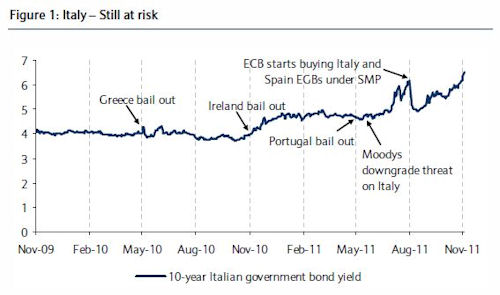
    But it may be too late. Interest rates are climbing as investors, spooked by the prospect of massive losses in Greece, demand a higher risk premium for Italian debt. Interest rates on 10-year Italian bonds have shot up to roughly 7% — roughly twice that of the United States. Italy now confronts a situation where it literally may be unable to raise taxes/cut spending fast enough to offset the higher interest payments.

    A new report by Barclay’s Bank suggests that “Italy may beyond the point of no return.” It is entering a “fiscal event horizon,” at which point the gravitational force of the black hole of debt is so powerful, there is no escaping its pull. Writes Barclay’s: “We doubt that Italian economic reforms alone will be sufficient to rehabilitate the Italian credit and eliminate the possibility of a debilitating confidence crisis that could overwhelm the positive effects of a reform agenda, however well conceived and implemented.”

    As interest payments mount, deficits worsen. As deficits worsen, investors demand higher risk premiums. As investors demand higher risk premium, interest rates and interest payment shoot even higher.

    Right now, the United States is the beneficiary of the euro crisis. Risk-averse investors are parking their money in U.S. Treasuries. As a result, interest rates here remain astoundingly low. Those low rates have bred a sense of complacency. Yeah, we know that budget deficits are out of control, but it’s not like we’re in an emergency situation yet. But Italy shows how quickly investor psychology can change. Borrowing costs there have surged from 4% to 7% in one year.

    For the United States, which is laboring under $15 trillion in debt, a comparable increase in interest rates would be very troubling indeed. Currently, the nation expects to pay $242 billion in interest on the national debt — big but manageable. Increase the interest rate by 75%, as happened in Italy, and the number rises to $423 billion (although not right away, given the fact that many bonds will take years to roll over). Scary, but still manageable.

    It’s a different story when we reach 2021. According to Office of Management and Budget forecasts, absent major changes in legislation, interest payments will reach $844 billion by 2021 due to (a) a bigger national debt and (b) the somewhat higher interest rates that attend the mature phase of a business cycle.” But tack on a 3 percentage-point risk premium like the Italians are experiencing, and we’ll add nearly $570 billion extra a year in interest payments. The following year, just the interest on the extra interest would amount to roughly $45 billion! Clearly, that is unsustainable.

    Basically, without massive budget reform, we’re about 10 years behind Italy. Boomergeddon is running ahead of schedule. Batten down the hatches while we still can!


  • Solo Commuting More Popular than Ever

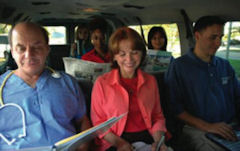
    If you've got to commute solo, do it in one of these babies, a Honda 3R-C, which runs on batteries, takes up less space in the parking lot and has space for carrying grocery bags.

    Wendell Cox has laid his hands on some U.S. Census commuting data that I cannot find on the Census Bureau website. In a recent column, he disseminated what he deems to be key findings. Solo automobile commuting reached an all-time record high in the United States in 2010, he says, increasing by 7.8 million commuters. Solo driving came partly at the expense of carpooling, which lost 2.4 million riders.

    Working at home (telecommuting) also gave a strong showing, gaining 1.7 million workers over the decade. Mass transit enjoyed its first 10-year gain since the Census Bureau began collecting data 50 years ago — picking up 900,000 daily commuters. Washington, D.C. was the third-largest transit commuting market in the country, following New York and San Francisco, picking up 130,000 commuters.

    It strikes me that traditional carpooling and van pooling — workers sharing the same vehicle between home to work — is doomed to continue declining. The practice requires participants to drive to work and back, with no stops along the way, at the same time every day. Fewer and fewer people have jobs that allow them to punch the clock like that.ย  The nature of work is changing — hours and schedules are becoming more flexible as people juggle work-life balance, run errands and chauffeur kids around town. Carpooling doesn’t match social and economic realities anymore.

    Technology may come to the rescue, however. Now that half the population has smart phones, it’s possible to wake up in the morning, check your phone and find someone nearby who is going the same place you are at the same time. The more people who participate, the more choices there will be, and the more attractive the car/van pooling will prove to be as a commuting alternative. It will be interesting to see how that pans out.

    Cox is an outspoken foe of Smart Growth, so the spin he put on the Census Bureau numbers may not be the same spin I would use. I’ll report the data first hand as soon as I come across it.

    — JAB


  • The Wonk Salon, November 9, 2011

    Linking Databases to Spur Educational Reform
    Education Sector
    By linking school, college and workforce databases, the federal Statewide Longitudinal Data Systems initiative has awarded $515 million to help states divine how well schools are preparing graduates for college and the workforce.

    Income Tax as Tool of Crony Capitalism
    John Locke Foundation
    North Carolina’s corporate tax stands at 6.9% but it’s riddled with loopholes. Politicians grant exemptions to subsidize favored or politically correct businesses. The system is “hidden, dishonest and inconsistent with informed decision making in a free and democratic society.”

    Pension Liabilities Bury Rhode Island in Deep Kimchi
    Mercatus Center
    Rhodes Island’s state and municipal debt is a lot worse than official figures indicate. Using more realistic assumptions about the rate of return on investment on pension assets, unfunded liabilities climb from $9.3 billion to $18 billion.

    New Priorities for Public Health
    Urban Institute
    With its emphasis on preventive medicine, the Patient Protection and Affordable Care Act can provide a big boost to public health care.


  • How Affordable Is College, Really?

    by James A. Bacon

    Educrats are fighting back against the public frustration with rising college tuitions. And who can blame them? Once Americans get properly fed up with the bloated and insulated world of higher ed and start holding colleges and universities accountable for their price gouging, a lot of people will lose their cushy sinecures. Writing for the New York Times, Judith Scott-Clayton says the tuition increases aren’t nearly as bad as they seem.

    Clayton, an assistant professor at Teachers College, Columbia University, notes in the Times’ Economix blog that while the sticker price of college has indeed increased, the average full-time student pays only half that amount, thanks to increased financial aid. “Many students,” she writes, “are actually paying less now to attend college than they would have five years ago.” (Hat tip: Larry Gross.)

    That’s of comfort, I’m sure, to those who are poor enough to qualify for student aid, though not to the suckers who sacrificed to save up enough money to send their kids to college. The hard-working middle/upper middle class gets stuck paying not only their own kids’ tuitions but those of other parents as well. Higher ed has transformed itself into yet another mechanism for the redistribution of wealth in American society.

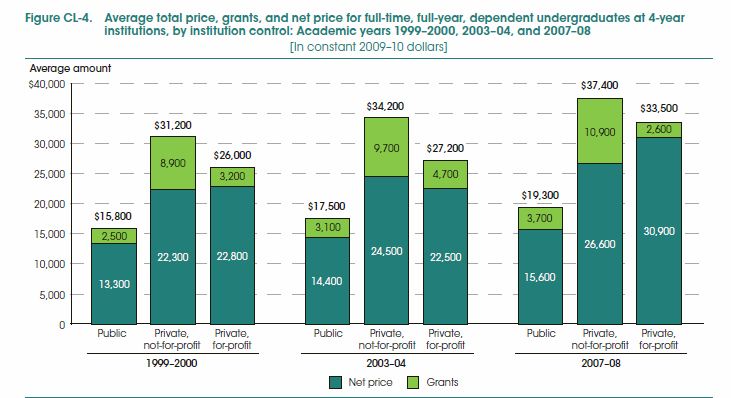
    But the fact is, the cost of college continues to increase even after adjusting for grants in aid. This chart comes from the newly published The Condition of Education 2011 from the National Center for Educational Statistics.

    (Click on chart to see more legible image.)

    The chart shows total prices for three categories of higher ed: public institutions, not-for-profit private institutions and for-profit private institutions. Then it deducts for scholarship grants (in light green), leaving the actual price paid (in blue-green). The increase (in inflation-adjusted dollars) between 1999 and 2008 was dramatic for all three categories.

    Class dismissed, Miss Clayton.


  • The Wonk Salon, November 8, 2011

    The Education Almanac
    National Center for Educational Statistics
    “The Condition of Education 2011” is jam packed full of statistics covering a wide range of topics in K-12 and post secondary education.

    Who Are the Poor?
    Urban Institute
    Not a lot of surprises here. The poor consist disproportionately of young people, single-parent households, people with lower education and minorities.


  • The Road to Crony Capitalism

    Bechtel corporate headquarters in Frisco: Rich and powerful

    by James A. Bacon

    Good news, bad news on the economic front. First the good news: Engineering-construction giant Bechtel Corp. will relocate 625 employees with its global operations, government services and civil business units from Frederick, Md., to Reston Town Center.

    “The company was attracted to the commonwealth due to its business environment, cost, and ability to attract the best workforce to meet future growth needs, especially [information technology] and engineering employees in the area,” said Gov. Bob McDonnell in a press release announcing the move.

    Oh, that and $6.5 million in state funds — a $1.5 million grant from the Governor’s Opportunity Fund to assist Fairfax County with the project and a $5 million Virginia Economic Development Incentive Grant. Previously, Bechtel had agreed to keep another 1,250 jobs in Frederick in Maryland after extracting a $9.5 million loan from that state, reports The Washington Business Journal.

    Once upon a time I would have considered that good news, and I guess I still do. Bechtel’s employees are highly skilled and highly paid. (The jobs staying in Maryland pay $125,000 each on average.) The deal means more jobs, bigger tax base, a hefty multiplier effect on the local economy and a reaffirmation of Virginia’s superior business climate. All very true. But the subsidy sticks in my craw. I’m getting increasingly cynical and disillusioned with a system that dispenses favors to the rich and powerful and nothing to the small and obscure.

    Here’s the other news from yesterday: Muller Martini Manufacturing, a maker of bookbinding equipment, has announced that it will close its Newport News facility, laying off 98 workers. And Berry Plastics Corp., a manufacturer of plastic bottles, will shutter its Henrico County plant, costing about 130 workers their jobs. Here we are, two years into an economic “recovery,” and it seems like more businesses are shrinking than growing. I don’t know if state or local economic development authorities tried to intervene to save those jobs (and I’m not even persuaded that it would have been a good idea to do so), but there seems to be a rank injustice that a rich and powerful company like Bechtel is getting state assistance while obscure, no-name companies don’t. Have you ever heard of Muller Martini or Berry Plastics? No, either have I. It’s a parable for our times.

    Meanwhile, a quick check with the Virginia Public Access Project shows that Bechtel Infrastructure Corp., based in McLean, has donated nearly $76,000 to Political Action Committees and politicians since VPAP started keeping track in 1999. Donations from Muller Martini: zero. Donations from Berry plastics: goose egg.

    Let me go way out on a limb and predict that Bechtel will be contributing more money in the future. Don’t forget, a Bechtel-led consortium is building Phase 1 of the Rail-to-Dulles project and soon will begin angling to win the contract on Phase 2. If it looks like crony capitalism and smells like crony capitalism…


  • TDM, the Transportation Step Child

    by James A. Bacon

    There are many ways to reduce traffic congestion — and adding more lane-miles of roads and highways is often the least cost-effective of them. You can shift travel demand from cars to other modes, such as walking, biking, carpooling and transit. You can shift travel to other, less-utilized routes. You can shift travel to less congested periods of the day. And you can eliminate trips altogether by means such as telecommuting. That is the essence of the discipline of Transportation Demand Management.

    Now consider: In Fiscal 2012 the commonwealth of Virginia is budgeted to spend $4,760 million building and maintaining the state’s road and highway network, and another $481 million on mass transit and rail — a total of $5,340 million on the supply side of the supply-and-demand equation. By contrast, the state spends a mere $11 million on programs and grants (run by a two-person staff) to manage the demand side of the equation. Of that sum, $7.1 million goes to Arlington County. That leaves about $4 million for the rest of the state.

    Put another way, for every dollar Virginia spends on the supply side, one-fifth of one cent is spent on the demand side. What is wrong with this picture?

    Economists love transportation demand management (or TDM, as it’s known in the trade). It is often far less expensive to persuade people to abandon their solo, rush-hour commute than it is to add the capacity to accommodate the growing traffic. But TDM doesn’t do much for politicians, who like to brag about building mega-projects that everyone can see and ooh-ah over…. or for career transportation officials, who justย  don’t get the same thrill paving up a park ‘n’ ride lot as they do erecting massive steel and concrete structures.

    Last month Christopher Arabia, manager of mobility programs, made a presentation to the Commonwealth Transportation Board meeting about the state’s modest TDM initiatives. Board members asked a few questions — just enough to be polite, so the poor fellow didn’t leave thinking that nobody cared — but otherwise showed zero curiosity. Here are some questions they did not ask.

    • Hey, Chris, can you calculate how much traffic congestion your programs relieve?
    • What is the Return on Investment on the state’s investment in TDM — and how does that compare to the Return on Investment in new road and rail projects?
    • Are there any worthwhile programs capable of generating a high ROI that you would like to see funded? If we gave you $50 million a year, what could you do with it?
    • Arlington County arguably has the leading TDM program in the entire country. Are there lessons that other jurisdictions in the state could learn from Arlington?

    Alas, none of those questions were asked. I don’t know if Arabia would have had the answers — but Arlington County probably does. A study underwritten by Arlington County Commuter Services in 2009 found that its $7 million programย  eliminated 38,000 car trips and 500,000 miles of vehicle travel, saving 23,000 gallons of gas and cutting 255 tons of greenhouse gas emissions every day. Admittedly, Arlington is an urban locale where biking, walking, buses and mass transit are ready alternatives to driving, so its numbers will look better than they would elsewhere. Nobody is suggesting that TDM is the answer. But it is part of the answer. We’re probably under-investing in it, although we can’t know for sure until we start asking the right questions.

    Lamentably, transportation in Virginia is all about building more stuff — more highways, more bridges, more rail lines — rather than figuring out how to make better use of the stuff we already have or, better yet, weaving a new urban fabric that is more fiscally and environmentally sustainable in the 21st century. What a shame.


  • What’s McDonnell Up To With Transportation?

    By Peter Galuszka

    The McDonnell Administration isย  taking a chain saw to policies that promote smarter, more efficient growth by axingย  reforms to make neighborhoods connected and pushing design contracts that fast-track road construction and discourage public input.

    Such are the conclusions drawn from two blog postings by David Alpert of Greater Greater Washington and Jim Bacon, publisher of this blog.

    They detail how Gov. Robert F. McDonnell and Transportation Secretary Sean Connaughton are throttling reform-minded policies that recently put Virginia at the forefront of good planning. They are using the Commonwealth Transportation Board (CTB), ย a 17-member panel appointed by the governor, as the spearhead to push their ideas on how subdivisions and roads should be built.

    According to the Alpert blog, the CTB recently got rid of policies enacted in 2009 that would encourage to build new subdivisions that connect easily to secondary and primary roads. Up until then, planning in Virginia was of the usualย 1950s model that erected countless cul de sacs without only a few roads outside the development.

    The result forced people into a lifestyle dominated by automobiles thatย wastedย time and gasolineย as residents traveled to shop or work and caused more trouble for emergency workers such as police, fire or ambulance drivers trying to respond to a crisis.

    Under former Gov. Tim Kaine, the CTB changed the rules in a way that put Virginia ahead of other states in planning concepts by adopting the connectivity policy. The CTB under McDonnell and Connaughton recently dumped the 2009 reforms. Why? My guess is to boost the interests of developers since McDonnell wants to be identified as “pro-business.”

    The Bacon post is an investigative look at the controversial bypass of U.S. 29 in Charlottesville. His work was funded in part by the Piedmont Environmental Council but they did not edit the article. Bypass proposals have been contentious because they would tend to exacerbate traffic congestion on what is already the most crowded road in the university city. Business interests, notably manufacturers in cities such as Lynchburg and Danville, want the bypass to improve truck deliveries.

    Connaughton’s goal is hastening development of the bypass. So, he pushed a “design-build” contract that is opposed to the way the state usually does construction project. In “design-build,” the contractor is also the designer and designs parts of the project as works goes along. The practice was once considered unethical by professional associations but it is has become widely adopted throughout the country. It can save money and quicken a project’s completion, but it can also lead to overruns and tends to limit public say about how a project looks.

    The CTB bought the “design build” idea for the bypass, but according to the Bacon report, Connaughton did not mention that engineers at his own Department of Transportation had serious doubts about the $244 million cost estimates, believing they would run much higher. Their concerns were not reflected in information given to the board which approved the project.

    The two excellent blog postings raise serious questions about exactly what McDonnell and Connaughton are doing. The state has just raised billions on the bond market for highway construction and is floating ideas for public-private roads such as a replacement for U.S. 460 in southeastern Virginia.

    Connaughton is steamrolling the U.S. 460 highway just as he is on the U.S. 29 bypass. Hisย concept took a hit recently when The Virginian-Pilot reported that a group of Tidewater politicians and business executives lobbied Connaughton to slow down on the road from Suffolk to Petersburg in favor of a third crossing in Hampton Roads, which they believe will do more to alleviate the water-locked region’s notorious congestion. Conaughton responded that the third crossing will cost twice as much as his pet road. There are problems with either plan. A third crossing would only dumpย traffic on clogged Interstate 64. Replacing U.S. 460 would create more exurban sprawl west of Suffolk, which has been the state’s fastest-growing city.

    Playing it both ways as free-spenders and cost cutters, McDonnell and Connaughton are refusing to provide funding for the D.C. Metro Silver Line Phase II project which would help alleviate traffic congestion. And, Connaughton has shown his bare-knuckles management style by firing nearly the entire board of the Virginia Ports Authority in one quick putsch.

    McDonnell, however, doesn’t have that much time in office left. What’s behind all of this?


  • The Wonk Salon, November 7, 2011

    Firearms Flow from States with Weak Gun Laws to States with Stronger Gun Laws
    National Bureau of Economic Research
    Gun-tracing data shows that guns flow from states with weak gun-control laws to states with stronger laws, creating cross-state externalities — a finding that strengthens the case for tighter federal regulation.

    Public Transit as an Emission Reduction Strategy
    Victoria Transport Policy Institute
    Critics say transit is an energy-inefficient mode of transportation because it uses as much energy per passenger-mile as driving. But that critique does not consider how transit supports energy savings through transit-oriented development and transportation pricing reforms.


  • A New Metric for Gasoline Affordability

    by James A. Bacon

    Todd Litman, who runs the Victoria Transport Policy Institute, provides a fascinating metric for tracking the affordability of gasoline. Rather than looking at price alone, in his paper, “Changing Vehicle Travel Price Sensitivities,” he refinesย  the cost per gallon (litre, actually, he lives in Canada) of gasoline by adjusting for median wages and the fuel efficiency of the average automobile. The result: the number of miles traveled one can purchase with one hour of work time.

    The calculation works like this: In 1967 annual median income in the United States was $2,464, gasoline cost $0.33 per gallon, and vehicles averaged 12.4 miles per gallon. An hour of work could buy you enough gasoline to travel 46 miles. In 2000, median incomes were $22,346, gasoline cost $1.51 per gallon and vehicles averaged 17 miles per gallon, meaning that an hour of work could buy you enough gasoline to travel 126 miles.

    After peaking in the late 1990s, travel affordability has declined precipitously. Wages have stagnated, fuel economy has improved only marginally but gasoline prices have risen. In 2010, an average work-hour could purchase enough fuel to take you 83 miles.

    The chart at the top of this post shows the trend. The metric is important because it shows how gasoline became increasingly affordable in the decades of the 1980s and 1990s. Not surprisingly, the number of vehicle miles traveled increased dramatically over that time. Admittedly, the increase in travel would have been impossible without a significant increase in the number of road-miles, but the falling cost of travel was the driving force. As travel affordability has declined since 2000, vehicle miles traveled have dipped as well, as seen in the second chart.

    Three broad policy conclusions stem from this insight.

    (1) Mandating higher fuel economy for automobiles could be somewhat self defeating: By reducing the cost per mile of driving, mandates could encourage more driving.

    (2) Stagnant incomes and rising prices for gasoline suggest that the number of vehicle miles traveled in the state has plateaued as well. It is foolish to spend millions of dollars on road-building projects predicated upon extrapolations of past trends into the indefinite future.

    (3) Insofar as the state does commit to funding new transportation projects, we should be supporting the kind of infill and re-development that allows Virginians to drive less rather than perpetuating the sprawling development patterns of the 1980s, 1990s and 2000s.


  • The Politics of Interstate Interchange Funding

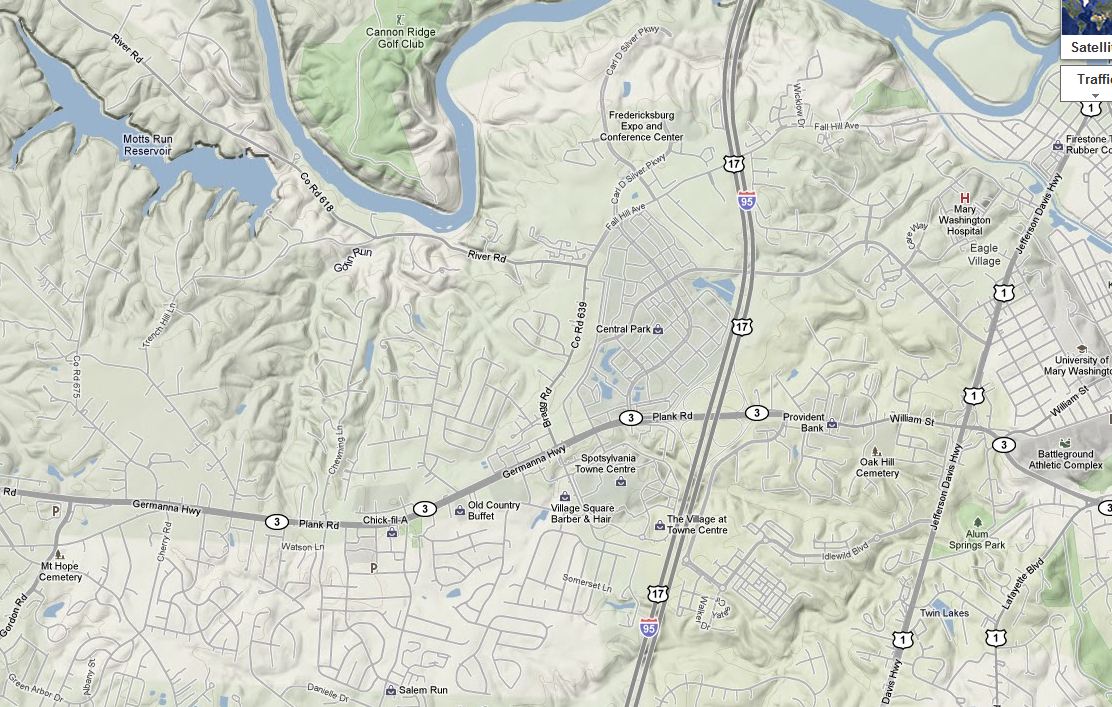
    The area around Celebrate Virginia. (Click on map for more legible image.)

    by James A. Bacon

    Here’s another proposed transportation project to watch closely: The Fredericksburg Area Metropolitan Planning Organization (FAMPO) has proposed building a new interchange on Interstate 95, estimated to cost $250 million to $300 million — or more, depending upon whom you believe — that would benefit the wealthy developers of the Celebrate Virginia project.

    William M. Beck, former mayor of Fredericksburg, has joined Ronald D. Utt, transportation scholar for the Heritage Foundation, to write a letter to Transportation Secretary Sean T. Connaughton urging him not to fund the interchange. “Under the circumstances,” they write, “a very costly project of modest, yet uncertain, benefits would seem to be an unlikely candidate for such scarce funds, and we hope you agree. Moreover, at a minimum of $300 million, the acceptance of the project would force the cancellation of many more worthy projects around the state and in the Fredericksburg area.”

    The rationale for the interchange is to relieve congestion on U.S. Route 3 by diverting traffic from Route 3, which is overloaded near its I-95 interchange, to a proposed, 3.5-mile toll road running from Route 3 near Gordon Road to its own intersection with I-95. As it so happens, the proposed route would zip right through Celebrate Virginia, a 2,500-acre tract owned by the Silver family, a major developer in the Fredericksburg area and Quantico guesstimated by Virginia Business magazine to be worth $750 million. The Silvers have invested millions of dollars in roads and other improvements at Celebrate Virginia through a Community Development Authority with the aim of creating an business/entertainment district that includes former Gov. L. Douglas Wilder’s ill-fated slavery museum as well as the highly controversial Kalahari water park, plans for which have been put on ice during the recession. At build-out, the Celebrate Virginia complex is expected to include more than 11 million square feet of commercial, residential and entertainment space.

    A big drawback of Celebrate Virginia is its lack of direct access to I-95. Motorists must use the Route 3 exit to the south and drive through the heavily traveled Central Park retail district, also developed by the Silvers. The new interchange would greatly enhance the value of the property, and it should come as no surprise that the developer has been lobbying heavily to get it built.ย  In 2010, the Silver Companies helped FAMPO underwrite a consulting study to evaluate options. That plan, submitted in May 2010, proposed building the interchange and connecting to the toll road. Meanwhile, the Silvers have engaged Washington lobbying firm Alcade & Fay to pursue a federal earmark for the interchange and toll road.

    Although squeezing $300 million out of either the feds or the state is a tall order in the age of austerity, the developers can be assured at least of a respectful hearing. Patriarch Carl D. Silver, son Larry D. Silver, who now runs the companies from Boca Raton, Fla., and a host of enterprises they control have collectively donatedย  $465,000 to various PACs and political candidates in Virginia since 2004. Among the donations: $5,000 to Sean Connaughton when he was chairman of the Prince William County Board of Supervisors and $5,000 more when he ran for lieutenant governor; $90,000 to former Gov. Tim Kaine, his inaugural and his Moving Virginia Forward fund; and $62,500 to Gov. Mark Warner and his inauguration. Interestingly, in a quick scan of the different entities through which the Silvers funnel political donations, I could not identify any contributions to Gov. Bob McDonnell. (If someone spots something I missed, please let me know.)

    Write Beck and Utt: “The embrace of outsized corporate welfare projects flogged as investments that benefit us all, are as old as the Republic and were common in the great debate over government funding of canals during the administrations of Jefferson and Madison. Not much has changed since.”


  • The Wonk Salon, November 5, 2011

    Health Exchanges Violate State Sovereignty
    Goldwater Institute
    Obamacare promises to give states flexibility in implementing state health exchanges. In reality, the feds control the providers who get to participate, control the plans and benefits and force states to enforce the individual mandate.

    Report on the World’s First Social Investment Bonds
    Rand Corporation
    The United Kingdom has launched the world’s first experiment in Social Investment Bonds (SIBs).ย  A private financier pays the upfront cost of reforming prison inmates and pockets a share of the reduced cost to government if the programs are more effective than the alternative.

    Kids Beware, Longer Schools Days May Be Coming
    Wallace Foundation
    Six hours a day and 180 days a year is not enough time to provide the education that American children, especially disadvantaged children, need to learn what they need to learn.

    Education in an Age of Austerity
    American Enterprise Institute
    After decades of spending growth, educators had better get used to the idea of doing more with less. Federal stimulus spending is ending, state budgets are underย  pressure and property tax revenues are down. Innovation and reform is the path ahead.

    Information Sharing and Child Development
    National Academy for State Health Policy
    The Better Child Care Health and Development learning collaborative supports healthy child development through care coordination and linkages among medical providers and community services programs.