• The Wonk Salon, November 4, 2011

    The Local Influence on Prison Population Size
    Urban Institute
    Local governments have three main policy levers for affecting the number of inmates in their jails and prisons: sentencing, inmate transfer and release, and supervision violation response.

    Who Uses Tax Incentives for Economic Development?
    National Bureau of Economic Research
    Who uses taxes incentives? Losers, that’s who. Well, maybe that’s a little harsh. To be more exact: Municipalities with low incomes, high levels of political corruption and locations close to state borders.

    The Return of Concentrated Poverty
    Brookings Institution
    Not only is there more poverty in the land compared to 2000, but it’s getting more concentrated. A rare and welcome exception to that trend: Poverty got less concentrated in Hampton Roads.

    Higher Ed Disclosure Laws? Mwa ha ha! What Higher Ed Disclosure Laws?
    Education Sector
    Most colleges are not complying with a 2008 federal law that mandated more transparency, including the reporting of measures that track graduation rates for low-income students.

    Signals and Sensors Improve Bus Performance
    Center for Transportation Studies
    An experiment in Minnesota shows that a system using wireless technology and a new algorithm improves bus travel times.


  • In the Dark

    The McDonnell administration omitted critical information from its presentation last summer when seeking the Commonwealth Transportation Board’s approval to fund the controversial Charlottesville bypass.

    by James A. Bacon

    On July 20 James Utterback, the Culpeper District administrator for the Virginia Department of Transportation, had the job of briefing the Commonwealth Transportation Board about the controversial Charlottesville Bypass. Flashing PowerPoint slides upon an overhead screen, he walked board members through the complexities of a project that had languished on the books for most of 20 years until the McDonnell administration had assigned it a top priority.

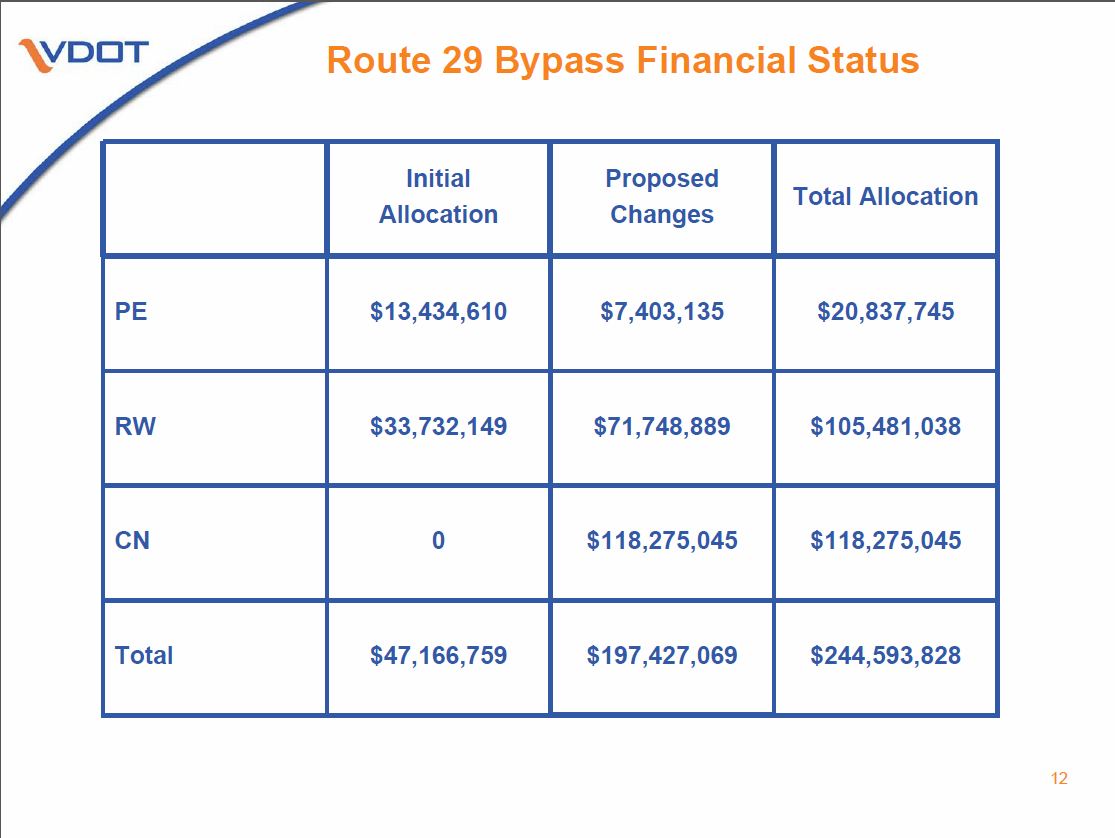
    The official cost estimate for the Charlottesville Bypass. (Click on chart for more legible image.)

    Utterback summarized the long, tortured history of the project.ย  He described how the 6-mile bypass would fit into the state’s long-range plans for U.S. 29 as a major highway for the movement of freight. He delved into a chart showing that the project would require $197.4 million to complete, includingย $118 million for construction plus millions for right-of-way acquisition and engineering, bringing the total cost to $244 million. (Click on image above for details.) And he displayed a rendering of the U.S. 29 corridor north of Charlottesville in which the bypass tied into U.S. 29 and U.S. 250 with interchange ramps.ย 

    After a lengthy public hearing in which dozens of Charlottesville residents and even a few from Lynchburg had driven to Richmond to let the board know what they thought, the CTB overwhelmingly approved the project.

    As it turns out, there were some very important things that Utterback did not mention in his scripted presentation. He did not tell the CTB, for instance, that central office engineers inside the Virginia Department of Transportation thought that construction could cost $100 million or more than the official estimate. He neglected to say that VDOT engineers were considering significant changes to the highway design to bring the cost down. Finally, he failed to mention that VDOT would not build the project using a “design-bid-build” process, doing the final design in-house as was customary, but as a “design-build,” which meant contracting out the final design to the winning construction team.

    In other words, the McDonnell administration omitted highly germane information — that the design and cost estimates of the project were uncertain and in flux — when it asked the CTB to approve the $197 million allocation.

    Would it have changed the outcome if VDOT had told the complete story about the cost and design uncertainties? One can only speculate. But it certainly would have strengthened the case of the bypass skeptics. At the very least, asks Dennis Rooker, an Albemarle County supervisor who played a leading role in opposing the bypass, “Wouldn’t it have been more honest to go to the CTB and say, ‘Here are our internal cost estimates, and we’re going to try to bring it in at a lower cost?’”

    James E. Rich, Culpeper district representative to the CTB, had even stronger words. “Deliberately providing incomplete information would prevent the board from fulfilling its statutory responsibilities to the commonwealth and to taxpayers.” If the omissions were shown to be deliberate, he said, “there should be consequences.”

    VDOT’s internal discussions were laid bare in documents obtained through a Freedom of Information Act request filed by the Charlottesville Albemarle Transportation Coalition, a self-described “local citizens group.” The organization works closely with, but is not formally affiliated with, the Piedmont Environmental Council and the Southern Environmental Law Center, which have actively opposed the bypass. (Full disclosure: The PEC sponsors Bacon’s Rebellion’s coverage of transportation and land use issues but keeps an arm’s-length distance from our reporting.) The treasure trove of emails and other documents sheds light on project uncertainties and risks that Gov. Bob McDonnell’s transportation team did not discuss publicly until after the project was a done deal.

    Roughly one month ago, Bacon’s Rebellion submittedย a list of detailed questions to VDOT seeking to clarify or confirm points arising from the documents and to solicit any additional information that would place the department’s actions in context. Lou Hatter, public affairs manager for the Culpeper district, replied that Commissioner Gregory A. Whirley had already addressed those questions when he spoke about the Charlottesville Bypass at the Commonwealth Transportation Board meeting on September 21 and when I interviewed him shortly afterwards. Said Hatter: “The information Mr. Whirley provided stands as the Departmentโ€™s response to your questions.”

    Two days before publication, Bacon’s Rebellion submitted relevant passages of this article to show the case we were making and the documentation behind it, offering VDOT one more chance to respond. Hatter thanked me for the communication but declined to comment. (more…)


  • The Wonk Salon, November 3, 2011

    The Strategic Importance of Advanced Manufacturing
    Third Way
    Advanced manufacturing sustains millions of jobs and is a key source of innovation, productivity and exports. How do we encourage more of it? By setting up government programs to stimulate more R&D and capital investment.

    Economic Development Tax Credits Don’t Do Much for Job Creation
    Show-Me Institute
    Tax credits are a favorite economic-development tool for state and local governments. But the economics literature says that the employment benefits are minimal.

    The Impact of Globalization on New York
    Center for an Urban Future / SUNY Levin Institute
    No state has benefited more, and suffered more, from globalization than New York. Manhattan has prospered while Albany and Rochester have fared better than most. But the manufacturing sector of the rest of New York has been hollowed out.

    State Debt and Liabilities: $4 Trillion and Counting
    State Budget Solutions
    When you tote up official state debt, pension obligations and other long-term liabilities, aggregate state indebtedness now exceeds $4 trillion. Among the 50 states in less-bad shape are Utah, South Dakota, Virginia, Wyoming and Idaho.

    Inside the Nation’s Education Report Card
    Education Sector
    Everything you wanted to know about the National Assessment of Educational Progress but were afraid to ask.


  • Art for Economic Development’s Sake

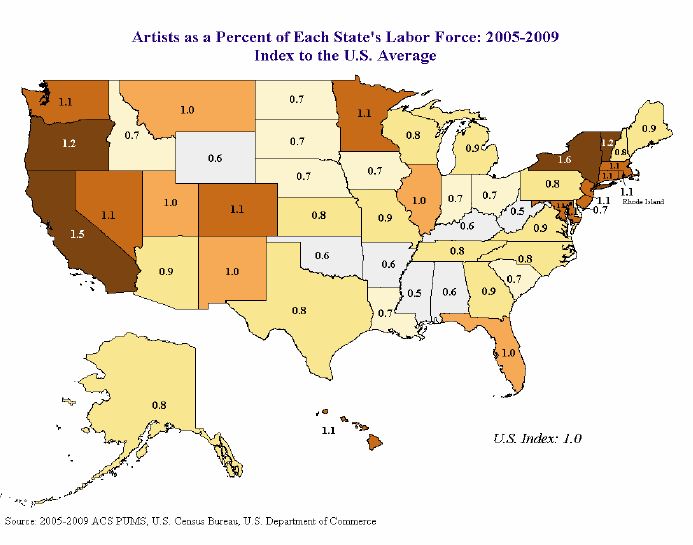
    Artists as Percentage of State Workforce. Click on map for more legible image.

    by James A. Bacon

    Forget about art for art’s sake. Let’s talk about art for economic development’s sake.

    A couple of days ago I lauded the City of Richmond’s efforts to create a downtown arts district. (See “Richmond’s Wine-and-Brie Path to Community Development.”) I was thinking mainly in terms of the effect that a cluster of artists would have in improving the region’s quality of life, making Richmond city a fun — dare I say it, even a coolย  — place to live. It turns out that I may have sold the arts district short by neglecting to observe that artists also make decent money and contribute to innovation.

    A research update to a study by the National Endowment for the Arts, “Artists in the Workforce: 1990-2005,” suggests that artists aren’t all of the starving variety. Indeed, the median wage/salary for artists — a group ranging from architects, producers and writers on the high end to dancers, photographers and “other” entertainers on the bottom — averages out to be $43,230. That’s 10% higher than the average wage.

    Artists are highly entrepreneurial: they are 3.5 times more likely than the total United States workforce to be self-employed. They also are better educated — more than half have a bachelor’s degree. However, they also are less likely to have full-year or full-time employment, which accounts for their having lower median incomes than workers with similar education levels.

    Not surprisingly, New York and California have among the largest concentrations of artists in the country, although the top honors goes to Washington, D.C., with 3.1% of the population. (That’s “artist,” not “con artist.”) The home state of Broadway counts 2.3% of its residents as artists, while artists comprise 2% of the workforce in LaLa Land. Virginia lags the national average: only 1.3% of its workers are classified as artists. Virginia stands out artistically speaking only in one way: It has a high concentration of writers and authors. (Ironically, Virginia ranks way below average in the book publishing occupational cluster.) Richmond, for what it’s worth, has a high concentration of dancers.

    As economic geographer Richard Florida has observed, artists are a key component of the “creative class” that contributes disproportionately to innovation and entrepreneurial activity. In the case of Richmond, the artistic cluster seems to be tied closely to the advertising/marketing industry segment. We’re not talking “high tech” here — a will ‘o the wisp for a region like Richmond.ย  But encouraging the growth of Richmond’s artistic community strikes me as a sound economic development strategy that builds upon existing assets (the Martin Agency, the Virginia Museum of Fine Arts, the VCU arts department) and contributes to the growth of a robust creative class.


  • The Wonk Salon, November 2, 2011

    Thirty-four Referenda this Year
    National Association of State Budget Officers
    It’s an off-year for elections so there are only 34 ballot measures in nine states this year, down from 160 last year. The referenda range from voting on slot machines in Maine to approving/rejecting an Ohio law limiting collective bargaining.

    Implementing Common Core State Standards
    National Governors Association
    Forty-four states serving 80% of the nation’s K-12 school population have adopted new common core standards in English/language arts and mathematics. But policy makers can do more.

    How States Can Support Creativity and Innovation
    Southern Growth Policies Board
    Innovation is the only way to climb out of the current economic malaise. States can stimulate innovation by establishing venture funds, hiring world-class researchers, establishing R&D tax credits, promoting STEM teaching careers and undertaking other measures.

    Healthy Americans, Health Economy
    Trust for America’s Health
    Healthy Americans are more productive at work. States and communities around the country are partnering with business to encourage employees and their families to make healthier choices.

    Best Start LA off to a Slow Start
    Urban Institute
    Best Start LA is designed to strength the capacity of families to raise children and the capacity of communities to support families. In other words, it takes a village. But this program seems to be having trouble getting off the ground.


  • They Attack By Night

    By Peter Galuszka

    It may go without saying that propaganda campaigns
    only tell part of the story.

    So it was in Richmond’s downtown Kanawha Plaza where a small band of “Occupy Richmond,” an offshoot of the national protest movement, had been camping since Oct. 15. This little group was protesting abuse of democracy and financial power not far from the capital city’s tall office buildings with their banks and law firms and lobbyist offices.

    Mayor Dwight Jones ventured out to the makeshift camp to chat with the protestors and invite them to continue a conversation. Members of the state’s conservative movement, notably the Tea Party, were quick to complain. They got airtime on Fox News and blogger attention on sites such as this one by complaining that the lefties in the city (read African-Americans) were coddling the Occupy people while the Tea Party had been charged $10,000 for a rally. They sent the city a bill for a refund.

    Things were not as they seemed. The city struck in the wee morning hours of Halloween. The tip off vanguard was a number of dump trucks that parked near the encampment. Then city police, augmented by Virginia State Police, appeared, some on horseback.

    The protestors were given a chance to leave or face charges of trespassing and being in a park after hours.ย  Some left. Others didn’t. The phalanx marched. Nine were arrested. Of Tuesday four were still being held in jail without bond. The camp areas were power-washed.

    So where’s the big news flash on Fox? Millions of Fox viewers will be left with the impression that Richmond is soft on lefties. Where’s the update on my fellow blogger Norm Leahy’s postings? His right-wing audience is probably still nodding in agreement about how the Establishment is two-faced about handling political parties.

    But then so is Mayor Jones who ends up as the villain of this tale. If anyone is two-faced, it is he.


  • Danger, Will Robinson: Metro Traffic Projected to Decline

    Metro station at Ronald Reagan Washington National Airport

    The Washington Metropolitan Area Transit Authority (WMATA)ย  is projecting a decline in ridership of as much as 5% in the next budget year. If Congress fails to extend Stimulus Act subsidies for federal employees, reports the Washington Examiner, ridership could dip another 2.8%.

    An WMATA spokesman blames a switch to manually operated trains in the wake of the deadly Fort Totten crash in 2009, which has slowed service. Furthermore, extensive track work has led to delays and closed stations. A maintenance backlog also has resulted in broken or rehabbed escalators. And don’t forget the impact of a fare increase and prolonged unemployment. It all adds up to a projected loss of $12 million in rail revenue — $28 million if the federally funded transit subsidy expires.

    In related news, WMATA’s budget forecasts indicate that the opening of Phase 1 of the Rail-to-Dulles project could run three months late, with a start date of Spring 2014, and that ridership will amount to 14.4 million in the first year — down from the official forecast of 15.3 million. So reports the Examiner.

    So, how much will Metro rail subsidies cost the commonwealth and its participating jurisdictions? According to Metro’s 2012 Budget Book, in FY 2012, Metro rail will require $149 million in operating subsidies. Virginia jurisdictions’ share will be $37.4 million. Plus, Virginia state and local governments will cough up an extra $110.2 million for capital improvements. (Fairfax County’s contribution should swell when Phase 1 of Rail-to-Dulles comes on line.)

    Here’s my worry: Metro Rail is a critical part of the metropolitan Washington transportation infrastructure but it relies heavily upon local government funding to cover operating expenses and capital maintenance. What happens if the federal government actually starts cutting spending (as opposed to pushing spending cuts into the indefinite future), workers get laid off, contracting work dries up and local tax revenues decline? Will the WMATA board curtail capital expenditures to alleviate local governments’ fiscal pain? If so, will maintenance suffer? If it does, will that hurt ridership? Will declining ridership bite into revenues, all in a vicious cycle?

    I’m not sure we have a fiscal formula that’s sustainable through the hard times that are bound to come. But we’re doubling down with the commitment to Rail to Dulles. I’m getting the heebie-jeebies just thinking about it.

    — JAB


  • The Wonk Salon, November 1, 2011

    A Modest Proposition: Treat College Students as Customers
    Center for American Progress
    Too many students fail to graduate from college, and among those who do, too many fail to acquire marketable skills. It’s a wild and crazy idea, but maybe colleges should make students their central focus.

    Teachers Paid 52% above Fair Market Value
    Heritage Foundation
    True, teachers get paid less than other college grads — but they tend to have fewer marketable skills. Given the value of their pensions, retirement health care and job security, their total compensation is 52% higher on average.

    Eat Taxes, Fat Boy!
    Tax Foundation
    The newest tax-raising craze in the 50 states: taxing sugar on the grounds of reducing obesity. Seventeen states now tax candy at a higher rate than other groceries, and four states collect a tax on sodas. Just one problem: Adolescents offset calories from sodas and sweets with calories from other sources.


  • Richmond’s Wine-and-Brie Path to Community Revitalization

    by James A. Bacon

    First Fridays Art Walk in downtown Richmond has a long way to go before it reaches the iconic status of, say, Miami’s South Beach or San Antonio’s canal walk, but it is increasingly defining the City of Richmond and, by extension, the Richmond metropolitan area. The art walk arose spontaneously a decade ago from the initiative of several art gallery owners to drum up business by instituting an art-world parallel to a Friday night pub crawl. People came in trickles, then in streams and now in droves. The monthly event has expanded to theaters and performing arts, restaurants and boutiques along the once-moribund Broad Street corridor, drawing from all walks of life. There’s so much activity that the city has had to get involved to regulate sidewalk vendors, enforce noise ordinances and clamp down on petty street crime.

    The idea for First Fridays Art Walk didn’t emerge from some consultant’s study,ย  Chamber of Commerce brain storming session or an idea-seeking delegation to another city. It arose from ground-up civic entrepreneurship and the unique tastes and sensibilities of the region.

    Richmond is one of the few Top 50 cities in the country without a major league sports team. We do have a AA team baseball team, the Flying Squirrels, and people do seem to like them. But we couldn’t get our act together to keep the AAA Richmond Braves, much less attract a big-league team. And if we don’t figure out how to finance renovation of the Diamond baseball stadium, we could lose the Squirrels. But we have one heck of an arts scene. In the Virginia Museum of Fine Arts, we can boast of the finest regional art museums in the country. At Virginia Commonwealth University, we have one of the highest ranked university art programs in the country. If we can’t aspire to being big league in the sports world, perhaps we can aspire to become big league in the arts world.

    In that spirit, City Councilman Charles R. Samuels has introduced an ordinance to create the Historic Broad Streets Arts District spanning 27 blocks in downtown. The proposal would qualify theaters, galleries, museums, dance studios, music halls and historical sites for special benefits such as participation in the city’s revolving loan program, tax exemptions and marketing/promotion dollars, according to the Times-Dispatch. The councilman’s heart is in the right place — better for the city to provide modest support to the arts than to spend multi-millions renovating a baseball stadium. But, as much as I love the idea of a turbo-charged arts district, I think he may be going overboard.

    Permit me to draw a distinction between different types of assistance that a city can offer. The most important assistance is enforcing ordinances to maintain public order and tranquility. Street vendors are getting out of hand? Fine, license them. Bands and boom boxes are too loud? Fine, enforce the noise ordinance. Petty thieves are picking pockets? Fine, assign a few police to patrol the streets. The city can do things like enforce parking ordinances, chase off the prostitutes and clean up the trash the next day. That’s the basic function of government, and the City of Richmond appears to be doing a good job.

    The second thing a city can do is get out of the way. For example, it can relax zoning codes that prevent artists or business owners from living in loft space above studios, galleries, shops and restaurants. It can prioritize building permit applications and inspections for entrepreneurs who are renovating old buildings. Both of ideas are part of Samuels’ package.

    The third thing a city can do is to actively help. Samuels proposes subsidies both direct (city appropriations for marketing) and indirect (reduced or waived fees from the city’s revolving loan program, a non-profit exemption from the city’s 7% admissions tax, and a temporary exemption of the business-license tax for arts-related businesses).

    That’s where I get nervous. I believe that government’s job is to create a level playing field for everyone, not to pick winners and losers. What if the city had favored some other use of downtown ten years ago? Would the Arts Walk ever have taken off? On the other hand, none of Samuels’ ideas should be terribly expensive and they can be easily reversed if they get out of hand — not like issuing $50 million in municipal bonds, say, to rebuild the baseball stadium, an action that cannot be undone.

    Whatever the final fate of the ordinance, it places the city’s priorities in the right place. The Arts Walk makes a fine fit with other grass roots institutions like the James River Writers Festival and the VCU French Film Festival. I’m a wine-and-brie kind of guy, and I’m happy for Richmond to carve out its defining niche as a wine-and-brie kind of town.


  • Work Ethic, the Welfare State and the Income Gap

    by James A. Bacon

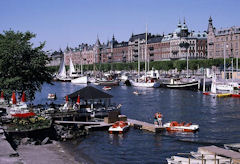
    Once again, Bacon sallies forth into the debate over the rising income gap… The latest piece to catch my eye is a new paper, “The Swedish Model Reassessed: Affluence Despite the Welfare State,” by a Finn, Nima Sanandaji, and published by the Helsinki-based Libera Foundation (which, as far as I know, is not funded by the Koch brothers, although you never know for sure, because they do have a global reach!)

    Sweden is American lefties’ favorite country because it is living proof that the socialist welfare state works. The Swedes, for all their high taxes and wealth redistribution, have maintained a high standard of living. However, Sanandaji argues that the Swedish model worked briefly only because it was living off the prosperity created by decades of entrepreneurial, wealth-creating capitalism, a strong work ethic and a value structure that inhibited Swedes from gaming the system.

    By the early 1970s, the socialist welfare state reached its apogee — and economic growth slowed dramatically. By the 1990s, the Swedes realized the system wasn’t working and embarked upon a dramatic about-face. While taxes remain high and the labor market rigid, Sweden enjoys among the greatest economic freedoms of any country in the world. The private sector is highly competitive and globalized, school vouchers create competition between schools, the national pension system has been partially privatized and tax rates have been cut. As a result, economic growth has rebounded.

    The most intriguing aspect of Sanandaji’s paper is the emphasis given to social norms. Until recently, Sweden was one of the most homogenous societies on the planet. “For a long time, the religious, cultural and economic systems in Sweden fostered strong norms related to work and responsibility,” he writes. “Since the norms relating to work and responsibility were so hard, Swedish citizens did not usually try to avoid taxes or misuse generous public support systems.”

    But as Swedes came to feel increasingly entitled to generous government benefits, those norms declined. In 1981-84, almost 82% of Swedes said that “claiming government benefits to which you are not entitled is never justifiable.” In a 1999-2004 survey, the percentage had declined to 55%. Since the partial rollback of the welfare state, that sentiment has moved back up to 61%.

    Sanandaji cites Swedish scholar Assar Lindbeck’s theory on the self-destructive dynamics of the welfare state: Welfare erodes norms relating to work and responsibility. As dependence upon welfare state institutions increase, the work ethic declines… and dependency increases.

    Now, let’s bring that back to the ongoing discussion over the income gap in the United States. We are approaching nearly a half century of the Great Society. We’ve had two or three generations of Americans born into welfare-state dependence. Has there been erosion in the work ethic? Many would say that, yes, the work ethic is weaker across the board, affecting all strata of society. (I know how hard my wife and I try to instil a work ethic in our 13-year-old son — trust me, it’s hard work!) But I would hypothesize, subject to empirical verification, that the erosion of the work ethic has been most acute among those raised in the multi-generational culture of poverty, e.g., a culture of welfare dependence. Insofar as the lowest-income Americans regard financial support from the government as a right and entitlement, they feel less motivated to make the sacrifices needed to acquire an education, work hard and find better jobs and make more money.

    If the bottom 20% of American tax filers are earning no more in inflation-adjusted dollars than they were 30 years ago, it’s not because America’s market-based economy is inherently biased against the poor. (The crony-capitalist system that we are embracing may favor the rich, but that’s a different issue.) Tragically, the disparity in income is used to justify even more of the wealth redistribution schemes that helped create that disparity. But the redistributionist schemes will only perpetuate the culture of dependency and poverty.


  • Uh, Oh, the Percentage of Insured Virginians Is Falling

    The decline in workplace coverage. (Click on graph for more legible image.)

    by James A. Bacon

    The percentage of Virginians withย  employer-provided health care has reached the lowest point in almost 20 years. While a higher percentage ofย  Virginians receive health care coverage in the Old Dominion than workers do nationally, that percentage is declining. And the percentage of premiums paid by employees is going up. So finds the Commonwealth Institute in its latest research report, “Unaffordable, Unavailable, Uncovered.”

    The problem is particularly acute among businesses with fewer than 50 employees. Only 40% of businesses with fewer than 50 employees offered health insurance in Virginia in 2010 — compared t0 97% of businesses with more than 50 employees who did.

    The Commonwealth Institute documents a real problem. The medical insurance system in the United States is broken.

    The authors, John McInerney and Michael Cassidy, suggest that the Affordable Care Act will help. The ACA provides tax credits for businesses with fewer than 25 employees and average wages less than $50,000 up to 235% of the premiums paid. The authors don’t see many new businesses signing up to take the credit, but they hope that it might prevent some businesses from dropping coverage. Another reform is the creation of a purchasing pool that will allow small businesses to access and purchase health insurance coverage for their workers, the Small Business Health Option Program.

    We’ll see how those insurance reforms work out. In the meantime, as documented previously in this blog, Obamacare has made life more difficult for small-company insurers by requiring all insurance plans to pay at least 80% of their premiums in benefits, driving at least one start-up insurer out of businessย  and making the space less attractive to others. (See “How Obamacare Helps the Working Class (Not)“). Furthermore, the federal government will impose minimum coverage standards, eliminating the option of providing bare-bones plans for those who can’t afford the gold-plated plans.

    So, color me skeptical. The way to fix the broken market for health insurance is not through more regulation, mandates and cross-subsidies. With the exception of education, health care is already the most highly government-dominated industry in the US. It’s no coincidence that it’s also one of the most dysfunctional. I laid out the path forward in “Boomergeddon.” The first place to start is eliminating the tax preference for employment-based health insurance. Putting the employer in the mix creates an entitlement mentality on the part of workers, divorcing them from the costs of their lifestyle and medical decisions. Also, it makes insurers compete for business by packaging plans that appeal to employers, not to patients. Obamacare only reinforces this insanity.


  • The Wonk Salon, October 28, 2011

    How to Shrink the Prison Population
    National Governors Association
    With the cost of incarcerating the average prisoner running around $29,000 a year, states are looking for ways to reduce their inmate populations. Among the recommended remedies: use evidence-based practices to reduce recidivism and tailor release decisions on individual risk factors.

    An Ounce of Prevention Is Worth a Pound of Pills
    Urban Institute
    The United States health care system could save a lot of money by preventing chronic diseases. No secrets here, just common sense. Get people to stop smoking and lose weight. Control diabetes. And prevent HIV.


  • Save the Bay — with Property Rights

    Oysters of the world, property rights are your friend!

    Same Chesapeake Bay, two different states…. and two very different fishing industries. Virginia’s fisherman are doing OK, adapting to pollution, over-fishing and oyster-killing diseases. Maryland’s are barely hanging on. Why is Virginia’s doing better? Property rights.

    At least, that’s the spin of Rona Kobell, writing for the Reason Foundation in, “Privatizing the Chesapeake.” Maryland has thrown research dollars and regulations at its watermen in the hopes of reviving the oyster industry. Virginia allows its watermen to lease oyster beds, giving them an incentive to steward their precious resource.

    It makes a great story, although I would like to see some solid numbers proving that Virginia’s oysters and clams are prospering while Maryland’s are not. Without question, our aquaculture industry is out-performing Maryland’s but I’d like to know how the wild critters are faring.

    As an anecdotal sidelight, there is a movement among Virginia bay-front landowners to plant mini-oyster beds in the waters off their property. An acquaintance of mine, a physician in his weekday life, seeds oysters and maintains a bed as a socially beneficial hobby — he’s doing his small part to help oysters regain their former glory. Many of his neighbors are doing the same. If every landowner created oyster beds off their property, it could make a material contribution to the healing of the bay.

    — JAB


  • The Wonk Salon, October 27, 2011

    The Unintended Consequences of Indiscriminate Spending on Higher Ed
    Cato Institute
    America opens up its purse strings for higher ed and what does it get? Runaway tuition inflation, sky-high non-completion rates and needless credential inflation.

    School Choice Improves Outcomes in Charlotte, NC
    National Bureau of Economic Research
    Inner-city kids in Charlotte-Mecklenburg picked by lottery to attend better schools are more likely to graduate from high school, attend a four-year college and earn a bachelor’s degree.

    Too Cozy: Trial Lawyers and State Attorneys General
    Manhattan Institute
    Plaintiffs’ attorneys donate campaign contributions to attorneys general; attorneys general help plaintiffs’ attorneys drum up more lawsuits. It’s a relationship as symbiotic as sharks and remoras.

    Native Indians Need to Strengthen Response to Rape, Domestic Violence
    Government Accountability Office
    Native-American women are twice as likely to be raped or sexually assaulted as women of other races. More tribally administered hospitals need to develop a capacity to collect and preserve forensic evidence.

    Investing in Public Health Provides Favorable ROI
    Robert Wood Johnson Foundation
    Investing $1 in proven, community-based public health programs can save the United States $5.60 in lower health care costs.


  • More Crazy Boomergeddon Talk

    James A. Bacon

    Imagine this scenario: Investors in U.S. Treasuries are so nervous about the country’s credit worthiness that they pile into notes with short-term maturities. Thirty percent of the national debt rolls over each year. To cover its routine borrowing, equal to 10% of the economy, and to keep the debt treadmill rolling, the federal government is finally forced to raise taxes or cut spending — not just talk about doing it. The anti-stimulus (I call it “suckulus”) threatens to tank the economy. Investors panic and no one wants to touch Treasuries. Abandoning its inflation targets, the Federal Reserve creates money as a short-term measure to purchase the bonds and keep government afloat. The prospect of fiscal austerity and runaway inflation proves even more ruinous to the economy. The political class starts discussing Greece-like scenarios. Should the U.S. continue printing money? Should it raise taxes? Should it force owners of U.S. debt to take a haircut?

    All the choices are bad. If the U.S. tries closing aย  budget gap equal to 10% of the economy, the resulting fall in output might approach 25% after the multiplier effect kicks in. The alternative is setting off Zimbabwe-style inflation that amounts to a 99% tax on financial wealth. Either way, a U.S. debt default triggers a global economic crisis far worse than the one we’ve just come through.

    Sounds like a scenario ripped out of the pages of “Boomergeddon”? Indeed, those are precisely the kind of unthinkable thoughts that I wrote about, predicting a Great Depression-scale economic catastrophe if the United States does not quickly and dramatically correct course. But it comes from a new paper, “Catastrophic Budget Failure,” written by Leonard E. Burman, Jeffrey Rohaly, Joseph Rosenberg and Katherine C. Lim and published by the National Tax Association.

    The thesis of “Boomergeddon” was an outlier when I published it more than a year ago. But the idea is going increasingly mainstream. The authors of “Catastrophic Budget Failure” are very worried about where the U.S. is heading, and for exactly the same reasons.

    I’m particularly intrigued by their paper because the authors buttress an argument that I alluded to only briefly — how the Euro crisis would interact with U.S. debt crisis: first masking the symptoms of our malaise and then accentuating it. The argument goes like this: The euro crisis has driven billions of dollars worth of investment into U.S. Treasuries as investors seek a safe haven for their money. While Treasuries are perceived to have long-term risk, that’s better than the short-term risks of European sovereign debt. The flight to safety keeps U.S. interest rates low, convincing the big spenders that there is little risk to their reckless fiscal policy.Write Burman et al.:

    This has been convenient in short-term because it enabled a huge amount of Treasury borrowing to fund economic recovery programs at miniscule interest rates, but it raises the threat of an explosion in interest rates in the future. Suppose that U.S. finances continue to deteriorate and that the European Union works out its policy coordination and monitoring problems. At some point (presumably in the distant future), investors could decide that the European Union, which is twice the size of the U.S. economy, is a better investment and Treasury interest rates could increase very suddenly. That shock could produce a tangible risk of default.

    Even if such a shift in investment sentiment doesn’t trigger a default, it will drive up the cost of carrying the national debt, now $15 trillion and heading to $22 trillion or so in another decade assuming that the Obama administration’sย  happy-face budget forecasts pan out. But rising interest rates would push annual interest on the debt from roughly $230 billion this year to well over $1 billion a year a decade from now. Treasury would borrow more money to pay the interest, swelling the debt and future interest payments. Crash. Boom.

    Since my book was published last summer, my every fear has been confirmed. Democrats and Republicans have utterly failed to make a serious dent in the budget gap. If government remains divided between the Ds and Rs, that’s it. Game over. Abandon hope. If the Rs sweep the presidency and both houses of Congress, the end of political gridlock might make progress possible on spending cuts… except in the defense arena… and most entitlements… The fear of electoral backlash and losing the next election to the Ds will restrain them from taking the bold measures that are necessary.ย  I hold out some hope that the Rs can do a better job of getting the economy moving again, but the economy faces bigger problems than Obama. There is no magic-wand solution.

    So, what’s a middle-class American to do? Buy that cabin in the woods and load up on shotgun shells and concertina wire. There’s still time. Boomergeddon should take 10 more years to get here. But it’s gonna get ugly when it comes.