Pitfalls in Assessing the Quality of Distance Learning Government Accountability Office
The Department of Education,which provided $134 billion a year in Title IV funds to college students last year, is interested in tracking the effectiveness of distance learning. Too bad the right hand doesn’t know what the left hand is doing.
Preparing for the Workforce: Apprenticeships vs. General Education National Bureau of Economic Research
Vocational education may improve the odds of a student landing a job when he enters the workforce, but narrower skills make him less adaptable — and less employable — over the long run.
Feds Can’t Reliably Track State Awards to DBEs Accountability Office
The feds want to increase participation of disadvantaged business enterprises (DBEs) in state highway contracts receiving federal funding. Trouble is, they don’t have the data to know if their goals are being met.
Low-Cost Strategies for Helping the Poor Center for Enterprise Development
With continuing shortfalls, states can’t afford to bolster social safety net programs. But they can pursue low-cost strategies for helping the poor by creating incentives for them to learn, earn, save, invest and protect.
Students without Borders Thomas Jefferson Institute for Public Policy Providing education in virtual classrooms costs 65% of what it does in traditional bricks-and-mortar classrooms. But Virginia’s education funding formulas get in the way of more widespread adoption. Chris Braunlich has a plan.
By 2030, K-12 Education Will Be Privatized Hoover Institution
Eventually, the United State will emulate the example of South Korea, Japan, India and Sweden, which encourage vigorous private-sector competition in educational services and achieve far better results.
What a Broadband Boost Would Mean for Rural New England Maine Heritage Policy Center
A seven percentage-point increase in broadband adoption in Maine, New Hampshire and Vermont would increase annual economic output by $1.4 billion, create or save $27,221 jobs, and boost annual income by $1 billion.
Income Segregation Has Grown Since 1970 US2010 Project
Not only are the rich getting richer, they’re living in places where they don’t have to mix with the hoi polloi.
Source: Federal Reserve Bank of Richmond. (Click on map for more legible image.)
The U.S. Economic Development Administration measures a region’s innovation performance relative to that of the nation based on component indices of human capital, economic dynamics, productivity and employment and economic well being. The first two measures are inputs to innovation, the second two are outputs that reflect the results.
The Washington-Baltimore area is the largest cluster of innovation in the district, followed by the North Carolina research triangle. The one other standout is Montgomery County, Va., home to Virginia Tech. (For the second time today, eat your hearts out, Wahoos! And I say that as a Wahoo myself.)
The rest of the region, including Richmond, Hampton Roads and Charlottesville, perform slightly below the national average for innovation.
Wahoos lament! According to Business Week, the best place to raise kids is… Blacksburg, Va.
Between the Alleghany Mountains and the Blue Ridge, Blacksburg is an upscale college town that is home to Virginia Tech. The area is known for education and lays claim to seven great public schools for the younger students.
The Metropolitan Washington Airports Authority approved today a multiparty agreement that outlines a new financing arrangement for Phase 2 of the Rail-to-Dulles project. All the key parties chipped in to help reach the estimated $2.8 billion cost.
“This momentous vote guarantees that the most important transportation project in our region’s history will go forward, that we will be able to reduce costs and that drivers who use the Dulles Toll Road will see less steep toll hikes than originally planned,” said Charles Snelling, Chairman of the MWAA board.
Last week United States Transportation Secretary Ray Lahood had forged an agreement in principle to fund the project that, under the original protocol, would have stiffed Dulles Toll Road patrons with rates that could escalate to $20 or more over 20 years. The commonwealth of Virginia would contribute $150 million extra and the federal government would provide loan assistance to help Fairfax County, Loudoun County and the MWAA fund construction projects associated with the extension, such as the building of parking garages.
The Reston2020 blog provides analysis and the text of the Memorandum of Understanding here. The General Assembly must appropriate the state’s $150 million share in the 2012 session. That contribution is less significant than it sounds. Notes the blog:
This money will be used to defray interest costs, not the construction of the Metrorail line, in the five years following the appropriation. In so doing, it will comprises merely 1-2% of the $10-$15 billion total debt servicing cost for the Silver Line over the next 40 years.
The Feds will provide Transportation Infrastructure Finance and Innovation Act (TIFIA) loan guarantees on up to $30 million. The MOU also contemplates various cost savings, such as reducing the size and scope of the Metrorail shop facilities at the Y-15 site at Dulles airport. Bottom line, concludes Reston2020, toll road users still could wind up with $12 to $13 full tolls by the 2040s, but that’s a lot less than feared and it’s also a long time away.
One sidelight: According to the MOU, “Virginia and MWAA have reached a separate agreement on the matter of Project Labor Agreements for Phase 2. Any Project Labor Agreement contemplated for the Project shall be consistent with applicable Federal statutory and regulatory requirements and Virginia law.” Getting a Project Labor Agreement, or PLA, which requires contractors and/or subcontractors to engage workers through a union hiring hall, was a prime objective of one of MWAA’s board members, Dennis Martire.
The wording of the MOU makes it totally unclear what agreement was reached. Will there be a PLA, or will there not? Inquiring minds would like to know.
The Virginia Department of Transportation has thoroughly documented the declining condition of Virginia roads (see the graph in this post) and the shrinking resources to pay for them. If you want to see what happens when you defer maintenance long enough, go to the City of Richmond. You’ll get a good feel for Virginia’s transportation future a few years from now unless current policy or funding changes.
The city would have to spend nearly $277 million to address the “legacy issue” of years of inadequate funding for road maintenance and reconstruction, reports the Times-Dispatch, drawing upon the findings of a city audit. Two thirds of the city’s streets are in need of major rehabilitation or repair.
How did that happen? Over the past five years, the city has budgeted only $2 million to $6.5 million yearly for road maintenance, far less than the $10 million needed. Next year, the Department of Public Works (DPW) expects to request $11 million, but at that rate it will take “several decades” to get streets back into proper condition, the newspaper quotes auditor Umesh V. Dalal as saying.
Stop gap measures to fill potholes accelerates the natural deterioration of roads, increasing the cost of maintenance in later years. “The National Center for Pavement Preservation indicates that every $1 spent on pavement preservation when pavements are in good condition eliminates or delays spending $6 to $10 on rehabilitation or reconstruction later when the pavement quality has deteriorated badly,” states the report.
The DPW has the tools to keep track of road conditions but hasn’t been using them. The department spent $9,000 on a pavement management system called Cartegraph in 2005. Despite paying annual maintenance fees of $1,800 yearly, the department hasn’t touched the system since the former pavement engineer retired in 2007. “Currently, no one in the Department has the credentials (password, user ID, etc) to access the system, so the system is not being used,” the auditors note. Not that it would make much difference. Rather than asking for the funds it needs, DPW administrators have been submitting budget requests for what they thought they could get.
Will the situation ever get this bad for the rest of Virginia? Hopefully not. VDOT has an asset-management system and uses it to prioritize maintenance spending. Also, due to policy embedded in state law, VDOT funds a higher percentage of maintenance needs than Richmond has been doing. But roadway conditions are deteriorating and VDOT is under pressure to siphon off maintenance funds to help pay for new construction projects. Without a sustainable, long-term source of revenue for maintenance funding, Virginia’s roads one day might end up looking like Richmond’s. If you think roads are expensive now, just wait.
Not that the City of Richmond does everything wrong… The city puts a lot of its GIS information online. You can download aps and maps, and even submit your own aps. Maybe someone should devise one that shows where the worst potholes are!
The Congressional Budget Office made quite a splash recently when it published its recent report, “Trends in the Distribution of Household Income between 1979 and 2007.” Progressives swooned in droves at seeming confirmation of their conviction that the rich are getting richer while the poor are getting poorer. (Actually, the report concluded that the richer are getting richer while the poor are treading water, while the middle class has gained ground modestly. Even then, it exaggerates the wealth gap by closing its study period in 2007. The wealth gap has declined significantly since then.)
But I post today’s Information Graphic, the work of Veronique de Rugy at the Mercatus Center, to dispel the notion that social mobility is a thing of the past and that a plutocracy is emerging. The chart above shows that million-dollar incomes are highly variable. You can do spankingly well one year and horribly the next. For many people, incomes spike in a single year while they exercise a decade’s worth of stock options or sell a business they built over a lifetime. Literally half of the million-dollar income earners hit the million-dollar mark for one year before falling back into the ranks of the muddled masses. Only six percent of millionaires scored million-dollar incomes for more than nine years running.
What seems to be a widening income gap actually could reflect the increasingly variable nature of compensation for society’s top money makers. Hundreds of thousands of Americans make a disproportionate share of their boodle in a short period of time, an outcome of corporate America’s effort to tie compensation to performance (bonuses, stock options, and the like) instead of treating executives to fat salaries and perks through good times and bad. Last time I checked, that was a good thing, not a bad one.
“No Excuses” Charter School Experience Can Be Transplanted to Public Schools National Bureau of Economic Research
The implementation of five core principles of the “No Excuses” charter school movement — increased instructional time, building human capital, differentiating between students, using data to inform instruction, and setting high expectations — has been implemented with positive results in nine low-performing schools in Houston.
Public Health Challenges of Prisoner Reentry Rand Corporation
Prisoners are sicker than the general population, with more infectious diseases, mental health issues and substance abuse problems. As states release an increasing number of convicts into the community, it’s time for communities to start planning now.
Rebooting Economic Development in Nevada Brookings Institution
The real estate boom didn’t end so well for Nevada. Time to try something new. Brookings thinks that Nevada’s economic development program needs a top-to-bottom overhaul.
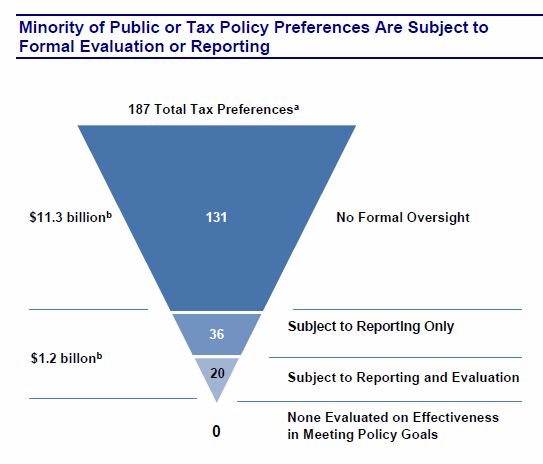
Republicans and Democrats alike are focusing on tax expenditures — exemptions, credits, deductions and other tax loopholes — in the federal government. It’s about time that someone took at comprehensive look at tax expenditures in the state budget. Thanks to the Joint Legislative Audit and Review Commission, we now know that tax preferences in the state tax code reduced taxpayer liabilities by $12.5 billion — equivalent to roughly 90% of the state tax revenues actually collected.
“Like most states, Virginia uses tax preferences to achieve specific policy goals,” write the authors of “Review of the Effectiveness of Virginia Tax Preferences.” Because tax preferences are not subject to the State budgetary process, they often remain in effect, sometimes indefinitely, without any evaluation of their effectiveness. Little information is available about tax preferences, including which ones should be continued because they are effective, and which ones could be revised to improve their effectiveness or eliminated altogether.”
Some tax preferences achieve their goals, others do not. JLARC recommends that the General Assembly set up mechanisms to give tax preferences regular scrutiny and review.
Three large preferences account for half of the reduction in tax liability, the report states: (1) the exemption of services from the retail sales and use tax, (2) the exemption of manufacturing materials and equipment from the same tax, and (3) the treatment of federal itemized deductions on individual income tax
returns. Five other preferences, aimed at helping the poor, account for $2.2 billion in reduced liabilities: the tiered income tax rate, special breaks for social security income and an age deduction from the income tax, and exemptions for food, drugs and medical products from the sales tax.
Among the more controversial recommendations, JLARC recommended extending the sales tax to services. “Services now represent approximately two-thirds of the national economy, and Virginia could significantly broaden the retail sales and use tax base and improve the reliability of collections by taxing some or all services. Service exemptions represent the largest group of tax preferences in Virginia, reducing taxpayer liability by over $3.5 billion in 2008.”
As for the tax breaks that are justified by helping the poor, JLARC notes, they don’t accomplish that goal very efficiently. “While taxpayers
with incomes of $20,000 or less comprised 14 percent of Virginia households, they received only seven percent of the reduction in tax liability associated with the partial exemption on food purchases available to all taxpayers.”
Some breaks were given for purposes of administrative efficiency. The exemption from the sales tax on prisoner artwork, for instance, was granted on the grounds that it would be impractical to try to collect the tax. Other tax breaks seem to accomplish their goals. The tax credit for conservation easements, for example, has put significant acreage under protection. But others apparently are too meager to be effective. As an example, JLARC writes, “the Worker Retraining Tax Credit has been historically underutilized because, according to businesses interviewed by JLARC staff, the $100 credit for non-community college retraining is not large enough to encourage companies to retrain workers.”
My philosophy on tax policy is simple: We should strive for the broadest tax base and the lowest rates possible. We should balance those concerns with ease of administration, both for those who collect the taxes and those who pay them. Taxes should be equitable, as in, no carve-outs for small groups. Finally, taxes should be transparent: Taxpayers should know what they’re paying. If lawmakers want to help the poor, fine, create a line item in the budget and review it every year. If lawmakers want to stimulate economic development, great, set up a fund for dispensing grants so the costs and benefits can be measured. But don’t create tax exemptions, put them on auto-pilot and forget about them. That is simply bad governance.
What Do We Do With Violent Sexual Predators When They Leave Prison? Joint Legislative Audit and Review Commission
Virginia’s methodology for assessing the risk posed by violent sexual predators when they leave prison is flawed, leaving it vulnerable to using out-of-date actuarial science and limiting input from qualified professionals.
Challenges to Growth of Virginia’s Bioeconomy Southeast Agriculture & Forestry Energy Resources Alliance In Virginia the “bioeconomy” of biopower, biofuels and bio-based consumer products is limited mainly to biomass burned in industrial boilers and to biodiesel.
Revitalizing Georgia’s Forestry Sector Southeast Agriculture & Forestry Energy Resources Alliance
Georgia does wood like Iowa does corn. Trouble is, wood is dependent upon the housing sector, which is in the dumps. So the state is hoping to spark innovation and new markets by putting industry, academic and government player together.
Reforming Primary Care National Academy for State Health Policy
As Obamacare is implemented nationally, states are wrestling with how to create new, integrated models of primary care. State budget cuts aren’t making the job any easier.
The port of Baltimore. Photo credit: Baltimore Sun.
It often makes interesting reading to see our problems through the eyes of others. In this instance, it is illuminating to read an analysis of the Port of Virginia’s woes from the perspective of the Baltimore Sun. After years of playing second fiddle to its chief Mid-Atlantic rival in Norfolk, the Port of Baltimore is rebounding very nicely from the recession.
What Baltimore did that Hampton Roads did not is diversify. Finding itself at a competitive disadvantage competing against Virginia for the container market — Virginia handles three times as many containers — the port began to pursue autos, agricultural and construction machines and niche cargoes in the 1990s. The strategy worked. Baltimore’s industrial segments are enjoying strong exports in the economic recovery.
There’s a lesson here for the Ports of Virginia, although I doubt its one that the newly reconstituted board appointed by Gov. Bob McDonnell is likely to heed. Maybe it’s time to re-think the port’s strategy, which heretofore has focused on handling container imports and, even now, anticipates a shift in traffic to bigger, post Panamax-class vessels when the widening of the Panama Canal is complete.
One problem with that strategy is that Norfolk ports face a major constraint to import-led growth: the transportation bottleneck for container traffic. A continued rise in the number of trucks will overwhelm the region’s transportation connections. That’s why Gov. Bob McDonnell proposes to invest hundreds of millions of state dollars in a public-private partnership that will build an Interstate-grade highway between Petersburg and Suffolk.
The underlying assumption of Virginia’s strategy is this: Container traffic from Hampton Roads will continue to grow, and it is the obligation of the state to accommodate that growth by adding highway capacity — even if the project is not economically self supporting through tolls and other revenue sources. (As it happens, Norfolk’s maritime industry prefers the Third Crossing, which would tie into Interstate 64 on the Peninsula, but the underlying assumption that the state should pony up big bucks is the same.)
But what if… But what if the Ports of Virginia pursued a different strategy? What if, instead of seeking more containerized imports, it began capturing more exports — just like Baltimore started to do more than a decade ago? That wouldn’t strain capacity very much, if at all. Instead of dead-heading into Norfolk and Portsmouth to pick up cargo, trucks could carry containers full of export goods on the trip, utilizing transportation infrastructure we already have.
Admittedly, new export business is not likely to materialize overnight. It might take a decade or more of work. But economic mega-trends might be with us. I find it just as plausible to believe that the U.S. will experience an export boom in the future as to count on 10 or 20 years of continued import growth in the face of continued consumer over-indebtedness and frugality.
Maybe the idea is full of holes. I’m just trying to think outside the box. But I’d like to see more people asking questions instead of automatically accepting hoary assumptions that may have run their course.
Taylor Reveley, the president of the College of William & Mary, has been pushing some unsettling ideas for re-defining the university’s relationship to the commonwealth of Virginia.
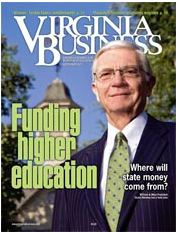
State funding, which constituted 43% of the institution’s operating budget 30 years ago, now provides only 13%. The university has responded by jacking up charges for tuition, fees, room and board, which now stands at $44,854 for out-of-state students and $22,024 for in-state. The state should allow W&M to raise its in-state charges to market rates, Reveley proposes. That would mean doubling them to where out-of-state charges are now, according to this month’s Virginia Business magazine.
The university then would use a portion of the proceeds generated by families who can afford to pay full price to provide financial assistance to lower-income and middle-income families. From each according to his abilities, to each according to his needs.
It is ironic that this plan for redistributing the wealth would come from Reveley. The patrician, silver-haired, former law school dean is not anybody’s idea of a campus radical. He was appointed president in 2008 in place of left-leaning Gene R. Nichol, whose decisions on culture-war issues had plunged the campus into controversy.
The beauty of the plan, according to Reveley, is that it would not compromise affordability. “If Virginia is to sustain its system of public education, it must be creative about how to do it. I’m just deeply concerned that the money [from the state] isn’t going to be there. We’ve got to pursue other means of sustaining ourselves.”
Reveley’s plan would allow the university to grow undergraduate enrollment, a core goal of the Virginia Higher Education Opportunity Act, which calls for creating 6,000 new slots statewide for in-state students. The W&M president also calls for developing new revenue streams by means of research grants, entrepreneurial activities more aggressive fund-raising, and he recommends productivity-enhancing changes such as embracing long-distance learning and year-round use of the facilities.
The Virginia Business article, though one of the best pieces I have read about higher ed in Virginia recently, did omit one important perspective: One reason that state support has declined so dramatically is that W&M, along with the University of Virginia and Virginia Tech, agreed to second-class funding status in exchange for greater freedom from state bureaucratic control. The hope was that granting more autonomy to the three universities with the largest endowments would allow them to save considerable expense and give them more latitude in undertaking new initiatives.
If Reveley gets his way, William & Mary would take another big step toward independence, becoming more like private, non-profit colleges that charge exorbitant fees and rebate part of them back to lower- and middle-income parents.
I’m ambivalent. On the one hand, I’ve got problems with enacting another wealth-distribution scheme in order to expand capacity and admit more students who very likely will derive little benefit from attending college. On the other hand, I agree with fellow-blogger Groveton that it may make good sense for W&M, UVa and Tech to go private and become totally self supporting. That would free resources for the commonwealth to plow into George Mason University, Old Dominion University and Virginia Commonwealth University with the goal of building prestigious institutions in the state’s three main population centers that can ignite economic development.
Reluctantly, I conclude that Reveley’s proposal is a step in the right direction. We should be explicit, though, that the ultimate goal is to take W&M private.
The commonwealth of Virginia lacks the fiscal resources to maintain and upgrade its transportation system, argues Bob Chase, president of the Northern Virginia Transportation Alliance, in the latest issue of the Virginia Newsletter. There’s nothing surprising about his conclusion — he and others have been making essentially the same arguments for a long time. What Chase accomplishes in his essay is to explore the topic in greater depth than is possible in a typical op-ed column and to update his argument with the latest state data.
Maintenance expense is eating up a larger percentage of available funds and, even then, road conditions are deteriorating year by year. Federal stimulus funds are expiring. Virginia has finite capacity to issue transportation bonds. Public-private partnerships, while promising, are suitable only for large, complex and toll-driven projects. The federal government will permit only limited tolling of federal highways. Meanwhile, long-term growth trends will put the transportation network under increasing strain.
That much is beyond dispute. But Case also advances an argument for “new, sustained, long-term transportation funding” — in other words, higher taxes. Options include increasing the motor fuels tax, raising the sales tax, hiking the motor vehicle sales tax, imposing a Vehicle Miles Traveled tax, and, harder to sell politically, raising the state income tax. No one likes paying taxes, he argues, but the failure to address intensifying traffic congestion imposes costs such as time spent in congestion and lost economic growth that are even more onerous.
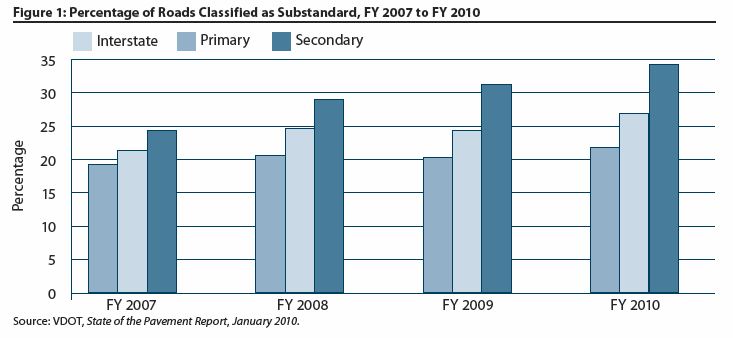
Percentage of roads classified as substandard. (Click on chart for more legible image.)
As I have argued repeatedly on this blog, Virginia is not spending enough on its transportation system. The mounting backlog of maintenance needs (shown in the chart at right, taken from the newsletter) means that our roads are getting in worse shape as time goes by. The McDonnell administration is addressing that problem in the short run by accelerating the outflow of unspent dollars that had accumulated excessively during the recession. Road conditions should show improvement this year. But the long-term trend is dire. We need more money, but none of the means for getting it are very popular.
That’s a key topic that Chase did not address. In 1986, Virginians trusted Gov. Gerald Baliles to spend the money well when he raised the motor fuels tax and sales tax to current levels. They don’t trust Virginia’s political establishment to spend the money wisely today. People belly ache about potholes and traffic jams but for all the talk about the cost of congestion and lost economic opportunities, the average citizen just doesn’t see the benefit to higher taxes. And there are very good reasons for that.
First, the cost of congestion is higher for people who perceive their time as more valuable — mainly higher-income Virginians and companies for whom transportation and travel is a cost of doing business. That’s why business lobbies have consistently endorsed higher taxes as a means to “get Virginia moving,” to borrow a phrase from Gov. McDonnell. Trouble is, they don’t want to pay for the roads in proportion to which they would benefit from them. They want the general public to pay. And that’s a hard sell.
Second, money isn’t funding projects that benefit the general public. The Charlottesville Bypass is a classic case. The Virginia Department of Transportation is spending $245 million to build a bypass designed mainly to accommodate freight traffic passing through the Charlottesville-Albemarle area. That expenditure for a 6-mile bypass will do very little to alleviate congestion for the people actually living there. It’s not clear how other expensive mega-projects in the works, from the U.S. 460 upgrade of the Coalfield Expressway, will help the average Joe either.
Third, there is no system for ranking projects, big or small, on a Return on Investment basis. The paucity of objective metrics encourages people to think that projects are funded largely on the basis of political considerations, for the benefit of developers and other special interests. That’s not, in fact, always true. But sometimes it is.
Fourth, the McDonnell administration has not re-prioritized transportation projects in light of the 2007-2008 recession, which brought an end to the post-World War II growth patterns characterized by increasing indebtedness, Mass OverConsumption and “suburban sprawl.” A very strong case can be made that the United States is entering an era of infill and re-development driven by higher gas prices, changing demographics and the collapse of the housing boom. Yet projects in the state’s Six-Year Investment Program, conceived in a time when metropolitan areas pushed ever outward with scattered, low-density and disconnected development, have never been re-visited. In other words, higher taxes would address yesterday’s perceived needs, not tomorrow’s.
If the General Assembly raised taxes to fund more transportation projects, the administration would find a way to spend it. But spending more money on the wrong projects makes no economic or political sense.
Virginia’s Republicans failed to replicate their national party’s success in last year’s mid-term national elections and barely squeaked by to win both houses of the state General Assembly.
The 20-20 split in the state Senate hung on a spare 222 votes in a Spotsylvania County race. By conceding his election race Democratic State Sen. R. Edward Houck does give Republican Lt. Gov. Bill Bolling the opportunity to cast the deciding vote on critical issues in the Senate.
Overall, however, Tuesday voting results are hardly a mandate for the GOP, despite how much pro-GOP commentators such as the publisher of this blog and Wall Street Journal columnists wish it to be so. The key is how the Gov. Robert F. McDonnell and other GOP leaders intend to use their new power in the legislature.
Possible agendas are not promising. McDonnell probably wants to change the state worker retirement system in ways that screw state workers and dump more costs back on them. He’s already raided the system indirectly by deferring payments the state is obliged to make in a smoke and mirrors attempt to present the state with budget that is in the black. Doing so lets him cast himself as a hotshot new Republican governor so he can pursue national ambitions.
He’s going to try to somehow change public schools, but he has already cut critical education spending and Virginia children are suffering the results with their worsening performance on national tests.
He might try to revive, once again, his efforts to privatize ABC stores but even with the seven new Republican state senators that’s going to be a battle since many GOP legislators abandoned McDonnell in his earlier efforts.
What is likely is more of the same corporate pork barrel we’ve seen for big corporations and Hollywood moguls like Steven Spielberg and West Coast defense industries. Spielberg got millions from the state film office to make a Lincoln movie in Richmond where the payback to the state seems to be limited to actress Sally Fields patronizing cute downtown and Cary Street restaurants in the capital. As far as corporate welfare, expect a new charge to lift the ban on uranium mining by a group of rich Southside farmers and Canadian businessmen who have already been taking legislators on suspicious, all-expenses-paid trips to uranium mining hotspots such as Paris.
In other areas, there’s not much McDonnell can hope to accomplish. His dream of erecting dozens of oil derricks off the Virginia caps to make Virginia “The Energy Capital of the East Coast” have come to naught. The U.S. Department of the Interior left Virginia off the list for new leases for at least a few more years.
The way appeals courts are running against right-wing Atty. Gen. Kenneth Cuccinelli’s efforts to block Obamacare, McDonnell will be hard-pressed to do much to further challenge the law which faces the ultimate constitutionality test in the U.S. Supreme Court. The ball here is no longer in Virginia’s court.
Lastly, despite McDonnell’s efforts to make himself over from staunch social conservative to moderate, the election results Tuesday have a conspicuous nut factor. Corey Stewart, the Prince William County politician who wants to make Virginia the next Alabama in terms of racist anti-immigrant laws, won. Loudoun County has a completely GOP board, including homophobe Eugene Delgaudio. And, ultra-nut Dick Black is heading for the Senate.
True, the Democrats did poorly and Obama is weak. But the real message is they are not as weak as the Republicans wished.
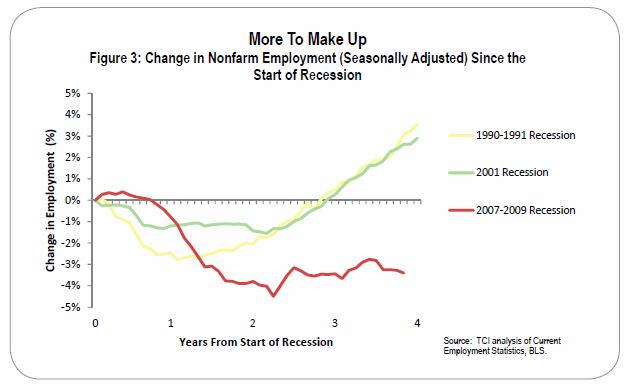
This chart, found in the Commonwealth Institute’s new report, “Unemployed, Underutilized, Undone: Employment and Labor Force,” shows why the 2007-2009 recession still feels like a recession here in Virginia, even though it technically ended two years ago. In contrast to the past two economic recoveries, this business cycle truly has been a “jobless recovery.”
Among the highlights of the CI report: Unemployment in 2010 was stuck at the highest level since the early 1980s, underemployment was at the highest level in 15 years, and the drop in employment rates for Virginians with low levels of education were roughly twice the drop experienced by their better educated peers.
Digging a little deeper into CI’s report, it is somewhat disconcerting to see that the “bright spots” in Virginia employment, showing the strongest job growth between 2007 and 2011 were: (1) the federal government, (2) education and health services (both of which are experiencing unsustainable bubbles), and (3) state government. Only one private sector occupational category, professional and business services, eked out a barely detectable job gain.
The year: 2075. The American colonies on the Moon are getting restless under Washington’s tyrannical rule….
This second edition of “Dust Mites” has a snazzy new cover, includes helpful lunar maps, and is 5,000 words tighter than the original. The sequel, “Trogs,” is scheduled for publication this summer.
Advertisement
Advertisement
Advertisement
Advertisement
About
Bacon’s Rebellion is Virginia’s leading politically non-aligned portal for news, opinions and analysis about state, regional and local public policy. Read more about us here.
Fund the Rebellion
Shake up the status quo! Your contributions will be used to pay for faster download speeds and grow readership. Make a one-time donation by credit card or contribute a small sum monthly.
Can’t wait until tomorrow
For your Bacon’s Rebellion fix?
Enter your email address to receive immediate notifications of new posts by email.
SUBSCRIBE
Search Bacon’s Rebellion
Categories
Archives
The Jefferson Council
Protecting Thomas Jefferson’s Legacy at the University of Virginia
Forgot Your Password?
Shoot me an email and I’ll generate a new password for you.