• How to Increase Transportation Revenue without Raising Taxes

    by James A. Bacon

    NORFOLK–Declaring that transportation is a “core responsibility” of state government, Gov. Bob McDonnell outlined today a legislative package that would increase funding for roads, highways and transit from the General Fund. Traditionally, Virginia has paid for transportation projects primarily through dedicated revenue streams such as the motor fuels tax, a half percentage pointย of the sales tax,ย a tax on automobile registrations and other narrow-bore levies.

    McDonnell’s plan would divert an additional one-quarter percentage point from the state sales tax, a bigger share of end-of-year budget surpluses, a full percentage point of the General Fund budget when revenue growth exceeds 5% in a year, andย a Tax Increment Financing-like mechanismย for capturing a share of state tax revenues made possible by state-funded infrastructure.

    “Transportation and economic development and prosperity are inextricably linked,” said McDonnell, presenting his initiative to the Governor’s Transportation Conference in Norfolk. “Whether it’s the infrastructure needed to move people and goods, or certain transportation-related industries poised for major growth and job creation, we must continue to make progress in improving our transportation networks if Virginia is to remain economically competitive.” (Read the press release.)

    The governor’s address was interrupted briefly by an outburst from a group identifying itself as Occupy Norfolk.ย The protestersย employed the Occupy movement’s trademarked human microphone technique to greet him with, “Welcome Governor McDonnell.”ย That elicited a fleeting smile, but the protesters then proceeded to shout over the governor as he tried to address the audience.

    The biggest chunk of new revenue would come fromย phasing in a one-quarter percentage point increase in theย share of the state sales tax dedicated to transportation over eight years. If enacted, the plan will boost theย share from one half percent (.50%) currently to .055%, or one-twentieth of a percent, sufficient to bolster transportation revenues by $110 million next budget. The governor provided no estimate of how much the other measures would generate, although he noted that over the past two years the state has transferred $100 million in surplus funds to transportation.

    Last year, the General Assembly backed McDonnell’s proposal to accelerate borrowing —ย $4 billion during his administrationย — to take advantage of low interest rates and low construction costs.ย Interestย will be repaid from sources traditionally dedicated to transportation. A potential sticking point with the new plan is that, by taking money from the General Fund, it may be perceived as funding transportation at the expense of priorities such as K-12 education, higher education, Medicaid and corrections, that rely upon the General Fund.

    McDonnell deals with potential objections by limiting the circumstances in which the transfers to transportation would be made. The proposal toย steer 75% of budget surpluses to transportation would apply only if the state runs a budget surplus. Takingย a one-percent slice from the General Fund would apply only in years whenย revenues increase by more than 5%. It’s not clear how the Tax Increment Financing proposal would work, butย the logic is that it would return to transportation a share ofย the revenues made possible by a transportation investment in the first place.

    Another foreseeable objection is that the planย will focus on the factย that McDonnell’s emphasis is on raising more money for transportation rather than reprioritizing how the money is spent. A recent Sierra Clubย report accused the governor of borrowing billions of dollars to build โ€œmajor, unneeded and destructive roadwaysโ€ instead of funding transit, bike paths, carpooling and transit- and pedestrian-friendly land use.

    In justifying the need for more revenue, the governor made two key points. First, the motor fuels tax, the primary source of transportation funds,ย will decline in the future.ย An increasing number of carsย will shift to alternate fuels, and even those that don’t will get better gas mileage. “Add those two things together and you have a math problem,” the governor said.ย 

    Secondly, transportation is vital to economic development. McDonnell cited a study by Chmura Economics & Analyticsย that found the 2011 transportation package will grow the Virginia economy by over $13 billion and sustain an additional 104,000 jobs. Among specific economic-related initiatives, the governor mentioned additional funding for the Mid-Atlantic Regional Spaceport, with the goal of making it the number one commercial space flight facility in the nation.

    The governor also touted theย ย the I-85 Connector Economic Development and Promotion Zone, an initiative that is tied to the construction of a new, limited-access U.S. 460 between Petersburg (the northern terminus of I-85) and Suffolk. A southern route linking Hampton Roads to the national interstate highway network would provide an Interstate-quality alternative to the overloaded U.S. 64 and open up vast new acreage for industrial and warehousing development.


  • VDOT Makes the Case for I-95 HOT Lanes

    by James A. Bacon

    NORFOLK–The McDonnell administration characterized a public-private partnership agreement for HOT lanes on Interstate 95 as a win-win arrangement that will expand capacity and create new choices for Virginia drivers without dunning taxpayers or motorists who don’t want to pay tolls.

    The agreement in principle with Fluor Transurban also protects taxpayers from financial harm if ridership projections fail to meet expectations but shares revenue with the state if revenues exceed a pre-set level.ย  “People have a choice. Nobody’s forcing them to go onto the HOT lanes,” Transportation Secretary Sean T. Connaughton said during Wednesday morning meeting of the Commonwealth Transportation Board. “As tolls rise, it will encourage people to use transit or carpools. This is all about using market forces.”

    Hours later, at the Governor’s Transportation Conference, the McDonnell administration highlightedย other design-build and public-private partnership projects (P3s), including a major truck-climbing lane on rugged terrain on Interstate 81, the addition of HOT lanes to the Washington Beltway, the Coalfields Expressway and the Interstate 295 interchange in Chesterfield County. In the absence of significant new revenue sources, the administration is turning to P3s to leverage the $4 billion the state will borrow during Gov. McDonnell’s four-year term.

    The unapologeticย trumpeting ofย P3s andย megaprojects followed the release yesterday of a report by the Virginia Chapter of the Sierra Club,ย “21st Century Green Transportation: A Vision for Virginia,” that criticized McDonnell’s “frantic road building program”ย for spending billions of dollars in borrowed money to build “major, unneeded and destructive roadways.”ย The Sierra Club said the state should prioritize spending on maintenance, establish performance standards to guide the selection of projects,ย require stronger links between transportation and land use and devote more spending to alternate forms of transportation such as mass transit, van pools, bicycles and pedestrian-friendly infrastructure.

    The governor’s office announced the I-95 HOT lane agreement Tuesday morning. The $940 million deal will add, improve or extend 29 miles of HOV lanes from Fairfax County through Stafford County. The HOV (high occupancy vehicle) lands will be converted to HOT (high occupancy toll) lanes, in which people can pay a toll to bypass congested traffic in the general lanes.ย  Carpoolers, buses and motorcycles will be allowed to continue using the HOT lanes with no extra charge.

    Virginia Department of Transportation officials expect that trips will run around 11 miles for a $4 charge on average, although the toll will change continually, depending upon demand, and could be considerably higher or lower. There will be no toll gates.ย Drivers will enter the HOT lanes like they enter HOV lanes, but they will pass under a gantry that will record their activity based on EZPass transponders in their cars. Toll rates will be set to maintain free-flow conditions of 55 miles per hour minimum speed.

    As tolls rise, the HOT lanes will encourage to carpool, ride buses or even join the ranks of “slugs” who hitch rides with drivers eager to avail themselves of the free HOV lanes, Connaughton said. To create transportation options, the deal contemplates the investment of $200 million in the expansion of transit bus services and park-and-ride lots.

    Chief Deputy Commissioner Charlie Kilpatrick gave a detailed explanation of how the commonwealth’s interests are protected in the agreement with Fluor Transurban. Although the state is granting a 73-year concession upon completion of construction, it will maintain legal ownership and all assets will revert to the state at the end. The state has the right to audit the concessionaire’s books, and it can suspend tolling in emergencies. The agreement outlines the concessionaire’s obligations to maintain operating standards and roadway conditions. And Fluor Transurban assumes the full risk of cost overruns or schedule delays.

    By investing $97 million, the state will attract roughly$840 million in private investment, some of it equity and some of it financed by bonds. CTB members asked what protection the state has if revenues fall short of projections and the venture loses money. Revenues would go first to pay operating expenses, he said, and only then be used to meet payments to bond holders. If the entity went bankrupt, private investors would lose their equity.

    The agreement also builds in options and protections for Fluor Transurban, such as allowing the enterprise to propose enhancements not contemplated in the original deal. The state has no effective veto over tolls, which are set by market rates. And the private partner has the right to be compensated if the state undertakes a project that is proven to impact the revenue flow from the road, such as making significant improvements to U.S. Route 1, which runs parallel to the Interstate.

    The Federal Highway Administration is scheduled to review and approve the project in the spring of 2012. The financing will close that summer. Construction is scheduled to be complete in 2015.


  • Fast and Furious

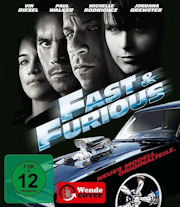
    The Fast and the Furious, starring Vin Diesel as Sean Connaughton, Paul Walker as Tony Kinn and Jordana Brewster as Thelma Drake.

    by James A. Bacon

    The public-private partnership deals are coming fast and furious. The McDonnell administration announced a new one today, a $940 million agreement in principle with Fluor-Transurban to build, operate and maintain a 29-mile HOT/HOV lane project on Interstate 95 from the Springfield Bypass to Stafford County.

    “With HOT lanes on both the Beltway and I-95, we will create a region-wide network of managed lanes that will enable travelers to get to and from some of Virginia’s most employment centers and military sites,” said Transportation Secretary Sean T. Connaughton in a prepared statement.

    Highlights of the project include:

    • Expansion of HOT/HOV capacity from two lanes to three for 14 miles in the northern leg, improvements to six miles in the middle leg, and extending the HOV/HOT lanes for nine miles into Stafford County, “alleviating the worst bottleneck in the region.”
    • Establishing a seamless connection with the Interstate 495 HOT lanes now under construction.
    • Free access for High Occupancy Vehicles.
    • Investment of $200 million into the expansion of regional bus services, including construction of more than 3,000 new park-and-ride spaces. A Department of Rail and Public Transportation study recommended a total of 9,575 park-and-ride spaces, 46 more buses, off-site parking, shuttle services at the Franconia-Springfield Metrorail station and other intermodal features.

    The project will generate revenue by charging single-occupancy vehicles for using the HOT lane; traffic volume will be regulated to ensure minimum travel speeds. The price will vary according by time of day, fluctuating with demand.

    The commonwealth will contribute $97 million to the project. Fluor-Transurban will pay for the rest. The consortium will have a 73-year franchise.

    The statement provided no details on what toll rates are expected. Connaughton undoubtedly will provide details in a media briefing this afternoon, but I will be on the road to Norfolk, where I will attend the Virginia Transportation Conference tomorrow. Although I-95 HOT lanes are not on the schedule of events, I would be surprised if the topic doesn’t come up for discussion.


  • Defiant MWAA Resists Seating of McDonnell Appointees

    666, baby! The mark of the beast.

    I missed this when it happened last week, but it’s never too late to comment… The Metropolitan Washington Airports Authority board won’t let a little thing like a new law passed by Congress and signed by President Obama encroach upon its autonomy. The board, which oversees management of the extension of Metro rail to Dulles airport, has retained legal council to resist increasing the size of the board from 13 seats to 17.

    According to Charles Snelling, chairman of the airports authority board, the law is not operable until Virginia and the District approve changes to the โ€œgoverning MWAA compact.โ€ That comes by way of Dana Hedgpeth, the Washington Post‘s Dr. Gridlock.

    Therefore, said Snelling in a letter to Rep. Frank R. Wolf, R-10, who authored the bill, the board will not seat two new board members appointed by Gov. Bob McDonnell last month. Wolf’s bill added two new seats for Virginia, and one a piece for Maryland and Washington, D.C. Wolf had argued that Virginia was under-represented on the board, which controlled not only Dulles and Reagan airports but the state-built Dulles Toll Road.

    โ€œTheyโ€™re ruining the credibility of the airports authority by fighting this,โ€ Wolf told Hedgpeth.”They’re ultimately going to lose. Theyโ€™re just dragging this thing out.โ€

    I’m amazed that this story isn’t far bigger. Maybe there’s a legal case to be made for Snelling’s position, but the MWAA is definitely coming across as combative and recalcitrant. The board opposed Wolf’s bill from the beginning, and this latest gambit looks like more foot dragging. Add to the MWAA’s legal resistance the lack of transparency in other areas — which I hope to find time to blog about in the future — and the authority comes across as an alien, undemocratic and oppressive beast that must be brought to heel.

    — JAB


  • New Studies, Reports and Inanity…

    Motor Vehicle Dealer Internet Access Study
    Report to the General Assembly

    In 2011 the General Assembly adopted legislation requiring all newly licensed automobile dealers to have an Internet connection and email address. The Motor Vehicle Dealer Board even engaged the Point Management Group to conduct a study, which proceeded to document that all MVDB dealers already have Internet access. But that didn’t stop Point Management from recommending that all new dealers — just in case someone laying thousands, even millions, of dollars on the line to open a new dealership was too friggin’ stupid to think of setting up an email address and Internet connection — should be required to do so as well.

    Why stop there?ย  Why not write a regulation requiring every auto dealer to have a phone? Why not spell out in detail how they must stock their offices with desks, chairs, copying machines and free coffee. Grrr. Makes me so mad. Hey, Gov. McDonnell, while you’re consolidating and closing all those useless state boards and commissions, here’s idea. Add the friggin’ Motor Vehicle Dealer Board to the list!!

    Status Report: Regulations Establishing Nutritional Guidelines For Competitiveย Foods Sold in the Public Schools
    Report to the General Assembly

    The General Assembly is rightfully concerned about increasing obesity rates among Virginia’s youth, and legislators have rightfully honed in on the volume of junk food that school kids consume from vending machines, snack bars and a la carte items in the cafeteria. This draft report contains numerous recommendations on how to regulate these sources of empty calories. Snack items shall contain no more than 200 calories per portion, derive no more than 35% of calories from fat of sugar, or have a sodium content exceeding 200 mg, blah, blah, woof, woof. But, oh, the regulation shall not apply to beverages.

    Really? Is that it? Did it occur to the geniuses drafting the regulations that restricting calories per snack might encourage kids to…. buy more than one snack? And what’s this about exempting soft drinks? Did the General Assembly cave in to the soft drink bottling industry?

    Let me make this real simple. Ban all vending machines and shut down all snack bars in public schools. When kids got thirsty back in my school days, they drank — can you imagine this? — water from the friggin’ water fountain! When we wanted snacks, we had to wait until we got home and raid the cookie jar. As far as I’m concerned, purveyors of junk food should be allowed to sell whatever they want to whomever they want, but not where they want. They have no more right to peddle their garbage in schools any more than they have to set up a vending machine in my pantry. Board of Education, get a friggin’ spine!

    What kind of monument are we talking about anyway? One like this…

    First Annual Executive Summary Commemorative Commission to Honor the Contributions of the Women of Virginia
    Report to the General Assembly

    You could make the case in a state that once practiced slavery and then oppressed blacks through decades of Jim Crow laws that there is justice in erecting a monument to Civil Rights heroes. Unfortunately, the General Assembly followed up that laudatory effort to establish a commemorative commission to honor the contributions of the women of Virginia.

    … or one like this?

    The rationale seems less than clear. Judging from this report, the commission devoted its proceedings over the past year bloviating in banalities about the contributions of the fairer sex and hosting a series of eight “community conversations” across the state. Public attendance appears to have been sparse. In the Richmond meeting, “the Commission heard from a group of students from St. Catherineโ€™s School and two members of the public.”

    Having gleaned valuable public input, the commission then moved on to more important matters, like voting to hire a consultant.

    Evaluation of Camera Use to Prevent Crime in Commuter Parking Facilities: A Randomized Controlled Trial
    Urban Institute

    Before 2003, half of all crimes on METRO property took place in commuter parking lots. Metro Transit Police teamed up with the Urban Institute to see if prominently placed video cameras would discourage car thefts and break-ins. Due to budget limitations, only one-third of the cameras were live, rendering the intervention of limited use for investigative purposes. The findings? “The cameras had no discernible impact on crime.” Oh, well, it was worth a try.

    Just remember to take the darn things down.

    — JAB


  • State Seals $2.1 Billion Midtown Tunnel Deal

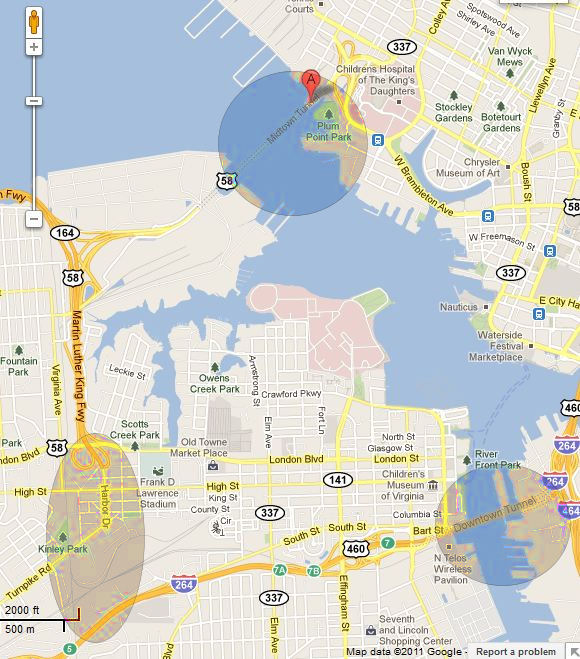
    Google map shows location of major improvements in the Midtown Tunnel deal. (Click on map for larger image.)

    by James A. Bacon

    The McDonnell administration has entered into a public-private partnership agreement with Elizabeth River Crossings to rehabilitate the Midtown and Downtown tunnels between Norfolk and Portsmouth and to extend the Martin Luther King Freeway. Construction on the $2.1 billion project is expected to begin next year.

    Of all the mega-projects under development by the McDonnell administration, this arguably offers the most clear-cut economic return on investment. The commonwealth will contribute $362 million to attract $1.7 billion in private investment, which will be repaid by means of higher tolls ranging initially from $1.59 to $1.84 per car for the tunnels and up to $1 for the MLK freeway extension.

    That’s a big hit to motorists who now use the facilities for free. But the two tunnels are two of the worst transportation bottlenecks in Hampton Roads. In a prepared statement released this morning, Virginia Highway Commissioner Gregory Whirley estimated that the average round-trip user will save 30 minutes a day when the project is created. The improvements also will increase evacuation capacity in the event of a hurricane.

    The agreement has been under negotiation for five months between VDOT, the new Office of Transportation Public-Private Partnerships and ERC, a joint venture between Skanska Infrastructure Development and the Macquarie Group. ERC will finance, build, operate and maintain the facilities for a 58-year concession period, and will assume risk for delivering the project on a performance-based, fixed-price, fixed data contract that protects taxpayers and users from cost overruns and delays.

    The agreement calls for a slightly smaller financial contribution from the state, $362 million, than the $395 million envisioned only a few months ago. VDOT attributed the difference to lower-than-projected interest rates, buttressing the McDonnell administration’s argument that it makes sense to borrow borrowing more money now in order to take advantage of lower construction costs and interest rates in the post-recessionary economic environment.

    โ€œThe Midtown Tunnel project has been at the top of the regionโ€™s priorities for many years,โ€ said Transportation Secretary Sean T. Connaughton. โ€œThe stateโ€™s use of a public-private partnership structure will enable VDOT to attract approximately $1.7 billion in private investment to a project that yields tangible long-term benefits to the region and the state.โ€

    Key components of the project include:

    • Doubling the capacity of the Midtown Tunnel by adding a new two-lane tunnel under the Elizabeth River
    • Increasing transit service between Portsmouth and Norfolk
    • Rehabilitating the existing Midtown Tunnel and both Downtown tunnels
    • Extending the Martin Luther King Freeway from London Boulevard to I-264, with an interchange at High Street in Portsmouth
    • Modifying the interchange at Brambleton Avenue/Hampton Boulevard in Norfolk

    ERC will provide financing through a $422 million TIFIA loan, and approximately $1.3 billion through equity, debt and revenue from operations. The state contribution will be used to buy down the cost of the tolls.

    The press release made no note of how rapidly tolls are projected to rise or what oversight the state will exercise over future increases.


  • The New Road Rage: Driverless Cars

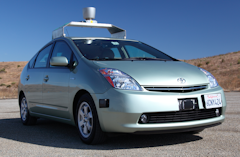
    Google's driverless car

    by James A. Bacon

    The automobile industry may not be anybody’s idea of a dynamic business sector, but it is highly competitive and more innovative than people give it credit for. The latest example is the research being conducted on driverless cars, which Bloomberg Business Week predicts could become the new “road rage,” a sci-fi dream that “could be real within a decade.”

    Needless to say, no-hands cars would scramble everything we think we know about transportation preferences today. On the positive side, automobilesย  equipped with laser sensors would allow them to travel much closer together, increasing the capacity of existing roadway and reducing the number of accidents. Driverless cars also would provide more independence for the elderly and the disabled. Furthermore, people could do something productive with their drive-time, like reading, answering email or surfing the Web (OK, maybe that’s not so productive), instead of listening to talk radio. On the other hand, driverless cars potentially would put more people (and cars) on the road, aggravating traffic congestion. It’s hard to say how it would all play out.

    There is, however, one factor missing from the breathless Bloomberg Business Week article, in which the only sign of skepticism is whether the technology really will be ready for widespread commercialization within 10 years. Here’s the big question: Will driverless cares be affordable? There was no indication in the article how much driverless systems would cost. Equipping cars with all those lasers, sensors, GPS navigation systems, artificial intelligence and who knows what else will be expensive.

    The cost of automobile ownership is already slipping beyond the financial reach of more and more American families as it is.ย  (See “The Era of Foreclosed Possibilities.“) Meanwhile, other factors are driving costs higher. The Obama administration has proposed mandating an increase in U.S. car-fleet fuel efficiency from 27.3 miles per gallon today to 54.5 miles per gallon in 2025. The Heritage Foundation says the mandate will add $2,000 to $2,800 to the sticker price of a car. Admittedly, that would be offset by lower gasoline expenditures, but it does not account for an increase in the number of injuries resulting from lighter cars and concomitant cost of insurance.

    Americans will not wake up one day to find that the technology fairy waved her magic wand and converted the entire motor vehicle fleet into driverless cars. Most likely, the new-car market will bifurcate into two tiers with auto makers packaging driverless cars for the high-end market and selling the old-fashioned dumb vehicles to middle-class Americans. And don’t forget the 10 years it takes to turn over the automobile fleet. Those two factors mean that a lot of dumb cars will stay on the road for a long, long time. Will the putative benefits of reduced traffic and improved safety materialize if only 10% of the cars on the road are equipped with lasers and sensors that allow them to communicate with other cars? One way around that problem would be for government to mandate use of the driverless technology. But another mandate would put the price of cars beyond the reach of even more Americans.

    Personally, I would love to own a driverless car, especially on those long, boring rides to visit family or escape to the beach. While my wife whips out her laptop, switches on her Verizon air card and answers business emails, I get stuck behind the wheel. Grrr. If a driverless car came equipped with a computer screen that would let me play Civilization, read a book or post content to Bacon’s Rebellion, I would pay almost any price! But I suspect that most Americans would deem driverless cars to be a luxury they cannot afford.


  • McDonnell Administration Moving to Reclassify Roads

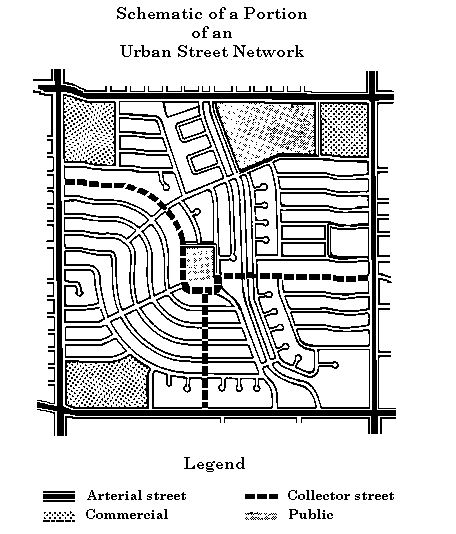
    Click map for more legible image. (Image credit: Federal Highway Administration)

    by James A. Bacon

    The McDonnell administration has prepared legislation to reclassify state roads along the lines of the system used by the federal government, Transportation Secretary Sean Connaughton told a transportation roundtable Friday sponsored by the Thomas Jefferson Institute for Public Policy.

    Virginia’s outdated classification of roadsย  — primary, secondary and Interstates — does not serve the commonwealth well, Connaugton said. Some “secondary” roads in Northern Virginia carry far more traffic than many “primary” roads in other parts of the state. By contrast, the Federal Highway Administration has a well-defined set of criteria for classifying streets as principal arterials, minor arterials, collectors or local roads based on their length, traffic volume and function in the road network.

    The classifications are important. For one reason, the Virginia Department of Transportation allocates money for maintenance and construction to separate funds based on road classification. As Connaughton acknowledged, if Virginia changes the road-classification system, it will have to change funding allocation formulas. For another, the McDonnell administration is inching closer to devolving responsibility for maintenance of secondary roads to local governments.

    Virginia is one of only four states in the country for which the state is responsible for maintaining secondary roads. “It’s crazy that the commonwealth is paving and plowing cul de sacs in Fairfax County,” Connaughton said. Moreover, formulas for allocating maintenance funds have become severely out of whack. VDOT pays cities an average of $17,000 per lane-mile for maintaining roads within their borders, leaving only $5,000 per lane-mile on average for county roads for which the state is responsible, he added. State law requires that reimbursements to cities be adjusted annually for inflation, which drives up VDOT’s payments to the cities over time. By contrast, VDOT’s main revenue source, the gasoline tax, is not adjusted for inflation — it has remained the same since 1986.

    Whit Clement, former transportation secretary in the Warner administration, warned that legislators will be concerned mainly with “where the dollars fall out.” The way to pull off reform, he advised, would be to “hold rural areas harmless” by ensuring they don’t end up with less money than before. But that would require injecting new money into the system — money the state doesn’t have.

    In related discussions, roundtable members explored ideas on how to raise more money for road funding. Among the candidates: Raise the motor fuels tax, pursue more public-private partnerships and create more special tax districts. There was little discussion in this Republican-leaning roundtable about exploring ways to moderate the number of Vehicle Miles Traveled through land use reforms or strategies such as Transportation Demand Management.

    Connaughton was the exception. A critical reason for devolving responsibility for secondary roads to local governments, he said, was to put accountability for transportation and land use decisions at the same level of government. He cited Fairfax County’s decision to upgrade density in Tysons Corner, which will stick the state with a $1 billion liability for improving road access to the business district. He also noted that the City of Alexandria lobbied the Pentagon to relocate 6,400 defense workers to the Mark Center office complex, which will cost the commonwealth $100 million for transportation improvements. Local officials weren’t concerned about the transportation implications of their decisions, the secretary said: They assumed the state would pick up the tab.

    Connaughton did not say if the administration had yet lined up anyone to sponsor its road-reclassification bill nor did he provide details on how VDOTย  funding formulas might be rejiggered.


  • Virginia and the Racism Index

    How does one measure racism? It’s a tricky question. Public opinion polls reveal very little overt racist sentiment. Racism has not disappeared, some pollsters think, it has just gone underground. People don’t want to sound gauche, so they don’t admit to racist sentiments in opinion polls. However, Harvard professor Seth Stephens-Davidowitz has come up with an interesting proxy for racism — Google searches employing the “N” word.

    In a study aiming to to guesstimate how many Americans voted against Barack Obama for president because he is black, Stephens-Davidowitz compares the difference in votes for John Kerry in 2004 with votes for Obama in 2008 and generates correlations with the frequency of the “N” word in Google. He makes a number of assumptions that readers may or may not find plausible but his presidential election analysis is not what interests me. His findings on the frequency of the use of the “N” word are what intrigue me. Always on the look-out for fascinating sociological insights into the Old Dominion, I was particularly fascinated by his state-by-state breakdown.

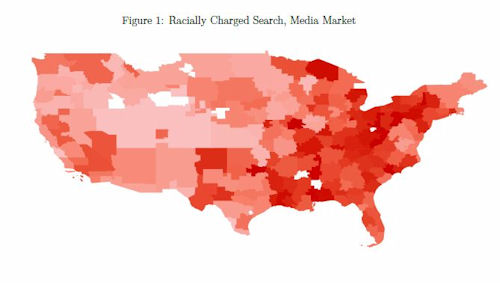
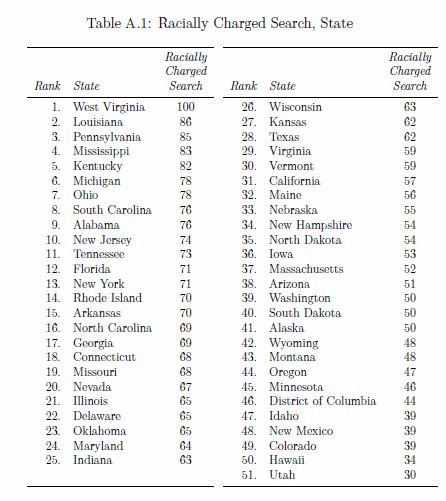
    Stephens-Davidowitz argues that use of the “N” word is a predominantly white usage, hence a valid gauge of racist attitudes, as opposed to the African American usage, “nigga.” The red chart at the top of this post shows a breakdown by media market. The area corresponding to Virginia is a center of relatively low use of the word compared to surrounding regions. Darker areas show higher search volume using the “N” word. Here is a state-by-state breakdown:

    So, where does Virginia fare on the Racism Index? Not as well as I’d like, but not as badly as I feared. We are 29th in the country — the lowest ranked of all the Southern states. Interestingly, West Virginia, which seceded from Virginia during the Civil War fought over slavery, is the most bigoted by this measure. Perhaps most interesting of all, those bastions of Yankee liberalism and enlightenment — New York, New Jersey and Connecticut — have more frequent recourse to the “N” word than Virginia.

    Heh! Heh!

    — JAB


  • The Heritage Foundation Takes on the Anti-Agenda 21 Crowd

    The Agenda 21 logo

    by James A. Bacon

    Finally, someone has responded to a bizarre sub-current of the conservative movement, the anti-Agenda 21 crowd. Wendell Cox, Ronald D. Utt, and Brett D. Schaefer with the Heritage Foundation have published a paper arguing that the anti-Agenda 21 movement is a distraction from the larger task of opposing “destructive smart growth programs.”

    A handful of activists, including here in Virginia, have been raising the alarm in conservative circles about Agenda 21, a plan of action adopted by the 1992 United Nations Conference on Environment and Development calling upon governments at all levels to support sustainable development. Conspiratorial-minded anti-Agenda 21 activists have conflated all local “smart growth” movements, regardless of philosophical stripe, with theย  social-engineering approach of Agenda 21. They have made it difficult to have an intelligent conversation in some conservative circles about land use issues.

    “If opponents focus excessively on Agenda 21,” write the Heritage scholars in a gentle reproach, “it is much more likely that homegrown smart-growth policies that undermine the quality of life, personal choice, and property rights in American communities will be implemented by local, state, and federal authorities at the behest of environmental groups and other vested interests. Preventing American implementation of Agenda 21 should therefore be viewed as only one part of a broader effort to convince U.S. government officials to repeal destructive smart-growth programs and prevent the enactment of new ones.”

    It’s good to see conservative scholars try to rein in the anti-Agenda 21 zealots, who only muddy issues relating to transportation, land use and growth management. The zealots have thrived, I believe, because most Tea Partiers are new to politics and public policy, know next to nothing about how transportation and land use decisions are made and find the conspiratorial Agenda 21 narrative to be vaguely plausible, while responsible critics of smart growth have, until now, retained an embarrassed silence for fear of offending conservative constituencies.

    So, I applaud the Heritage trio for writing the paper. However, I do have to take issue with the paper’s underlying assumption that everyone within the broader smart growth movement, from Greenpeace to New Urbanists, favors the mobilization of government power to impose a vision of squeezing Americans into compact communities and taking away their cars. Without question, more radical elements of the smart growth movement would happily trample on property rights and individual liberties in pursuit of their utopian ideal. But many do not. The fact is, “smart growth” encompasses a wide spectrum of views.

    More to the point for this blog, the organizations promoting “smart growth” in Virginia are not big-government liberals who seek to bludgeon Virginians into being environmentally virtuous. Over the years, I’ve spent a lot of time hob-nobbing with the Coalition for Smarter Growth, the Southern Environmental Law Center, the Piedmont Environmental Council (a Bacon’s Rebellion sponsor), the Virginia Conservation League and others, and I can say with total confidence that (1) they are not taking their marching orders from the United Nations and (2) many would disagree with Agenda 21 on many of the particulars.

    Indeed, I would classify myself a member of the smart growth parade, though I’m certainly not representative of the mainstream. I have devoted this blog to showing how the application of the principles of free markets, fiscal conservatism and respect for property rights can be reconciled with smart growth ideas. I find considerable overlap in my thinking and that of many smart growth activists in Virginia.

    Tea Party activists in Virginia need to switch their focus from the Agenda 21 boogie man to understanding the way growth and development issues play out in the real world. There is no such thing as a “free market” in real estate development. Land use is more heavily regulated (by zoning codes and comprehensive plans) and subsidized (through transportation policies,ย  infrastructure funding, housing subsidies) than almost any other sector of the American economy. Only the education and health care sectors, also known for being dysfunctional, are worse. Politics in the statehouse and the courthouse have been dominated for years by business interests seeking to manipulate the system to their advantage, stymied mainly by anti-growth (not smart growth) populists who make things worse by adding layers of heavy-handed and arbitrary restrictions.

    Many of the smart growth supporters I talk to in Virginia view themselves as fiscal conservatives. They oppose wasting money on extravagant highway projects that enrich land speculators and developers. (Some, I’ll concede, fail to show the same skepticism regarding extravagant rail projects that also enrich land speculators and developers.) The thinking of the smart growth movement has evolved far beyond that of the old anti-growth populists. Virginia smart growthers (smarties?) do preach a vision of creating more compact, walkable communities with access to mass transit shared by all smart growthers (and Agenda 21) but they are more inclined to convert people through positive examples of successful development than to ram their ideas down the throats of a reluctant populace.

    Be that as it may, I am hopeful that the Heritage broadside signals the marginalization of the anti-Agenda 21 conspiracy mongers in conservative circles and a revival of intelligent debate over how to handle complex issues relating to growth and development.


  • The “Cooch” Makes Things Really Interesting

    By Peter Galuszka

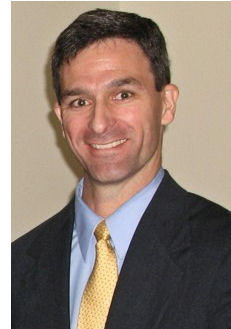
    Kenneth Cuccinelli’s announcement that he will run for Virginia governor in 2013 presages some very interesting days ahead.

    The controversial and hard-right Attorney General has been a highly polarizing figure in state politics. Despite ample evidence to the contrary, he stubbornly ย insists that humans have little to do with climate change and has indulged in a months-long witch hunt against a former University of Virginia scientist who, like most of his colleagues in the civilized world, do see a link. Cuccinelli has trampled on gay rights by refusing to extend legal protections against discrimination against gays in public universities. He has fought headlong against President Barack Obama’s health care reform, spending plenty of taxpayer money in the process.

    Meanwhile, Cuccinelli hasn’t come up with any positive proposals or platforms. Perhaps that’s not his job as attorney general, but voters have no clear idea of what he stands for, only what he is against. Given Cuccinelli’s obvious and robust reactionary ideas, it will be hard for him to remake himself into a moderate as Gov. Robert F. McDonnell, once a hard-line social conservative, seems to have done successfully.

    The state GOP establishment has been pushing Lt. Gov. Bill. Bolling as McDonnell’s successor, notably by calling him the “go to” guy on jobs. The fact is that Bolling is pleasant — ย and utterly forgettable.

    Who else could run among the Republicans? One possibility is Sean Connaughton, McDonnell’s secretary of transportation and former chairman of the Prince William County board of supervisors. Connaughton is a technocrat professional who once head the National Maritime Administration and has been both a Coast Guard and a Navy officer. He’s been on a tear recently. He fired just about the entire board of theย Virginia Ports Authority for failing to keep up with Baltimore and Savannah and has been the brains behind a big bond push to build new roads. Although his methods may be heavy-handed, at least Connaughton is a doer, not a reactionary. Should he run, Connaughton might be a more reasonable choice for the GOP.

    Either way, the state Democrats badly need to get their act together. And fast. They are going to have to come up with a better candidate than Creigh Deeds who was easily beaten by McDonnell last time.


  • Why People Are Pissed

    There are good reasons why the American people are angry at the big bankers on Wall Street. The latest news is the revelation by way of Bloomberg that the Federal Reserve Bank discretely lent up to $1.2 trillion to United States banks at below-market interest rates during the height of the financial meltdown, a gift that translated into roughly $13 billion of income. There was no transparency to the action, and no accountability. This subsidy came on top of the subsidies made available through the Troubled Assets Relief Program.

    With their purses thus padded by public intervention, executives in the financial sector went on to pay themselves obscene compensation packages. (The New York Times estimated pay packages averaged $595,000 per employee at Goldman Sachs and $463,000 for JPMorgan Chase.) While millions of Americans were losing their jobs, scrimping by on part-time work and coping with wage cutbacks, they were also paying for the privilege of enriching the masters of the universe whose great claim to business acumen was the ability to borrow and risk extraordinary sums of money, pocket the gains when they won their bets, and socialize their losses when they lost.

    This is not free-market capitalism. This is heads-I-win-tails-you-lose crony capitalism. Wall Street does provide a legitimate and valuable function for society in allocating capital. But it was a party to a grotesque mis-allocation of hundreds of billions, if not trillions, of dollars in the 2000s, and the Attilas and Tamerlanes in pinstripes who pillaged the nation should be prostrating themselves in gratitude that they live in a country where the peasants don’t string up their oppressors by the gibbet.

    Of course, the mercy bestowed upon these wealth destroyers may have something to do with the fact that the financial sector has donated $130 million so far in 2011-2012 to Congressional and presidential candidates of both parties, including President Obama. Donate millions to the politicians, reap billions in ill-gotten gains. That’s a pretty good Return on Investment.

    — JAB


  • Why Not Public-Private Partnerships for Parks?

    by James A. Bacon

    Few people outside the Roanoke area have heard of Virginia’s Explore Park, a 1,100-acre facility set in the mountains of Roanoke and Bedford counties. Launched with great fanfare in 1986 as a public-private partnership, the park offers mountain bike trails, a forester’s trail, a fishing and kayaking access point to the Roanoke River, special events like trail runs and adventure races — and a Film Center that has been involved with 16 film and documentary productions over the years, including the soon-to-be-released “Alone Yet Not Alone” (see trailer), which explores the conflict between English settlers and native Indians.

    Virginia’s Explore Park is operated by an entity created by the General Assembly: the Virginia Recreational Facilities Authority (VRFA). The Roanoke community sank considerable funds into the venture but it never lived up to expectations,ย  andย  it closed in 2007 during the adverse conditions of the financial meltdown and recession. But it has since reopened, and the VRFA board has a new plan, which it describes in a report to the General Assembly, “Virginia’s Explore Park Status Report.

    The board has articulated a new vision: “to be a leader in providing outdoor recreation opportunities, stewardship of this region’s heritage, and advocacy for environmental conservation for the enjoyment, education and inspiration of present and future generations.” The VRFA, states the report, is poised to “reinvent” the park by seeking out concessionaires, developers and outfitters to create privately generated revenue streams. (Among other revenue-generators, the board recently agreed to authorize two cell phone towers on park property.)

    The board touts the park as a potential model for other public-private partnerships around Virginia, “allowing the state to stretch limited resources and share the burdens and jobs of investment with local governments and private individuals, foundations and corporations.”

    Here’s the catch: The board would like the state to step up as a partner. It doesn’t seem to be asking for much: just tweak the representation on the board, move theย  park from non-state agency status to a line item in the Department of Conservation and Recreation, allow Virginia departments to assist and collaborate, and “consider” investing in capital development venues and revenue-producing programs.

    It’s not like the VRFA is asking for a lot of money that the state doesn’t have, so why not? Maybe Virginia’s Explore Park can act as a template in our new age of austerity for expanding Virginia’s park lands through public-private partnerships. Let’s give it a try.


  • How to Rate Schools by Educational Choice

    by James A. Bacon

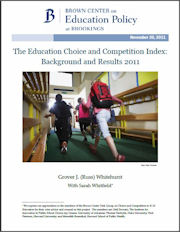
    An increasing number of people across the ideological spectrum are coming to the conclusion that “school choice” is a desirable goal of educational reform. The trick is defining what constitutes “choice.” Conservatives typically think of private schools, charter schools, homeschooling and vouchers. But there are many other measures, as a new report by the Brookings Institution makes clear.

    In “The Education Choice and Competition Index: Background and Results 2011,” Brookings scholar Grover J. Whitehurst has developed an index based upon 12 indicators, which takes the view that school choice can be a meaningful strategy for driving positive change within public school systems. His measures include:

    1. Availability of alternate schools, such as charter schools, magnet schools, denominational schools and private schools. Schools vary by curriculum, teacher workforce, parental involvement, length of school day and year, school autonomy, quality of facilities and per-pupil budgets. “In economic theory, competition produces efficient markets. Competition on the features of schooling can only occur to the extent that there is both choice of schools and variation in features.”
    2. Policies on virtual education. “Under current K-12 models of virtual education, a state or, more typically, the local school district is able to determine whether the virtual schooling meets its standards and is acceptable as a credit towards graduation. At the local district level, this places the bureaucracy that may be most disrupted by the introduction of virtual education in the position of gatekeeper.”
    3. Funding follows students. “A primary driver of competition among schools is the loss or gain of funding that comes from changes in enrollment. A school that is unpopular with students and losing enrollment should lose funding. Likewise, a popular school should gain funding as it attracts more students.” Many schools systems function according to the opposite principle.
    4. Restructuring or closing unpopular schools. “Changes in student-based funding may not be immediately obvious or consequential to staff, whereas the prospect that the school will be closed or restructured if it continues to decline in popularity is hard to ignore.”
    5. Assignment mechanism. “The antithesis of choice is an assignment mechanism based on residence, with little or no chance of parents being able to enroll their child in a school other than the one in their neighborhood. In contrast, the paragon of assignment systems is one in which students are assigned to schools through an application process in which parents express their preferences and those preferences are maximized.”
    6. Application. “The ideal [application] process has a common application for all public schools within a districtโ€™s boundaries, including charter schools.”
    7. Comparable standards and assessments. “Common standards and assessments provide transparency for choice and allow schools to be compared on a common metric.”
    8. Gain scores. “Information presented to parents as a basis for judging school performance should include student achievement gains based on longitudinal data on academic growth of individual students.” In other words, schools should be rated on their ability to add educational value, not their ability to select the best students.
    9. Accessible online information. “Information about the choice process and school performance data should be easily accessible on a district website, presented clearly, permit side-by-side comparisons of schools, and be sufficiently complete that there isnโ€™t a population of ‘in the know’ parents.”
    10. Additional performance data. “Best practice for districts includes the provision of additional information on such things as student and teacher absentee rates, measures of parental satisfaction, and course offerings. Also important in a system of open enrollment is information on school popularity as revealed through the ratio of applications to slots. Publishing popularity scores on schools in districts that have open enrollment plans could, we believe, have a significant influence on school leaders at both the building and district levels.”
    11. Transportation. “An ideal choice system is one in which students are provided transportation to any school of their choosing within district borders on the same terms as for the neighborhood school.”
    12. School quality. “School choice is a sham if all schools are low performing. In that scenario little competition is likely to result.”

    The Index ranks 25 large school districts around the country, including Fairfax County’s, based on these indicators. Receiving “B” ratings, New York City and Chicago schools enjoy the highest rankings for educational choice. Fairfax County rates 8th, with a “C+” rating. You can view the details of the rankings here.


  • Second IG of the Day: State Budget Squeeze


    Over the past three decades, state governments enjoyed steadily growing revenues. That felicitous trend ended abruptly in the 2007-2009 recession and shows no sign of resuming. This chart, taken from the “Fall 2011 Fiscal Survey of the States” shows the weak recovery. As the stock broker ads always warn, past performance is no guarantee of future performance. Still, it’s hard to conjure up a scenario in which state revenues suddenly stage a rebound.

    The situation for Virginia looks somewhat better. In fiscal 2011, Virginia General Fund expenditures increased 4.5% compared to a national average of 4.0%. In fiscal 2012, Virginia expenditures are projected to increase 7.1% compared to a national average of 2.9% (see Table 6 in the Fall 2011 survey).

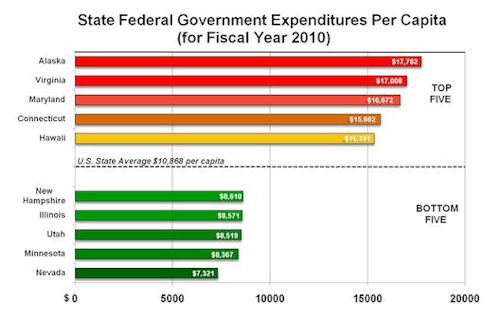
    Looking to the future, of course, the big wild card for Virginia is what happens if federal spending falls off a cliff? The chart below, just published by Veronique de Rugy at the Mercatus Center, shows that Virginia’s economy is the second most dependent of all states upon federal spending. (And unlike Alaska, we don’t have vast oil wealth to fall back upon.)

    — JAB