Virginia’s new governor has taken strong and important steps to force the state into much needed ethics reform by issuing an executive order setting a gift acceptance cap of $100 for himself, his staff and members of state agencies.
He’s also allocating $100,000 to set up a state ethics commission to collect information on gift giving and probe transgressions, although details of how it would work are still hazy.
McAuliffe is performing an obvious and needed end run past the General Assembly, which for years has done as little a possible to address Virginia’s laissez-faire ethics rules which are among the most lax in the nation.
The only proposal so far after months of scandal involving former Gov. Robert F. McDonnell and Star Scientific, a dietary supplement maker, is lame at best.
Pushed by House Majority Leader M. Kirkland Cox (R-Colonial Heights) and House Minority Leader David J. Toscano (D-Charlottesville), the proposal would ban officials and family members from accepting gifts of more than $250.
It also would set up an “advisory” committee to “educate” officials on ethics but would have no investigative power, making it little more than window-dressing. As now, officials would have to file reports but no one is tasked with officially vetting them.
McAuliffe’s smart ploy takes the initiative away from the General Assembly although his executive order cannot address what elected officials do. That’s obviously a problem, but McAuliffe has raised the bar and legislators cannot ignore that.
I’ve been reporting on Virginia politics off and on since the 1970s and I’ve seen several ethics reform initiatives come to nothing.
This time, there is hope, thanks to McAuliffe who is making a surprisingly strong showing in his first days in elected office.
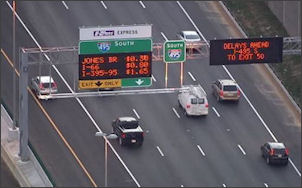
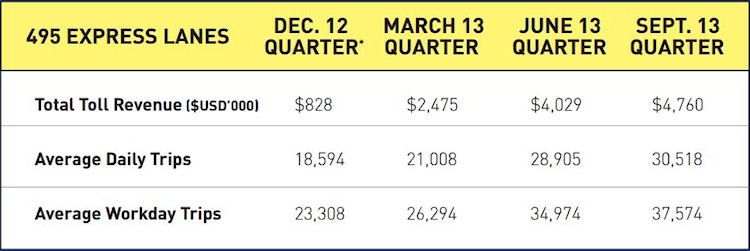
Traffic and revenues on Northern Virginia’s 495 Express Lanes increased steadily in 2013, generating a record 47,000 trips and toll revenue of $124,000 on December 19, according to data the company released yesterday. Whether that’s enough to meet expectations of parent company Transurban Holdings Ltd., headquartered in Australia, or to encourage additional private investment in Virginia’s transportation infrastructure, however, remains an open question.
At the end June 2013, Transurban stated in its annual report that the first half year’s traffic performance “has been lower than expected, but has continued to grow.” At that time the company said it was too early to determine any reliable traffic trends. The latest publication indicates that traffic volumes and average tolls have increased since then, even though 4th quarter results were hampered by the federal government shutdown. Of special note, revenues rose markedly, from $3.3 million in the first half of the year to $8.8 million the second half.
Source: 495 Express Lanes
Here’s Transurban’s problem: When it was lining up financing in 2007 for the $2 billion project, which added four new lanes to a 14-mile stretch of the Capital Beltway, the economy was booming. A 2007 traffic and revenue study by Vollmer/Stantec forecast average weekday trips over the first full year of operations at 66,000 and revenue of $46.1 million, according to Toll Road News. After four years of operation, the study forecast, the express lanes would log 117,000 average weekday trips and annual revenue of $79 million. No one anticipated the severe recession or the national erosion in Vehicle Miles Traveled that eased congestion on the nation’s highways. The whole point of paying a toll to use the express lanes is to avoid the unpredictability and time delays caused by congestion. No congestion = no revenue.
The company pulled out of its investment in the Pocahontas Parkway outside Richmond last year but remains committed to completing the Interstate 95 express lanes project in Northern Virginia.
Bacon’s bottom line: For supporters of market-based and fiscally conservative solutions to Virginia’s transportation challenges, the 495 Express Lanes are a vital test. Failure would cast a shadow over future private investments in Virginia transportation infrastructure, and the state could return to Business As Usual practice of blindly building highway projects with no accountability for results.
The express-lanes concept is appealing for several reasons. First, the private sector raised most of the money to pay for the expansion of Interstate 495 capacity — money the state did not have — and assumed the financial risk should traffic and revenues prove disappointing. Given the shortfall in ridership and revenues, Virginians should be darn grateful that Transurban, not the commonwealth of Virginia, is taking on that risk. Transurban shareholders, not Virginia taxpayers, will take the hit if the shortfall persists.
Second, the express lanes use price as a rationing mechanism for scarce highway capacity. Those who place the greatest value on their time — to get to a business meeting, say, or to pick up a child from day care — can pay a premium to bypass the congestion and save themselves time. As it turns out, 84% of riders surveyed — yes, Transurban actually surveys its customers; take a hint VDOT — cited predictable travel times as one of their “favorite things” about the lanes. Sixty-eight percent said they use the lanes to “reach a destination on time.”
The logic of paying to avoid congestion is the antithesis of the all-too-common sentiment that roads should be “free” and that the state has an obligation to spend whatever it takes to keep those roads free-flowing — all with the expectation, of course, that “someone else” should pay. It is an axiom of economics that when a good is free, consumers will use far more of it than if they had to pay for it. In the case of roads, excess demand creates pressure to create excess supply. Express Lanes avoid that trap — if motorists want free-flowing conditions during period of peak traffic, they pay for the privilege. If they are unwilling to pay, it’s a clear indication that they place trivial value on reducing their travel time.
Third, requiring road projects to cover their own costs is a mechanism for weeding out uneconomic projects, whether funded by private or public dollars. One good thing about 495 Express Lanes is that the public gets a regular accounting of traffic volumes, toll prices and revenue. (It would be nice if we got a cash flow analysis, too.) The project creates information about the economic viability of highway projects that we could not obtain otherwise. We get no such information from non-tolled projects, whose costs are buried within Virginia Department of Transportation budgets. We have no way to judge whether public investments in non-tolled projects such as Rt. 288 or the Interstate 295 circumferential highways around Richmond, to pick an example, were wise or foolish.
I regard the 495 Express Lanes as a template for transportation policy across Virginia. I would like to see it succeed financially because I’d like to see companies like Transurban propose more market-based solutions to Interstate congestion, not just in Northern Virginia but for congested stretches of Interstate 81 in western Virginia, Interstate 95 around Richmond and Interstate 64 in Hampton Roads. If the 495 Express Lanes project proves financially disappointing, I fear, the state will default to funding highway projects based upon political considerations with no mechanism to hold the decision-makers accountable. The end result will be construction of projects with weak economic justification and the squandering of billions of public dollars.
The Asian garden at the Lewis-Ginter Botanical Gardens.
by James A. Bacon
Biologist and philosopher E.O. Wilson coined the term “biophilia” to describe humans’ deeply rooted love of life and nature — a sentiment that may be a product of man’s biological evolution. It is human nature to take delight in the presence of wildlife (at least the kind that doesn’t eat you), trees, flowers and bodies of water. Even as mankind moves toward an increasingly urban environment largely for economic reasons, people don’t lose their love of greenery. A manifestation of biophilia in affluent societies is the mania for creating parks, nature preserves and green corridors.
Now a study published in the journal of Environmental Science and Technology shows that moving from a less-green urban environment to a more-green one can lead to lasting positive changes in mental well-being.
Using data from over 1,000 participants, the research team at the University of Exeter Medical School focused on two groups of people: those who moved to greener urban areas, and those who relocated to less green urban areas.
They found that, on average, movers to greener areas experienced an immediate improvement in mental health that was sustained for at least 3 years after they moved. The study also showed that people relocating to a more built up area suffered a drop in mental health. Interestingly this fall occurred before they moved; returning to normal once the move was complete.
Some will be tempted to conclude that the results reflect little more than greenie-weenie wishful thinking. I might have the same reaction were it not for that fact that the findings are entirely consistent with studies showing that proximity to parks and green space lends a boost to property values. There can be no clearer demonstration of peoples’ biophilia than the near-universal willingness to pay a premium for views of trees, woods, gardens, rivers, streams, ponds, oceans and mountains.
In the knowledge economy, economic development blends into community development. Creating places where people enjoy living and spending time is a key not only to bolstering property values and, by extension, the tax base, but to recruiting and retaining educated, skilled and creative people who power economic growth. What once was dismissed as the fussing over parks and trees and flowers — the preserve of little-old ladies in the Garden Club — has been transformed into the art of “place making.”
Here in Richmond, a group has emerged that takes green place making seriously. Beautiful RVA is a regional coalition of public, private and not-for-profit groups “invested in improving the quality of life in greater Richmond through public horticulture, urban greening and beautiful place-making initiatives.” Organized by the Lewis Ginter Botanical Garden, Beautiful RVA meets every other month, typically showcasing place-making initiatives around the region, supporting networking, propelling dialogue and sharing best practices. Randee Humphrey, director of education, sends out periodic emails recapping place-making news with links to local media.
Beautiful RVA is little known outside of the narrow circle to whose interests it caters. But pulling together people passionate about parks, trees, beautification, clean water and urban wildlife, and getting them to work together to create a more livable region, represents a huge step forward.
In a recent survey of registered voters, 64% of respondents agreed with the proposition, “Political leaders are less ethical than they used to be.” Distrust of political leaders crossed party lines, gender and race. “While public officials still may think they operate with a sense of noblesse oblige, the public clearly does not,” say Quentin Kidd and Meyrem Baer in the latest edition of The Virginia News Letter, “Virginia’s Ethics Rules for Public Officials: The Need for Reform.”
Kidd, a political science professor at Christopher Newport University, and Baer, an undergraduate researcher, provide a useful overview of state ethics laws and regulations in Virginia. The good news: Virginia is a standout in its requirements for disclosure, rating 4th best in the nation for campaign disclosure laws in a 2008 report. The bad news: The Old Dominion falls short in almost every other regard.
The paper provides context for many of the proposals that have surfaced following the Bob McDonnell GiftGate scandal, but raises one issue that I haven’t seen discussed anywhere else. Virginia law places no real limits on how campaign funds can be spent. The law is clear that when a campaign committee is disbanded, money cannot be converted to personal use. But when it comes to spending the money during a campaign anything goes.
The unlimited way in which campaign money can be spent was illustrated by a recent case involving a delegate from Northern Virginia who reportedly spent nearly $30,000 on travel, food, and cellphone expenses in an 18-month period. A spokesperson for the State Board of Elections said recently that there were “no restrictions” on how campaign contributions could be spent, suggesting that college tuition could probably be justified. Additionally, there is no regularized auditing process of expense reports or disclosure statements by the commonwealth. … The law leaves it largely up to the candidates and campaign committees to assure the expenses are proper, with no real oversight beyond meeting the reporting and documentation deadlines.
The General Assembly will have a full plate when it comes to drafting ethics reform, and it may be impracticable to address every weakness in Virginia law. But the spending of campaign money should not be left off the list. If we don’t address it now, when will we?
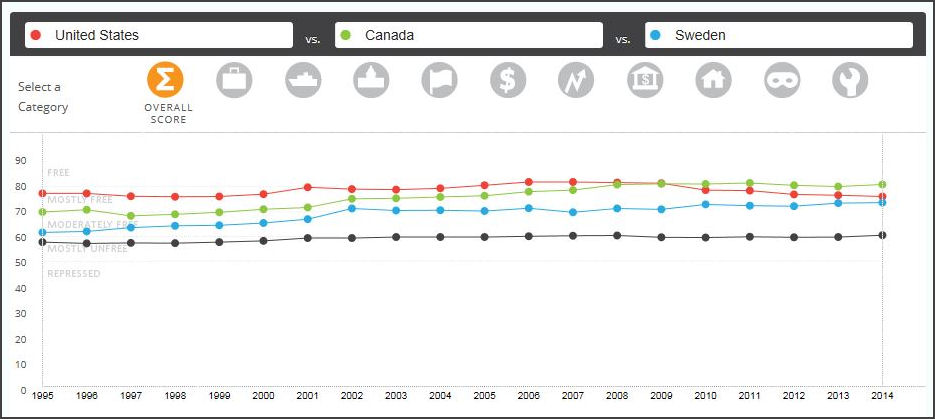
So depressing… The red line in the chart above chronicles the steady erosion of America’s economic freedom, the fountainhead of its prosperity. The United States’ score has fallen seven years straight, from one of the Top 10 freest economies to No. 12, according to the 2014 Index of Economic Freedom published by the Heritage Foundation in partnership with the Wall Street Journal. Canada now has a freer economy than the United States. Egalitarian socialist icon Sweden has almost caught up with us.
What have we gained in exchange for the loss of freedom? More economic prosperity? Hardly? More social justice? Not if you believe President Obama. More political power concentrated in Washington, D.C., to be exercised by liberals and progressives? Ah, now we’re getting somewhere.
“In 2012, at least 117 men, women, and children lost their lives to domestic violence, representing a 12.7% increase in family and intimate partner homicides from 2011 to 2012. Also in 2012, there were more than 67,000 calls to domestic and sexual violence hotlines across the state. A total of 6,592 adults and children received 198,274 nights of emergency or temporary shelter due to domestic violence; however, 2,486 families requesting shelter services were turned away due to lack of shelter space.”
Del. David A. LaRock, R-Hamilton, the man who beat legislative veteran Joe May in the Republican primary last year, comes to the General Assembly promising to represent conservative values and principles. Judging by the bills he has submitted so far, he will be true to his word. Aside from one bill providing tax credits for private schoolers and another fine-tuning the transfer of firearms, he has focused mainly on transportation issues affecting his Loudoun County constituents. In effect, he has positioned himself as a champion of Dulles Toll Road commuters and scourge of the Metropolitan Washington Airports Authority (MWAA), the Rail-to-Dulles Metro project and mass transit generally.
Direct the General Assembly to petition Congress to impose tolls on the Dulles Access Highway, which provides direct access between the Capital Beltway and Washington Dulles International Airport, and apply the revenues to reducing the tolls on the Dulles Toll Road that runs parallel to it.
Forbid the state from contributing any more funds to the Rail-to-Dulles project until MWAA implements the toll on the access road and also agrees to apply 50% of any revenue from the sale of federal land for non-aviation purposes toward the offset of Dulles Toll Road tolls.
Limit allocation of transportation funds to mass transit by the Commonwealth Transportation Board to 25% of total allocations to the Northern Virginia construction district.
Eliminate the ability of the Northern Virginia Transportation Authority to spend discretionary revenues on mass transit projects not included in the regional transportation plan.
Many Loudoun commuters who rely upon the toll road are frosted that under the terms of the Phase 2 financing agreement for Dulles Rail roughly half the funds are coming out of their pockets. They will pay more in tolls than the people riding the Metro will pay in fares, while people driving to Dulles on the parallel access road will pay nothing at all. This is the issue that propelled LaRock to the General Assembly.
Bacon’s bottom line: Loudoun commuters are being sodomized, metaphorically speaking, by Phase 2 of Dulles Rail. They will pay billions of dollars over the next three-to-four decades not only to maintain and upgrade the toll road but to subsidize Metro rail service to the airport. If they are asked to pay, it is hard to concoct a rationale for not asking users of the parallel access road to pay, too. The bills aren’t likely to go anywhere — MWAA isn’t asking for more state funding for Dulles Rail, so it has no reason to go along — but LaRock does stand on the moral high ground.
His crusade to limit spending on Northern Virginia mass transit is harder to justify. Once upon a time, when the majority of transportation funding came from the gasoline tax, one could argue that motorists shouldn’t be asked to subsidize mass transit. But the McDonnell transportation tax deform of 2013 reduced the contribution of the gas tax and eliminated any pretense that transportation taxes are a “user fee.” A large majority of transportation revenues will come from the sales tax and other non-fuel taxes — in other words, from the general taxpayer. Allocating tax dollars to roads is just as capricious and political as allocating them to mass transit.
Placing arbitrary caps on the allocation of state dollars, as LaRock proposes, is not the solution. Given the political reality that returning to a user fee is not in the cards, what we should do instead is devise a rigorous methodology for calculating Return on Investment on all proposed transportation improvements, of whatever type, and fund the projects with the highest return. Public policy should be agnostic as to whether the money goes to roads, mass transit, traffic light synchronization, incident management, Transportation Demand Management or other strategies for coping with congestion. Let’s make sure we get the most bang for the buck.
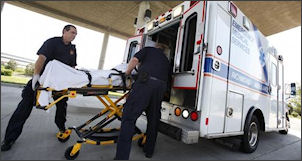
Eleven years ago NASCAR racer Jerry Nadeau was blazing hot on the Richmond Raceway… until he barreled into a turn and smashed into a concrete wall. The wreck registered at 121 times the force of gravity — three to six times the force that had sent other NASCAR drivers to the hospital. He had to be cut out of the car. Suffering a skull fracture, concussion, collapsed lung and several broken ribs, he was rushed to Virginia Commonwealth University Health System main hospital downtown. As grim as his injuries were, he was fortune in one way: VCU was nationally renowned for its emergency medical services. Doctors put Nadeau in a medically induced coma, and he didn’t regain consciousness for three weeks. But he survived to live a semblance of a normal life.
A new study published by the Richmond’s Future think tank, “The Future of Health Care in the Richmond Region,” suggests that, thanks to pockets of world-class excellence like that at VCU, emergency medical services (EMS) could provide the basis for an innovation cluster and a source of economic growth. Though a small part of the total health care economy, EMS accounted for $48.3 billion in economic activity nationally in 2010, and was growing.
The Richmond region has other assets in the field, including the Richmond Ambulance Authority, which is known as a world-class provider and innovator. The authority uses state-of-the-art predictive modeling to stage its garage-less ambulances around the city, and has been at the forefront of testing artificial blood, cardiac arrest survival and chest pain procedures in the ambulance. Richmond also is home to the United Network for Organ Sharing (UNOS), which manages the nation’s organ transplant system. UNOS collaborates with emergency medical services around the country to recover and distribute organs nationwide. Additionally, VCU faculty are internationally recognized for their expertise in resuscitation outcomes and traumatic brain injuries from blasts and bullets.
That expertise, suggests the Richmond’s Future, is a non-traditional economic development asset that the region should build upon. States the report: “The Economic Development Offices in the Richmond Region should collaborate on an innovation ecosystem strategy to promote and provoke disruptive thought, apply inspired research, experimentation and accelerated implementation to attract companies serving the emergency medical services sector.”
As part of a larger strategy on leveraging health care for economic growth, the authors advance several recommendations: (1) the region should highlight its excellence in EMS; (2) corporate recruitment should target major corporations, equipment suppliers and other vendors in the EMS field; (3) the region should lobby to have the EMS Today annual meeting for professionals to meet in Richmond on a regular basis.
Bacon’s bottom line: EMS may be Richmond’s best-kept secret. I had no idea that the region was a standout in this way. As a practical matter, I don’t know if innovation linkages can be built between the EMS heavyweights in the region as they often can be in biotech, IT or other industries, but the idea is worth a serious look. EMS may never amount to more than an economic niche, but it could be a niche that attracts highly skilled workers, technicians and scientists and one that generates a lot of new medical devices and procedures. Richmond’s Future should be commended for its outside-the-box thinking. Let’s get moving!
It’s curious against whom the “War on Coal” really is.
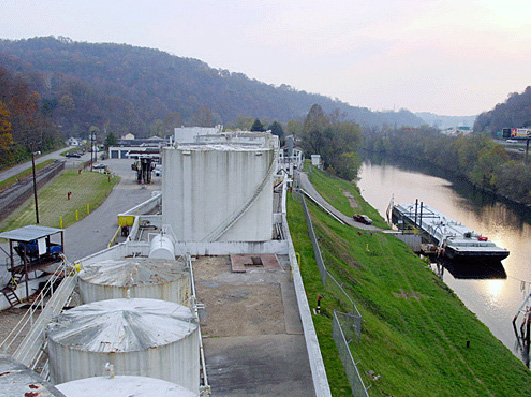
You might ask the 300,000 residents of Charleston, W.Va. who are being trucked emergency bottles of water because the spill of a toxic chemical used to help prepare coal has polluted their drinking water.
As many as 5,000 gallons of 4-methylcyclohexane methanol or Crude MCHM leaked from a tank owned by Freedom Industries just up the Elk River from the treatment plant where Greater Charleston gets its drinking water.
Executives of the chemical plant have apologized but, hey, it’s just another instance of raw environmental disregard in the Appalachians, including West Virginia, eastern Kentucky and southwest Virginia. About 15 years ago, then Richmond-based Massey Energy ended up with an underground spill at an abandoned mine in eastern Kentucky that fouled the Tug Fork and then the Ohio Rivers.
One lawyer told me the spill was four times that of the Deepwater Horizon well blowout in the Gulf of Mexico four years ago. But the British Petroleum disaster got a lot more media attention. So did the fact that it killed 11 people. About three weeks before, a blast at an underground mine at Upper Big Branch owned by Massey Energy in West Virginia killed 29 miners, but, hey, they’re miners and as such, didn’t get as much attention.
If you want to see one of the crudest collection of pollution potential in this country, head west on Interstate 64 on the West Virginia Turnpike. Once you get over the mountains and into the Kanawha River valley, you’ll see mile after mile of chemical factory and coal prep plant lining the narrow river.
West Virginia got into chemicals because it was a natural fit with coal and the steel industry nearby. The valley was also a favorite place to make munitions in World Wars I and II since it was far from ocean shores and considered safe.
Corrupt politicians were more than willing to look away when it came to dumping the plant stuff (the Elk River flows into the Kanawha at Charleston). It goes for mountains, too, if you consider the devastation of mountaintop removal.
The irony of it all is that King Coal and its minions have been screaming about the “War on Coal” waged by Barack Obama for his supposed over-regulation.
If anything, Obama and Mountain State regulators haven’t regulated enough, as the spill tends to show.
Imagine if Greater Richmond or Northern Virginia could not drink tap water because it might cause nausea, vomiting or diarrhea. You see an outcry everywhere. But hey, it’s West Virginia we’re talking about.
Galuszka is author of “Thunder on the Mountain: Death at Massey and the Dirty Secrets Behind Big Coal,” St. Martin’s Press, 2012.
Self-driving cars (SDCs) are coming. Will Virginia government, law and transportation planning keep up? There’s sign no of it. Indeed, the Old Dominion could experience a transportation crack-up in 15 to 20 years if we don’t start preparing now.
There’s no excuse for not thinking ahead. A new study by the IHS Automotive market research firm provides a timetable of what to expect.
“Autonomous” cars, which take over limited driving functions from drivers such as cruise control and lane-keep assist, are already on the road. Rather than leaping into fully self-driving cars, automobile manufacturers are adding more autonomous features with each passing year. The National Highway Safety Administration (NHTSA) rates automobiles’ autonomy from Level One to Level Five, in which cars assume greater control at higher levels. Level Four vehicles allow drivers to assume control, if they desire. Level Five do it all — drivers just plug in the destination.
Several automobile manufacturers have declared that they will sell autonomous cars by 2020, if not earlier. In IHS’s estimation, these cars will be only Level Three vehicles, providing significant auto-pilot features but still requiring driver involvement. However, Level Four cars will be introduced to the market by 2025, and Level Five cars by 2030. Due to the length of time it takes for old cars to phase out of the automobile fleet, it will take several years more before Self Driving Cars (SDCs) actually dominate the roads.
With North America leading the way, worldwide sales of SDCs will grow from 230,000 in 2025 to 11.8 million in 2035. Truly driverless cars (Level 5) will enter the market in 2030 with about 240,000 sales, growing to 4.8 million in 2035. In the early years, the percentage of SDCs on the road will be very small. But with turnover in the automobile fleet, the percentage will grow steadily.
The Mercedes concept car of the future: body of carbon fiber, powered by hydrogen fuel cell… and self-driving.
Cost will be a significant barrier. The price premium for SDC electronics technology will add between $7,000 and $10,000 to a car’s sticker price by 2025. As Level Five vehicles are introduced, however, the premium will drop to $3,000 because driver controls can be eliminated. Offsetting that price will be the compelling advantage of increased safety. Driverless cars will experience fewer accidents, and those will come mainly from tangling with human drivers. As the roads come to be dominated by driverless cars, IHS predicts (perhaps optimistically) that accidents will approach zero.
There will be other advantages, such as the ability for driverless cars to “platoon” on highways, driving safely at high speeds in tighter formations, thus increasing highway capacity. Driverless cars will allow the elderly to maintain their personal independence later into life. Affluent parents can be liberated from the tedium of driving their children everywhere. (IHS doesn’t mention this but, if drunks can let their cars drive them home, driverless cars could spark a rebirth of partying!)
IHC sees two major technical barriers that the automobile industry will have to resolve. One is software reliability. Automobiles will contain millions of lines of code that will be impossible to test under all circumstances. Mishaps will happen. It’s one thing when a PC crashes, it’s quite another when a car crashes. The second issue is cyber security. There is a risk that cars can be hacked. Some futurists are already speculating how a hacker could sabotage a driverless car in order to kill the occupants.
The other barrier is the legal and regulatory structure. The number one issue: Who is liable when something goes wrong? Do you blame the driver/owner or the automobile manufacturer? The evolution of tort law pertaining to driverless cars can have a big impact on how rapidly they are adapted in a particular state.
There are public policy issues as well. In theory, platooning will increase the capacity of Virginia highways, relieving the need to spend billions of dollars in highway widening projects. That will be a boon a half century from now when every car on the road is an SDC. But the transition could get tricky. Can platoons of fast-moving, tightly packed vehicles share the roads with ordinary cars? Should Virginia privilege autonomous cars by creating SDC-only lanes?
We also need to re-think traffic forecasts. As I’ve argued repeatedly, Virginia’s traffic forecasts consist mostly of straight-line projections of past trends and don’t account for changing demographics and the increasing preference for walkable communities and mass transit. But driverless cars could scramble the equation. If such cars could drive faster in platoons, if drivers could spend their time reading the news, emailing friends, watching movies — or catching up on their sleep — then an hour-long drive to work would become more tolerable. If driverless cars revitalize the long-distance commute, what will happen to the demand for mass transit? What will happen to the relative demand for real estate in the urban core and on the metropolitan periphery? Will we see a reversal of America’s urban renaissance? Planners, urbanists and smart-growth thinkers haven’t begun to grapple with these questions.
I see driverless cars as a significant net gain for American society. But there are potential pitfalls and we have to anticipate them. In the meantime, I would urge public officials to anticipate the impact of driverless cars when allocating transportation dollars. The last thing we need to do is to sink money into transportation assets that will become outmoded in 20 to 30 years. Driverless cars will be here long before the financing bonds are paid off.
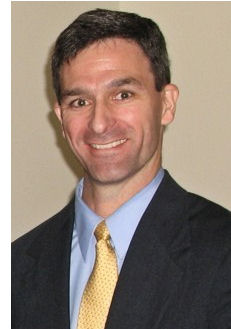
Tomorrow, Kenneth Cuccinelli leaves office after an intriguing run as attorney general and as a failed Republican gubernatorial candidate. Say what you want about him (I certainly have) but Cuccinelli can never be accused of being boring.
So, it seems especially remarkable that his first task after leaving office will be to help U.S. Sen. Rand Paul in his lawsuit against the Obama Administration for the massive government eavesdropping and collection of cell phone calls, emails and text messages that were brought to light by fugitive Edward Snowden, now in Moscow.
On one level, the involvement of a staunch conservative like Cuccinelli in an issue that has eerie resemblances to the Pentagon Papers case back in the early 1970s seems strange if not downright bizarre.
Maybe not. Cuccinelli has always had a ying to his yang. While pushing ahead with abortion rules that brought great protest from feminists and pro-choice advocates, he has also supported women’s issues when they involve such crimes as date rape and violence. He may want to put what he considers to be hordes of Medicaid cheats in jail but he went far to help an innocent man get out of prison.
Suing the government is nothing new for Cuccinelli, as his measures against Obamacare have shown.
Still, it is weird that by opposing an overly-powerful National Security Agency fed by hysteria after the 9-11 attacks, he is kin to the very liberals who risked prison to make public the secret history of the despised Vietnam War.
In remember that well. I was rising college sophomore in June 1971 and like many, I opposed the war. Lucky for me I was just a smidge too young and the war was winding down for me to be a serious candidate for the draft, although I did have a draft card and knew plenty of people who had fought in Southeast Asia. I had been teargassed five or six times at anti-war demonstrations as a high school student int he DC area and later as a college student in Boston.
The Pentagon Papers were the secret study ordered by former Defense Secretary Robert McNamara and purloined by defense analyst Daniel Ellsberg, the Snowden of his day.
The New York Times took a big risk and published them. Later, The Washington Post, also under significant legal, political and corporate pressure, did the same.
Among other things, the papers revealed that, contrary to what the Kennedy and Johnson Administrations had claimed, the U.S. had secret operations to provoke the North Vietnamese into combat. Of course, they were aiding the Viet Cong in the South, but the extent of American duplicity had never been documented.
Liberals and anti-war activists hailed the papers’ release as a major victory for liberty. Conservatives were aghast that classified documents would be released in such a way. You had to live through those times to realize just how polarized the country was. It was nothing like today. Then President Richard Nixon seemed inclined to let the publication slide since it made Democrats look bad until adviser Henry Kissinger said that the precedent could screw up future U.S. attempts at secret deals.
The scary thing about the current problem is that advanced technology allows the government to cache just about anything electronic. This raises fears about how much data can be gathered about us and how it will jeopardize our personal freedoms. This is no “Internet of Things” buzzword popular among the chattering classes. The fears date back years and now they are coming true.
Of course, the NSA has been gathering information for decades. That’s what it does when it isn’t breaking codes. It is essential for U.S. security but there must be limits. Obama has pitched some but the horse is well out of the barn.
Paul and Cuccinelli are wrong to claim that this is all Obama’s fault without noting the huge role George W. Bush played. Bush’s post 9-11 actions were needed to prevent future terror bloodlettings but he went too far. The entire Iraq War was not necessary and based on bad intelligence.
In any event, it is indeed curious that Cuccinelli has chosen the Rand lawsuit as the focus of his next endeavor. One wonders what’s next after that.
A bill submitted by Del. Tim Hugo, R-Centreville, would expand the Commonwealth Transportation Board from 18 members to 24 by adding three members of the Virginia Senate and three members of the House of Delegates.
I have not talked to Hugo about his reasoning, but I can conjecture. The bill represents an effort to make the CTB a more independent-minded body for establishing state transportation policy and setting spending priorities. As currently constituted, the board is comprised entirely of gubernatorial appointees: the Secretary of Transportation, the Virginia Highway Commissioner, the director of the Department of Rail and Public Transportation, and 15 citizens from around the state who serve at the pleasure of the governor.
In a companion bill, Hugo proposes to allow removal board members only for offenses of malfeasance, misfeasance, incompetence or gross neglect of duty.
As I reported in a story a year ago, the CTB had held 10 monthly meetings and voted on 134 resolutions during the first 10 months of 2012. Of those, 131 passed unanimously. When there were dissenting voices, only a single board member voted in the minority. Controversial mega-projects involving the expenditure of hundreds of millions of dollars typically received little debate. James E. Rich, former Culpeper District representative, was one of the few board members to ever speak out against, or vote against, controversial McDonnell administration decisions. He was fired and replaced.
Hugo’s bills would diminish the power of the executive branch only slightly. Governors still would appoint a majority of board members, the Secretary of Transportation still would control the agenda, and board members still would rely upon state employees for most of their information. But Hugo’s bills would do two important things to improve the quality of CTB deliberations. First, legislators would bring a valuable independent perspective and body of knowledge to the board. Second, gubernatorial appointees would feel free to speak more openly if they knew they could not be dismissed for disagreeing with the governor.
My main reservation is that expanding the board would make it more cumbersome. But a larger board would be a small price to pay for a more independent board comprised of members willing to ask tough questions.
Here comes another example of creativity and innovation from the private sector that politicians, planners and pundits (even clear-eyed, forward-looking pundits such as myself!) could not possibly have foreseen — the Onewheel.
Onewheel, whose inventors are trying to raise $100,000 through Kickstarter, is a one-wheeled, self-balancing skateboard-like transportation device. It can reach speeds up to 12 miles per hour and has a range of four to six miles. Weighing 25 pounds, it’s much smaller, lighter and easier to store than a Segway. Placing an order through the Kickstarter campaign will cost you about $1,300.
With such a limited range, the Onewheel is unlikely to create a new transportation mode analogous to bicycles. The inventors are positioning the device in their promotional materials more or less as a fancy toy. There are no guarantees that the novelty will catch on, or that the developers will survive as a business enterprise. And even if people do start buying the thing, despite the images of lithesome young women riding the thing, I don’t see it appealing to many beyond the 18- to 28-year-old male demographic.
Still, don’t count out the possibility that the idea of a skateboard-like device continuing to evolve. Larger production volumes could bring the costs down and advances in battery technology could extend the range. Onewheels could provide a mobility option in dense urban environments…. until they cause too many collisions with pedestrians on crowded sidewalk, at least.
Transportation technology has entered a period of incredible innovation — the greatest since the invention of the automobile. There’s no telling what’s coming next, or what crazy idea might take off. The more transportation options, the better. We just have to find a way to accommodate these new gadgets in the public realm.
Virginia finally seems on a path toward toughening its ethics rules after the Giftgate scandal involving Gov. Robert F. McDonnell. but — predictably — the deal reached by the two parties is toothless.
The arrangement proposed by a bipartisan group within the General Assembly would cap gifts to officials and their families at $250 and require biannual reporting of giving. But it would fall far short of creating an ethics commission with real power.
More than 40 states have ethics commissions, according to the National Conference of State Legislatures, and most have subpoena power.
The Virginia proposal being pushed by House Majority Leader M. Kirkland Cox (R-Colonial Heights) and House Minority Leader David J. Toscano (D-Charlottesville) would do nothing of the sort. It would create a state ethics advisory commission (note the word “advisory”) made up of politicians and others.
In other words, it would not really investigate anything and would have no subpoena power. It would “educate” politicians about the rules, advise the General Assembly on ethics laws and help make sure that disclosure statements are filed online.
The deal would not do much with campaign financing, either, and lobbyist-supplied goodies such as free food and travel would be permissible.
In all, it would be a tiny step forward. It would require reporting of gifts to family members of officials and ban gifts to those family members worth more than $250. But the lack of a real ethics commission with independent power to probe and issue subpoenas means that Virginia would still have among the weakest ethics rules in the country.
As for increasing reporting of disclosure statements, the nonprofit Virginia Public Access Project already does that, although it, too, has no teeth.
No one is required to check the reports filed by officials, although the information would at least be out there. It will be up to the news media and concerned citizens to do the legwork. And if they turn something up, where do they go?
When former Executive Chef Todd Schneider, later convicted of misdemeanors, had information about the McDonnells, he went to Attorney General Kenneth Cuccinelli, who then sat on the information or months.
And regarding “educating” politicians about the rules, McDonnell certainly ought to have known them. He had been attorney general himself.
Sadly, this weak effort will do little to clean up the state’s political gift giving.
This blog posting represents the first in a debate series developed by authors of Bacon’s Rebellion and Blue Virginia on actions that Virginians can take to address climate change. All articles will be simultaneously posted on both blogs.
Introduction. Renewable Portfolio Standards (RPS) are laws or regulations designed to increase the percentage of energy made from renewable sources. This change is intended to reduce pollution including the CO2 emissions responsible for global climate change. Renewable portfolio standards are usually directed at electrical generation companies. RPS regulations vary from state to state. There are no federal RPS rules.
A typical RPS specifies a percentage of electricity in a state that will be generated from renewable sources by some time in the future. For example, California has an RPS of 33% of its electricity generated by renewable inputs by 2020. Renewable portfolio standards may be either mandatory standards or voluntary goals.
Presently, 29 US states have mandatory RPSs. Eight states have voluntary RPS goals. Thirteen states have no RPS regulation.
Virginia is among the eight states that have adopted voluntary RPS goals. The Commonwealth has set an RPS goal to generate 15% of the state’s electricity from renewable sources by 2025. This goal is one of the least ambitious among the 37 states that have RPS standards or goals.
RPS regulations are controversial. In the recent Virginia governor’s race Terry McAuliffe supported a move to make Virginia’s RPS mandatory and to increase the percentage of electricity produced from renewable sources from 15% to 25%. Ken Cuccinelli opposed McAuliffe’s plan claiming that mandatory RPS legislation would raise electricity prices and eliminate jobs. However, both Ken Cuccinelli and Virginia environmental groups agree that the existing RPS legislation has been ineffective.
The question before the debaters is this: Should Virginia make its RPS standard mandatory?
Yes – Leading Virginia to a Clean Energy Future Lowell Feld and “Kindler,” Blue Virginia
The U.S. government is at its most effective when it sets big, forward-looking goals for society – sending a man to the moon, overcoming the Great Depression, eliminating slavery, creating the national parks system. In each of these cases, we could have said: “no problem, the free market will take care of it!” But that wouldn’t have gotten the job done, and all of us would have been worse off as a result.
The ongoing battle against global climate change, caused largely by the use of fossil fuels, is a classic case of systemic “market failure” necessitating strong governmental action to correct it. In this case, most of the enormous environmental, health and social costs of fossil fuels are simply unaccounted for in their price. So fossil fuels are priced far lower than they would be if those costs were accounted for — meaning that the oil, gas and coal industries get a free lunch, while we pay for all the damage they cause.
Renewable Portfolio Standards (RPSs) are a highly effective way to begin to level the playing field in ways that make it easier for renewable energy sources to compete. But since it requires the government to take a stand, we can already hear our conservative friends saying NO: government must not interfere with the “free market,” government must not “pick winners and losers”, government screws up everything it touches, we should let the market figure it all out. So let’s just be clear on a few key points: Read more.
Yes – Fossil, Nukes Got Support, Why Not Renewables? Peter Galuszka, Bacon’s Rebellion
Virginia is typically behind the rest of the country when it comes to addressing new problems and finding solutions. Renewable energy is yet another example.
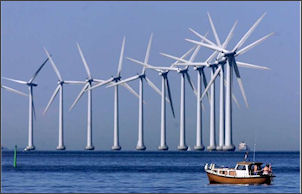
In the middle part of the past decade, undeniable evidence of the threat of climate change became obvious across the globe. A movement began to shepherd a shift to renewable energy-sources – solar, wind, geothermal and others — by passing laws making it mandatory that utilities obtain a specific percentage of their energy from such sources by set deadlines.
Thirty states and the District of Columbia — including all of Virginia’s neighbors -– joined the movement for Renewable Portfolio Standards (RPS) as have other countries, such as the United Kingdom, Poland and Belgium. True to form and genuflecting to big business interests, Virginia made its RPS voluntary. Read more.
No — How a Renewable Portfolio Standard in Virginia Will Punish Electric Customers and Erode Competitiveness James A. Bacon, Bacon’s Rebellion
What would Henry Howell think of Virginia’s liberals and progressives today? Howell, the populist candidate whose watchword was “Keep the big boys honest,” came within a whisker’s width of defeating the conservative Mills Godwin in the 1973 race for governor. The “big boys” against whom he railed were the senior executives of Virginia’s electric power companies and their minions around the state. The 1970s were a period of soaring electricity prices, and Howell championed the cause of the little guy who saw his paycheck eroded by higher electric bills.
There is no way to know what “Howling” Henry would think of modern-day liberals and progressives if he were alive today, but there is a good chance he would be dismayed by their push for a mandatory Renewable Portfolio Standard (RPS) in Virginia. In contrast to the voluntary goal in place today, a mandatory standard would require power companies to derive a major share of their electric-generating capacity from renewable fuels such as solar, wind or biomass. The reason it is necessary to mandate the use of these power sources is that they are far more expensive than fossil fuels. Mandating an RPS would add billions of dollars to the rate base of Dominion, AEP and the smaller power companies, resulting in higher electric bills for all Virginians.
A new, multibillion-dollar industry of politically connected insiders – ethanol producers, wind generators, solar power producers, electric car manufacturers — has arisen around the renewable movement on the grounds that the United States and Virginia need to reduce fossil fuel combustion and carbon-dioxide emissions implicated in global warming. Rather than compete on the basis of cost, these rent seekers work the political system to force their uneconomic technologies upon a reluctant populace. They are the unaccountable Big Boys of the early 21st century but there is no Henry Howell to keep them honest. Read more.
The year: 2075. The American colonies on the Moon are getting restless under Washington’s tyrannical rule….
This second edition of “Dust Mites” has a snazzy new cover, includes helpful lunar maps, and is 5,000 words tighter than the original. The sequel, “Trogs,” is scheduled for publication this summer.
Advertisement
Advertisement
Advertisement
Advertisement
About
Bacon’s Rebellion is Virginia’s leading politically non-aligned portal for news, opinions and analysis about state, regional and local public policy. Read more about us here.
Fund the Rebellion
Shake up the status quo! Your contributions will be used to pay for faster download speeds and grow readership. Make a one-time donation by credit card or contribute a small sum monthly.
Can’t wait until tomorrow
For your Bacon’s Rebellion fix?
Enter your email address to receive immediate notifications of new posts by email.
SUBSCRIBE
Search Bacon’s Rebellion
Categories
Archives
The Jefferson Council
Protecting Thomas Jefferson’s Legacy at the University of Virginia
Forgot Your Password?
Shoot me an email and I’ll generate a new password for you.

 By Peter Galuszka