• Redneck Chic

    duck_dynasty-620x412By Peter Galuszka

    One of this country’s most popular past times is the constant spinning and re-spinning of cultural stereotypes for profit. I’ve actually only seen snippets of “Duck Dynasty” and have noted the cheap goods on sale under its brand in convenience stores. But it fits the bill.

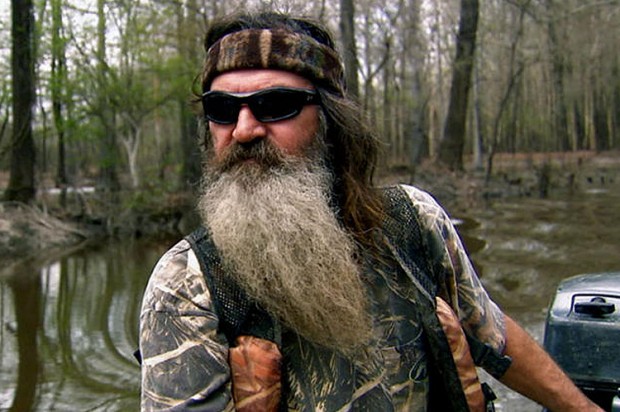
    The supposed patriarch of the A&E show (partly owned by Disney) is Phil Robertson, who told a magazine he regards homosexuality as “bestiality” and his subsequent suspension has been seized by the social right wing as evidence of government takeover.

    Let’s get rid of that now. Robertson has the right to say whatever he wants. A&E, a private company, has the right to ditch or suspend the people it employs.

    Both entities, however, are cashing in on stereotyping. One example of such profiling is Jersey Shore, which insults Italian-Americans everywhere by casting them as crude, chain-wearing idiots with lots of cleavage. The other beloved stereotype is that of the “Southerner” which takes certain regional and Scots-Irish traits and massages them into a blend of folksiness, racism, independence and pig-headed stubbornness.

    For a Virginia version, go no further than former U.S. Sen. and Gov George Allen who affects cowboy boots and Dixie-fried down-hominess when he really grew up in Southern California.

    Cable TV is littered with this genre. It includes the duck-call making family, rattlesnake hunters who drive all night from Tennessee to South Carolina to Texas and so on. The only one I have bothered to watch and do like (since it rings true and doesn’t stoop to rank patronization) is the one about the Eastern North Carolina loggers who brave cottonmouths and mud while ruining swamp forests.

    Poking fun at Southerners and their supposed characteristics has been around for centuries. The sad part is that people actually believe what’s being portrayed.

    Author James Dickey, a former ad writer turned professional Southerner, exploited this in his novel “Deliverance” where four coddled Atlanta guys have a bad canoe trip. They want to brave nature but one ends up dead and the other raped by cretin-looking mountain men.

    The reality was that Dickey wrecked his canoe in a Georgia mountain stream and was actually rescued by the mountain folk who made sure he was all right and got him home. He apparently wasn’t raped. But when they filmed the popular movie they carried the stereotype even further. To depict a mountain child rendered to imbecility by in-breeding, they actually went to a local school’s special ed class, gave his family a few bucks and ducted his face with flour. But he did play a mean banjo.

    Stereotype sustained and money made.

    Now we have right wingers Sarah Palin, the failed presidential candidate, and Louisiana Gov. Bobby Jindal seizing the gauntlet thrown down by a thickly bearded reality tv star.

    This is what social conservatives regard as important — a person’s absolute right to bash gays.

    If you want to see where it leads, look no further than Vladimir Putin’s Russia where he has freed businessman Mikhail Khodorkovsy and members of the Pussy Riot punk band from prison to squelch opposition to his extreme policies against gays before the Sochi Olympics.

    I don’t know Pussy Riot but I do know Khodorkovsy, having interviewed him back int he 1990s. He’s been in jail for 10 years for, among other things, trying to bring Western-style financial transparency to an oil firm.

    No matter, let’s support Duck Dynasty’s right to bigotry in the name of freedom.

  • The Laughable Fiction of Travel-Demand Forecasts

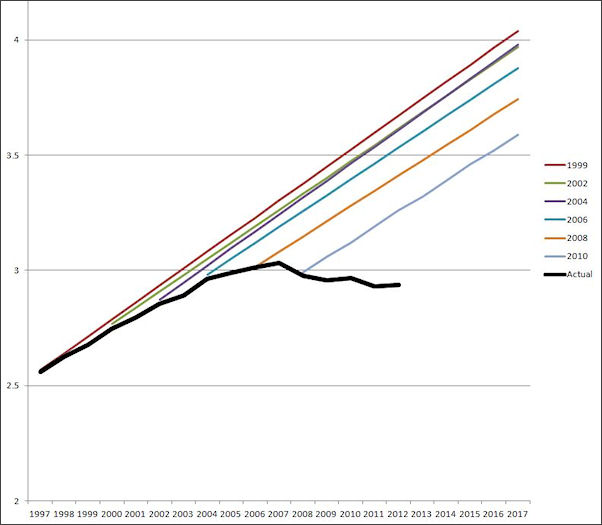
    U.S. VMT (in trillions) as tracked by FHWAโ€™s Travel Volume Trends (โ€œActualโ€) and as projected by U.S. DOTโ€™s C&P reports (by year reports are dated). Source: State Smart Transportation Initiative.
    U.S. VMT (in trillions) as tracked by FHWAโ€™s Travel Volume Trends (โ€œActualโ€) and as projected by U.S. DOTโ€™s C&P reports (by year reports are dated). Source: State Smart Transportation Initiative.

    by James A. Bacon

    The Virginia Department of Transportation and regional transportation planning organizations periodically make traffic forecasts for planning purposes. The idea makes sense in the abstract — estimating future volumes of traffic is needed to determine how much, and where, we should invest in new transportation infrastructure. Unfortunately, the process is flawed. Estimates have consistently overshot the mark in recent years, feeding the sense of transportation “crisis,” justifying the construction of uneconomical projects and feeding the clamor for higher taxes.

    The problem is hardly unique to Virginia. The U.S. Department of Transportation has been consistently overestimating traffic volumes for years, though rarely so egregiously as in the past ย year. In its 2012ย Conditions and Performance Report to Congressย issued December 2012, USDOT projected that Vehicle Miles Traveled in the U.S. would reach 3.3 billion. Turns out the estimate was about 11% too high. Think about that:ย Eleven percent offย in just one year!

    The Frontier Group decided to compare past USDOT projections with real-world performance. The result was the graph shown above. Writes Eric Sunquist with the State Smart Transportation Initiative: “The rolled-up trend estimates show essentially the same slope year after year, indicating that agencies providing [Highway Performance Monitoring System]ย data generally have not updated their models and assumptions to account for current conditions, as if they expect the year to be 1980 forever.”

    Projecting long-term traffic forecasts is bad enough. Acting upon those forecasts is foolhardy. There are just too many unknowns to take the forecasts seriously. Will the price of gasoline go up or down? Will Millennials continue to reside in urban centers, sticking to their buses and bicycles as they get older, or will they move to the ‘burbs and embrace the auto-centric lifestyle? What impact will smart-cities technology have on relieving traffic congestion? Which transportation mode will innovate faster and gain more transportation market share — cars, bicycles or mass transit? How will economic restructuring affect the distribution of jobs? Will new technologies enable more people to work at home? Will driverless cars make long-distance commuting less onerous and more popular? Will developers continue building green-field projects on the metropolitan periphery or will they shift to infill and re-development? We can guess the answers but we cannot know them. And we don’t have a clue how the trends might interact in unexpected ways.

    There’s one other reason to regard predictions of infinite increases in traffic and congestion with suspicion. In personal correspondence, Barry Klein, president of the Houston Property Rights Association, invokes the work of transportation theorist Yacov Zahavi to suggest why the traffic modeling systems used in Houston are thoroughly inadequate: When congestion intensifies, people change their behavior. “Travel models,” Klein writes, “historically have not included a ‘feedback loop’ย so the reactions by road users when confronted with congestion was not reflected.”

    Congestion is a subjective experience and people have different levels of tolerance for it. … When individuals perceive themselvesย to have an intolerable congestion problem they usually find a way to resolve their problem. This phenomenon is unacknowledged by transportation planners. …

    Here are three examples of how individuals in different social roles adapt their use of the road network and allow the commute time to stay under half an hour.ย Workersย often-times relocate (not hard for renters), adjust their work hours and even change employers when traffic becomes irritating.ย Employersย will relocate to parts of the region that are less congested or that put them close to the workforce that they desire.ย Retailersย play a role,ย because of their habit ofย looking for under-servedย pockets of consumers and then set up stores in their proximity, which incidentallyย reduces congestion by giving consumers shorter shopping trips.ย 

    All these factors combine to disperse traffic over the road network. Theyย each play a role in the on-going, unplanned but never ceasing trends that mitigate congestion.ย 

    People adapt in other ways. As traffic congestion increases, people are more likely to avail themselves of alternatives to the automobile: walking, biking, riding mass transit or working at home. Developers respond to the increased demand for convenience by building housing where more transportation options are available. Employers implement Transportation Demand Management strategies. The list goes on.

    Bottom line: Long-term traffic forecasts are a fiction. Rather than spending billions of dollars expanding the transportation network in anticipation of travel demand that may or may not materialize, we should focus short-term on addressing demand that demonstrably exists right now and longer-term on achieving a better balance of land uses that generates fewer and shorter trips.


  • Are the Feds Going Soft on the McDonnells?

    maureen_and_bob(1)By Peter Galuszka

    There is something unsettling about Gov. Robert F. McDonnell and his wife, Maureen, being allowed to have a possible indictment on federal criminal charges delayed after senior U.S. Justice Department officials went along with requests from their attorneys.

    Federal prosecutors reportedly told lawyers for the McDonnells on Dec. 9 that they planned to ask a grand jury to return an indictment. But those lawyers appealed to higher Justice Department officials, who agreed on Dec. 12 to delay any such decision, according to The Post.

    While the Post reports that it isnโ€™t uncommon for DOJ officials to delay indictments of high-profile figures, overriding federal prosecutors would be extremely rare. Possible indictments could now come sometime between Jan. 2 and February.

    Why the delay? This is where the move gets murky.

    The Post report suggests that one reason is so Virginia can avoid the shame of having a sitting governor under indictment. McDonnell is scheduled to leave office Jan. 11 when Democrat Terry McAuliffe takes over.

    This is absurd. The McDonnells willingly and repeatedly entangled themselves in an unsavory relationship with Star Scientific Chief Executive Jonnie R. Williams, including accepting gifts and loans worth more than $165,000. Some of this was not reported on the governorโ€™s financial disclosure forms. Maureen McDonnell appeared to be actively promoting a dietary supplement and other products made by financially struggling Star.

    They did all this while McDonnell was in office; they can face any consequences for their actions while he is in office. It was obviously wrong because McDonnell gave back much of what could be given back and publicly apologized.

    The Post reports that another argument for the indictment delay would be to make sure that the transition of power from McDonnell to McAuliffe is smooth. Huh? McDonnell has already introduced his proposed budget and McAuliffe has picked most of his team. How could any of that be disrupted?

    Perhaps more important, there may be a credibility problem with potential prosecution witness Mary Shea Sutherland, who served as Maureen McDonnellโ€™s chief of staff for 21 months. Sutherland was involved in setting up a special event in August 2011 with Mrs. McDonnell to launch Anatabloc, a dietary supplement crucial to Star Scientific.

    Why would Sutherland be a weak witness? Itโ€™s not as if she was a novice in the executive mansion? She had worked for former Republican Governors George Allen and Jim Gilmore. When Sutherland left to go into private events planning, Maureen McDonnell praised her work.

    Thereโ€™s also a deadline problem related to a sidebar state prosecution of the McDonnells. State authorities are looking into whether McDonnell violated state law by not filing complete and timely disclosure reports on required gift forms.

    The timing in this matter has always been curious.ย Iโ€™m not a lawyer, but it seems that the McDonnell team is effectively pushing everything back as far as they can in hopes the governmentโ€™s case will collapse. The team has the savvy to do so. For example, William A. Burck, Maureen McDonnellโ€™s lawyer, is a Washington-based expert in helping corporations in crisis and was a federal prosecutor in New York. He was involved in the case against famed home-making star Martha Stewart.

    I canโ€™t help but speculate. Is some kind of dramatic move been engineered behind the scenes? Is Terry McAuliffe considering a grand gesture of granting McDonnell some kind of Gerald Ford-style pardon?

    I hope not. That would be a betrayal of the trust of the people of Virginia. They have endured among the weakest disclosure and accountability laws in the nation. The biggest political corruption scandal in years should not be resolved behind closed doors.


  • About those Henrico School Disparities, Part Deux

    Average salary at Henrico County schools correlated with percentage of pupils on free or reduced lunch. (Click for more legible image.)
    Average salary at Henrico County schools correlated with percentage of pupils on free or reduced lunch. (Click for more legible image.)

    by James A. Bacon

    In my never-ending quest to bring to you, the readers of Bacon’s Rebellion, a keener insight into the dynamics of Virginia’s educational system, I present the chart above, which shows the correlation between average teacher salaries at Henrico County schools and the percentage of children on free or reduced lunch.

    Why would anyone possibly be interested in such a chart? Because there is a widespread concern about the “disparities” in resources made available to schools in Henrico’s poor East End and its affluent West End. That concern surfaced politically most recently during the debate over the meals tax but it had been bubbling for a year or more before then.

    Last month I showed that staff-to-pupil ratios at Henrico County schools favored schools in poorer neighborhoods (as measured by the percentage of pupils enrolled in free/reduced lunch programs). Schools in poor neighborhoods had fewer students per teacher/staff/administrator than schools in affluent neighborhoods. That seemed strong evidence that claims of disparities were exaggerated — if anything, poor schools got more resources — but there was one significant data point missing. People argued that East End schools couldn’t hang on to more experienced teachers who used their seniority to snag jobs in schools with easier students to work with. In effect, by this line of logic,ย affluent schools got the better teachers — a qualitative factor that would not be captured by raw staff-to-pupil ratios.ย 

    Accordingly, I went in search of data to address that point. Andrew Jenks, director of communications for Henrico County Public Schools, supplied me the 2013-2014 Fall Financial Verification Report, which contains average teacher salaries at each Henrico County school (on pages 18 to 21). From that data I charted teacher salaries against free lunches. (To see the data underlying the chart, click here.)

    First the facts…. Average teacher salaries in Henrico vary within a fairly narrow band — $44,482 for Sandston Elementary being the lowest and $51,371 at Godwin High School being the highest.

    While some “poor” schools have higher average salaries than some “rich” schools, overall, there is a correlation between average pay and poverty level. Roughly speaking, teachers at schools with the fewest poor kids have annual salaries about $2,000 higher than teacher at schools with the most poor kids — a pay differential between 4% and 5% higher.

    However, those numbers do not include incentive pay. In 2010 Henrico County won a five-year, $16 million federal grant to pay bonuses to teachers and administrators at schools with among the poorest student bodies in the county. That program, open only to teachers in core subjects at eight schools, pays teachers up to $8,000 annually and administrators up to $10,000 when students show superior academic performance.

    Now the interpretation… Yes, a pay gap exists, so the people who focus on “disparities” can feel partially vindicated. But how significant is that pay gap? Does a differential of 4% to 5% really make a difference in the quality of teachers? Who’s to say that teachers with more seniority do a better job? One could argue that they’re more seasoned at running a classroom. But one also could argue they’re more likely to be burned out and marking time until retirement. Who knows? I don’t think we can presume anything. We need to see the research on the impact of seniority on teaching outcomes.

    Thus, the argument about disparities in Henrico County cannot yet be settled conclusively. However, my sense is that a pay differential of 4% to 5% is not such a yawning gap that it can account for starkly different educational outcomes. If you want to address disparities in educational outcomes (higher test scores, higher graduation rates), there probably are more important things to worry about.


  • Virginia Rates a B+ for Tax Administration

    tax_appealThere is broad agreement that tax rates are an important factor influencing a state’s business climate. Less widely recognized is the importance of how taxes are administered. Apparently, there is as much variation in tax administration as there is in tax rates.

    The transparency and even-handedness of tax administration is an attribute that Virginia can use to its advantage. Contrary to the Bolshevik wing of the Bacon’s Rebellion commentariat, which portrays Virginia as a bourbon-swilling, seersucker-wearing, pro-business oligarchy, the Old Dominion ranks 26th in the nation for its business tax climate, according to the Tax Foundation 2014 surveyย — hardly a capitalist paradise.ย (Such a dismal ranking may go a long way towards explaining Virginia’s equally mediocre economic performance.)

    But Virginia gets a better grade for tax administration. According to the Council on State Taxation (COST), Maine and Ohio each garner an A rating for their tax appeals and procedural requirements, while five other states can claim an A-. Virginia is included among the eight states that score B+, putting it way ahead of the likes of California and Louisiana, which scraped bottom with D- scores. The rating puts the Old Dominion in the top third. Not great, but not shabby.

    Among the key elements that COST looks for are an independent appeals forum, minimal bond-posting requirements during appeal, even-handed statutes of limitations, reasonable due dates for filing income tax returns, adequate time to file protests, clearly defined procedures and administrative transparency. Virginia scored well in all categories but one — the lack of an independent dispute forum. In Virginia the tax commissioner makes the final determination in administrative appeal.

    It’s pretty turgid stuff — even accountants might nod off just thinking reading about it. But setting up an independent forum might bolster Virginia’s perception of even-handedness, which could offset its less-than-stellar reputation for business taxation. I wonder if anyone in the General Assembly has ever considered it.

    — JAB


  • Virginia’s Pension Picture: Among Most Improved

    most_improved

    Here’s the good news: Virginia ranks among the seven “most improved” states in the union measured by the reduction of unfunded pension liabilities between 2009 and 2012, according to data published by the Institute for Truth in Accounting. Here’s the bad news: The commonwealth still has billions of dollars in unfunded pension liabilities.

    Have fun compiling your own charts using the Institute’s State Data Lab. Submit the best ones to Bacon’s Rebellion. I’ll publish those that tickle my fancy.

    –JAB


  • The Rise of Personalized Learning


    IBM has just published five big predictions for the next five years. A couple of them are germane to Bacon’s Rebellion, but none more so than this. Personalized learning is a very different vision from Massively Open Online Courses (MOOCs), which teach the same material to potentially thousands of students, but it’s just as revolutionary: “In five years, classrooms will learn about you, and personalize coursework accordingly. It’s the end of the era of one-size-fits-all education, and the beginning of personalized learning.”

    Will Virginia’s educational systems embrace the change? Or will the naysayers pooh-pooh the potential? It will take time to figure out how to make things work. There will be false starts and failed experiments. But the potential benefits are staggering. Those who start experimenting early will be the first to reap the rewards.

    — JAB


  • Game Changer for Medicaid Debate

    William A. Hazel: bearer of bad tidings
    William A. Hazel: bearer of bad tidings

    by James A. Bacon

    The debate over Medicaid expansion took a major left turn yesterday when the McDonnell administration revealed that the VCU Medical Center and the University of Virginia Medical Center will lose about $500 million in federal funds to offset uncompensated care between 2017 and 2022.

    The Affordable Care Act (Obamacare) will phase out the financial aid on the theory that hospitals won’t need it anymore because, thanks to an expanded Medicaid program and a new state health exchange, most Virginians will have health coverage and uncompensated care will no longer be a problem.ย But the authors of Obamacare didn’t bargain on the fact that the U.S. Supreme Court would allow states to opt out of Medicaid expansion. Worried about significant fiscal liabilities for the state down the road, Virginia, Republicans are largely opposed to expansion; Democrats, including Gov.-elect Terry McAuliffe, favor it.

    The disclosure by William A. Hazel, secretary of health and human resources, that VCU and UVa could lose a half billion dollars changes the debate. Either the state will have to pony up the difference, about $100 million a year, hospitals will have to eat the cuts, or the pain will be spread between the two. Not surprisingly, hospitals are crying bloody murder. The cuts would be “disastrous,” VCU CEO Sheldon Retchin told the T-D. “It’s going to look like Calcutta. It’s going to be bad.”

    However the pain is allocated, $100 million in lost federal funds roughly equals the $1.1 billion over 10 years (beginning 2019) that Virginia could be expected to save from opting out of the expansion.

    Now, Obamacare supporters can point to the billions of federal dollars that will flow into the state as a reason to support expansion, while foes (of whom I have been one) are deprived of our argument that the state cannot afford it. Whether Virginia expands Medicaid or not, the state gets fiscally hosed either way, so why not at least reap the benefits of it?

    This leaves only one substantive argument against expansion: the fear of what would happen if the federal government were no longer able to live up to its obligations and, at some time in the future, shifted financial obligations back to the states. Virginia would face intense pressure to take up the slack rather than abandon a program upon which hundreds of thousands of citizens were then dependent. Democrats and progressives, of course, mock the possibility of the federal government ever reneging on its political obligations. By contrast, some of us regard such a default as nearly inevitable.

    Bacon’s bottom line: I’m of two minds. On the one hand, the American hospital industry threw its political support behind the Obamacare legislation in exchange for provisions that would limit competition from physician-owned facilities. You helped foist this abomination upon the American people, you rent-seeking scum, now you own it. If things didn’t turn out like you expected, that’s your tough luck. You made your bed, now sleep in it.

    On the other, the loss of half a billion dollars over five years would indeed hit the VCU and UVa medical centers hard. VCU’s FY 2012 net operating revenue was $1.3 billion in FY 2012 and its net income was $122 million in 2012, according to Virginia Health Information data. The impact onย UVa would be even greater. Its revenues were $1.2 billion and profits only $88 billion in FY 2013.

    Would that “look like Calcutta”? I’m dubious. Clearly, profitability would suffer. Yet both hospital systems would remain profitable. The real impact, I would conjecture, would knee-capping the ability of both hospitals to expand. That’s a legitimate issue to discuss, but let’s make sure we discuss that issue rather than some apocalyptic scenario. Regardless, there’s no denying that the nature of the debate is very different today than it was a week ago.


  • Christmas at Bacon’s Rebellion!

    sexy_girl_santa_411Christmas time is here and with a few lapses all of you bloggers and commenters have been very good little boys and girls this year.

    So, here is what you can expect to find under the tree or in the stocking:

    Jim Bacon: His very own MOOC course titled, โ€œA conservativeโ€™s take on everything in the world and beyond.โ€ Jim dives into human settlement patterns, entitlements, lazy public school teachers, feral high school students, ObamaCare, climate change denial, The Charlottesville Bypass, ย the need to privatize everything, and why Jesus and Santa are really, truly White Men. Naturally, Jimโ€™s MOOC course will be available to millions of interested and diligent students around the world and perhaps in outer space and on other planets. The course, of course, will be free, and that means Jim will NOT get paid, either (sorry Jim).

    Don the Ripper: His very own Richmond Clown Show Action Figure set! Imagine playing with lifelike recreations of Bill Howell, Ken Cuccinelli, Tommy Norment and others on Christmas morning! Batteries not included.

    LarryG:ย  An original, autographed copy of the Dillon Rule. This extremely rare find was actually signed by Iowa judge John Forrest Dillon in his 1872 โ€œMunicipal Corporationsโ€ study that established the โ€œDillon Ruleโ€ and later wreaked havoc on Virginia municipalities for decades.

    TMT: A Caribbean cruise with the Editorial Board of The Washington Post.ย  Sunny skies and warm sea breezes mix like a smooth daiquiri as Post editors Fred, Lee and the gang explain that they are really not liberals but neocons in disguise. They would never, ever ask a reporter to twist his facts to match their views. Added extra: A private lecture by Charles Krauthammer at a beachfront Tiki hut.

    Andrea Epps: Anatabringiton Cream. This new crรจme developed by Jonnie R. Williams Sr., the soon-to-departed CEO of Star Scientific (soon to be called Rock Creek Pharmaceuticals) will make all public officials everywhere accountable for what they say and do. This miracle cream was beta tested by Maureen McDonnell, so you know itโ€™s good!

    Peter Galuszka: A huggable Paul Krugman doll. When the wind whips the cold rain on dreary nights and one feels insecure and alone in his or her progressive thoughts, thereโ€™s always the Paul Doll to hug and make everything all right.

    Merry Christmas! Peter G.


  • How Shanghai, Finland and Canada Teach

    chinese studentsBy Peter Galuszka

    Not one to be carried away by the STEM craze, I did find it fascinating in today’s editorial page of the New York Times that the United States is way low on theย  totem pole on math scores for students. We’re below Latvia, Russia and Spain and a little above Sweden, Israel and Greece.

    Shanghai leads the pack while Finland and Canada are in the upper middle.

    Why so?

    According to the Times, the better scoring countries are more vigorous in their training and selection of teachers, have funding mechanisms that are more equal and have school systems that shun elitism.

    Teaching is a respected profession that pays more than it does in the U.S. If you want to get a general idea about how teachers are regarded, read this blog for a dose of sneering and snobbery. Not so in Finland where teachers make just a little more than average salaries. But they are better selected and highly regarded by the Finnish public. Snobbery is out. Educating the poor is as important as teaching the rich.

    Canada does not fund its schools according to property taxes the way Americans do. The apple pie method ensures entitlement and disparity since richer communities obviously put more money into schools. The Canadians do it more on a provincial basis and by need so there isn’t the huge spending and resource gap between rich and poor. Likewise, they automatically cut back during bad economic times. In Virginia, teachers are usually the first targeted and among them the first to go are arts, music and physical education teachers.

    One of the Gregorian Chants you hear on this blog is that spending has nothing to do with quality. In fact, lots of spending distributed equally has everything to do with quality.

    Shanghai led China’s comeback in education after Mao’s zany ideas destroyed it. The Times believes that Shanghai has boosted its students’ performance by making sure that everyone — including the children of migrants — are included. To be sure, there’s plenty of graft and influence peddling in China so that rich kids get prime placement, but one can’t argue with the scores.

    Another takeaway: it’s not all about STEM. Although the scores used in these comparisons are based on mathematics, the successful school systems have competent programs in language skill, are, social studies and foreign languages. They have NOT treated their children like robots that need be only programmed to handle a physics experiment or a software program. This is another asinine idea that you get from American think tanks and thoughtless bloggers who shall go nameless.


  • McDonnell Budget: Touches all the Bases

    mcdonnellby James A. Bacon

    In his last hurrah as governor, Bob McDonnell has submitted his proposed biennial budget for 2014-2016. The document has won bipartisan praise, including from Sen., Janet D. Howell, D-Fairfax, a member of the Senate Finance Committee. While quibbling with a few details, she told the Times-Dispatch, “Overall, for a budget, this is one of the best I’ve ever seen.”

    Any time the political class comes to an agreement on anything, I reach for my wallet. Maybe this is a good budget, maybe it isn’t. I won’t be satisfied that it is until we’ve had a chance to drill into the numbers.

    We do know this: General Fund revenues are expected to grow 4.2% in Fiscal 2015 and another 3.9% in Fiscal 2016. That’s a modest growth rate for this stage in the cycle when companies are expanding, incomes are rising and unemployment is dipping. Compared to this stage in previous business cycles, this is not runaway spending.

    Moreover, the budget is built upon numbers that are defensible, if not “conservative,” as the governor’s budget documents describe them. Revenues are predicated upon real GDP growth of 2.1% this year, 2.8% in in 2015 and 3.2% in 2016. Personally, I’m not so optimistic — I don’t see how growth can accelerate much if the Federal Reserve Board winds down its quantitative easing. But, then, the numbers aren’t outrageous. Furthermore, the governor wisely assumes that sequestration-racked Virginia continues to grow slower than the nation as a whole.

    Budget growth is concentrated in the Non-General Fund expenditures, which the governor does not emphasize in his press release. The growth reflects the transportation tax increases passed in the 2013 legislative session. The Virginia Department of Transportation will get $1.06 billion more, and the Department of Rail and Public Transportation net an extra $344 million.

    Regarding the more fiscally constrained General Fund budget, the winners (in absolute dollars) are:

    • $583 million extra for K-12 and pre-K
    • $183 million extra for higher ed
    • $55 million extra for public safety
    • $38 million extra for mental health

    Meanwhile, if all goes well, the Rainy Day Fund will reach $1 billion by 2016, debt service will increase by $197 million, and the state will kick in an extra $315 million for state and teacher pension benefits, “representing funding at 80 percent of the full pension contribution rates, as well as funding for the 10-year scheduled payback of deferred employee retirement contributions from fiscal years 2011 and 2012.”

    Closing the remaining 20% gap in funding the pensions is not an issue that the governor addressed. Fixing more than half the shortfall was accomplishment enough for one term in office. It’s only fair that the next guy gets something to worry about.


  • Smart Growth Comes to the Military

    Norfolk naval base
    Norfolk naval base

    by James A. Bacon

    My dad was a naval officer and, as consequence, I spent a good part of my youth in Norfolk. Although we lived off base, we regularly drove to the naval station to frequent the commissary, the doctor, the movie theater and the barber shop (25 cents bought you any kind of hair cut you wanted, as long as it was a buzz). No doubt the physical layout has changed in the half century since, but I do recall that it was a place where the only way to get about was in a car. The buildings were long and flat, surrounded by parking lots. The distances between destinations were considerable, and the streetscapes were sterile and univiting. I don’t remember doing much walking or seeing other people walking. No one rode bicycles either. The enlisted men’s housing was segregated from everything else — mixed use development was a foreign concept. There may have been base buses on the base but I never rode them.

    The physical layout of Naval Base Norfolk was, in many ways, a mirror of 1960s society, paralleling the low-density, segregated land-use pattern of development prevalent in the nation’s sprawling suburbs. It has been years since I have visited the naval base, but a look at Google Mapsย suggests that little has changed.

    But time moves on and, according to the D.C. Streets Blog, legislation moving through Congress would bring smart growth sensibilities to the nation’s military bases. An amendment to the National Defense Authorization Act, writes Tanya Snyder, would require bases “to consider compact, infill development that preserves land and considers life-cycle costs in their master planning. The plans should also consider growth boundaries, expand transit options, and create connections to off-base transit systems.”

    While one of the motives is to foster environmental sustainability by reducing the carbon footprint, another is to reduce costs, which probably explains why the bill won approval of a Republican-dominated House of Representatives.

    Take a look at the Norfolk base. Vast expanses are consumed by horizontal buildings and acres of parking lots. The residential compounds are physically separated from the ships, working areas and base amenities. It is easy to visualize a design in which military housing shifts to multi-story dwellings in much closer proximity to the ships and facilities. Closer proximity allows more people to walk, which eliminates the need for so much parking… ย which allows more multi-story housing to be built nearby. With the exception of the airfield, the base could be reduced to perhaps half its size.

    A smaller footprint for the naval base would allow one of the following: (1) the Navy could consolidate other facilities to Norfolk or (2) the Navy could sell excess land for private-sector development. The location in the very heart of Hampton Roads is prime, and the land possibly could command a premium price.

    Given the budgetary constraints of the federal government, the military must cut expenses. The brain-dead way is to cut the number of ships, aircraft and ground units. The better though more difficult way is to make more efficient use of existing assets. In theory, applying smart growth principles to military bases should rank high on the list of priorities. City officials in Hampton Roads should look at this as a golden opportunity to advance economic development in the region.


  • Idealism Crushed by Bureaucratic System

    neal
    Luke Neal. Photo credit: Times-Dispatch

    by James A. Bacon

    One of the obstacles to enacting school reform is the difficulty in ascertaining and apportioning responsibility for Virginia’s failed schools. Is the root problem aging school buildings and unequal resources for poor school districts? Is it the inability to get rid of bad teachers? Is it the disruptive behavior of students, particularly those from poor families? A plausible case can be made that each of these plays a role.

    But an article in the Times-Dispatch today makes it clear that a big contributor to educational dysfunction can be the school administration. Zachary Reid profiles the story of C. Luke Neal, a 30-year-old teacher who attended Richmond public schools, graduated from North Carolina A&T University, successfully taught several years in Greensboro and Charlotte public schools, and then returned with high hopes to Richmond to teach sixth graders at Martin Luther King Jr. Middle School.

    Neal quit after one quarter. He now plies his profession at Fairfield Middle School in Henrico County (no cushy setting; 70% of the students qualify for free or reduced lunch).

    Neal poured out his complaints in a 3 1/2-page letter to the City of Richmond school board and other government officials. The physical conditions were deplorable — no soap, no toilet paper and mold growing on the walls. The administration was slipshod. He never received an employee identification card or email address, and his health care did not kick in until he had been on the job for more than a month (a matter of more than passing concern, as he had special needs stemming from a previous liver transplant).

    Moreover, discipline was deplorable. In seven years of teaching in North Carolina, he had never experienced a fight in class. In Richmond, a “huge fight” broke out in his classroom in the first week. The students were back in class the next school day.

    Neal attributed many of the problems to maladministration. “The administrators have no systems in place to make this a functional place to work and learn,” he wrote. “They don’t realize that there aren’t systems and, when an attempt was made to bring the obvious to their attention, they acted as if it’s all going well when it’s not.” Neal finally quit in exasperation when he was unable to get permission to use a website he had created for his class.

    Next month, students, teachers and administrators will move into a brand, spanking new school building, part of a larger effort by the city administration to upgrade its physical plant. The move will make a nice controlled experiment. Will the quality of education improve enough to be measured? Or will the flaws in the public school administration render Martin Luther King Jr. Middle School as dysfunctional as ever?


  • The High Cost of Free Parking

    apartment_parkingby James A. Bacon

    As parking guru Donald Shoup has long argued, there is a very high cost to “free” parking. Typically, those costs are hidden, so people are unaware that they exist. While Shoup’s theory is gaining traction among urban planners, particularly the smart growth set, it hasn’t caught on with the general public, possibly because there isn’t much data showing how the cost of parking mandates trickle down to the average Joe.

    Now come Jesse London and Clark Williams-Derry with the Sightline Institute with a study of 23 recently completed Seattle-area multifamily housing developments. In “Who Pays for Parking? How the oversupply of parking undermines housing affordability,” the authors found that 37% of parking spots remained empty overnight. That was consistent with another finding that apartment complexes had 20% more occupied apartments than occupied parking spaces, meaning many tenants had no cars. Further, not one project recovered enough in fees to cover the cost of building and maintaining the parking facilities.

    Here’s the coup de grace:

    Landlords’ losses on parking — calculated as the difference between total parking costs and total parking fees collected from tenants — add up to roughly 15 percent of monthly rents in our sample, or $246 per month for each occupied apartment. Because landlords typically recoup these losses through apartment rents, all tenants — even those who don’t own cars — pay a substantial hidden fee for parking as part of their monthly rents.

    Here’s a wild and crazy idea. How about a free market in parking? Why not let apartment owners build as many parking spaces as they think there will be a demand for? Why not let them substitute bicycle parking spaces for automobile parking? Even crazier, how about letting apartment owners de-bundle parking spaces from apartment rents and charge only those tenants who want a space? Hold onto your hats for this one, folks, how about letting landlordsย build no parking spaces at all if the neighborhood is walkable, there is convenient access to mass transit and they are targeting households that own no cars? ย 

    I know it sounds radical, but why not let consumers, not local government officials acting on the basis of often outdated and arbitrary formulas, make their own trade-offs between the cost of rent and the convenience of parking?


  • Oops, Long-Term Health Spending Crisis Not Averted After All

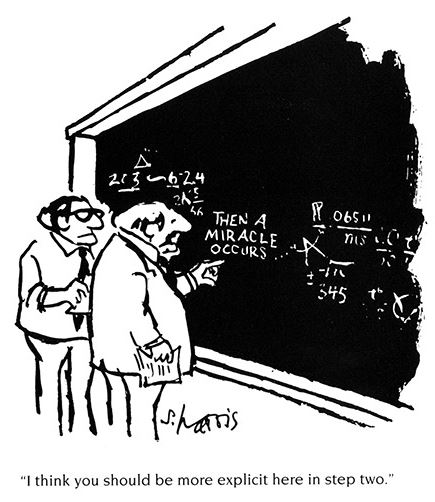
    miracleThere has been much prattling of late that the cost increases for health care are slowing, that the long-term cost curve for Medicare and in the United States is bending downward and that Obamacare may even deserve some of the credit. Liberals everywhere are hopeful that health care expenditures somehow, miraculously, will not drive the nation into fiscal Armageddon and that no major entitlement reforms are necessary. Meanwhile, contrarians have attributed the slowdown in health care spending to economic weakness caused by the Great Recession and paltry recovery.

    Now comes a paper written by Amitabh Chandra, Jonathan Holmes and Jonathan Skinner, “Is This Time Different? The Slowdown in Healthcare Spending,” that says both viewpoints are off the mark. State the authors:

    We identify three primary causes of the slowdown: the rise in high-deductible insurance plans, state-level efforts to control Medicaid costs, and a general slowdown in the diffusion of new technology, particularly in the Medicare population.

    Moreover, they believe the slowdown, like a similar abatement in healthcare spending in the early 1990s, is temporary. “Our best estimate over the next two decades is that health care costs will grow at GDP plus 1.2 percent; lower than previous estimates but still on track to cause serious fiscal pain for taxpayers and workers who bear the costs of higher premiums.”

    Boomergeddon… running right on schedule.

    — JABย