• A Sea By Any Other Name

    seajapanBy Peter Galuszka

    Pity Terry McAuliffe.

    It’s hard to be a politician and trying to please everyone, especially when it comes to rivals Japan and South Korea.

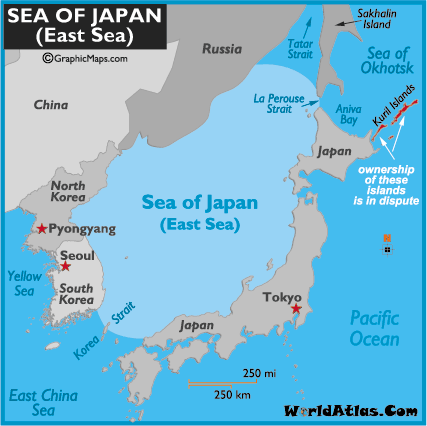
    The new governor promised Virginia’s large Korean community that he would move to have the state’s textbooks call what is commonly referred to as “the Sea of Japan” as “East Sea” as well.

    Japanese, a major trading partner with the Old Dominion, like the former. Koreans, of course, like the latter, since “East” means, east of them. There are lots more people of Korean descent in Virginia than Japanese and they know how to pack a Senate gallery as they did in Richmond recently.

    Now that he’s won the election, McAuliffe has to navigate the treacherous waters of both seas made stormy by centuries of East Asian bloodletting, war and colonization. This dispute has reached the highest levels and has become a diplomatic issue for the Embassy of Japan in Washington. According to The Washington Post, Japan is the second largest source of direct foreign investment and is a major export market. South Korea, less so.

    Virginia always loses when it considers changing its textbook since its history is just as tortured as Japan’s or South Korea’s. It happened a few years back when a Connecticut-based history book writer claimed, falsely, that African-Americans fought for the South in significant numbers during the Civil War. That was fine with Sons of Confederate Veterans types because it makes the South seem not so bad. But African-Americans were a mite upset.

    It’s hard to win with differing versions of history. My big memory is “Ukraine” versus “THE Ukraine.”

    Back when the Soviet Union was breaking up I was either a news correspondent in Moscow or an editor in New York on the international desk handling news from that area.ย When the USSR fell apart, some Ukrainians, mostly in the western part of the country, wanted their country referred to as “Ukraine” instead of “the Ukraine.”

    Why? Political etymology. Ukraine means “border” or “edge.” When you add “the” it makes it sound like “edge of what?”

    The answer was Russia and centuries of Russian power, domination and imperialism. So, adding “the” makes it sound like Ukraine is the “edge” of Russia rather than its own important self. Another problem is that Russians like to diminish Ukrainians by calling them “Little Russians.” How patronizing! But then, lots of Ukrainian Communists, notably Nikita Khrushchev, made it big in Moscow

    The problems are exacerbated when you deal with the diaspora of a particular country. When I was in Moscow in the 1980s, I often went to Ukraine. Same problems as Russia but there had been a lot of intermarriage especially in eastern Ukrainian cities like Kharkov. Not so in the west where Moscow was despised. In general, though, the tension level seemed low.

    In the 1990s, I was back in Kiev. We had a stringer or freelance reporter there who spoke fluent Ukrainian and grew up in Canada. Lots of Ukrainians flocked to Canada after the Bolshevik Revolution and they set up an intensely ethnic support system. Our reporter had spent her childhood summers at Ukrainian kids camps in the Canadian wilds and became thoroughly indoctrinated in Ukrainian things. Or, rather, in what were Ukrainian things back in the 1920s.

    So, I show up in Kiev and she wants me to meet a new-comer, a Canadian professor of Ukrainian descent who speaks the language. When he asked me where I was based, I said Moscow.

    “That really pisses me off,” he said. “What are you, some kind of Russian imperialist? How do you think you can come here from Moscow and understand ANYTHING about Ukraine?

    Good question.

  • A Free-Lunch No-Brainer: Pay-As-You-Drive Insurance

    pricing

    by James A. Bacon

    Pay-As-You-Drive (PAYD) automobile insurance bases premiums on the number of miles the customer drives. It stands to reason: the less you drive, the less likely you are to be involved in a traffic accident. As it also happens, the less you drive, the less you contribute to traffic congestion. Thus, it is in the interest of state transportation policy makers to encourage the adoption of PAYD insurance.

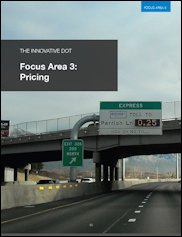
    PAYD is one of the pricing strategies explored in Smart Growth America’s new policy manual,ย โ€œThe Innovative DOT: a handbook of policy and practice.โ€ In the third of eight focus areas, the manual also makes a case for congestion pricing on toll roads. That’s a topic I have addressed extensively elsewhere, and Virginia is already a leading practitioner, so I will not dwell upon it. Instead, I will focus on PAYD, which has only recently entered the Virginia insurance marketplace.

    According to the SGA manual, the Brookings Institution has calculated that PAYD insurance implemented nationally could reduce the number of vehicle miles traveled (VMT) by eight percent and save $50 billion to $60 billion a year by reducing the number of crashes and other driving-related externalities. Moreover, two-thirds of households would save an average of $270 per car per year, making insurance more affordable and decreasing the number of uninsured drivers on the road.

    If the Brookings estimate of eight-percent VMT savings is anywhere near accurate, a shift to PAYD would be the closest thing to a free lunch imaginable. In Virginia, an eight percent reduction in traffic would translate into tens of billions of dollars in construction dollars that would not have to be spent. Add hundreds of millions of dollars yearly in reduced accident-related costs, and the policy is the closest thing to a public policy “no brainer” I can think of.

    There are two predictable sources of resistance. One is the alliance of contractors, engineers and related vendors who make their livings building transportation infrastructure. Another is people who drive a lot more than average; they will miss their subsidies from low-mileage drivers. But arrayed against them is a politically potent group: Everyone else.

    From the standpoint of conservative philosophical principles, PAYD is a two-fer. First, it is fiscally conservative, potentially saving billions of dollars in transportation spending and reducing pressure for tax increases. Second, it is non-coercive and market-based. No one would force insurance companies to provide PAYD, and no one would compel drivers to adopt PAYD policies.

    What Virginia state government can and should do is encourage the spread of PAYD insurance. First, eliminate any laws that might interfere with the adoption of the PAYD rate structure. Even better, join other states in explicitly allowing insurance companies to offer the product.

    SGA suggests that it also might be helpful to adopt a pilot project.

    One of the biggest obstacles to widespread adoption of PAYD is a lack of knowledge on the part of insurance companies and state decision makers about how to structure it. A pilot program can be an effective way to test potential payment structures and data collection methods and reduce the start-up costs to insurance companies. It can also be a means to collect state-specific data about the benefits of PAYD, by monitoring changes in driver behavior. State transportation agencies can play an important leadership role and, in many cases, will be in the best position to administer such a program.

    Privacy issues are minimal. Most new cars already record odometer data electronically onto internal computers, and millions of cars provide the data through GPS-tracking services like On Star. Progressive Insurance also installs an odometer-tracking device for subscribers. If people are wigged out by privacy concerns, they should be free to opt out of PAYD and subscribe to traditional insurance policies.

    One last thought. Think of the powerful impact created by adopting a Mileage Based User Fee (MBUF) for funding road maintenance (as described here) in conjunction with PAYD. For a typical driver, PAYD premiums would amount to about 6.5 cents per mile. In Virginia, a mileage-based user fee could cover the state’s maintenance budget for about 2.6 cents per mile. Add it up, and that’s about 9.5 cents per mile. If people calculated that it cost them a dime for every mile they traveled, they would likely find ways to drive less.


  • Virginia Colleges among Least Unfree in the Country

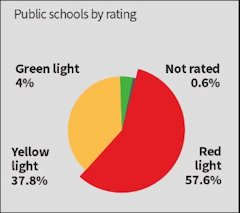
    Only 4% of higher ed institutions nationally are free of restrictions on speech and expression.
    Only 4% of higher ed institutions nationally are free of restrictions on speech and expression.

    by James A. Bacon

    I’ve chastised my alma mater the University of Virginia on many an occasion over the years but today I can say I’m proud to be a Wahoo. UVa is numbered among a mere four percent of all public colleges and universities in the United States whose written policies do not seriously threaten free speech and expression on campus, according to a new report published by the Foundation for Individual Rights in Education (FIRE). Kudos to President Kathleen Sullivan for preserving a truly liberal environment of free expression and free inquiry.

    To give credit where credit is due, the College of William & Mary and James Madison University also earned FIRE’s top recognition. Other institutions of higher learning did not fare so well.

    Bart Hinkle, columnist for the Times-Dispatch, provides an excellent overview of the study. I whole-heartedly concur with his sentiments and have little to add. Read the column.

    FIRE gives three ratings: green, yellow and red. Green indicates policies that allow free expression, yellow indicates policies that restrict narrow categories of speech, and red denotes the existence of at least one policy that “unambiguously” infringes upon protected expression.

    virginia_ratingsVirginia’s public institutions of higher education are among the least restrictive in the country but we can do better. Writes Hinkle:

    This year, two Republican delegates โ€” Scott Lingamfelter and Rick Morris โ€” have introduced legislation in Virginiaโ€™s General Assembly to restore a modicum of free speech at the stateโ€™s colleges and universities. Lingamfelterโ€™s would do away with โ€œfree speech zonesโ€ that deny free speech outside the zones. Morrisโ€™ would grant students facing non-academic disciplinary charges the right to attorney representation. Based on FIREโ€™s findings, the measures are sorely needed.


  • Virginia Population: 8.3 Million and Climbing

    peopleVirginia 2013 population growth highlights fresh from the University of Virginia’s Weldon Cooper Center:

    • Current population: 8.3 million
    • The state population grew 74,531, less than one percent and the slowest rate since before the Great Recession.
    • Still, that rate was faster than the national average, making Virginia the 14th fastest-growing state in the country.
    • Population gains were concentrated (a) in Northern Virginia, and (b) in urban areas. Urban-core jurisdictions of Arlington, Fredericksburg, Harrisonburg, Radford and Richmond grew faster than the state average.
    • Many counties outside the urban crescent, including all seven coal-producing counties in Southwestern Virginia, lost population.

    For details, click here.

    — JAB


  • How to Stretch Those Transportation Tax Dollars

    focus2aby James A. Bacon

    The Commonwealth of Virginia has expended way more effort in recent years figuring out how to raise taxes for transportation than it has ensuring that those tax dollars are well spent. That’s not for a lack of opportunities.ย In its new publication, “The Innovative DOT: a handbook of policy and practice,” Smart Growth America (SGA) argues that there are many techniques for stretching our tax dollars.

    In the second of eight focus areas, the report explores three big ideas relevant to Virginia:

    • One funding pot. Put all transportation dollars for roads, rail and other transportation infrastructure in one big pot and allocate dollars based on Return on Investment. The project that provides the greatest benefit gets funded first, regardless of transportation mode.
    • Asset management. Adopt an Asset Management program for inventorying transportation assets, appraising their condition, and prioritizing maintenance expenditures. Timely preservation of assets can prevent the accelerating degradation of assets once they have begun deteriorating.
    • Performance metrics. Identify goals — congestion relief, facilitation of commerce, economic development, energy savings, pollution mitigation, coordination with local land use — and rank proposed transportation projects by the degree to which they improve those metrics.

    Bacon’s bottom line:ย By pigeonholing our transportation dollars between roads and rail, Virginia may be under-investing in some areas and over-investing in other areas.ย The idea of throwing all transportation dollars into a single pot has a certain appeal. In theory, it would facilitate financing of projects, regardless of mode, that offered the greatest public benefit.ย 

    Here’s my reservation: This idea conflicts with the goal of nudging transportation toward a user-pays system. If we emphasized a Value Capture approach (special tax districts on property owners benefiting from an interchange or Metro station) to project financing, it would be manifestly self-defeating to put those dollars into a Big Pot. The same logic applies to a Mileage Based User Fee (MBUF), especially if, as I advocate, those dollars are dedicated exclusively to maintenance. However, insofar as the Big Pot is filled with tax dollars derived from general taxes like the sales tax and an impartial methodology exists to rank road and rail projects, the idea might have merit.

    Maintenance accounts for about 40% of all dollars by the Virginia Department of Transportation (VDOT) this year. VDOT began to build an asset management system about a decade ago. The department sends out vans equipped with sensors to measure road conditions across the state and publishes an annual “State of the Pavement” report every year that summarizes road quality and driving conditions.

    Deficient lane miles in VDOT transportation districts (from left):
    Deficient lane miles in VDOT transportation districts (from left): Bristol, Salem, Richmond, Hampton Roads, Fredericksburg, Culpeper, Staunton, Northern VA.

    That’s a big step forward compared to the ad hoc practice of the past, in which district engineers drove around and tried to figure out what needed to be done. But there still is a long way to go. According to a December 2012 Federal Highway Administration document, VDOT still wasย in the pilot-project phase, testing the validity of the system before implementing it statewide. VDOT had adopted a philosophy of incremental roll-out to gain staff buy-in and minimize risks. VDOT may be moving at a snail’s pace, but it does appear to be moving in the right direction… and it has been doing so for the past 10 years.

    The idea of performance metrics is making inroads in Virginia as well. The Secretary of Transportation’s office is devising a set of metrics for purposes of long-term planning, and a task force including VDOT and the Department of Rail and Public Transit is hip-deep into a three-year process to determine how to rank road projects by congestion mitigation. The goal is to have 25 to 30 major highway, transit and technology projects rated by December 2014 to guide the distribution of construction dollars in 2015.

    Asset management systems and performance measures will never capture the public’s imagination. There are no ribbons to cut, no ceremonial spades of dirt to overturn, no photo ops. But they hold out the potential to ensure that tax dollars are more effectively spent. That beats higher taxes any day.


  • Dominion Proposes to Bury Problem-Plagued Electric Lines

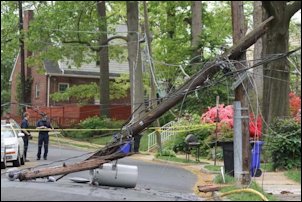
    Downed power line in Arlington. Photo credit: ARLnow.
    Downed power line in Arlington. Photo credit: ARLnow.

    Dominion is pushing a bill that would allow the electric utility to raise rates to pay for moving interruption-plagued power lines underground. The plan calls for burying 350 miles of line per year until 4,000 miles have been relocated, reports the Washington Post. The task would cost about $175 million per year, to be recompensed by charging residential customers from $.70 monthly extra on average to $4 monthly over the duration of the project.

    Nearly a third of Dominion’s 58,000 miles of distribution lines (local lines carrying power to individual houses) is underground today. Putting the entire electric grid underground would be cost prohibitive the power company maintains. But putting the “worst offenders” — 20% of power lines underground — would cut the time it takes for all power to be restored by as much as 50%.

    Bacon’s bottom line: We’re talking about an investment of roughly $1.75 billion. Presumably, there would be an economic payback to Dominion through reduced maintenance costs (tree trimming and the like) and reduced work restoring downed lines. Presumably, those lower costs eventually would be rebated to consumers.ย Dominion doesn’t provide estimates for those benefits; it would be interesting to see them.

    In addition, the selective burial of troublesome power lines would spare residential customers a lot of grief. I don’t know how much economic value you place on quicker restoration of electric power but, as a fairly frequent victim of outages, $4 a month sounds like cheap insurance. However, I’d still like to see the numbers. How many house-days of electric service loss will prevented? What economic value can we assign to that prevention?

    My gut tells me that this is a great idea but Dominion can make a stronger case than it has so far.

    — JAB


  • Henrico’s $6 Million Surprise

    bestproducts
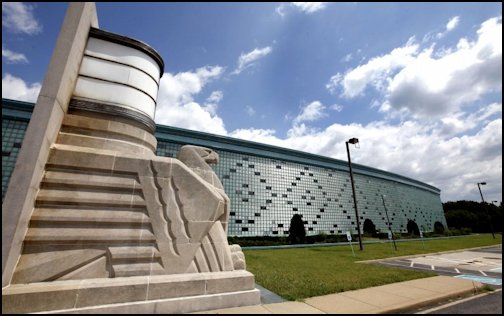
    Photo credit: Times-Dispatch

    When last we heard from Henrico County officials about the parlous state of the county budget, we were told that it was necessary to impose a 4% meals tax because there was no other way to balance the budget without raising taxes or gutting the school budget. Tax foes argued that the county would not need the $18 million in meals tax revenue if it cut expenses instead. One of the strategies mentioned we mentioned was selling excess county real estate.

    County officials disputed our arguments and got their meals tax referendum past the voters, but look what’s happening now! The county has announced its intention to sell the old Best Products Co. headquarters site, which it had purchased in 2011 for $6.2 million with an eye to turning it into a county-government facility. After some study, according to the Times-Dispatch, county officials concluded that the cost of configuring the facility as a county building wasn’t worth the cost.

    It turns out that the complex has been costing the county about $150,000 a year to maintain. The county has been foregoing about $70,000 a year in tax revenue by taking the property off the tax rolls. Voila! Selling the property will yield an instant $220,000-a-year budget gain! Oh, yes, the county also expects the property will sell for as much or more than it paid.

    And there’s more savings where that came from. According to the T-D:

    As his recent State of Henrico County address, County Manager John A. Vithoulkas outlined a commitment to minimizing the countyโ€™s stock of unused buildings. He pointed to a former library and a former fire station, currently on a lease-to-own program with groups in the community.

    โ€œIf we have assets, as a county, that are not in use, that are fallow, if you will, we are (going to put) them into use,โ€ he said.

    Questions that Henrico citizens should ask. On the one hand, it’s good to see that the county administration is making efforts to reduce the cost structure of county government. On the other, this incident does not inspire citizens to trust that government. Why did the county wait until three months after the election to release this information?

    One cannot help but wonder if county officials sat on the information for political reasons — it would have undermined their case that Henrico had no alternative but the meals tax to raising property taxes or cutting school spending. It’s not absolutely clear from the T-D story when a decision was made to dispose of the property, but it appears to have been some time ago. States the T-D: “The county awarded a $400,000 contract for a study of its space needs and of how to use the Best building. It quickly became clear that it wouldnโ€™t be cost-effective to renovate the building, so county officials shut down the study.” (My emphasis.)

    Questions: When did the county shut down the study? When did the county put the property back on the market? What other magic tricks will county administrators pull out of their hats? Stay tuned…


  • A Movement to Impeach Mark Herring?

    Is the Virginia state constitution... unconstitutional?
    Is the Virginia state constitution… unconstitutional?

    Oh, my, it didn’t take long for Virginia’s new attorney general to spark a constitutional crisis. Bearing Drift has published the draft of a resolution, under consideration by two unnamed General Assembly delegates, to impeach Mark Herring for refusing to defend a provision of the state constitution. Read the resolutionย here.

    Money quote: “The nature of General Herringโ€™s neglect of duty is not only unprecedented, but is a danger to all Virginians because without adherence to the paramount law that governs the government of Virginia, all rights of Virginians are at the mercy of government unconstrained by the rule of law.”

    Here is Herring’s explanation of why he changed Virginia’s legal position on Bostic v. Rainey, which asks federal courts to overturn the recent amendment to the state constitution banning gay marriage. Stated Herring:

    “I swore an oath to both the United States Constitution and the Virginia Constitution. After thorough legal review, I have now concluded that Virginiaโ€™s ban on marriage between same sex couples violates the Fourteenth Amendment of the U.S. Constitution on two grounds: marriage is a fundamental right being denied to some Virginians, and the ban unlawfully discriminates on the basis of both sexual orientation and gender.”

    — JAB


  • Lerner Aims to Complete Tysons Office Tower… Only Two Years Late

    tysons_tower
    Artist’s rendering of Lerner’s new Tysons Tower. Original completion date: early 2014. New completion date: Late 2015/early 2016.

    by James A. Bacon

    Well, well, well, what do you know? The commercial building boom in Tysons triggered by the imminent completion of Phase One of the Rail-to-Dulles project doesn’t seem to be running on schedule. A Washington Postย article today highlights Lerner Enterprise’s lengthy delay in building an 18-story, 476,000-square-foot office building near one of Tysons’ four Metro stations. Writes Jonathan O’Connell:

    Office leasing has been flat, at best, in most parts of the region since then. The vacancy rate at office buildings in Northern Virginia is more than 17ย percent, and other buildings built without tenants lined up are still largely empty. And the Silver Line has been delayed.

    The good news is that Lerner is finally ready to move; it expects to complete construction by late 2015 or early 2016. But the question is how rapidly the Tysons commercial market can absorb (a) existing vacancies, (b) Tysons Tower, a Macerich project nearing completion, and (c) the Lerner office space, in a regional economy driven by federal spending in an era when federal spending, especially the defense spending so predominant in Northern Virginia, is severely curtailed and as businesses continue to shrink their office footprint per employee. Rob Whitfield, a former commercial real estate broker and a Rail-to-Dulles gadfly, estimates that Northern Virginia could have an eight-year office supply at present.

    The multibillion-dollar long-term plan for transforming Tysons from a poster child for autocentric sprawl into a walkable, transit-oriented community has more interlocking pieces than a Chinese puzzle. The plan depends heavily upon an increase in development around Tysons to stimulate Silver Line ridership, pay for the reconfiguration of the business district’s paisley street pattern into a walkable grid, and generate tax revenues to offset the billions of dollars of road and highway improvements needed to move traffic in and out of the district.

    If the development is slow to materialize, then the money to pay for the supporting transportation and streetscape upgrades will be slow to materialize. The question is, what happens if the anticipated smart-growth amenities aren’t built? Will Silver Line revenue fall short? If it does, who will pay? Will businesses find the district less attractive and locate in more walkable places, like Arlington, instead?

    At least Tysons partisans can console themselves about one thing. Reston, a prime competing market on the Silver Line, turns out to have massive financial obligations of its own. The Reston Citizen Association estimates that Reston’s infrastructure needs to be $1.5 billion in current dollars ($2.5 billion in future dollars). Meeting those obligations could drive up Reston leases and rents.

    The Silver Line is being built — that die has been cast, and there is no going back — so it only makes sense to use the Metro as a stimulus for more rational land use in Tysons and along the Dulles corridor. Tysons stakeholders are doing what the logic of the situation impels them to do. I’m just worried that the cost of the transformation — Silver Line subsidies, transportation access in and out of Tysons, and other infrastructure — is so huge that it can’t be paid for and the whole thing will disintegrate in slo-mo. I hope my fears are overblown. Somebody please tell me why I’m wrong.


  • MBUFs and Value Capture asTransportation Financing Tools

    focus_area_oneby James A. Bacon

    A common challenge for every state is finding the funds to expand the transportation system to serve a growing population and economy. Virginia endured a grueling debate last year over former Governor Bob McDonnell’s proposal to shift much of the burden to the state sales tax. Other states have made a similar choice.

    The problem with taxing retail sales to pay for transportation is that it demolishes the user-pays principle, with the consequence that there is no longer an objective criteria for allocating funds. Predictably, the pot of transportation dollars is now up for grabs, as evidenced by a slew of bills in the General Assembly that would have the effect, directly or indirectly, of limiting the flow of dollars to mass transit.ย Greater Greater Washington, which has a round-up of the billsย here, framed the issue this way:ย “Was last year’s transportation bill a bait and switch?”ย 

    Anti-transit proponents can rightfully claim that mass transit is uneconomical and totally dependent upon subsidies. Of course, transit advocates can advance the identical argument about roads. Virginia’s system is so riddled with subsidies and cross-subsidies that virtually nothing pays its own way and every funding decision becomes a political slugfest because no mechanism exists (a) to prevent transfers of wealth from one constituency to another or (b) to ensure that transportation dollars are funneled to projects that offer the greatest economic payoff.ย 

    That’s why Smart Growth America’s new publication,ย โ€œThe Innovative DOT: a handbook of policy and practice,โ€ is so welcome. In the first of eight focus areas, the handbook explores new mechanisms for funding transportation projects. If we can figure out how to make different transportation modes pay their own way in Virginia, we can dispense with a lot of politics and focus on putting money to work where it will do the most good.

    While the handbook points to several states that have tapped sales tax revenue to fund transportation, I find two other alternatives preferable. One is Value Capture. The other is the Vehicle Miles Traveled tax.

    Value capture. The premise behind Value Capture is that transportation improvements create economic value and represent a windfall gain to property owners lucky (or shrewd) enough to own land in the right location. Those landowners should help pay for the value created.

    New transportation improvements such as transit stations, roadway networks, or interchanges add value to nearby properties, but while anyone can use those new facilities, all users do not share equally in the added value they produce. …Value capture offers and equitable means of recouping value from the private sector in proportion to the benefit received from transportation improvements. Applied correctly, value capture is narrow and targeted. It is generally not only palatable to, but often supported by, private property owners because they receive a direct and tangible benefit from their investment.

    Value capture techniques take many forms, any one of which may be the most advantageous for a particular situation. Generally speaking, the one that makes the most sense to me is the Transportation Benefit District (or Special Assessment District). Property owners benefiting from a transportation improvement create a special tax district to generate revenue to pay off the bonds that finance construction of the asset. Property owners willingly accept the tax surcharge because they know the new transportation asset will create more than enough value in the form of higher rents and leases to pay for it. If property owners balk because insufficient value is created, that’s a good sign that the project is economically unjustifiable and should not be built in the first place.

    Mileage Based User Fee (MBUF). One can debate around and around who should pay for new construction, but a bedrock principle of transportation financing is that drivers should pay to maintain roads and highways in direct proportion to which they cause wear and tear on roads and highways. With virtually all cars equipped with GPS positioning devices, there is no technological barrier to capturing how many miles a car travels in between trips to the gas station and collecting the tax at the pump.

    The Virginia Department of Transportation has allocated $1.86 billion in its Fiscal 2014 budget for the maintenance of all roads, highways and bridges in Virginia. A tax equivalent to 2.6 cents per mile would cover that entire cost plus the six percent-of-revenue that SGA says it would cost to administer the tax. Two-and-a-half cents is a trivial percentage of the 56 cents per mile that the Internal Revenue Service estimates it costs to operate a vehicle. Moreover, adopting an MBUF would allow the state to eliminate the $600 million it anticipates collecting from motor fuels taxes, $639 million from the retail sales tax, $233 million from motor vehicle licenses and $131 million from insurance premiums, with more than $250 million left over to cut the motor vehicle sales tax by one third. (more…)


  • McDonnells: Don’t Need “Quid” for “Quo”

    2760555SO03_BlagojevichBy Peter Galuszka

    How many times have you seen on this blog the comments or headlines regarding the McDonnell case as โ€œNo quid for the quoโ€ as if that somehow absolves the former governor and his wife of any legal problems and brings them to automatic innocence?

    Well, before we all become over-Baconated in amateur interpretations of federal law that might not be quite right, consider this from the morningโ€™s New York Times about the McDonnellsโ€™ arraignment yesterday.

    โ€œExperts on corruption law said that prosecutors do not have to show thatย  Mr. (Jonnie) Williams (of Star Scientific) received state contracts, or that the McDonnells promised specific gifts in return for his gifts.

    โ€œ’They donโ€™t have to prove an explicit quid pro quo,โ€™ said Josh Berman, a former prosecutor of corruption cases in the Justice Department. The McDonnells are charged with โ€˜honest services fraudโ€™โ€”a lesser charge than bribery. It requires that prosecutors show only ‘a connection between the goodies, the loans and the official action,’ Mr. Berman said.

    โ€œThe indictment is largely a detailed timeline of Mr. Williamsโ€™ gifts and what the McDonnells did to promote a dietary supplement he made, Anatabloc.โ€

    So, dear readers and corruption sleuths, you might want to reconsider the argument by McDonnell apologists that their charges could be applied to any public official doing his or her job. For one thing, the regular stream of gifts over a two year period from Williams certainly suggests some kind of understanding.

    Itโ€™s not exactly like taking a one-time-only 10-day tropical holiday at someoneโ€™s island vacation house. The McDonnells sought and accepted a wide range of gifts including loans that the former governor apparently did not own up to when he was seeking bank financing. And you donโ€™t need to show a clear โ€œquid pro quo.โ€

    I went to the Wiki and looked up โ€œhonest services fraud.โ€ Here is a list of how it has been applied in recent cases:

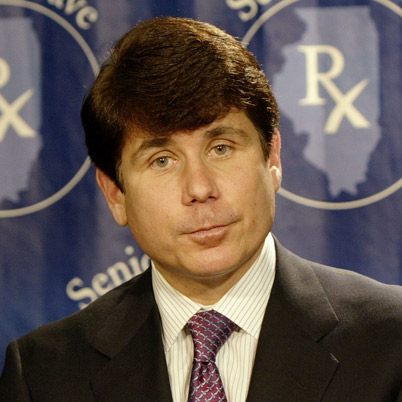
    โ€œSeveral notable figures have been charged with or convicted of honest services fraud. Washington lobbyist Jack Abramoff pleaded guilty in 2006 to honest services fraud in addition to conspiracy and tax evasion; he was convicted in 2008 of further charges of honest services fraud in addition to further charges of conspiracy and tax evasion.[26] Former Enron CEO Jeffrey Skilling was convicted in 2006 of honest services fraud, in addition to securities fraud.[26] Former Illinois governor George Ryan was convicted in 2006 of honest services fraud, in addition to racketeering, tax fraud, obstruction of justice, and making false statements to federal agents.[27] Former Alabama Governor Don Siegelman was convicted in 2006 of honest services fraud, in addition to conspiracy, bribery, and obstruction of justice.[28] Duke Cunningham, a former Congressman from California, was convicted of corruption charges including honest services fraud.[26] Bob Ney, a former congressman from Ohio, was convicted of corruption charges including honest services fraud.[26] Newspaper magnate Conrad Black was convicted in 2007 of honest services fraud, in addition to obstruction of justice.[29] Former Alaska state legislator Bruce Weyhrauch was convicted in 2007 of honest services fraud in addition to bribery and extortion.[30] Former New York Senate Majority Leader Joseph Bruno was convicted in 2009 on two counts of honest services fraud.[31] Mary McCarty, a former Palm Beach County Commissioner, is currently serving a federal prison sentence for honest services fraud.[32] New Jersey political boss Joe Ferriero was convicted in 2009 of conspiracy and two counts of mail fraud.[33] Former Illinois governor Rod Blagojevich was indicted in 2009 for allegedly conspiring to commit honest services fraud, as well as for allegedly soliciting bribes.[34] Former Alabama state legislator Sue Schmitz was convicted in 2009 of three counts of mail fraud and four counts of fraud involving a program receiving federal funds.[35][36] Judges Mark Ciavarella and Michael Conahan originally pled guilty to honest services fraud and conspiracy in the Kids for cash scandal. The pleas were later withdrawn.โ€

    I rest my case.


  • In Court With the McDonnells

    mcdonnells arraignedBy Peter Galuszka

    The courtroom was packed and I ended up in the hallway of Richmond’s fairly new and modern look federal courts building. Inside, history was being made: a bond hearing for Robert F. McDonnell, the first Virginia governor, former or sitting, ever to be charged with misconduct while in office.

    Inside, U.S. Magistrate Judge David Novak asked McDonnell and his co-defendant wife Maureen if they understood the severity of the 14 felony counts against them. This would be unlikely, but if they were convicted of every corruption count and got the maximum sentence running consecutively, they would be in jail for 300 years. I actually did the math on my notebook.

    That factoid becomes more bizarre when one realizes that just a year ago, McDonnell’s name was being touted as a possible GOP presidential contender in 2016. In 2012, he might have been Mitt Romney’s running mate had Vaginal Ultrasound not caught him with him.

    Novak waived bail and released the McDonnells but they had to surrender their passports. He issued a gag order stating that โ€œthe gamesmanship with the media ends now” — an obvious reference to the months of leaks that have energized the state and national media about the case.

    Another court matter awaited upstairs. As the McDonnells emerged, there was much emotional hugging. House Speaker Bill Howell, a loyal McDonnell supporter, had been standing with me in the overflow and he’d didn’t look too happy. A Catholic priest from the parish where the McDonnells attended on Church Hill grasped their shoulders from time to time.

    Upstairs was the arraignment in a larger courtroom before U.S. District Judge James R. Spencer. The McDonnells sat stage right with their attorneys and some of their children were in the courtroom. McDonald still wore his hair in a flawless helmet but it seemed a lot more grey than the last time I had seen him personally.

    The McDonnells pleaded not guilty. Trial was set for July 28 and it should last five to six weeks.

    A mob scene of cameras greeted the former First Couple as they exited on Broad Street. There was screaming and I guess it came from the reporters. They finally entered a white van and left.

    Speaker Howell had actually tried calling federal prosecutors before the indictments were issued Jan. 21 to say that McDonnell was a fine man and public servant. His call was not accepted. As he and I had been standing outside of Judge Novak’s courtroom, I introduced myself and asked about ethics reform since Virginia has among the most lax ethics laws in the nation.

    “It’s coming,” Howell said.

    I asked if that meant an ethics commission. “We have one,” he replied.

    “Will it have subpoena power?” I asked.

    Howell gave me a hard look and said “no.”

    It was one of the scenes where you have to pinch yourself to remind yourself that it is real.


  • Federal Transportation Funds Running Short? Try Local Innovation.

    Innovative_DOTThere are two ways to respond to the shrinking federal budget for transportation projects: You can whine and mewl and curse the injustice of things, or you can look for other ways to cope with the country’s transportation challenges. Smart Growth America (SGA) has chosen the latter course, publishing “The Innovative DOT: a handbook of policy and practice,” which systematically explores alternatives to the old tax-and-build paradigm. This handbook covers ways to allocate existing revenues more efficiently, enact pricing strategies, adopt system efficiencies and integrate transportation and land use — the very things that states and localities should have been doing all along.

    As SGA asks, “Could state DOTs provide better service for less money?” To pose the question is to answer it. “States and their departments of transportation (DOTs),” states the handbook, “are reevaluating and retooling traditional practices to ensure that those practices continue to provide users with a robust, economically beneficial transportation network.”

    Insofar as necessity is the mother of invention, the impending contraction of federal transportation funds actually may prove to be a good thing.ย The Handbook doesn’t recommend which strategies to pursue. But it does lay out the array options available to state and local policy makers, and provides case studies of how different states, regions and communities made them happen. As SGA makes clear, every state is different. Not every option is suitable for all 50 states. But state officials can learn from what others are doing.

    There is too much densely packed material to summarize in a single blog post. For details, I refer you to the handbook itself. However, there is such a treasure trove of information that, as time permits, I will explore several handbook themes in future posts with an eye toward defining policy options appropriate for Virginia.

    (Full disclosure: Smart Growth America sponsors the Bacon’s Rebellion blog.)

    — JAB


  • AG to Virginia Constitution: Drop Dead

    herringLess than two weeks ago, Attorney General Mark Herring swore to preserve, protect and defend the Constitution of Virginia. Apparently, he was crossing his fingers behind his back while taking the oath of office, for he now asserts that Virginia’s constitutional ban on same-sex marriage is…. unconstitutional. Not only that, but the AG’s office will not defend the state constitution in a case before U.S. District Court challenging the ban.

    As state senator from Loudoun County in 2006, Herring had voted for the state amendment banning same-sex marriage. At some point since then, he had a change of heart. He just never bothered to tell voters, presumably because he thought it would hurt his run for the AG’s office. That was probably pretty shrewd thinking. Given the fact that he won by a razor-thin margin, hiding his intentions undoubtedly made his victory possible. It also speaks loudly about what kind of man Herring is, and what kind of AG he will be. (I say this, incidentally, as a blogger who has never written about Herring before and had formed no impression of him.)

    There is a strong case to be made to allow same-sex marriages. Personally, I’m on the fence on the issue. I see the merits of both sides of the argument. As it happens, there is a very good way to reverse the constitutional prohibition — go through the same amendment process that voters previously went through to pass it.

    Herring says that Virginia needs to be “on the right side of ย history.” Given the sea change in attitudes towards gay marriage, I expect that Virginia will reverse the constitutional ban eventually. But abandoning the AG’s role as upholder of the state constitution substitutes the rule of man for the rule of law. That is very much the “wrong side of history.”

    Update: Actually, there may be legitimate issues regarding the duties of the Attorney General. I was surprised to see that those duties are not enumerated in the state constitution, which says, ”ย He shall perform such duties and receive such compensation as may be prescribed by law.”

    Here is the oath of office, as stipulated in Virginia’s Constitution: “I do solemnly swear (or affirm) that I will support the Constitution of the United States, and the Constitution of the Commonwealth of Virginia, and that I will faithfully and impartially discharge all the duties incumbent upon me as ……………….., according to the best of my ability (so help me God).”

    I suppose Herring could argue that in a case where the U.S. and state constitutions conflict, he can legitimately side with the U.S. constitution. It’s lame but at least it’s an argument.

    Update: Paul Goldman illuminates the legal ethics of Herring’s obligations underย the Rules of Professional Conduct applicable to all lawyers: “These Virginia Supreme Court sanctioned rules prohibit a lawyer from unilaterally taking any action materially adverse to a former client. That at least is the plain reading.ย What could be more materially adverse than having your former lawyer use his prestige and taxpayer funding to defeat you?”

    — JAB


  • Big Brother? I Think He’s On My Contact List.

    gps_trackingby James A. Bacon

    Not long ago there was a fair amount of buzz over the idea of a Vehicle Miles Traveled (VMT) tax as a way to finance the maintenance and construction of roads and highways in the United States. That buzz, it seems, has largely died down. Technologically speaking, it would be a no-brainer to attach a GPS device to a car and track how many miles it drove over the course of a year. But any time someone broaches the idea, foes say it would never work — Americans would never tolerate the government monitoring their movements in order to calculate how many miles they drive. End of conversation.

    A new poll calls that conventional wisdom into question. Life360, a company that sells an inexpensive service enabling subscribers to track the whereabouts of friends and family, recently surveyed 1,169 teens and adults who own smart phones. Sixty percent reported that they use at least one location-sharing app on their phone, and 36% say they use two or more.

    Life360 concluded that location-sharing is driven by safety. Parents like to know where their children are. Sometimes, children even want to know where their parents are. Admittedly, that’s a far cry from sharing your location with the government for the purpose of taxing you. But it shows that people are willing to trade a modicum of privacy for something else of value.

    Many other apps offer inducements for people to share their GPS data.ย Subscribers logging into Waze yield their location in exchange for access to maps showing real-time traffic flow based on the movement of all other subscribers. Subscribers to FourSquare share comments about restaurants, nightclubs, parks and other urban amenities — and can detect the whereabouts of friends who are nearby. Glympse, an Android app,ย locates the location of friends and shows their movement on a map. Marco Polo provides another twist on the same concept.

    One might respond that those are small start-up companies, and they’re only sharing GPS location with friends. But General Motors’ OnStar unit tracks subscribers’ car locations to provide turn-by-turn navigation, quick crash-response service and stolen car assistance. Three years ago the company forecast the number of subscribers to reach 7.9 million by 2017. Meanwhile, the service has inspired numerous competitors, including Ford, Toyota, Volkswagen, State Farm and WatchDog.

    The fact is that millions of Americans share their GPS-derived locational data already, and no one gets bent out of shape about it. There is one important difference, I’ll concede, between these private services and a VMT tax. People voluntarily share their GPS data with Life360, Waze, OnStar and the rest. A tax is compulsory.

    While civil libertarians may grumble, Americans are getting acclimated to the idea of sharing GPS data. If they are willing to make their location public to their network of friends and acquaintances, and if they relinquish the data to giant auto manufacturers, it’s a relatively small step to allow the Department of Motor Vehicles to access the same information for the purpose of determining how many miles they drive in a year.

    A VMT tax is an elegant solution to funding the maintenance of roads and highways. Motorists pay in direct proportion to which they use the roads, add to wear and tear on asphalt and incur public expense. A VMT does not shift the fiscal burden to pedestrians, cyclists, bus riders and little old ladies who drive 1,000 miles a year going back and forth to the beauty parlor. It puts responsibility squarely where it belongs, on people who drive the most. To my mind, that is a compelling public purpose that justifies the minimal loss of privacy associated with GPS sharing.

    Virginia, it’s time to think seriously about instituting a VMT tax and moving toward a true user-pays system for funding Virginia’s roads, bridges and highways.