• Two Ways Municipalities Can Save Money

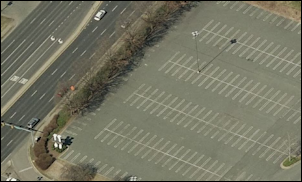
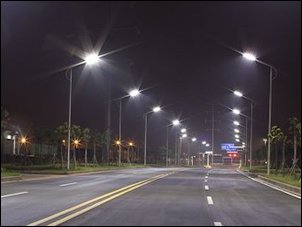
    Empty streets, wasted light
    Empty streets, wasted light

    by James A. Bacon

    I’m sick and tired of the false choice between raising taxes and cutting services. There are many ways that enterprising localities can save money and/or generate non-tax revenue without hosing taxpayers or neglecting core responsibilities. Here are just two ideas that popped up recently.

    Street lights. Every municipality in Virginia operates street lights at a collective cost of tens of millions of dollars per year. (At one point the City of Los Angeles was spending $42 million annually to monitor and maintain its 200,000 street lights.) Light pollution issues aside, street lights run up the electric bill and generate costs to monitor and replace the light bulbs. You can’t bring along a step ladder and stand on your tippy-toes — you have to use a cherry picker to replace a burned out bulb.

    The good news is that there are new technologies — cost-effective LED lights and sensors that detect when no one is around and no light is needed — that can drive down the cost of lighting up the outdoors.ย The bad news is that buying the bulbs and installing the sensors requires an up-front capital investment that local governments often cannot afford.

    One possible solution: a public-private partnership. The Washington Metropolitan Area Transit Authority (WMATA) recently contracted with Philips Electronics, a private company, to light all of its parking garages. The authority estimates it will save $2 million annually in operating expenses while maintaining a contracted-for quality of service, reports Greater Greater Washington.

    If WMATA can save money, so can every Virginia locality. This is low hanging fruit. There is no friggin’ excuse for local governments not to save this money. If your local government isn’t exploring these savings, it’s time to tar and feather your city council or county board.

    Landfill mining. Virginia localities have been operating landfills for decades. A few have figured out how to generate cash by tapping the methane emanating from these facilities. As metal prices have risen, the same municipal dumps also may be sitting on a small fortune in copper, aluminum and other processed minerals. In the Jefferson Policy Journal, Rob Hartwell describes how localities can turn their landfills into windfalls.

    “eWaste” is the fastest growing municipal waste stream in the U.S., with thousands of computers, peripherals, printers, fax machines, televisions and mobile devices discarded each day. Twenty-five states โ€œrestrict eWaste from being dumped into landfills. Virginia is not one of them. Localย governments could be monetizing this waste stream and capturing millions in revenues. Writes Hartwell:

    One combined effort underway in Southeast Virginia, the Hampton Roads Urban Mining Center, would start with eCycling and move to produce fuels from municipal waste. Utilizing the latest in European technologies just now available in the U.S., the benefits from similar regional efforts across Virginia per site would be monumental, including: (more…)


  • Bacon Bits: Schools and Higher Ed

    bacon_bitsOK, people, you’re out of control. You’re generating way too much quality content that is disappearing into the ether because Virginia’s newspapers and bloggers simply aren’t equipped to cover it all. Once again, I find myself falling back upon the Bacon Bits format, just to ensure that readers know what’s out there.

    Advanced placement credits. Virginia boasts the third-highest percentage of public high school seniors qualifying for college credit on Advanced Placement tests, according to the College Board’s 2104 report. Reports Virginia Business magazine: “28.3 percent of Virginiaโ€™s 2013 graduating seniors earned a grade of three or higher on at least one AP exam. Virginiaโ€™s seniors trailed behind students in Connecticut and Maryland, who earned the No. 1 spot.” Gains over the past 10 years have been especially marked for African-American and Hispanic students.

    Fixing virtual school governance. Chris Braunlich, writing in theย Jefferson Policy Journal,ย elucidates how Virginia lags the country in using virtual (online) schools to provide education to children with special needs or circumstances at home. More than 2750,00 students are enrolled in virtual schools nationally, and the number is growing 30% per year. ย The number in Virginia: less than 1,000. Writes Braunlich: “Itโ€™s just one example of state law not keeping pace with a 21st century world in which students arenโ€™t limited to their neighborhood school, but quite literally are ‘students without borders.’ The fact that the law hasnโ€™t kept up with technology has badly hurt the growth of full-time virtual schools.”

    University endowments kicking bootay. The University of Virginia endowment grew to $5.16 billion during fiscal 2013, up 7.9%, making it the largest endowment in Virginia and the 19th largest in the country. Runner-up was the University of Richmond, whose endowment surpassed $2 billion, followed by Washington & Lee ($1.345 billion) and the College of William & Mary ($698 million). Read Richmond BizSense’s recap hereย (the article lists all endowed Virginia universities) and read the report upon which it was based.

    The end of higher ed’s golden age. A must-read essay by Clay Shirkey describes the dilemma facing higher ed today:

    Decades of rising revenue meant we could simultaneously become the research arm of government and industry, the training ground for a rapidly professionalizing workforce, and the preservers of the liberal arts tradition. Even better, we could do all of this while increasing faculty ranks and reducing the time senior professors spent in the classroom. This was the Golden Age of American academia.

    As long as the income was incoming, we were happy to trade funding our institutions with our money (tuition and endowment) for funding it with other peopleโ€™s money (loans and grants.) And so long as college remained a source of cheap and effective job credentials, our new sources of supportโ€”students with loans, governments with research agendasโ€”were happy to let us regard ourselves as priests instead of service workers. …

    Golden Age economics ended. Golden Age assumptions did not. For 30 wonderful years, we had been unusually flush, and we got used to it, re-designing our institutions to assume unending increases in subsidized demand. This did not happen. The year it started not happening was 1975. Every year since, we tweaked our finances, hiking tuition a bit, taking in a few more students, making large lectures a little larger, hiring a few more adjuncts.

    Each of these changes looked small and reversible at the time. Over the decades, though, weโ€™ve behaved like an embezzler who starts by taking only what he means to replace, but ends up extracting so much that embezzlement becomes the system. There is no longer enough income to support a full-time faculty and provide students a reasonably priced education of acceptable quality at most colleges or universities in this country.

    Our current difficulties are not the result of current problems. They are the bill coming due for 40 years of trying to preserve a set of practices that have outlived the economics that made them possible.

    (Hat tip: Michael Cassidy.)


  • Map of the Day: Wal-Mart Versus Downtown Waynesboro

    Kudos to Luke Juday for his latest graphics in “Mapping the Commonwealth.” As an intellectual exercise, he overlaid Google images of ten downtown areas around Virginia with overhead images of nearby Wal-Marts. There was no particular agenda to the images, he says — “I’m not a big Walmart hater or anything.” ย He just wanted to illustrateย the difference in scale between places meant to be experienced on foot and places meant to be experienced by car.

    Writes Juday: “Automobile-oriented places provide the same grid of connections and destinations at a dramatically expanded scale.ย  The time distance is still the same – everything is accessible in five to ten minutes.ย  But that means something different in terms of space – more like five miles than a half mile.”

    — JAB


  • Why Are Virginians Such Weather Whoosies?

    norilskBy Peter Galuszka

    The other day I tried to book a lunch date with the Blogger in Chief but was informed that inclement weather was looming on the Old Dominion and he might be hibernating for a few days.

    Imagine my surprise this morning when I awoke to find a few inches of snow and some light sleet pelting around. Sure enough, the state seems to have shut down. This begs another question. Why are Virginians such weather whoosies?

    Millions of people around the world live and work in much harsher conditions. I spent six years reporting from Moscow in the 1980s and 1990s and had plenty of bone-chilling experiences. There was that ultra-cold day in Novosibirsk just before Thanksgiving when the temperature was about minus 30. But if you want to consider the granddaddy of them all, go to Norilsk in Siberia, the northern-most city of more than 100,000 in the world.

    khodorkovsyI went to Norilsk in January 1996 for a BusinessWeek cover story on the crop of rising oligarchs who were cashing in on post-Communist privatization. One was Mikhail Khodorkovsky, a geek-turned-billionaire who, ironically, was just recently released by President Vladimir Putin after spending a decade in prison. It was a pre-Sochi Olympics gesture to make nice. I had interviewed Khodorkovsky many times and found him a meek and thoughtful man.

    Another oligarch was Vladimir Potanin who was cornering the market on Russiaโ€™s vast reserves of precious metals. It was thanks to Potanin that I got to go to Norilsk. He was involved in a rough proxy battle to take over Norilskโ€™s rich array of smelters insofar as Russia was capable of having real proxy fights back in the 1990s.

    Vladimir-PotaninSo, with Potaninโ€™s invitation, Alexei, a Russian photographer, and I jetted off to Norilsk, a horrible, treeless snow-swept waste. It has a particularly horrible history.

    Founded at the end of the 1920s, Norilsk became a center of Stalinโ€™s GULAG system which in this case exploited rich reserves of nickel, cobalt, copper, platinum, palladium and coal. The only way in or out if by air or by rail and road to a specially built port on a river that flows into the Arctic Ocean.

    Norilsk is covered with snow for up to 270 days a year and has snow storms lasting a total of about 120 days. In January and February, the average lows are about minus 23. Record lows are about minus 63.

    Political prisoners built up a huge metals mining and metallurgical apparatus from the 1930s until the 1950s. More than 16,000 died and many fatalities occurred during World War II when food was short.

    When we arrived at the airport, we were met by one of Potaninโ€™s black limousines that hustled us across a snowy tundra road whose outlines only the driver could see. Our hotel was a shamble of brickwork and amenities were similar to what many reporters are finding today in Sochi albeit no stray dogs. Theyโ€™d be dead. Tracked bulldozers worked 24/7 keeping snow from piling up.

    Rogov and I had trouble finding food. The hotel kitchen was closed and we slogged down the streets until we pounded on the door of a closed restaurant and convinced them to give us something to eat. (more…)


  • Visualizing the Unthinkable

    Worst-case "Sandtrina" inundation scenario for south Hampton Roads.
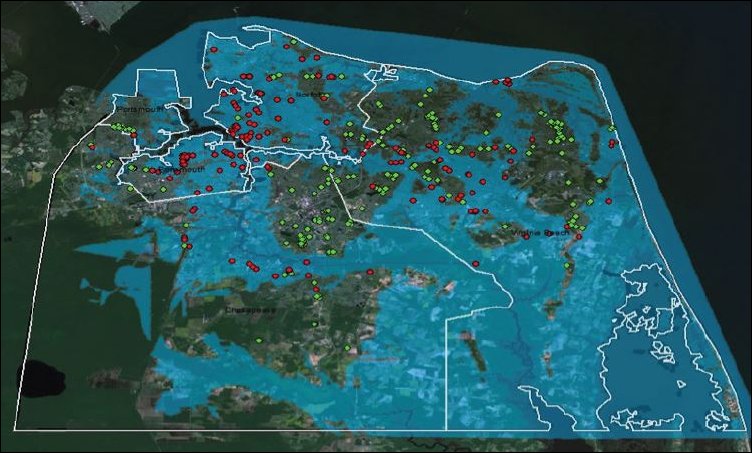
    Worst-case “Sandtrina” inundation scenario for south Hampton Roads. Red dots are inundated, green dots above water.

    by James A. Bacon

    Combine the power of a Katrina-scale hurricane with the geographic proximity of a Hurricane Sandy, aim it at Hampton Roads, and what do you get? Old Dominion University professors Joshua G. Behr and Rafael Diaz cranked up their supercomputer to visualize what might happen.

    A “Sandtrina” catastrophe would extend way beyond the loss to houses, buildings, roads and infrastructure to include widespread disruption to the economy and the health care system, they explain inย Hurricane Preparedness: Community Vulnerability and Medically Fragile Populations,” published in the latest edition of the Virginia Newsletter.

    Do not confuse this issue with Global Warming (GW). Behr and Diaz, who work at ODU’s Virginia Modeling, Analysis and Simulation Center,ย were not simulating the impact of hypothesized GW-induced sea level rise, as others have done. The phrases “climate change” and “global warming” never appear in their paper. They were simulating an event that, though statistically unlikely, is within the bounds of experience in the United States and could happen to Hampton Roads.

    I have no competence to critique the modeling methodology underlying the Behr-Diaz simulations, but I do believe they deserve credit for broadening their analysis beyond a simple calculation of property damage. They also map financial and medical vulnerability of the Hampton Roads population, recognizing that some households are too poor to effectively prepare for a lengthy hurricane-caused disruption and that some have medical needs that may go unmet after a disaster.

    “Resilience,” referring to the ability of communities to recover from disasters, is all the rage among GW believers, but it would be a mistake for conservatives to dismiss the concept out of hand. The Behr-Diaz simulations make it clear that the concept is very relevant right now. Conservatives should take the lead in devising ways to make Virginia communities more resilient to natural disaster. One good place to start: Curtail federal insurance subsidies that encourage people to build in flood-prone coastal areas. Another idea: Encourage development either in higher-elevation areas or in low-elevation areas that can be hardened against a massive storm surge.


  • What E-Cigs Mean for Tobacco-Happy Virginia

    e-cig adsBy Peter Galuszka

    A couple of weekends ago, RVA Vapes, brightly lit with colorful lights, held its grand opening in Richmond.

    Itโ€™s one of a rising number of new outlets that cater to โ€œvapersโ€ or people who use electronic cigarettes. There are plenty of such stores, many decorated in a 1960s head shop style from Arlington to Virginia Beach not to mention the rest of the country. I was there for a Style Weekly cover story which ran just as Business Week (ironically, my old employer) ran its cover piece on e-cigs.

    E-cigs look like tobacco cigarettes and offer the same addictive kick of nicotine. But thereโ€™s no smoke, just vapor made up of water, nicotine and flavorings from bubble gum, to mango to cookies and cream. There is no tar and other deadly chemicals that allow tobacco smoking to take 480,000 lives a year. But itโ€™s not quite certain just how safe unregulated e-cigs are.

    This trend has enormous implications for Virginia which has genuflected before the Golden Leaf since the days of Jamestown. When the predecessors of todayโ€™s General Assembly sat down to do business, one of their first items of legislation was setting tobacco price supports.

    Today, Altria and Philip Morris USA have their headquarters in Richmond as well as a huge manufacturing facility that is the last place in the country that makes Marlboros, the nationโ€™s best-selling traditional cigarette.

    Altria is a major player in philanthropy, giving to arts, municipal groups, sports and other causes throughout the state not to mention the District. Since 2000, Altria has given $3.8 million to Virginia political campaigns, according to the Virginia Public Access Project.

    E-cigs popped up from Asia and their growth has come organically up from the bottom with the help of small, independent entrepreneurs many of whom fit a counter-culture style. Big Tobacco is just catching up in a business that overnight has grown to about $1.5 billion to $1.8 billion. One expert I spoke with, Bonnie Herzog at Wells Fargo Securities, says that within a decade there will be as many e-cig โ€œvapersโ€ as there are tobacco cigarette smokers now.

    So why is Altria so late in the game with e-cigs? Competitor Lollilard beat it by buying the โ€œBluโ€ e-cig brand. Altria just started test marketing MarkTen e-cigs in Arizona and Indiana last year and is shelling out $110 million for another e-cig brand called โ€œGreen.โ€

    One problem is that no one knows whether the U.S. Food and Drug Administration will regulate e-cigs as tobacco products. Doing so is problematic because the only related product is nicotine and one can get that from non-tobacco sources such as potatoes, eggplants and peppers, not to mention marijuana.

    Altria employs nearly 4,000 in Virginia and many of those jobs depend on how well their employer can deal with the unmistakably downward trend on tobacco use, roughly about 4 percent less year over year. Altria has tried to diversify into wine and non-tobacco products but cigarettes still make up about 88 percent of its $23 billion in revenues.

    Tobacco critics are not certain what to make of e-cigs yet. Matthew Myers, head of Washington-based Campaign for Tobacco Free Kids, says that e-cigs do not have many of the fatal ingredients of regular smokes but thereโ€™s still cause for concern. Nicotine, the central ingredient in e-cigs, is addictive and can be harmful, if not fatal, if ingested in sufficient quantities. It can cause birth defects if used by pregnant women and can hamper adolescent brain development. It boosts blood pressure and causes the heart to beat faster.

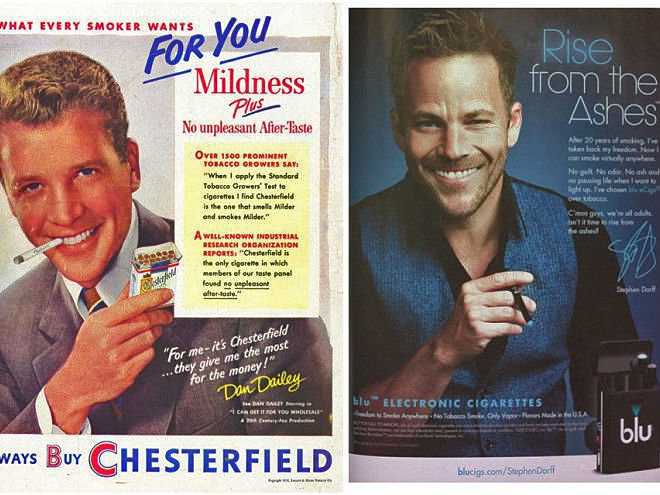
    Plus, Myers says, there isnโ€™t much quality control at places that sell e-cigs now, โ€œso, you really donโ€™t know what youโ€™re getting.โ€ Another problem he sees is that e-cig sellers are drawing from Big Tobaccoโ€™s tried-and-true advertising to make their products seem sexy and sophisticated. The problem is that young people mesmerized by Humphrey Bogart bedecked in a rumpled trench coat puffing away on a stogie might see the entire smoking experience as ultra-cool.

    That positive vibe might be transferred from a e-cig to a real cig, revitalizing Big Tobaccoโ€™s lethal image. It could happen if Big Tobacco somehow dominates the e-cig trade and then uses it to expand its old product line rather than seeing e-cigs as a healthier replacement product.

    A lot depends on what the FDA does and, for much of Virginia, how Altria responds.


  • Bacon Bits

    So much to blog about, so little time…

    New type of interchange.ย Later this month, the Virginia Department of Transportation will open a new “diverging diamond interchange” at the Zions Crossroads exit of Interstate 64. VDOT chose this configuration (see simulation above) in preference to a cloverleaf interchange because it economizes on land. The diverging diamond interchange, adopted first in France, is relatively new to the United States. This is only the sixth one built in this country.ย (Hat tip: Larry Gross.)

    The incredible disappearing traffic congestion. Ever since Elizabeth River Crossings instituted tolls on the Downtown and Midtown tunnels in Hampton Roads, traffic dropped 22% last week compared to pre-toll levels and, miracle of miracles, congestion has evaporated. For the moment, peak tolls are $1 one way. The traffic backup often delayed commuters a half hour. Is $2 in tolls worth saving an hour stalled in traffic? For most people, it probably is.

    Green power. Dominion Virginia Power reports that 20,000 customers have signed up for a program that allows them to buy additional increments of “green” power for the equivalent of $2 per 154 kilowatt-hours. Dominion has nearly 2.4 million customers. In other words, about one customer out of 120 believes enough in renewable energy to put their money where their mouth is. This voluntary program is far preferable to a mandatory Renewable Portfolio Standard.

    — JAB


  • Virginia Missing from White House Climate Conversation

    Flooded street in Norfolk during Hurricane Sandy.
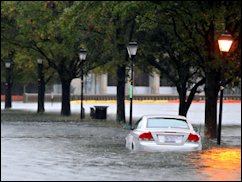
    Flooded street in Norfolk during Hurricane Sandy.

    by Rachel Cannon

    On November 1st, 2013, President Obama signed an Executive Orderย โ€œPreparing the United States for the Impacts of Climate Changeโ€ โ€“ the newest addition to the Administrationโ€™s Climate Action Plan. One part of the Executive Order establishes the Task Force on Climate Preparedness and Resilience: a collection of state, local and tribal leaders from across the country who will serve as advisors to the government on building climate preparedness and resilience in their communities.

    This is a great idea โ€“ so what is the problem? Scanning the list of Task Force members reveals a glaring omission: Among all of these names, there is not a single representative from Virginia. Why not? Other east coast states, including Delaware, Maryland, and New Jersey, are represented. One state (California) has not one, not two, but three representatives on the Task Force.

    Virginia, particularly coastal Virginia, needs to be a part of this.

    The Task Force was created to advise, based on first-hand experiences, on how the federal government can respond to the needs of communities that are dealing with the impacts of climate change.In part, it will help agencies assist cities and towns to build โ€œsmarter and stronger,โ€ identifying and removing barriers to investing in resilience. In other words, the Task Force will tell the government how it can help these communities prepare for and survive climate-change-fueled disasters.

    Virginia, especially the Tidewater region, faces tremendous and unique threats from climate change. Moreover, communities such as Norfolk have been battling damaging weather events, not to mention storm surges and relentless flooding, for years. Virginia research institutions, such as the Virginia Institute of Marine Science (VIMS), have developed superb research on best practices and implementation.ย Insights from our regionโ€™s community leaders are invaluable and irreplaceable to the White Houseโ€™s efforts. With no Virginians on the Task Force, who can speak on Virginiaโ€™s behalf? Maryland? Delaware? How could they? The region faces unique concerns, and must offer its correspondingly unique perspective.

    Although storms and sea level rise are only some of many concerns the Administration hopes to address, they are significant, and Virginia can help. First, the predicted effects of climate change on the state are tremendous. Virginiaโ€™s Tidewater region has one of the fastest rates of sea level rise in the country. NOAA predicts there will be almost two feet of local sea level rise over the next 100 years at Chesapeake Bay Bridge Tunnel โ€“ the highest increase on the east coast.ย VIMS estimates that over the next 20-50 years, the Hampton Roads area could experience up to a 1.5-foot increase in sea level rise.ย Over 80% of the Virginia coastline is considered at โ€œhighโ€ or โ€œvery highโ€ risk from sea level rise.ย According to one estimate, 19,000 people in Norfolk and 40,000 people in Virginia Beach live below the 100-year flood level, ranking Norfolk among the five most vulnerable U.S. cities to harm from hurricanes.

    Recent weather events like hurricanes have been unprecedented both in frequency and severity (consider the 4-foot storm surge in Hurricane Irene in 2011). Whatโ€™s worse, the regionโ€™s land is sinking as sea level rises.ย The cruel trifecta of sea level rise, subsidence, and these extreme weather events, threaten to leave a much of cities like Norfolk under water. When (not if) a hurricane like Sandy touches down in Virginia, it will jeopardize homes, lives, critical infrastructure,ย not to mention the enormous federal investment in Naval operations. The economic and human harm in the region threatens to be astronomical.

    Most importantly, Virginia is working to prepare for these forecasted harms. Leaders in Hampton Roads have expressed their desire to work with state and federal government on climate change in the region.ย A recent conference on adaptive planning for sea level rise in the region reached maximum capacity, with legislators, local leaders, and researchers coming together to discuss the challenges facing coastal Virginia, and how they can move forward to protect our cities and citizens.

    To many, it only seems like a matter of time until Virginiaโ€™s perspective shifts from preparation to restoration, unless the region gets attention and assistance from federal resources. Entire communities are at risk, and are waiting to be heard. If the White House wants to learn fromย communities that are taking steps to protect themselves from extreme weather and other impacts from climate change, Virginia needs to be part of that conversation.

    Rachel Cannon is a student at the College of William & Mary Law School, class of 2014.

  • Paving Paradise

    parking_lotby Luke Juday

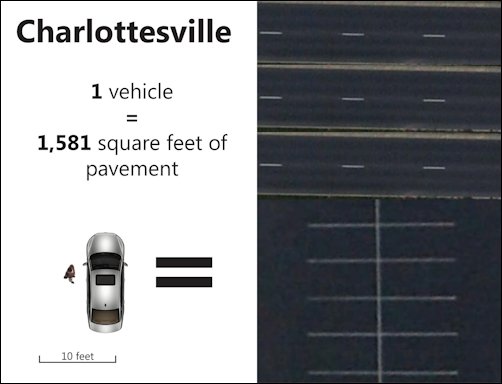
    How much space does a car take up exactly?ย  The answer, of course, is that it depends – on the design of the place, the type of driving going on, the density, the tendency of the population to build new lanes and parking lots everywhere, etc.ย  The answer is important because people so frequently think of sprawl in terms of houses and house size, which is fairly unimportant until you get into really dense configurations.ย  It’s the automobiles that are taking up the space.

    Cars are larger than houses, at least in terms of their urban footprint.

    A metric every county should know about itself is its “Pavement Per Vehicle” and/or “Pavement Per Capita” (either works since there is about one car per adult in Virginia).ย  Most counties have the data to calculate this pretty easily. I’d love to do a state index but, unfortunately, most counties do not provide that data free of charge.

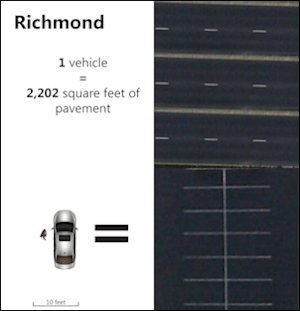
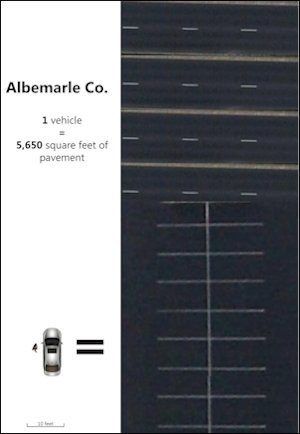
    Three do, however: Charlottesville City, Albemarle County, and Richmond City.ย  Charlottesville and Richmond are two of the most compact cities in the state and both have lots of college students who tend to own cars but not drive them.ย  Their numbers should be similar and at the low end of the spectrum. Albemarle is a largely suburban and exurban county with a population density close to that of the state as a whole. It is fairly affluent, has major state and interstate highways, and should have a number at the higher end.

    So here’s the question: How many square feet of pavement dedicated to automobiles — parking spaces, driveways, roads, etc., not including sidewalks or pedestrian trails — does the city or county have per vehicle?

    The data on paved surface comes in all three cases from the municipalities – and props to them for making their data freely available.ย  Charlottesville boasts over 1,100 acres – nearly 2 square miles – of automobile pavement. Richmond clocks in with nearly ten square miles, and Albemarle has over 14 square miles altogether.ย  The data on number of vehicles and residents comes from the 2009 NHTS and the Census, respectively.

    Remember that each house today has an average of two to three vehicles, if you’re thinking about the paved space taken up by each new home. (Note that the roads and parking spaces in the drawings are not to scale and are just meant to illustrate the approximate breakdown between road and parking lot.)

    CharlottesvilleRichmondAlb

    Why should we care at all about this number? Well paving places over carries a number of costs. (more…)


  • Tar Heel Grief Just Down the Road

    By Peter Galuszka

    Itโ€™s sad to see mccrorytwo states to which I have personal ties โ€“ North Carolina and West Virginia — in such bad ways.

    The latest raw news comes from the Tar Heel state where we are seeing the handiwork of hard-right- Gov. Pat McCrory who has been on a tear for a year now bashing civil rights here, pulling back from regulation there.

    The big news is Duke Energyโ€™s spill of coal ash and contaminated water near Eden into the Dan River, which supplies Danville and potentially Virginia Beach with drinking water. Reports are creeping out that the McCrory regime has been pressuring the N.C. Department of Environment and Natural Resources (DENR) to pull back from regulation.

    According to Rachel Maddow, DENR officials had stepped in with environmentalists as plaintiffs on two occasions in lawsuits to get Duke Energy to clean up coal ash. But when a third suit was filed, McCrory, a former Charlotte Mayor and career Duke Energy employee, influenced a third lawsuit settlement against Duke to be delayed.

    Also, not long before the Eden spill, the City of Burlington released sewage into the Haw River which flows into Lake Jordan serving drinking water to Cary, Apex and Pittsboro. DENR allegedly did not release news of the spill to the public.

    Late last year, Amy Adams, a senior DENR official, resigned to protest the massive cuts McCrory and Republican legislators were forcing at her department, notably in its water quality section.

    McCroryโ€™s been on a Ken Cuccinelli-style rip in other ways such as cutting back on unemployment benefits in a top manufacturing state badly hit by the recession and globalization. Heโ€™s shut down abortion clinics by suddenly raising the sanitation rules to hospital levels, much like former Gov. Robert F. McDonnell did in Virginia.

    A reaction to McCrory is building, however. Recently, I chatted with Jason Thigpen who served in the Army and was wounded in Iraq in 2009. When Thigpen returned to his home in southeastern North Carolina, he was upset that the state was sticking it to vets by making them pay out-of-state college tuition in cases where some had been state residents before deploying. So, he started an activist group to protect them.

    Next, Thigpen decided to run for Congress. His views fit more neatly with the Republican Party but he simply could not take what McCrory was doing in Raleigh so he became a Democrat and is a contender in a primary this spring.

    Why the switch? โ€œI just couldnโ€™t see what the GOP was doing with my state in Raleigh,” He told me. “Also, I didnโ€™t like what they were doing with women. I had served with women in war and they come back to North Carolina and they are treated like second class citizens,โ€ he said.

    West Virginia, meanwhile, is still struggling with its drinking water issues from a spill near Charleston. Although drinking water for 300,000 is said to be potable, children are reporting rashes.

    Somehow, this conjures up another story involving a Republican governor โ€“ Arch Moore.

    Back in 1972, Moore was governor when Pittston, a Virginia-based energy firm, had badly sited and built some damns to hold coal waste. After torrential rains, the dams burst and a sea of filthy water raced down the hollows, inundating small villages and killing 125 people. The state wanted a $100 million settlement from Pittston for the Buffalo Creek disaster, but Moore interceded and they settled for a measly $1 million.

    Moore was later convicted of five felonies after he was caught extorting $573,000 from a coal company that wanted to reduce its payments to a state fund that compensated miners who got black lung disease.

    Does anyone see a pattern yet?

    Meanwhile, we in Virginia should breathe a sigh of relief considering just close it was dodging the bullet last election.


  • Time to Overhaul Traffic Engineering Guidelines

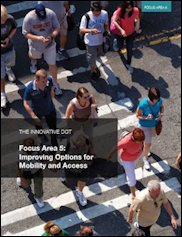
    focus5by James A. Bacon

    Employees of the Virginia Department of Transportation, like most transportation departments, see themselves as being in the profession of building roads for cars. The challenge is to move the highest volume of cars as rapidly as possible through a given number of lanes. Designing roads for the convenience of pedestrians, bikers and transit riders is typically an after-thought. Let someone else worry about sidewalks and bus stops.

    VDOT could accomplish great good if it tweaked its mission. Instead of focusing primarily designing streets and roads for cars, it should design roads and streets for everyone. In a word, it should design Complete Streets.

    That slight change of mission could accomplish wonders to improve mobility and access in Virginia. That’s not to say it will be easy. A streets-for-everyone approach would require adopting different design guidelines detailing lane widths, curb radii, intersection design, pedestrian crossings, on-street parking and a whole lot more. Perhaps even harder, it would require a change in culture and outlook: acknowledging that in some locations, it may be necessary to sacrifice automobile volume and speed to accommodate other modes, knowing that the payoff is fewer cars on the road.

    Smart Growth America’s “The Innovative DOT” manual makes the case that fiscally strapped state transportation departments can stretch their dollars by approaching old problems in new ways. The chapter, “Improving Options for Mobility and Access,” discusses how to promote Complete Streets, mass transit and bicycle-pedestrian travel as an alternative to the automobile.

    The first step, I would argue, is to understand the distinction between “roads” and “streets,” as delineated by Strong Town’s Charles Marohn. Roads provide mobility, primarily for vehicles, over long distances — between cities and towns, across metropolitan areas. These should be designed for maximum speed and traffic flow. The problem, the manual explains, is that traffic engineers have tended to apply the same kind of thinking to streets, where the emphasis is on access. Streets are where people get our of their cars to work, shop, dine out, conduct business… and, if they live nearby, even to walk home. Blurring the distinction creates street-road hybrids, or stroads, that fail to fulfill either function well.

    When traffic engineers apply “road” standards to “streets,” they tend to do some unfortunate things. They create wider lanes so cars can drive faster. But wider lanes eliminates space that could be dedicated to bicycles, bus stops and on-street parking; they also create greater distances for pedestrians to cross when they walk across the street. Engineers tend to blunt their street corners with larger curb radii so cars can take corners at higher speeds. That makes intersections even wider for pedestrians. And faster car speeds scares non-cars off the streets. DOTs should adopt “context sensitive solutions” that apply guidelines that are appropriate to the urban context.

    Designing Complete Streets is only part of what’s needed. In preserving the distinction between roads and streets, DOTs also should be more aggressive about access management — curtailing access to state highways, for instance, by subdivisions, shopping centers and other property owners along the road. Highways should be highways, not main streets, as they have become in every metropolitan area across Virginia. Appreciating the different functions of roads and streets and applying appropriate design standards to each could go a long way to creating more livable communities and solving our transportation problems.


  • Map of the Day: Dollar Density

    va_income

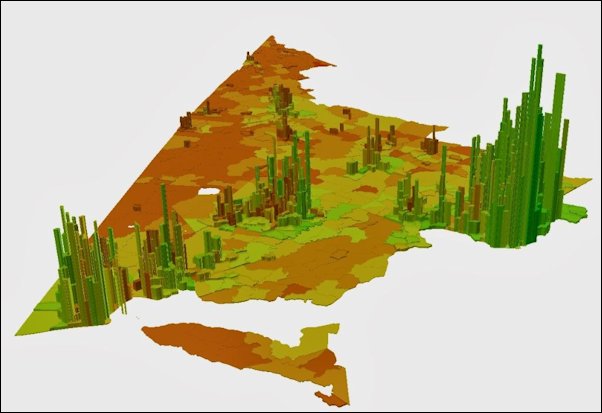
    Luke Juday has struck again, publishing a fascinating map on his blog, “Mapping the Commonwealth.” This one depicts the amount of household income in each census district. The greater the population and the higher the income, the higher the spike. Green indicates median incomes that are above average, red below average. (Check his blog for other perspectives on the map.)

    The map vividly portrays the overwhelming economic dominance of the Chesapeake Crescent in Virginia’s economy — and Northern Virginia’s dominance within the crescent.

    — JAB


  • Keep ’em Poor; It’s for the Best

    minimum-wages-around-the-worldBy Peter Galuszka

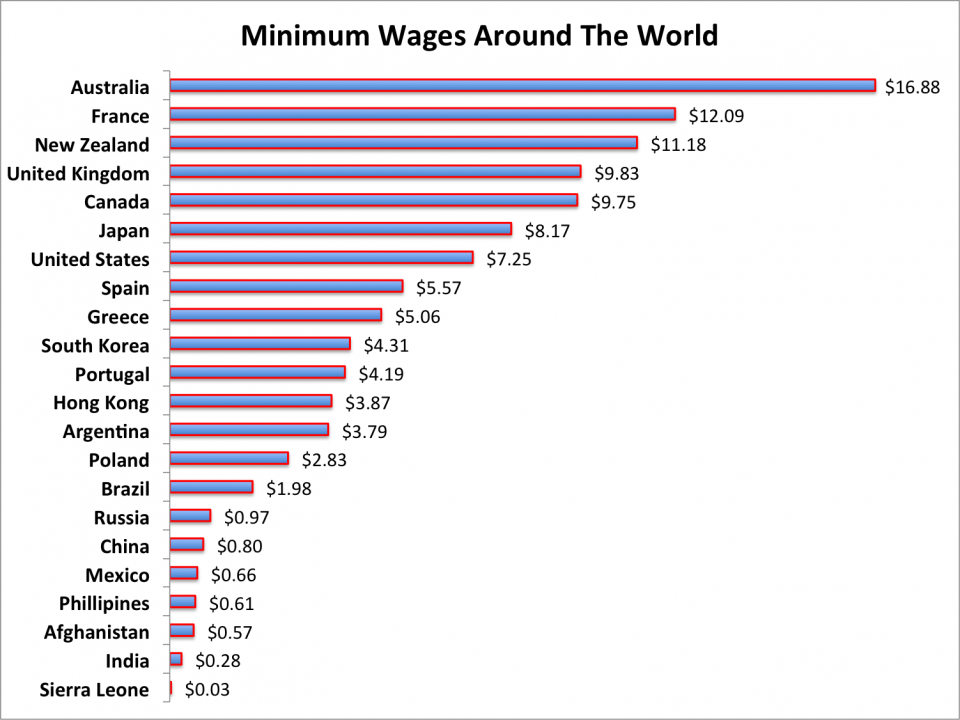
    The think tanks are spinning their lines now that Congress is considering raising the federal minimum wage.ย  A Democratic proposal would hike the level from $7.25 an hour to $10.10 by 2016, putting more money in the pockets of 27.8 million people.

    As The New York Times points out this morning, think tanks and other professional navel gazers are coming out with the pros and cons of doing what seems to be a no brainer. One Employment Policies Institute in Washingtonย  claims that hiking the wage would increase poverty and unemployment.

    Not reported, the Times notes, is that the think tank is run by a P.R. group paid in part by the restaurant industry which has a vested interest in keeping wages low.

    So, I guess it is no surprise that on Sunday’s “Commentary” front page in the Richmond Times-Dispatchย  is a piece making pretty much the same argument. It was written by A. Fletcher Mangum, managing partner of Mangum Economics in Richmond, who also advises the governor and General Assembly.

    Mangum argues that raising the wage is a bad idea because, “If politicians want to help the least fortunate among us, knocking an unlucky number of them into employment is simply not the best way to do it.” Virginia is one of 19 states that follows the federal minimum wage as its own. Twenty states have higher minimum wages and four have lower rates and (of course) are all in the South.

    Mangum’s logic is keep ’em poor because they are more hireable that way. Mangum offers no other economic argument, but that should be no surprise since he’s writing for the Richmond Times-Dispatch whose editorial policies tend to represent the Capital’s monied classes and business interests. It was this way when the Bryan family owned the TD and hasn’t really changed with Warren Buffett.

    Now I have been an editor and actually used to handle the first reading of some economic opinion pieces like this. If I had been at the keyboard, I would have demanded a higher altitude argument than improving wages will hurt the poor because if you increase the price of something people automatically buy less of it.ย  One could make a similar argument as justification for usury, penury and slavery that way, but I don’t edit the TD. I do know that Richmond and Virginia in general are rather short on economic forecasters.

    The New York Times, which is somewhat more sophisticated than Richmond’s daily newspaper, on the same day refuted conservative arguments that hiking the minimum wage only hurts the lowest working classes. “The weight of evidence shows that increases in the minimum wage have lifted pay without hurting employment. . . ,” the Times says.

    But that doesn’t stop conservatives from claiming, as Mangum does, that raising the minimum wage prompts less employment or that it will push up prices for goods. “Those arguments are simplistic,” The Times says.

    I tend to agree. The bigger issue facing this country is dealing with the disparity in income and larger gulf between classes. CEO pay has skyrocketed to obscene levels over the past decades while CEO performance has hardly matched it.

    Yet there are plenty of people out there, such as Mr. Mangum, who seem to want to keep people making less than $15,000 a year by arguing disingenuously that it’s really the best they can hope for.


  • Dominion to Upgrade Security of Electric Grid

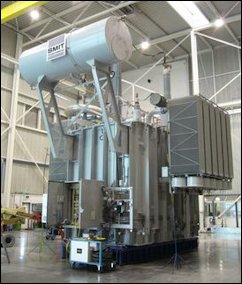
    Since 1999, Dominion has purchased more than 60 power transformers like this 500  kv unit from Smit Transformers.
    Since 1999, Dominion has purchased more than 60 power transformers like this 500 kv unit from Smit Transformers.

    by James A. Bacon

    Without electricity, contemporary American civilization collapses. We depend upon electricity to operate the pumps that supply our water, to run the refrigerators that preserve our food and to power the economy by which we earn a living. That’s why, I believe, Dominion Virginia Power will have no trouble winning regulatory approval to spend as much as a half billion dollars strengthening its transmission grid in Virginia over the next five to ten years.

    The company maintains more than 400 electrical substations on 6,400 miles of high-voltage power transmission lines. The utility intends to bolster the security around vulnerable substations, create a new, hardened operations center and bolster its spare equipment inventory, reports Peter Bacque with the Times-Dispatch.

    The electric power industry has long worried about the vulnerability of the national power grid to disruption, whether by a thermonuclear pulse, cyber-sabotage or terrorists. The terrorist scenario suddenly looms large since revelations last week of an attack that knocked out a Pacific Gas & Electric transmission substation near San Jose, Calif. last year. The power company was able to prevent devastating disruptions by rerouting electric power around the station, but security experts warn that coordinated attacks on multiple targets could cause cascading blackouts that could plunge much of the country into darkness.

    We need to build resilience into our electric grid. In the short term, that means hardening the system against attacks, building inventories of critical parts that take weeks or more to replace (like the transformer pictured above) and taking the other measures proposed by Dominion. As the California attack showed, the concerns are not theoretical. The threat is real. We have no time to waste. Failure to act would be the height of irresponsibility.

    In the longer run, we must recognize that this hardening of the existing infrastructure is only a partial solution. We need ask whether the existing structure best serves the public’s needs. Should we consider creating a “smart grid” that deploys digital technologies to sense faults in the system and allow for self-healing without manual intervention? (Does Dominion have such capabilities already — I don’t know.) Should we redesign the grid for bi-directional energy flow, which creates far more flexibility than the one-way flows that prevail today? Should we create mechanisms by which customers large and small can, under voluntary agreement, shed electric loads to reduce the strain on a damaged system?

    More fundamentally, we need to ask: Which provides more resilience — a centralized system organized around large power generating facilities in remote areas linked by large transmission facilities…. or a decentralized system that encompasses numerous independent producers drawing upon solar, wind, co-generation and other energy sources?

    I don’t pretend to know the answers. But we need to ask the questions. We live in a insanely complex, interconnected world in which chaos theory applies and black swan events appear seemingly from nowhere — a butterfly flaps its wings in Borneo and the power grid collapses in Virginia. Maintaining the integrity of the electric grid is a matter of life and death. It is, quite literally, the most significant public safety issue we face.

    While I respect Dominion’s engineering prowess and appreciate its commitment to the public welfare, we need other voices in this discussion. Dominion is going to advocate a system that safeguards the public welfare on terms that are most advantageous to Dominion. That’s not good enough. First we decide what’s best for Virginia. Only then do we decide what’s fair and reasonable for Dominion and Virginia’s other regulated utilities.


  • The House Proposes Overhaul in Allocation of Transportation Dollars

    congestionby James A. Bacon

    In September House Speaker William J. Howell, R-Stafford, gave a major policy speech to the Fairfax County Chamber of Commerce declaring that money alone cannot solve Virginia’s transportation problems. He called for a “new way” to think about those problems that relies heavily upon new technology and prioritization of projects by Return on Investment.

    Part of the promised legislative package came to light in a bill filed by Del. Christopher P. Stolle, R-Virginia Beach. in which the Commonwealth Transportation Board, acting in cooperation with regional organizations, shall develop a process for prioritizing funds allocated under the Six-Year Improvement Program.

    There are two critical pieces to the reform. First, funding categories shall include highway, transit, rail, roadway, technology operational improvements and transportation demand management (TDM) strategies. While technology projects have been getting more funding in recent years, there still is a bias in the Virginia Department of Transportation to increasing capacity by building new roads and adding new lanes. The bill potentially puts technology and TDM projects on an equal footing.

    The other breakthrough is the methodology used to rank priorities. States the bill: “The prioritization process shall be based on an objective, quantifiable analysis that considers at a minimum the following factors relative to the cost of the project or strategy: congestion mitigation, economic development, accessibility, safety, and environmental quality.”

    The CTB may assign different weights to the factors based upon geographic location and other factors. Small pots of money — air quality funds, state matching funds and the like — are exempt.

    The bill was expected to win approval by the House of Delegates some time today.

    Bacon’s bottom line: I’m not so naive to think that these reforms will totally take the politics out of transportation funding decisions. I’m sure the special interests will have a lot to say about the factors and weights that go into the ranking methodology, and I’m certain they will make the case that certain projects are so unique that they should be exempt from this review altogether. Still, objectively quantifying the touted benefits of projects and calculating the Return on Investment for each should be a real eye-opener. When it can be demonstrated that a politician’s pet project offers fewer benefits per dollar expended than competing projects, it will be a lot more difficult to push it through.

    This reform likely would divert money from splashy, high-visibility mega projects to smaller projects with more localized impact but a higher ROI. The new methodology also is likely to steer more money into technology and TDM programs, which have gotten short shrift in the past.

    Presumably, the CTB would build upon the ranking methodologies already under development in the Secretariat of Transportation, so we won’t have to wait for years until the new prioritization process is approved. This bill is unlikely to generate one one-hundredth of the visibility that Governor Bob McDonnell’s transportation tax overhaul did but it is every bit as important. Virginians can be assured that their money will be better spent.