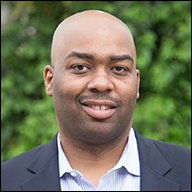
2016 graduates of Arlington’s Washington-Lee High School. Photo credit: Washington Post
In 2016 the Washington Post wrote an article touting improving graduation rates in Washington, D.C.’s public high schools, right across the Potomac River from Virginia:
The number of students finishing high school on time in D.C. Public Schools reached an all-time high with the Class of 2016, inching the school system closer to meeting an ambitious graduation goal it set nearly five years ago. The District’s most recent graduating class saw 69 percent of seniors earn diplomas within four years, a five-point increase from the previous class.
More than 1 in 3 students who graduated from D.C. public high schools last year had help from violations of system policy, a study commissioned by the school system found. The study, released Monday, found that 937 out of 2,758 graduates had excessive absences from school or from credit-recovery course, or they took those courses, which are supposed to be for students who have failed a class, “concurrently or in place of regular instruction. … At Ballou [High School], there was a culture of doing ‘whatever it takes’ to pass students so they could receive their diploma,” the report said.
More than 90 percent of Virginia’s high school Class of 2016 graduated on time, the highest rate recorded since the state changed how it tracks high school graduations nearly a decade ago. The on-time graduation rate rose from 90.5 percent last year to 91.3 percent this year, continuing an upward trend since the state started keeping more accurate data in 2008, keeping closer tabs on transfer students and dropouts who were sometimes miscategorized in state data.
Does anyone think that Virginia might need to conduct its own study?
General Assembly Republicans have capitulated on the issue of Medicaid expansion. All that remains to be decided is the terms of their surrender.
Speaker of the House M. Kirkland Cox, R-Colonial Heights, has signaled his willingness to “dialogue” with Governor Ralph Northam about Medicaid expansion if the Governor is willing to accept the condition that would require able-bodied recipients to work or be actively seeking employment.
Wrote Cox to the Governor in a letter that House leadership distributed publicly:
The House is willing to begin a dialogue on health care that includes significant reforms and strong taxpayer safeguards, but I want to be clear that the 51-member House Republican Caucus has taken a binding caucus position against ‘straightforward’ Medicaid expansion.
If your position is to pass straightforward Medicaid expansion without work requirements or other reforms, then you will be responsible for the failure to provide health care coverage to more Virginians.
Republican bills, reports the Richmond Times-Dispatch, also would require periodic checks of the recipients’ household income, and would include exemptions for adults attending college, acting as sole caregivers for children under six, receiving long-term disability benefits or otherwise proved to be “physically or mentally unable to work.”
A spokesman said Northam was “encouraged” that Republicans were willing to begin discussion about Medicaid expansion but not happy with Cox’s proposed restrictions.
Bacon’s bottom line: Republicans have held the line against Medicaid expansion on fiscal grounds for four years. It’s difficult to imagine any explanation for the about-face other than fear and trembling over the 2017 election results, which came within a frog’s eyelash of evicting the Republicans from control of the House of Delegates. Cox has caved on the expansion and now he’s bargaining over the fine print. It will be exceedingly difficult politically for him to backtrack.
But Medicaid expansion still will be bedeviled with the same problems that afflicted it when former Governor Terry McAuliffe was pushing for it.
Even with the federal government funding 90% of the budget for expansion, Medicaid expansion still will cost Virginia nearly $190 million a year more by 2022, according to the Heritage Foundation, putting the squeeze on other budget priorities. All for what? Yes, expansion will provide “insurance” to more poor and near-poor people. But what quality of coverage will they receive? Will Medicaid expansion help them find a doctor in a country plagued with primary care physician shortages, or will recipients continue to clog emergency rooms? And who benefits financially? The patients themselves — or the hospitals that will see a great reduction in the treatment costs they have to write off as charity or uncompensated care? Will legislation expanding Medicaid ask anything of the hospitals, many of which, like Scrooge McDuck, are rolling around in piles of money? Or will they just fatten their profit margins? Finally, is there any evidence that Medicaid recipients’ health will improve? Or will physicians dish out more painkiller prescriptions, as is said to be the case in other states, and risk aggravating the opioid epidemic?
If past is prelude, it really doesn’t matter if Medicaid expansion actually helps anyone. People are suffering, and people want to “do something” — regardless of what it costs or whether it works.
Jim Scanlon at his Newport News store. Photo credit: Richmond Times-Dispatch
Poor Jim Scanlon. He bought into the conventional wisdom that food deserts are a supply-side problem — an unwillingness of grocery store operators to locate in inner cities. Hoping to remedy that deficiency, the idealistic former Ukrop’s executive opened Jim’s Local Market in a low-income neighborhood in Newport News in May 2016.
Now, a year and a half later, he’s closing the store, reports the Richmond Times-Dispatch. Explains Scanlon: “It’s just that the sales are not there, and the profitability is not there. It’s not working out.”
Bacon’s bottom line: Food deserts are a demand-side problem, not a supply-side problem. Poor people, like many Americans, just don’t like broccoli, kale, quinoa, cauliflower, or other trendy superfoods that go in and out of fashion among the cultural elites. Pleasures in life in the inner city are far and few between, and the poor, also like many Americans, gravitate to food that provides immediate gratification… Which means they gravitate to processed food loaded with salt, sugar and fat that tastes good. Go into any convenience store or corner grocery in the east end of Richmond and you’ll see aisles stocked with snack foods and soft drinks — the kind of food people are willing to spend their money on.
If you want poor people to eat healthier food, putting healthy food in front of them won’t work. You can literally give away the carrots and squash, and many people won’t eat them. Not only have they not acquired the taste, they have lost the cultural knowledge of how to cook them.
Tricycle Gardens in Richmond was launched to create urban gardens and create a supply of healthy vegetables that poor, inner-city residents should include in their diets. The idea behind the nonprofit was the old give-a-man-a-fish-and-you-feed-him-for-a-day, teach-a-man-to-fish-and-you-feed-him-for-a-lifetime philosophy. The group built small, “key-hole” gardens that anyone could install in their backyard and reap a bounty of vegetables. I don’t know if Tricycle Gardens had many takers, but let’s just say, I have seen little evidence of a horticultural revolution sweeping through Richmond’s inner city. The last time I communicated with the group — it’s been a couple of years — its leaders were recognizing that they had to work on the demand side. The outfit was talking about giving cooking classes to teach how to make yummy dishes out of brussel sprouts, and it was partnering with local schools to get kids involved with raising garden vegetables, learning about nutrition, and excited about eating healthy food. If we want poor Virginians to eat more healthy food, that’s the kind of slow, plodding change we need to undertake.
Another well-meaning group is investing a grocery store in Richmond’s East End. The building is now under construction. With all the gentrification taking place in the East End, that venture may find enough customers among young urban professionals to sustain itself. Otherwise, it will likely meet the same fate as Scanlon’s Newport News enterprise. Simply put: The enterprise is addressing the wrong problem.
With the Election of Rutherford B. Hayes by a one vote margin, the Compromise of 1877 ended the era of Reconstruction. As Southern states were re-admitted into the Union, federal troops stood down or returned to the North.
From about 1885 to 1924, before and after the 50th Anniversary of the War between the States, Americans felt a need for forgiveness, reunification and remembrance of the greatest war Americans ever fought and hopefully ever will. There was a great desire for conciliation and honor for aging veterans and those who had perished on the battlefields. The America Beautiful movement was in full swing with the goal of employing parks, public spaces, sculpture, urban landscaping and rebuilding to make life more livable, civil and cultured. The era was our American Renaissance – economically, politically, artistically and scientifically.
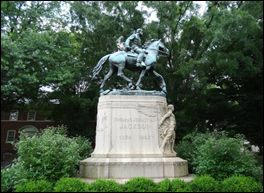
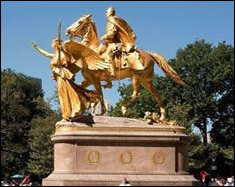
Contemplate for a moment two great works of American sculpture, one honoring Gen. homas “Stonewall” Jackson, CSA,(above) and the other Gen. William Tecumseh Sherman, USA (below). The American sculptors of these two great works of equestrian martial art, Charles Keck and Augustus Saint-Gaudens, were both members of the National Sculptor Society. Saint-Guadens along with the architect Stanford White formed the society and also the American Academy in Rome. Both statues employ angels. Saint-Gaudens also depicted, an angel, as a last addition, in his most famous work “Shaw and the 54th Colored Troops”. In the monument to Sherman his female angel is on the statue itself as a full figure. She holds a branch of laurel, a sign of victory, in front of her like a guiding force pulling Sherman forward In “Shaw,” his angel is far more quizzical. (Shaw and his men were largely slaughtered in their attempt to take Fort Wagner outside of Charleston). The Sherman angel is hinged off a sloping ground plain which gives her a feeling of suspension and her wings and chitin are blown back by the wind going past her forward motion. Likewise, Sherman’s cape is billowing back, implying his forward motion, while his posture is erect and easy, and his horse is in a canter, all signs of surety and composure in victory. Keck also has an angel in his statue of Jackson, but it is carved into the base, its wings thrown back in defensive protection of Southern ground. The male angel bears his breast and defiantly exposes himself to danger, thrusting out his manly bosom in bravery to the wind. He carries a shield with the cross of St. Andrew of the Confederacy to likewise defend the Southern land from aggression. Above, the sculpture of Jackson is mounted on a small war horse, which Jackson holds back at a trot. (Jackson did not like to ride and, in fact, preferred smaller horses. Sherman is mounted on a tall and impressive dress horse.) Jackson’s figure shows agility and dynamic action and his gaze is one of decisiveness and determination. He holds the reins as his horse tilts his head implying that Jackson is about to make a daring move. Saint-Gauden’s Sherman is gilded and elevates Sherman to the plane of the Gods with his angel as his guide. By contrast, the angel of Keck’s Jackson is fixed firmly on the sacred ground Jackson defends, as a common man with divine aid. Both of these great American monuments, to mortal men and great martial events, portray a story of defense and valor, victory and defeat, but above all they are symbolic artistic representations of our nation’s rich historical past, bequeathed to us by our forefathers. They are important pieces of American art!
The venerable Grand Old Army and the Confederate Veterans of America held conventions where tales were swapped of valor, loss, glory and honor. Wizened, white-bearded veterans held reunions at battlefields, where they staged mock engagements, relived the past, broke bread with comrades and former enemies, and extended hands of forgiveness, reconciliation and respect. During this time both North and South erected their monuments and memorials to war heroes, leaders, comrades, and the many who had fallen in the field of battle.
Sculptures acted as eternal symbols to the Northern and Southern causes. The people who erected statues intended for soldiers and generals to live on in the minds of posterity, for the nation’s struggle not to be forgotten, and for their lives not to be counted as squandered in vain. The hope was that the honored men and events would be recalled far into the future, argued about, reflected upon, as actors in a grand play of immortal history. The purpose of the statues was to give meaning to heroism, bravery, honor, commitment, patriotism and duty.
The Civil War was a grand epic tragedy that should remind us of the faults and failures, and also the nobility, found in mankind. Northern and Southern monuments serve as guiding lights to direct future generations of Americans. Furthermore, the monuments are among the greatest sculptural assets of our nation, created at the zenith of our cultural history.
No one monument can define this era in time, any more than a single actor or a single scene can define a play — no more than the First Battle of Manassas could define four years of endless carnage, blood, sorrow, glory and defeat. America’s historic monuments are our heritage, the complete play, warts and all… the story of America’s great defining epoch. But, it is not just our story. It is a story for the world!
Political correctness in America has metastasized into something resembling the Maoist Cultural Revolution. As the world leader, America’s actions, attitudes and fashions are mimicked everywhere on the globe, whether they are innovative, wholesome, or obscene.
We all perceive the recent iconoclasm of extremists and terrorists in the Middle East as repugnant and a crime against humanity, art, and world history. Not long ago, the West spurned the Cultural Revolution as shameful. Somehow this madness has infected our nation nearly fifty years later, like an Asian flu. Once it hits American shores, this pathogen could become a global contagion that consumes the world’s historic culture and its symbols of heritage and civility.
Rather than accept this disease, Americans should act more civilly and maturely. America’s historic monuments are the visual representations of our American History. We have a responsibility to promote the values of our inalienable rights of speech, writing, assembly and expression. When America constrains these rights, by censorship in whatever form, she does so at her own peril.
Cliff Page, a sculptor, lives and maintains his studio in Portsmouth.
Proposals to overhaul Virginia’s system for regulating electric rates would provide no opportunity for the State Corporation Commission (SCC) to order refunds to rate payers until 2024 for Appalachian Power Company and 2025 for Dominion Energy Virginia, concludes a State Corporation Commission analysis of Senate Bills 966 and 967.
The SCC conducted the analysis at the request of Sen. Chap Petersen, D-Fairfax, who has advocated a return to the regulatory system that prevailed before the 2015 enactment of a rate freeze that has resulted in hundreds of millions of dollars of excess profits for the two utilities. Dominion has worked with legislators to advance a proposal that would return $1 billion to ratepayers over 10 years and replace biennial rate reviews with triennial rate reviews.
Key impacts on rate payers can be summarized as follows, states the analysis submitted by John F. Dudley, counsel to the Commission (quoting verbatim):
There will be no opportunity to consider base-rate reductions or refunds to customers for at least six years, and then only if the utility over-earns for two consecutive three-year periods, effectively extending the current base-rate freeze further into the future.
There may be only a partial return of reduction in federal income taxes currently being collected in base rates.
The provision in current law that allows utilities to keep more than 30% of their excess earnings is continued.
The legislation allows the utilities to keep future excess earnings (i.e. customer overpayments) and, rather than return them to customers, use them for capital projects chosen by the utility. In addition the utilities can charge customers for these same projects in base rates.
The legislation deems certain capital projects to be “in the public interest,” thus impacting the SCC’s authority to evaluate whether such projects are cost-effective or whether there are alternatives available at lower costs to customers. This provision could potentially result in billions of dollars of additional costs that will be charged to customers in higher rates.
An amount that appears to represent the customers’ portion of prior period excess earnings is returned to customers, but the amount has not been examined in a formal proceeding to determine its accuracy.
Dominion Energy Virginia has issued the following response:
This report analyzes a work in progress [that is] subject to change. We continue to believe a reinvestment model that transforms our energy grid and significantly increases the amount of renewable energy we produce is sound policy for Virginia. We have always said all tax savings should return to customers effective Jan. 1, 2018 and be appropriately adjusted by the SCC when the final IRS rules are available. To the extent that is not clear, we would support an amendment making it so.
On Jan. 19, Patrick Hogan, the chief operating officer of the University of Virginia, sent out an email community advisory to students, faculty, and staff asking people witnessing “suspicious activity” such as posting “offensive flyers and memes” to please call 911.
“The safety and wellbeing of every member of the University community remains our top priority, and we ask for your assistance in remaining vigilant of your surroundings,” said Hogan.
That communiqué struck Hans von Spasovsky, a scholar with the Heritage Foundation, as an egregious affront to free speech. Here’s how he responded in an article published by the Foundation’s Daily Signal:
Apparently, in Hogan’s mind, saying something “offensive” is the same as committing a heinous criminal act. How do we know that? Because his email tells students to call 911 if they see someone “posting offensive flyers or other material.”
No, really. Posting such material violates the university’s “posting and chalking” policy and is included in Hogan’s definition of “suspicious activity.”
Hogan was particularly concerned over any “offensive” material that might be distributed at “buildings and centers for under-represented groups, particularly Women’s Studies.”
In other words, if you decide to exercise your First Amendment right to speak at UVA by, perhaps, calling the “Women’s Study” program a faux social science curriculum, or by pointing out that its graduates may have a very tough time finding a job in which they can actually support themselves, then law enforcement officers will be called to come after you—a total abuse of the 911 emergency response system.
This is apparently UVA’s version of the “Thought Police” from George Orwell’s “1984.”
Spasovsky makes a searing indictment. Is it fair? Here is the full text of what Hogan wrote:
The University of Virginia is aware of reports of solicitations by national organizations to encourage distribution of offensive flyers and memes at colleges and universities across the country during the upcoming weekend. The reports indicate that the organizations are specifically interested in buildings and centers for under-represented groups, particularly Women’s Studies. We are not aware of any specific threats to the University of Virginia and its facilities. We still believe it is prudent to make members of the University community aware of this possible activity.
If you witness individuals engaged in suspicious activity, including posting offensive flyers or other material in violation of the University’s Policy on Exterior Posting and Chalking, please call 911. The University Police Department and the Ambassadors are aware of this information and will be closely monitoring activities on and near Grounds. We will be maintaining an enhanced security environment across Grounds this weekend.
The safety and wellbeing of every member of the University community remains our top priority, and we ask for your assistance in remaining vigilant of your surroundings.
Oddly, it’s not clear from Hogan’s advisory who these outside groups are or how their flyers might prove offensive — although his epistle implies that “women’s studies” might be targeted. He’s not aware of any specific “threats” to the university, but the rumored activities are alarming enough that university police have been notified and the administration will maintain an “enhanced security environment.”
The advisory is so vague that it’s hard to make heads or tails of it. While Spasovsky might be jumping to conclusions, it is easy to see how he made the inferences that he did. Reading between the lines of Hogan’s email, it sounds like feminist groups on campus were having fainting spells at the prospect of someone posting material — offensive “memes” — that assaulted their snowflake sensitivities. We do not know that for a fact. However, given the tenor of campus politics these days, it is a not unreasonable supposition.
Adding plausibility to Spasovsky’s spin on the memo, Hogan’s words must be interpreted through a filter of modern-day academia-speak. The document referred to women’s studies as an “under-represented group.” Only in an academic culture steeped in the culture of victimization could an institution where women comprise 55% of the student body possibly refer to them as an “under-represented” group.
When asking for UVa spokesman Anthony de Bruyn for a copy of Hogan’s advisory, I asked if the university had a response to Spasovsky’s column. De Bruyn did not respond. It’s all very mysterious.
For the record, conservatives on campus can play the victimization game, too. In December I wrote how the UVa Student Council had denied the Young Americans for Freedom (YAF), a conservative student group, recognition as an official student organization. YAF called foul. UVa responded that the non-discrimination policy had been applied in error and that the student council would reconsider. De Bruyn informed me today that the YAF had been approved as a CIO (contracted independent organization) last week.
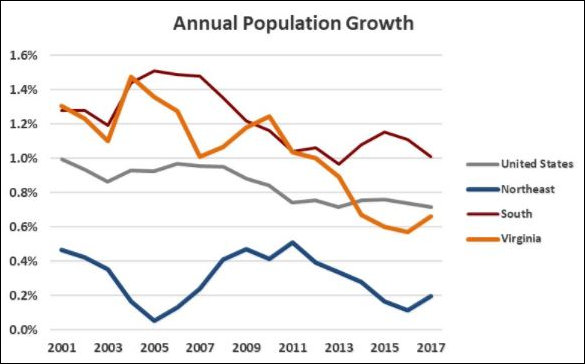
After decades as one of the nation’s fast-growth states, Virginia’s population now is growing line with national averages, according to data found in Hamilton Lombard’s latest post on the University of Virginia Demographics Research Group’s StatChat blog.
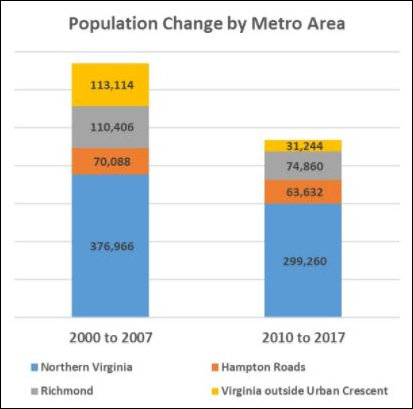
Lombard attributes the lagging population growth to out-migration resulting from the impact of federal budget austerity on Northern Virginia’s defense-oriented technology sector. Despite this slowdown, NoVa is adding to the state’s population faster than any other region in Virginia because its population skews younger — more women are in the child-bearing age. Indeed, since 2010, NoVa has added more people than the rest of the state combined.
The Richmond region has added the second largest number of people since 2000. And despite its lagging economy, Hampton Roads has contributed substantially to population growth. However, due to emigration of young people, an aging population, and fewer births, population growth in Virginia outside the urban crescent has collapsed since 2010.
Writes Lombard: “Without a surge in population growth, by 2020 Virginia could have close to 200,000 fewer residents than would have been expected based on past population growth trends. Meanwhile, Virginia’s aging population will likely cause the number of counties with more deaths than births to continue to increase, slowing population growth throughout the Commonwealth, even in Northern Virginia.”
Fairfax County has more than 18 million square feet of vacant office space, with little hope of filling it in the foreseeable future. Having already enacted zoning changes to make it easier to convert empty buildings in industrial and mixed-use areas to other uses, the county now is considering a proposal to do the same for buildings in suburban neighborhoods. Summarizes a county description of the proposed change:
This could give these offices new life as apartments, schools, co-working spaces, maker spaces or food incubators. As an example, a former, five-story brick office building across from the Seven Corners Shopping Center was converted into Bailey’s Upper Elementary, the county’s first “high rise” school. …
More recently, the board approved the conversion of a 10-story office building at 5600 Columbia Pike into flexible live-work units. The building stood empty for about four years, and it will put the 173,000- square foot building back into use in an innovative way that meets market demands.
The county’s Office Building Repositioning and Repurposing Work Group is particularly enamored with the potential for converting office space into “e-lofts” — highly flexible spaces within a building that can be used as apartments or small offices.
Bacon’s bottom line: Rigid, obsolete zoning codes across the state are hindering the ability of the real estate sector to adapt to changing market conditions. Zoning codes arising from the post-World War II era of rapid suburbanization are hopelessly antiquated and self-defeating today. Aging office and industrial parks are emptying out. Unless we want them to resemble the ghost malls of the retail sector, we must give property owners the flexibility to re-purpose their assets in line with market demand.
The Fairfax initiatives represent a positive step forward. If people want to convert an old office or industrial building into apartment housing, why not let them? E-lofts sound like an especially promising idea. A similar evolution is taking place in Scotts Addition in Richmond. That light-industrial district is rapidly transitioning to mixed offices, restaurants, and apartment buildings. People are perfectly happy to live in the neighborhood despite the continued presence of light-manufacturing activity.
The only problem with the Fairfax proposal is that it doesn’t go far enough. The county should encourage the wholesale recycling of antiquated office properties by permitting greater densities and the construction of new buildings, not just the re-purposing of individual buildings. Zoning codes slow the process of adaptation to a snail’s pace. Time to open up the process and turn loose the animal spirits!
Pioneer Community Hospital in Patrick county before it closed.
By Beth O’Connor
In the January 24th edition of Bacon’s Rebellion, author James A. Bacon poses the question; “Are Broke Rural Hospitals Worth Saving?” He acknowledges that many of Virginia’s rural hospitals are in trouble, but wonders if it makes financial sense to let them die.
The problem with his question is that he is only considering the issue in terms of healthcare dollars and outcomes. The reality is that a small rural hospital means much more to the local community and taxpayers than just a place to go when you have a heart attack.
The National Rural Health Association (NRHA) has published extensive information regarding the distress of rural hospitals and the importance of those facilities to small towns across the country. Since 2010, seventy-nine rural hospitals have closed. 673 additional facilities are vulnerable and could close, representing more than one-third of rural hospitals in the U.S. The rate of closures in rural areas is five times higher in 2016 compared to rates in 2010.
NRHA notes that losing access to healthcare is only one of the negative outcomes. When a rural hospital closes, the rural economy suffers:
In rural America, the hospital is often one of the largest employers in the community. Healthcare in rural areas can represent up to 20 percent of the community’s employment and income.
The average critical access hospital — the hospital in Patrick County alluded to in Mr. Bacon’s column was a CAH facility — creates 170 jobs and generates $7.1 million in salaries, wages, and benefits annually.
The recession in rural America continues, with 90 percent of all job growth since 2008 occurring in metropolitan areas. If a hospital closes in a rural community, health providers relocate, and the town withers.
If a rural provider is forced to close, the community erodes.
That’s right, if a hospital dies the whole town dies. Patrick’s closure is recent, but a quick look at Lee County predicts the future for Patrick. Lee Regional Medical Center closed in 2013; it supported 190 full time equivalent positions. These were not low-paying, entry-level jobs; these were doctors, nurses, anesthesiologists, therapists. The hospital had been the fourth largest employer in the county; it pumped $11.5 million in labor costs into the local economy every year.
Once those jobs left, other jobs followed. Local clinics as well as ancillary services such as food service and cleaning services struggle without a hospital serving as an anchor. After the hospital closed, the community’s only day care center closed too. Virginia’s elected officials have spent untold hours trying to lure businesses to the Commonwealth, but a town without a stable healthcare system will not land the next business enterprise.
Additionally, when a rural hospital closes the taxpayer suffers:
Rural hospitals provide cost-effective primary care. It is 2.5 percent less expensive to provide identical Medicare services in a rural setting than in an urban or suburban setting. The focus on primary care, as opposed to specialty care, saves Medicare $1.5 billion/year. Quality performance measurements in rural areas are on par with if not superior to urban facilities.
Critical Access Hospitals represent nearly 30 percent of acute care hospitals but receive less than 5 percent of total Federal Medicare payments.
A ‘bigger is better’ mindset suggests that sending patients to Martinsville or Roanoke would be more efficient and have better outcomes, but the data suggests otherwise. The healthcare analytics group iVantage has documented that hospitals in rural areas have significantly higher ratings on Hospital Consumer Assessment of Healthcare Providers than those located in urban areas. This includes:
Lower risk-adjusted rates of potential safety-related events.
Significantly lower adverse event rates than urban counterparts.
Significantly lower rates of post-op hip fracture, hemorrhage, & hematoma.
Mr. Bacon refers to Medicaid expansion as “blunderbuss legislation.” I call it a lifeline. Since 2010, seventy-nine hospitals in rural America have closed. Two-thirds of those were in states that have refused to expand Medicaid, including two in Virginia.
By not expanding Medicaid, Virginia loses $142 million in federal funding every month. Since 2014, the Commonwealth has forfeited over $10 billion in federal funds — our own tax dollars that should have been used to help uninsured adults, hospitals, and businesses.
Others may be content to allow their tax dollars to go to Washington, D.C. and stay there. I am not. Virginia taxes should be spent on Virginia people and Virginia healthcare providers.
Because the question is not, “Are Broke Rural Hospitals Worth Saving?”, the question is, “Can We Afford to Let Rural Hospitals Die?”
Beth O’Connor is executive director of the Virginia Rural Health Association.
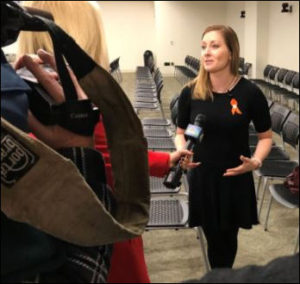
Cortney Carroll, survivor of the Las Vegas mass shooting, talks to local media at the General Assembly. Photo credit: Richmond Times-Dispatch
In a 4-to-3, party-line vote, the House Militia, Police and Public Safety subcommittee killed a bill yesterday that would ban bump stocks — a mechanism, made notorious by October 1 mass shooting at a Las Vegas country music concert, which allows semiautomatic weapons to fire more like automatic weapons.
I’m skeptical of many gun control measures and much of the rhetoric emanating from anti-gun crusaders, but after the Las Vegas massacre, which left 58 people dead and 851 injured, I figured it would be no-brainer to ban bump stocks. I’m not a gun owner — indeed, the only gun I’ve ever shot was a 22-caliber rifle when I was 12 years old — so I’ll confess to a vast depth of ignorance on the subject. But I can see no possible justification for bump stocks, which are clearly meant to circumvent the ban on automatic weapons.
Las Vegas provided a vivid example of how bump stocks can be used to magnify the horror of a mass shooting. A bump stock ban would not have stopped the shooting, but it would’ve given people “time to run and take cover,” argued 40-year-old Cortney Carroll of Henrico County, a survivor of the shooting who testified before the subcommittee, as reported by the Richmond Times-Dispatch.
There’s something to be said for making weapons less deadly, for having fewer people killed in mass shootings.
At the hearing, Del. Thomas C. Wright Jr., R-Lunenburg, said evil can move people to use anything to cause mayhem, “whether they use trucks, cars, box cutters, knives or whatever. … Regardless of what laws we pass, until the evil in men’s hearts change, it’s not going to solve the problem.”
There is some truth in what he says. But, by that logic, why not allow people to own self-propelled grenades, mortars, bazookas, and anti-tank rockets? Why deprive Americans of the entertainment value in going out to an empty field and blowing stuff up? After all, we can’t change the evil in men’s hearts. But, in fact, we don’t allow civilians to play with such toys because the potential for abuse is too horrifying.
It strikes me that the Las Vegas shooter, Stephen Paddock, has raised the bar for all potential maniacs, terrorists, and death-by-coppers. If your goal is to cause as much mayhem as possible, how stupid do you have to be to not add a bump stock to your semi-automatic?
Wright is right to say that determined people will always find a way to commit mass murder. As long as no fundamental freedom is being infringed — and the right to bear bump stocks is not a fundamental freedom — let’s not make it easy for them.
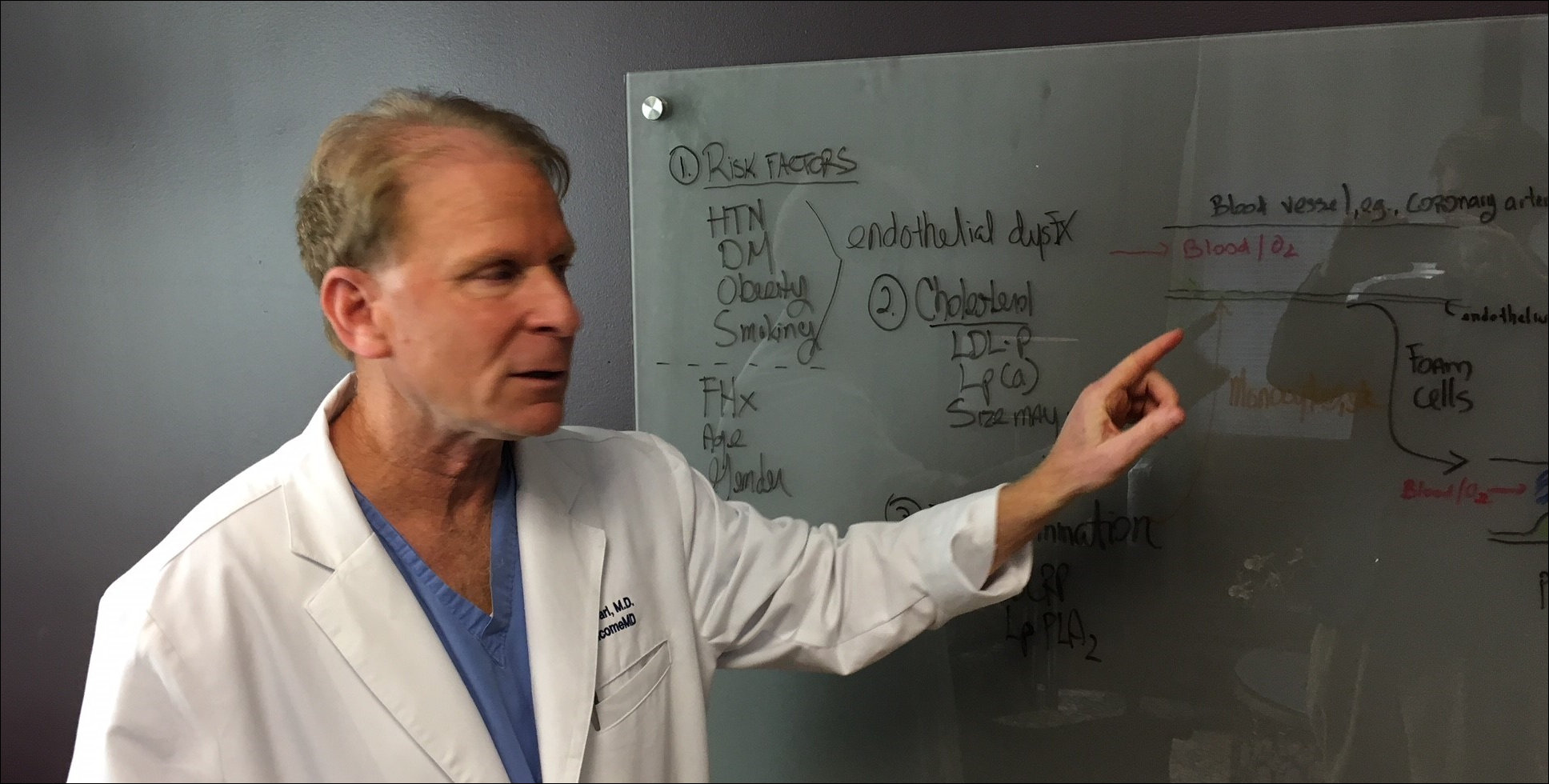
If all you want is a doctor who will prescribe you pills, Dr. Neal Carl is not the man for you. If you want to understand the metabolic pathways of your medication, he’ll take the time to explain.
Personalized medicine is the new frontier of healthcare. DNA testing has become so inexpensive that it is now practical to develop wellness regimes tailored to peoples’ individual genomes. Virginia’s biggest endeavor in this field is taking place in Northern Virginia under the auspices of Inova Health System’s Center for Personalized Health. But another approach to health care delivery is taking place here in Richmond. My friend Linda Nash has launched a next-generation concierge medicine business, WellcomeMD, whose physicians treat their patients based on an in-depth analysis of their DNA, gut biome, and a full-battery blood test.
To get a feel for how personalized medicine works, I took up Linda on an offer to have my DNA tested and then meet with WellcomeMD’s Dr. Neal Carl for a consultation. Except in rare instances, genes are not medical destiny. But they do influence our health in many ways, and knowing our genetic proclivities is helpful in crafting an approach to fitness and nutrition.
The testing process is absurdly easy. Visit the WellcomeMD office, take a cheek swab, send it off, and wait ten days for the results. Interpreting the findings, however, requires a background in genetics, proteomics, and metabolic pathways — subjects that few primary care physicians studied closely in medical school. But Carl has immersed himself in these disciplines and how they relate to wellness. After poring through the data on some 20 to 30 “actionable” genes — that is, genes that provide information that can inform us about individual fitness and nutrition — he sat down with me to go through the findings.
I never made it past Introductory Biology in college, so a lot of it was over my head. But here’s what I gleaned from the consultation: Like most people, my genes confer both strengths and weaknesses in the 21st-century struggle for health and wellness.
My genetic profile indicated that my power/endurance response is weighted in favor of endurance. I was never destined to develop a weight-lifter’s physique. I wasn’t genetically predisposed to become the fabled 90-pound weakling, but I was never going to become a Charles Atlas either. Lifting weights could increase my strength, but I’d never develop bulky muscles. Conversely, my body is genetically suited to moving oxygen to body tissues and metabolizing it efficiently. Practically speaking, I’m far better suited to fitness regimes that emphasize endurance over strength.
The genetic test also measures for the body’s ability to detoxify muscles after exertion. I fall in the middle range, suggesting that I needed a day’s break between intense workouts. I also have a proclivity for injury of tendons and ligaments, with special concern for the Achilles tendon.
All this rang true. While I was never a great athlete, I devoted 14 years of my life to serious study of Tae Kwon Do, the Korean martial art. On the side, I ran, lifted weights, and did aerobics. I was never the strongest, certainly not the fastest (Carl confirmed that I lack the fast-twitch genes), nor the most flexible, but I did have the capacity to finish grueling hour-and-a-half workouts while others were hugging the floor. If I could survive the first 45 minutes of a fight, I could definitely kick the other guy’s ass!
Without the benefit of medical coaching, I have fallen into a fitness regime consistent with what my body was telling me. These days, I sporadically lift light weights and do one or two bouts a week of intense half-hour cardio. My efforts at consistency are bedeviled on and off by minor problems with rotator cuffs, pulled muscles and once, in an ill-fated fling with barefoot running, a pulled tendon in my foot that left me limping for weeks. All of these traits were consistent with my genetic profile.
As for nutrition, my genes don’t put me at risk for obesity, but just gaining 10 to 12 pounds over my ideal weight does put me at risk for pre-diabetes. I have a metabolism that makes me gain weight more readily by consuming carbs than fat. I’m salt sensitive (which may help explain my hypertension), and I have a heightened cancer risk from eating charred meat — which is a major bummer, because half the meals I eat consist of grilled beef or chicken. This information is useful because, evidently, I have not naturally gravitated in life to a nutritional regime consistent with my genetic endowment. Things must change. There will be more broccoli and brussel sprouts in my future.
The body is an incredibly complex organism, and a handful of genes don’t tell the whole story. To get a full, rounded picture of my health, Carl also would test my gut biome. Intestines are a “second brain” loaded with neurotransmitters, he says. When your intestinal bacteria aren’t happy, you aren’t happy. If I were a patient, he also would get an in-depth blood panel looking at dozens of markers — far more than the normal primary care physicians would track. And he would integrate all that data into a holistic understanding of my health that encompasses exercise, nutrition, stress and sleep.
New medical model. Managing a patient’s wellness at this level of understanding is time-consuming, and primary care physicians, who typically have a roster of 3,000 patients, cannot do it. The business model of WellcomeMD calls for Carl to oversee only 300 patients.
Nash founded PartnerMD, a successful concierge medicine practice, before leaving the company selling out her interest several years ago. As soon as her non-compete clause expired, she was ready to roll out what she calls “concierge 2.0.” The old model allows doctors to spend more time with patients and give them more holistic care. But WellcomeMD pushes the envelope of medical practice.
“Genetics testing has to be part of concierge medicine going forward,” says Nash. “It really is a different model. For people who want to delve deeper into their genetics, their stress, their sleep, we’ll have more time and more advanced tools. Under the traditional model of medicine, there is no possible way to do this.”
Carl, who practiced general medicine at Chippenham Hospital, found the traditional medical model frustrating and unsatisfying. He saw on average about 25 to 30 patients a day, whom he had to move through in an assembly-line process. He focused on getting their “numbers” to look good — numbers for blood pressure, cholesterol, blood sugar, and the like.
“As it played out, a percentage of the patients didn’t feel that well. Many were on several. Even with good numbers, they still had bad events,” he says. By way of comparison, he notes that television broadcaster Tim Russert had a “normal” cholesterol panel, but he had an underlying cardiovascular disease that his doctors didn’t catch until he had a fatal heart attack.
“We were putting Band-Aids on things and not getting root causes,” Carl says of his former practice. “There had to be a better way to practice medicine.” (more…)
State Sen. Mark Peake, R-Lynchburg, has filed a resolution and budget amendment to study building an eastern bypass around U.S. 29 around Charlottesville, reports the Daily Progress. During the McDonnell administration, Charlottesville residents managed to kill a proposed $230 million western bypass around the city in favor of making extensive improvements to U.S. 29 itself. Now Peake wants to try building a bypass around the eastern side of Charlottesville. Danville built a bypass and Lynchburg built one, he says, and it’s reasonable to ask Charlottesville to build one, too.
I understand Lynchburg’s fixation on the Charlottesville bypass. Back in the days when interstate highways were being mapped out, Lynchburg drew the short stick and got… bypassed. U.S. 29, a state highway, became its major industrial access corridor. But local land use decisions in Charlottesville and Albemarle County gunked up the highway with shopping centers, malls, stop lights, curb cuts, and other encumbrances. U.S. 29 north of Charlottesville became, in essence, a suburbified Main Street at the expense of travelers passing through. Lynchburg residents had every right to complain.
But $230 million is a lot of money, and analysis showed that construction of a bypass, which would circumvent only a fraction of the congestion, would save only a few minutes in travel time. The Virginia Department of Transportation instead invested in the money spot improvements that, along with stoplight synchronization, have eased congestion somewhat.
Enough time has passed, however, that Peake wants to try again, this time exploring the potential for a bypass east of the city.
This proposal won’t fly any more than a western bypass. For starters, an eastern bypass would be longer, hence more expensive. Second, most Charlottesville-Albemarle residents don’t want a bypass, period, they will oppose it with every fiber of their being, and the politics will be just as ugly this time around as it was for the western bypass.
Third, Peake is overlooking an emerging threat to travel times on U.S. 29 — the gunking up of the entire highway between Charlottesville, Warrenton and Northern Virginia. As the Northern Virginia development blob penetrates ever deeper into the rural hinterlands, the highway is attracting more exurban-style development. It seems as if a new stoplight is added with every passing year. While the stoplights tend to be miles apart, the sheer number of delays are equivalent to what travelers encounter in Charlottesville.
Peake and his fellow Lynchburgers should fear the stroadification of the entire highway north of Charlottesville. (Stroads are dysfunctional street-road hybrids, which U.S. 29 is becoming.) Instead of pushing for an expensive, unpopular bypass, he should work on legislation that safeguards the integrity of the remaining highway portion of U.S. 29 by limiting direct access to it.
Dominion Energy Virginia is studying two potential sites for a proposed $2 billion pumped storage facility in Southwest Virginia, one in Tazewell County and one in Wise County. Over and above the jobs created, the facility would generate more than $7.7 million a year in new tax revenue. Under Virginia’s current tax structure, a single county — the one where the facility is located — would garner the lion’s share of the benefits.
However, companion bills sponsored by three coalfield-area legislators would divvy up the tax revenues between seven counties and the City of Norton, reports the Coalfield Progress. Under Senate Bill 780, revenues would be allocated as follows:
16% each for Tazewell and Wise Counties, with a 6% bonus for the host county.
12% each for Buchanan, Lee, Russell, and Scott counties.
10% for Dickenson County
4% for Norton
Likewise, any direct costs to the host localities for infrastructure improvements will be allocated between the localities in the same proportion.
Bacon’s bottom line: I’m intrigued by the logic behind this proposal, especially why Tazewell and Wise went along with it. Think of it this way: Let’s assume each of those two localities have a 50% chance of winning the whole kit and caboodle. (Actually, the odds look somewhat better for Tazewell, but let’s make the assumption anyway for purposes of argument.) Under the new proposal, they are guaranteed to get at least 16% but only 22% if they are the host locality. It’s a classic bird-in-hand-versus-two-in-the-bush situation, except that it’s really a bird in hand versus five birds in the bush.
If I were a gambling man, which I’m not, and the odds were 50/50 on two horses, one with a $1 payout and one with a $5 payout, I’d bet on the second horse. But Wise and Tazewell are foregoing that approach. One might think that local leaders are calculating that sharing the revenue will unify and strengthen the region politically in the bid for its biggest economic development prospect in years. But the enabling legislation for the pumped-storage facility is already law. Unless there is something that I’m missing, which is entirely possible, it seems that Wise and Tazewell are showing remarkable forbearance. The coalfields could serve as a shining example for other Virginia regions competing for big economic development projects.
Sen. David Suetterlein, R-Roanoke County, has submitted a bill that would exempt college student cellphone numbers and private email addresses from publicly available data. Del. Chris Hurst, D-Blacksburg, and Del. Tony Wilt, R-Rockingham, have submitted similar bills. Reports the Roanoke Times:
The bills address concerns raised during the 2017 election when NextGen Virginia, a progressive political group, submitted Freedom of Information Act requests for campus directories from all of the state’s public universities.
The group sought student cellphone numbers in order to seek to drive up voter turnout for Democratic candidates.
In Virginia’s House of Delegates Wednesday, Del. Steve Landes, R-Augusta, highlighted protecting student data as one of the House Republican Caucus’s top education priorities this session.
Disgusted by the “unseemly practice” that progressive political groups took during campaign season, Landes praised legislation from Del. Tony Wilt, R-Rockingham, that also restricts student data, but takes a different route than Suetterlein and Hurst. Wilt’s bill is broader and changes the current “opt-out” system so students have to “opt-in” for their data to be released. …
“When students and parents provide their personal information to colleges and universities of the commonwealth, they don’t expect that that information would be available to political activist groups and campaigns,” Landes said.
Bacon’s bottom line: Normally, I’m a big fan of open access to government data. But open access needs to be balanced against the right to privacy.
I work at home, and I’m bedeviled all day long by unsolicited calls from telemarketers. I can’t remember the last time I got a phone call from someone whose telephone number I did not provide either personally, by posting on this blog, or by including in the directory of our homeowners association. I’ve signed up for the do-not-call list — while I was typing this sentence I literally got a robo-call from “Greg with the Health Care Enrollment Center” — but it hasn’t stopped the inundation of calls. Accordingly, I have become a big fan of restricting access to personal contact information.
Judging by the Roanoke Times article, students have an opt-out option already. They can prohibit the release of their contact data. It would be interesting to know if that option was honored in the dissemination of data to NextGen Virginia. If it was, that provision arguably is protection enough. But changing the “opt out” provision to an “opt in” strikes me as a justifiable change. Students who want their data to be public still can allow it to be so. At the same time the measure protects those who might carelessly skip over the opt-out box or be oblivious to the ways in which their personal data might be abused.
Fact one: Del. Lamont Bagby, D-Henrico, signed on as a co-sponsor of a bill, written with help from Dominion Energy Virginia lawyers, to end the electricity rate freeze and alter how electric utilities are regulated.
Fact two: In his day job, Bagby is director of Operations for the Peter Paul Development Center, a nonprofit that provides after-school programs and summer programs for poor children in Richmond’s East End.
Fact three: Thomas Farrell, CEO of Dominion, agreed in June 2016 to make a $100,000 donation to a Peter Paul capital campaign in addition to his annual $5,000 donation.
Fact four: Bagby says he was unaware that Farrell had made the commitment, and Farrell says he was unaware that Bagby was employed by the charity.
Question: Is this front page news? Someone at the Richmond Times-Dispatch decided it was, for it ran on the front page of the newspaper this morning. While the article never explicitly suggests that there was a quid pro quo involving Farrell, Dominion, Bagby and the Peter Paul Development Center, the T-D‘s decision to post a detailed article on the front page of the newspaper implicitly raises the possibility — otherwise why headline the front-page story, “Dominion, its CEO donated to Henrico delegate’s charity”?
Remarkably, the newspaper offers no evidence that a deal was cut, and it doesn’t even quote anyone willing to suggest that something improper might have occurred. Indeed, deep in the story, writer Patrick Wilson provides a perfectly innocent explanation. Farrell has been donating to the charity for several years, former Dominion executive Mary Doswell serves on the board, Dominion has a practice of donating to charities where employees serve as board members, and the Dominion Energy Charitable Foundation has donated between $500 and $5,000 a year since 2014.
The article comes at a time when Dominion is under fire for spreading around campaign contributions to members of the General Assembly and exercising considerable behind-the-scenes influence in fashioning legislation. Dominion is, in fact, the largest corporate contributor to Virginia political campaigns, donating almost $8 million since 2005 (not including personal contributions by Dominion executives). And it does, in fact, field a large team of lobbyists — nine directly employed by the company and ten retained from law firms this year, according to the Virginia Public Access Project.
The Dominion Energy Charitable Foundation also plays a large role in the community, awarding about $20 million to charitable causes in Virginia and other states each year. The unstated implication of the T-D article is that Dominion might use charity to exercise back-door influence with legislators. If the implication is true, that’s a legitimate news story and the practice is fair game for public scrutiny. If it isn’t true, the story casts unjust suspicion upon Dominion and its CEO.
In fairness to T-D writer Wilson, his reporting did include facts that undermine any suggestion that anything sleazy occurred.
The article does not state when Bagby commenced employment with the charity, and the information in Bagby’s biography does not include that information. However, we know that he was elected in July 2015 to succeed former Del. Joe Morrissey. Before then, he was just an ordinary guy working in a managerial capacity for a small, nonprofit company.
Farrell, one of the Richmond area’s more prominent philanthropists, has personally given $5,000 donations to the charity since as far back as 2012, the T-D reports, so it is clear that his interest in the cause pre-dates Bagby’s elevation to political prominence. The Dominion Energy Charitable Foundation began its donations in 2014, also before Bagby’s election. Doswell, the Dominion executive, joined the board in July 2015. That happened to be the same month that Bagby won a special election to replace Morrissey, a coincidence that might delight conspiracy theorists. But I would suggest, subject to confirmation, that Doswell’s name was placed in nomination and discussed before Bagby’s electoral victory, and that her decision to join the board was entirely unrelated to the event.
Farrell did agree in June 2016 to up his commitment to Peter Paul through a two-year, $100,000 donation, after Bagby had been elected. But that donation took place long before Dominion had any thought of needing to end the rate freeze and re-write Virginia’s regulatory statutes.
Bagby says that he was unaware of the donations from Farrell and Dominion. Says the T-D: “He said his job is focused on how the money is spent, not who gives it.” His account is confirmed by the Peter Paul “leadership team” web page, which indicates that Danielle Ripperton is the charity’s director of development.
We can infer from a statement by Dominion spokesman Ryan Frazier that Bagby did not attend the July 2016 meeting in which Farrell agreed to donate the $100,000. That meeting included Executive Director Damon Jiggetts, “a second Peter Paul staff member” (probably Ripperton), and board member Justin Moore III, a lawyer and son of a former Dominion chairman.
Every piece of evidence indicates that Farrell and Dominion’s generosity to Peter Paul was entirely altruistic. Any insinuation otherwise, on the basis of the evidence presented, is insulting to Farrell, Bagby, and Dominion.
There are many issues where it is legitimate to raise questions about Dominion’s policies and practices — coal ash, the Atlantic Coast Pipeline, nuclear power, solar power, the rate freeze, Dominion’s influence in the legislature, just to name a few. We need a vibrant press to, in the immortal words of Henry Howell, keep the big boys honest. But a $100,000 donation to an East End charity is not one of those issues.
Update: It may be worth nothing that Dominion has contributed $4,000 to Bagby, making it his third largest contributor behind the Virginia Association of Realtors and the Virginia Legislative Black Caucus, according to the Virginia Public Access Project.
The year: 2075. The American colonies on the Moon are getting restless under Washington’s tyrannical rule….
This second edition of “Dust Mites” has a snazzy new cover, includes helpful lunar maps, and is 5,000 words tighter than the original. The sequel, “Trogs,” is scheduled for publication this summer.
Advertisement
Advertisement
Advertisement
Advertisement
About
Bacon’s Rebellion is Virginia’s leading politically non-aligned portal for news, opinions and analysis about state, regional and local public policy. Read more about us here.
Fund the Rebellion
Shake up the status quo! Your contributions will be used to pay for faster download speeds and grow readership. Make a one-time donation by credit card or contribute a small sum monthly.
Can’t wait until tomorrow
For your Bacon’s Rebellion fix?
Enter your email address to receive immediate notifications of new posts by email.
SUBSCRIBE
Search Bacon’s Rebellion
Categories
Archives
The Jefferson Council
Protecting Thomas Jefferson’s Legacy at the University of Virginia
Forgot Your Password?
Shoot me an email and I’ll generate a new password for you.




 State Sen. Mark Peake, R-Lynchburg, has filed a resolution and budget amendment to study building an eastern bypass around U.S. 29 around Charlottesville, reports the
 Sen. David Suetterlein, R-Roanoke County, has submitted a bill that would exempt college student cellphone numbers and private email addresses from publicly available data. Del. Chris Hurst, D-Blacksburg, and Del. Tony Wilt, R-Rockingham, have submitted similar bills.