• The Only Thing Worse than a Tuition Cap… Is No Tuition Cap

    A proposed cap on tuition & fees is a flawed solution for runaway college costs. But it has the virtue, like the sword of Damocles, of focusing the minds of college presidents on what should be their top concern.

    In the previous post I published a position paper distributed by the Partners for College Affordability and Public Trust, a sponsor of this blog, making the case that the General Assembly should freeze tuition & fees at public Virginia universities.

    I share the overall goals of Partners — long-time Bacon’s Rebellion readers know that I have crusaded against escalating college tuition for years. College affordability is one of the defining issues of this blog. Also, I fully support the Partners’ proposals for increased transparency and governance reform for Virginia’s higher-ed system. (See “The Reform Agenda of Virginia’s Higher-Ed Critics.“)

    Escalating tuition & fees is creating a social crisis as ever-growing numbers of college graduates enter the working world encumbered with ever-growing piles of debt — not counting the college dropouts who fail to earn a degree and enter the workplace lacking the credential needed to find a job that will enable them to pay off their debt. The higher-ed system in this country is creating a generation of debt slaves (who cannot legally discharge their debt) in order to sustain out-of-control spending on administrative sinecures and star faculty who burnish institutional prestige but do little teaching.

    So, yes, we have reached a crisis, and something drastic needs to be done. I’m just ambivalent about getting the General Assembly to cap tuition & fees. I see it as a necessary evil.

    A strength of Virginia’s system of higher education is its institutional diversity arising from a decentralized system of governance. Virginia’s colleges and universities have been allowed to define their own identities and carve out their own niches in the highly competitive higher-ed marketplace. This has been particularly beneficial for the non-elite institutions. Thus, Mary Washington University has evolved as a college appealing to socially conscious kids with Peace Corps-like aspirations, Longwood University has positioned itself as a champion of the liberal arts (liberal in the traditional sense of the word), Norfolk State University is restructuring itself around faculty-student-alumni collaborations called PODS, and Christopher Newport University has evolved into that rarest of creatures, a college that is friendly to conservatives. These smaller institutions give Virginia’s higher-ed system bench strength that few other state systems possess.

    Micro-managing tuition & fees is the antithesis of the decentralized management that has fostered this flowering of second-tier institutions.

    Some public institutions have pushed tuition & fee increases more aggressively than others. As the Partners white paper notes, increases have varied widely from college to college, ranging fromย from 149.8% over the past 15 years at Old Dominion University to 344% at College of William & Mary. Imposing a uniform cap would penalize universities that have withstood the pressure to charge more in the past, depriving them of the ability to make necessary adjustments in the future. Outrage at William & Mary’s excesses do not justify punishing colleges like Virginia Tech, ODU, NSU, Longwood, Virginia State University, and the University of Virginia-Wise Campus, which have pursued more restrained tuition policies over the years.

    We need more transparency — more openness into data and into the decision-making process inside colleges and universities — and better governance. Board appointees at public colleges and universities should be instructed that their primary responsibility is to the public and the students they serve, not to ambitious college presidents with dreams of institutional glory. The Partners’ recommendations on this score are excellent.

    While I have yet to be persuaded that a freeze on tuition & fees would be a good thing if actually implemented, I do believe it is a useful “sword of Damocles” to hang over the heads of university presidents. Something needs to instill the fear of God in the top echelons of university administrations. University presidents are keenly attuned to the priorities of their internal constituencies. They need also to clearly understand the frustration and outrage of the parents and taxpayers who pay the bills. A credible threat of a tuition freeze should concentrate their minds wonderfully.


  • The Case for Freezing Tuition & Fees

    The following position paper was published by Partners for College Affordability and Public Trust, a sponsor of the Bacon’s Rebellion blog.

    ISSUE:ย  Tuition and fee increases at public colleges and universities are unaffordable for many Virginia students and families, and must be frozen.

    PROBLEM: Tuition and fees at Virginia colleges are increasing at an out-of-control pace, making the cost of higher education a barrier for entry and also constricting graduates who take on debt to attend in-state public universities. In just the past 15 years, the average published tuition and fees charged at a Virginia four-year public institution has increased 3.3 times as fast as Virginia median household income. In that time period, university tuition and fee increases ranged from 149.8% at Old Dominion University to 344% at College of William and Mary, while distinctive higher education costs only increased by 53%.[1] Today, tuition at Virginiaโ€™s state universities ranks the seventh highest in America.

    While tuition and fees is ultimately a maximum price and financial aid can help offset student costs, in the past 12 years tuition and fees in the state increased by 170%, while state funded financial aid only increased by 75%.[2]ย  As a result of Virginiaโ€™s high growing net cost to students, at least 62% of undergraduate students have turned to loans to attend university, with an average debt level constantly increasing to now $29,822 for recent graduates.[3]ย  These graduates now make monthly debt payments instead of spending that money contributing to the Virginia economy.

    OPPORTUNITY: Dramatically rising tuition has become a national issue and plagues many states.ย  Recognizing the need to act, several state policymakers and institutional leaders have acknowledged that the ultimate way to improve affordability is to stop the increases in tuition and fees. In the past three years, 23 states have taken the bold move to freeze tuition.[4]ย  This action attacks the affordability problem at its root, ensuring that students will not spend more money or take out more debt to access public universities in their state.

    SOLUTION:ย  Virginia should stop further tuition and fees increases.ย  This winter, Virginia public universities are already moving forward with proposed tuition increases for the academic year starting in fall 2018. Policymakers should step in and mandate a tuition and fees freeze at public institutions. During the 2017 Virginia General Assembly Session, legislation was introduced to limit increases in in-state tuition and fees to the annual percentage increases in the consumer price index, national average wage index, and Virginiaโ€™s median household income.

    Other states that have chosen to implement freezes have done so through legislative mandates. While there are real costs to a high quality higher education that require revenue, Virginia is already in the top 10 of states nationally for dependence on tuition revenue to support higher education costs[5].ย  Several states have required tuition freezes while considering the need for balanced institutional budgets that focus on student success. For example:

    • California recently passed a four-year plan to freeze tuition in exchange for small increases in state funding to preserve institutional revenue.
    • Ohio has required tuition freezes for much of the past decade, while creating efficiency initiatives for universities to reduce costs without compromising educational quality.

    (more…)


  • This Is Us. Ugh.

    by Chris Saxman

    During Mondayโ€™s Senate Commerce and Labor Committee, three bills were on the agenda attempting to raise the minimum wage.ย Virginiaโ€™s policy has been at least since the late 1990s to mirror the federal minimum wage which stands at $7.25 an hour. That rate became effective in July of 2009.

    Watching the committee hearing via video streaming, I was struck by the political exchange. Trust me, this is not a criticism of any committee member or bill patron or even those who came to testify on the issue. Itโ€™s just where we are as a nation.

    Like the title of the popular series on ABC:ย “This Is Us.

    Full disclosure – I personally oppose a minimum wage. It is not the role of government to set the cost of labor or any other business costs. Federal Reserve Bank notwithstanding. Having run a business with my family in which we had some employees at an hourly rate and having been an employee paid the minimum wage, I think a federal minimum wage sets a false floor for fair, market based compensation for labor. For hourly workers, the minimum wage is the starting point for the negotiations rather than the true value of labor in the market. But thatโ€™s just me.

    There were three bills submitted by Senators Rosalyn Danceย (SB251), David Marsden (SB240), and John Edwards (58) on the agenda.ย During the discussion, Chairman Senator Frank Wagner pointed out that the committee last year defeated minimum wage increase legislation and that the committee composition was roughly the same, indicating a similar fate for the legislation.

    This was a legislative courtesy to suggest that something needed to have changed in these bills from last yearโ€™s bills if a different result was to be possible. In short, โ€œWe havenโ€™t changed much, have you?โ€

    The bills from Marsden and Dance were โ€œrolled intoโ€ Senator Edwards’ bill (HB58), which meant they were set to hear testimony and debate on that legislation seeking to raise the minimum wage to $8 in July this year, $9 in 2019, and $10.10 in 2020.

    Seems pretty functional at this point, right? Here’s the “Us” — the text of the bill was NOT discussed. There was no mention of why those wage levels were offered and what impact it would be on either employers or employees. Instead, what happened was that a series of speakers for an increase just said, in essence, โ€œWe need more money,โ€ โ€œWe canโ€™t subsist on $7.25 an hour.โ€

    (Senators would likely agree since, based on a forty hour work week, they only make $8.65. House members only get $8.48.)

    Then came the opponents from the business community who opposed the legislation largely because they always have due to the fact that it hurts small business, which has smaller margins from which to negotiate labor costs.

    It was like those scenes from Casablanca where Captain Renault rounds up โ€œthe usual suspectsโ€ and then to impress his German counterparts, he rounds up โ€œTWICE the number of usual suspects.โ€

    Back to Commerce and Labor…

    During the meeting, all of the Democratic members of the committee spoke in favor of increasing the minimum wage but never discussed the actual bill that scaled up the wage from $8 to $9 to $10.10 an hour. Why $10.10?

    Senator Dick Saslaw, D-Fairfax, asked some pointed questions of one lobbyist who represents several Northern Virginia chambers of commerce. Since the $7.25 an hour in Northern Virginia is very different than $7.25 in Wise or Matthews Counties, Saslaw asked, โ€œIs raising the minimum wage anti-business? I have spoken to several of your members and they donโ€™t oppose raising it.โ€ Again, not to the text of the bill with possible economic implications but rather a political question based on some are and some are not. Saslaw is a very pro-business legislator and has been so for his entire career, but he was direct. There is direct and then there is Saslaw Direct. This was the latter not the former.

    Senator Dance, whose bill offered a $10 to $13 to $15 in 2020 scale, again without economic impact, asked if there was something, anything, that could be done to help those making minimum wage.

    Shortly thereafter SB58 was voted on achieving the same results as last year – 11-3 to Passย By Indefinitely or PBI for short. Defeated.

    Had an amendment even been offered to adjust the 2009 rate of $7.25 to inflation ($8.34 in 2018 dollars) and peg the rate forevermore to CPI or COLA adjustments, that would seem more reasonable right? Well, until it got to the floor and then weโ€™re back to square one – bidding up the bill with amendments to $15 an hour.ย That’s, again, political calculus rather than economic consideration.

    No articles have appeared, to my knowledge, on this issue in either the Richmond Times Dispatch or via the VPAP daily news feed (you should get that by the way – www.vpap.org)

    Thankfully, the committee meetings are live streamed so we can watch our legislative process in action or, in this case, inaction.

    But didnโ€™t the business community get the outcome it desired? Perhaps.

    Yes, a $15 statewide minimum wage would be bad, but was any progress made on the merits – either way – on the best wage policy for the Commonwealthโ€™s economic and business climate?

    Not at all.

    This is Us.

    Chris Saxman is executive director of the Virginia Foundation for Research and Economic Education. This commentary was originally published as an email missive.


  • Tarheel Coal Ash Data Could Inform Virginia Debate

    Coal ash at the Chesterfield Power Station. Photo credit: Richmond Times-Dispatch

    Last week I argued that Virginians need more information about the disposal costs and health risks associated with coal ash ponds before the General Assembly rushes ahead with a law requiring Virginia’s electric utilities to recycle and/or landfill their coal ash. Some of that data could come from the experience of Duke Energy in North Carolina as well as utilities in South Carolina, which are farther along in the process than Dominion Energy Virginia.

    Travis Fain, a former Daily Press reporter who has moved on to WRAL.com, reported yesterday how Duke Energy has blasted its opponents in a regulatory filing, asserting that they leaned on “simplistic crutches,” false analysis, and a Pollyanna hindsight to argue against the company’s bid to raise electricity rates sufficient to cover its coal as clean-up costs. Duke Energy’s foes have some not-so-nice things to say about the utility, too. The bottom line for Virginia is that political and regulatory facets of the coal-ash controversy are further along in North Carolina than they are in the Old Dominion. Many of the same issues are likely to surface here, and economic data from the Tarheel State could illuminate our debate.

    Writes Fain:

    The company complied with existing laws and industry standards when it left wet ash in unlined pits for decades, they said. At one point “the lack of a liner was considered a feature, rather than a flaw” because soil would filter out contaminants, the company said. Impact on groundwater wasn’t initially a concern “because the ash basins were built more than a decade before the adoption of any federal or state regulation related to groundwater corrective action,” attorneys argued.

    That same commission will decide now whether Duke Energy Progress shareholders or its customers will cover the majority of costs for a cleanup that has since been ordered by changes in state and federal law. Between Duke Energy Progress and its sister company, Duke Energy Carolinas, parent Duke Energy has asked for more than $1 billion a year in increases. …

    “They fault the Company for not doing something that no one was doing, but at the same time washing their hands of any responsibility of paying for that which they โ€“ in 20/20 hindsight โ€“ wish the Company had done,” the utility’s brief states. …

    The Attorney General’s Office referenced to a number safety reports, including an inspector who found “open cracks” and other problems in safety features at the H.F. Lee Plant in Goldsboro in 1999. That inspector returned in 2004 to note that “those same problems had not been repaired and still existed,” the Attorney General’s Office said.

    If Duke had been proactive, cleanup costs “would have been far less than the costs are now and will be in the future,” the Attorney General’s Office said. …

    The Public Staff also proposed that Duke Energy Progress split coal ash cleanup costs 50-50 with customers, something the company rejected.

    Coal ash cleanup costs alone would add nearly $183 million a year to customer bills under Duke Energy Progress’ proposal.

    Dominion has said it would cost roughly $4.5 billion to landfill all the coal ash at its Bremo, Possum Point, and Chesterfield plants. Dominion foes have charged that its estimates are inflated because the utility could reduce its costs by recycling coal ash into cement, bricks and pavers. Basically, we have a he-said, she-said situation. Although both Dominion and the Southern Environmental Law Center have hired consulting engineers, no non-aligned third party has weighed in with a judgment.

    One obvious step, it seems to me, would be to compare Dominion’s situation to Duke Energy’s. Duke Energy says the cleanup will cost $183 million a year. It’s not clear how many years we’re talking about — likely 15 at least, maybe longer. If so, that implies a total cost ofย  between $3 billion to $4 billion. As I recall, Duke Energy has to remove more tonnage than Dominion, so its removal costs per ton are likely lower than Dominion’s estimates.

    However, it is dangerous to make simplistic comparisons. Costs vary widely power station by power station, depending upon a number of factors, and direct comparisons may or may not be appropriate. Furthermore, the properties of coal ash vary, and Duke Energy’s material could be more, or less, suitable for recycling. Finally, Duke Energy has first-mover advantage in recycling its coal ash. Its coal ash will flood the Mid-Atlantic market, arguably depressing prices and making the recycling option less attractive to Dominion.

    The article hardly answers all the questions one might have, but it seems clear that we are talking about disposal costs in the billions of dollars. Whether recycling/landfilling is an economical option in Virginia remains to be seen. Hopefully, the General Assembly won’t pass law in the absence of authoritative information.


  • Nonprofit Hospital Profits and Medicaid Expansion

    Every year Virginia’s hospitals cry poverty as justification for expanding Medicaid, and every year their profits just grow bigger.


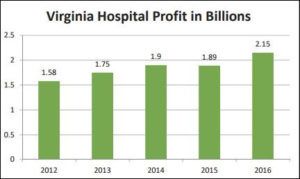
    Admittedly, hospital profits did decline 0.6% in 2015. But hospitals more than made up the difference in 2016. According to an annual update on Virginia hospital profitability by the Thomas Jefferson Institute for Public Policy (TJI), hospital profits increased 13.9% that year. Over the past four years, Virginia hospital profits have increased 36%.ย 

    Some hospitals are more profitable than others, of course, and it’s true, as the Virginia Hospital Association reminds us, that some hospitals lose money. Twenty-eight Virginia hospitals ran deficits in 2016 compared to 42 in 2012, reports TJI, but that’s not the problem it might seem. Some money-losing hospitals are new, and their losses are temporary as they build market share. Other hospitals, typically rural, are part of larger health systems; while they may operate at a deficit, they funnel patients to larger tertiary-care hospitals where the real money is made. And at least one, Sheltering Arms in the Richmond area, has a business model that relies heavily upon philanthropy.

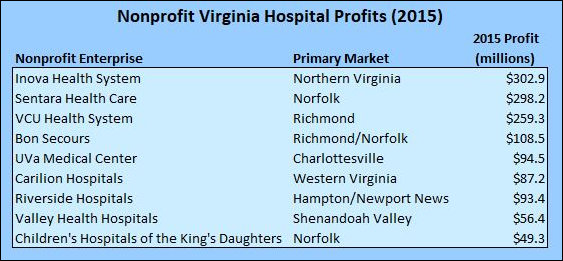
    Remarkably, most of the industry’s $2.15 billion in profits come from the non-profit sector. For-profit Hospital Corporation of America (HCA) accounts for $244 million of the industry’s profit. Other for-profits have a negligible market presence in Virginia. The vast majority of profit comes from the non-profits. Here are the top earners:

    Let’s be clear: I’m not attacking hospital profitability. We want our hospitals to be financially healthy. Who wants to have surgery in an institution that’s always cutting corners, can’t hire competent staff, and lacks the capital to reinvest in new technology and best practices?

    But it is a legitimate question to ask, especially of nonprofit hospitals, how much profit is enough? The state grants nonprofits exemption from property taxes, corporate income taxes, and other taxes worth hundreds of millions of dollars to support their public mission. What is that public mission, if not providing medical care to the community at large — and especially to the poor?

    The Virginia Hospital Association, I hear, will propose to finance Medicaid expansion by means of a hospital bed tax. That gambit will have the political virtue of avoiding a highly visible general tax increase, such as the state income tax or the sales tax, and embed the tax all-but-invisibly in your hospital bill where you likely will never take notice of it because hospital bills are indecipherable and your insurance company is covering most of it anyway. The proposal also will have the practical effect of transferring wealth from paying patients to nonpaying patients. Paying patients are being dunned already through opaque hospital bookkeeping to support the existing Medicaid program, which notoriously pays less than Medicare or private insurance. With a bed tax, paying patients will be dunned again.

    But hospitals will retain their revenue surpluses to spend as they please.

    Democrats feel terrible thatย some 240,000 low-income Virginians are stuck in what the center-left Commonwealth Institute think tank calls the health care coverage gap: States a recent paper: “They are unable to get quality, affordable coverage through the federal insurance marketplace because they donโ€™t make enough money, and they canโ€™t qualify for Medicaid because they make too much.”

    We’ll see how Democrats propose funding the Medicaid expansion, but the money has to come from somewhere — either from taxpayers generally or the hospital bed tax. If past is prelude, Dems will have few qualms about shifting the burden to either one. After all, as Governor Ralph Northam opined yesterday, Medicaid expansion is “a matter of basic economic justice.” Unfortunately, economic justice, as we have learned from years of experience, is for the poor, not for middle class taxpayers and insurance payers.

    In my taxpayer-friendly view of economic justice, perhaps we should be asking Virginia’s hospitals what the public is getting for nearly $2 billion in nonprofit profits.ย The press doesn’t cover hospital board meetings to report on how that money is disposed of. It doesn’t have the resources to do so.ย Perhaps the Joint Legislative Audit and Review Commission could determine how much nonprofit hospitals are getting in state and federal tax breaks and how hospitals are redirecting the money. I’d sure like to know before Governor Northam and his friends in the legislature salve their social-justice consciences by sticking it again to the middle class.

    Update:ย The Virginia Hospital and Healthcare Association objects to TJI’s methodology for calculating profits. Says spokesman Julian Walker:

    “In past studies of this sort, the Thomas Jefferson Institute has miscounted, included non-hospitals in its tabulation, evaluated total margins rather than operating margins which are a truer measure of fiscal condition, factored in investments and other assets in its calculations of profit, among other calculations that have resulted in a skewed and imbalanced impression of what the actual data from VHI shows. …

    From 2008-2016, the annual rate of Virginia acute care hospitals with negative operating margins has ranged from 38 percent to 23 percent. Among rural acute care hospitals, the range is 63 percent to 40 percent.”


  • American Higher Ed: Innovative, Adaptable, Transformative

    Edward L. Ayers

    by Edward L. Ayers

    Hereโ€™s a puzzle:ย  Americans love their own colleges and universities and yet are suspicious of and even disdainful of colleges and universities in general. Why is that?

    Polls show that the great majority of Americans who graduated from college are grateful they went to that college, felt they got their moneyโ€™s worth, and would go there again. Theย  love of institutions by students, alumni, and neighbors appears in gifts and inย  window stickers proclaiming loyalty to their institution long after they have left. People acknowledge that universities are the source of much of our countryโ€™s comparative economic and military advantage, that our nationโ€™s system of higher education is one of the great accomplishments of the United States.

    And yet criticism of higher education descends from all parts of the political spectrum. From the right, we hear that colleges and universities are overrun with radicals; from the left, we hear that colleges and universities are overrun with corporate and managerial ideals. From the right, we hear that college costs too much because the federal government subsidizes students who should not be there; from the left, we hear that college costs too much because state and federal government has starved them. From the right, we hear that colleges need to rely more on on-line instruction and efficiencies that come from replacing tenure-track faculty with adjuncts. From the left, we hear that on-line education is one more way for big business to take over higher education, the turn to contingent faculty one more way to strip the freedom of thought and expression tenure was created to protect. Both sides agree that administrators are to blame, but for different reasonsโ€”either for not being in charge enough or being too much in charge.

    The familiar debates over higher education are not very productive, in part because each side indicts rather than persuades the other. Critics begin with assumptions and reverse engineer solutions that meet those assumptions. In the meantime the real and immediate challenges of higher education go unmet.

    A broader historical perspective can perhaps help move the conversation forward. Pulling the camera back, we see that the range, depth, and diversity of Americans achieving higher education has increased exponentially over the last half century and is still increasing. Between 1970 and 2017, the total number of students increased from 8.5 million to 20.6 million and the numbers and rates are still increasing. The number of female students increased from 3.5 million to 11.5 million. The percentage of students of color has doubled since 1976.

    The transformation is gaining momentum and extending into all aspects of our institutions. Since 2000 alone, the number of low-income students enrolled in college has increased 14 percent, the number of female students by 29 percent, the number of black students by 73 percent, and the number of Hispanic students 126 percent. In 2017, 70 percent of high school graduates went on to another level of higher education, the highest ever. When they arrive in college, these students see that almost a quarter of full-time faculty are persons of color and almost exactly half are women.

    These are remarkable, and heartening, transformations, some of the most positive things that have happened in this country over the last half century. They define the context for everything else in higher education, both our success and our remaining challenges.

    Because of the transformation, demand for all kinds of education has never been stronger. Our community colleges are bulging at the seams; public universities of all sizes and kinds are flooded with applicants; for-profit and on-line enterprises have grown up to meet a demand that states and non-profits cannot meet. College has never been worth more, for the wage gap between college-educated and non-college educated people is higher now than it has ever been:ย  56.6%.

    Far from being hidebound and resistant to innovation, higher education is and has been one of the most dynamic economic and social components of American society since World War II. Our universities have developed the most transformative industries of our time and have been on the forefront of every major social change. They have been agents of integration, inclusion, and internationalization, advancing the society far beyond their own gates. They are unruly and loud and sometimes self-righteous because they are the places where the nation tests itself, where new generations define what it means to be American.

    American higher education, in other words, has never educated more people, it has never educated a broader array of people, it has never offered an education that embraces so many fields of learning, it has never offered degrees more valuable and more coveted, and it has never been more respected and appreciated by the people who benefit from it. The world admires and copies every aspect of Americaโ€™s diverse system of higher education, from our liberal arts colleges to our research universities.

    Colleges and universities have assumed greater responsibilities than ever before. Higher education is now serving a student body far larger, more diverse, and often poorer than ever before in our history. It educates more people from more backgrounds in more ways. Higher education is hard, intellectually and socially, and it is not surprising that those who are the first in their family to go to college or who speak English as a second language or have other work responsibilities may struggle and require more support. Student welfare, engagement, and protection have become institutional responsibilities and those responsibilities bring enormous benefits as well as new costs.

    Institutions of higher education are hardly above criticism, of course. In fact, they are built to foster critical thinking, hard questions, good evidence, and strong arguments. In my experience with a broad range of people from a broad range of institutions, colleges and universities are run with rigor, discipline, and hard numbers. They continually explore and test their assumptions, constantly adapt to changing circumstances and learn from one another.

    Like those institutions, critics need to focus on particular problems rather than resort to a generalized set of assumptions. The two major problems of American higher education are the amount of debt some students accrue and low levels of completion for some students in some schools. The two problems go together, for the students who do not finish are those who cannot repay the debt they acquire. Most who graduate do not build up large amounts of debt and default rates are low. Students who give up after a year or two, however, are not equipped to get a job that allows them to repay the debt. Colleges themselves, having analyzed the issues, are putting their resources, in the form of need-based aid, to this purposeโ€”hundreds of millions of dollars each year in Virginia alone. A broader focus on behalf of those students would pay the biggest dividends for the institutions and those who support them.

    These problems matter. How well colleges and universities succeed matters because higher education embodies and reflects the possibilities of society at large. Questions about affordability are questions about social mobility in America; questions about diversity are questions about fairness in this nation.

    Rather than fixating on why โ€œcollege costs so much,โ€ in other words, it would be better to focus on the more concrete problem of debt and completion, problems that are both byproducts of the transformation and the strongest impediments to its progress. The democratic transformation of American higher education is not complete and it never will be, but it can be advanced with deeper perspective and clearer priorities.

    Edward L. Ayers is president emeritus of the University of Richmond. This column is based upon a speech he delivered to the State Council of Higher Education for Virginia last week.ย ย 


  • Senate Committee Spikes Bill to End Electric Freeze, Promises Comprehensive Reform

    Sen. Chap Peterson. Photo credit: Associated Press

    The Senate Commerce and Labor Committee today killed a bill championed by Sen. Chap Petersen, D-Fairfax, that would have ended the freeze on base electric rates, restored State Corporation Commission (SCC) control over rate setting, and enabled the refund of hundreds of millions of dollars in electric utility profits to rate payers.

    Senate leaders said that they are working on legislation that will direct the long-term future of the electric utility industry, subsuming the regulatory topics that Peterson’s would address. “There will be a larger conversation that will take place in the next week,” said Senate Majority Leader Tommy Norment, R-Williamsburg.

    Peterson has pushed for a return to the regulatory regime that existed before 2015 when the General Assembly, worried about the potential impact of the Obama administration’s Clean Power Plan, enacted a freeze on base rates and canceled biennial SCC reviews. Peterson contends that Dominion Energy Virginia has earned excess profits of more than $400 million. Moreover, the new federal tax law will reduce Dominion’s tax bill by $150 million a year. His bill will protect rate payers, he said. “This is not an environmental bill. It’s not a pro-business bill. It’s a pro-ratepayer bill.”

    Sen. Frank Wagner. Photo credit: Helment2Helmet

    However, Committee Chair Frank Wagner, R-Virginia Beach, said the legislature needs to consider rate regulation in the context of building an electric transmission/distribution system that can accommodate more solar power and keep the grid secure and resilient. Virginia needs to upgrade its grid, he said. “We’re not there — we’re not even close to where we need to be.”

    About a dozen speakers mainly representing consumer, environmental and business-customer interests spoke in favor of Petersen’s bill.

    In remarks typical of those who supported Petersen, Sam Towell, with the office of consumer council for the Attorney General’s office, argued that Virginia should return oversight of the electric power companies to SCC judges who have the staff and expertise to review complex regulatory issues. “If the rates are too high, as they currently are, the SCC should have the authority to lower them,” he said. “If utilities make prudent investments, they should have the opportunity to recover their investments with a fair rate of return.”

    Another advantage of SCC oversight, said Louis Monacell, an attorney representing the Virginia Committee for Fair Utility Rates, is that the public hearings allow for the production of documents and questioning of experts. In contrast to Dominion with its army of lobbyists, who meet with legislators and aides in settings where people don’t have a chance to challenge their assertions, he said, “the SCC bases its decisions on an open record.”

    Norment said he was “taken aback” at the insinuation that legislators aren’t getting all viewpoints. “How can you stand there and tell me that your voices are not being heard?”

    Dominion has a far greater financial interest in the outcome of the legislative process and can afford to hire more lawyers, lobbyists and experts, responded Monacell.

    “We think the consumers do have an articulate voice,” as evidenced by the number of speakers at the hearing, said Norment. “And now they have an Attorney General who is serving their interests more than ever before.”

    As Virginians ponder how to restructure the electric utility industry, said Wagner, the General Assembly needs to transcend the “myopic,” two-year time horizon of the SCC and adopt a longer-term perspective.

    “It’s very clear that the Clean Power Plan is not moving forward,” Wagner said. “We have a degree of certainty that we didn’t have three years ago. This is the time to go back to a re-regulated environment.” Still, the General Assembly sets the broad parameters for energy policy. Solar is competitive now with every other form of electricity. Decisions must be made how best to integrate it into the grid without throwing off frequency and voltage, while also protecting the grid against a range of threats from hurricanes to cyber-sabotage, he said.

    “We have huge changes coming,” said Wagner, echoing many of the same points that Dominion executives raised last month when announcing their openness to end the rate freeze.ย ย “More electric vehicles, more batteries, more storage, more generation at the [local] level. …. We need to look a decade down the road.”

    Update: An earlier version of this post said that the Committee “tabled” Petersen’s bill. In fact, committee members voted to “pass by indefinitely,” which I am informed is legislative jargon for killing the bill. I have rewritten the article to correct the mistake.


  • Retirement, Not Jobs, Pushing Virginians Out of State

    Virginia has been losing population to domestic out-migration for the past five years. Most people (including me) have assumed that the reason for the exodus (well, not really an exodus, more of a drip… drip… drip… leakage) can be attributed to sub-par economic growth. In other words, more people are leaving than coming because more jobs are being created elsewhere than here.

    But the latest data from United Van Lines calls that assumption into question. United’s data roughly tracks that of the Internal Revenue Service taxpayer change-of-address data in noting that for every 100 moves in and out of Virginia 53% were outbound compared to only 47% being inbound.

    But get this: Two-thirds of the reasons cited for moving into Virginia were jobs, while only a little more than half were so cited for moving out. The widest outbound-over-inbound gap was for retirement, the second widest for family. Virginia also suffered smaller gaps for health and lifestyle.

    Why would there be such a large retirement gap? Our 5.75% top income tax bracket? Hellish traffic in Northern Virginia? Too many polar vortexes? Perhaps readers can chime in with their speculations.


  • The Reform Agenda of Virginia’s Higher-Ed Critics

    While the higher-ed lobby blames cutbacks in state support for the soaring cost of higher education, the Partners for College Affordability and Public Trust (a sponsor of this blog) are advancing the argument that colleges should take responsibility for their own actions. And the Partners are advancing an agenda that goes beyond simple caps on tuition increases in order to achieve fundamental governance reform.

    The justification for reform is well known: Tuition for public colleges has risen 74% on average over the past 10 years while inflation has increased only 20%. Virginia baccalaureates are graduating with an average of $30,000 in student debt. Eighty-five percent of Virginians say college isn’t affordable, and 70% said in a 2017 poll that it was very important for policy makers to lower the cost of a college degree.

    The Partners advance a six-point platform for Virginia:

    1. Freeze tuition to provide relief for debt-ridden students and parents. This set of proposals also would limit increases in room and board to the Consumer Price Index, and would cap the percentage of out-of-state-students.
    2. Require performance and outcome-based state funding to get at the root of the problem. Other than enrollment, there are no discernible criteria for distributing money to public colleges and universities. The Partners’ proposal would distribute half of all higher-ed appropriations according to outcomes-based metrics such as the percentage of Virginia students enrolled, tuition rates, student graduation rates, average time of degree completion, student employment rates, and median salaries six months after graduation.
    3. Like other Virginia state boards and agencies, require public comment at universities to give voice to students and parents. Virginia law requires that colleges and universities give public notice of planned tuition increases, but provides no provision for public comment.
    4. Eliminate special carve-outs giving FOIA working paper exemptions to college presidents that restrict the public’s view of how public funds are spent.ย Decision-making at higher-ed institutions is opaque an insulated from public scrutiny. The system could benefit from greater transparency.
    5. Restore public trust by defining a board’s primary duty as to the Commonwealth and her citizens.ย Appointees to college governing boards, usually alumni, tend to be co-opted by the administration and buy into presidents’ visions for institutional advancement. Many boards rubber stamp administrative proposals. The state code should define university trustees’ primary duty as to the Commonwealth and its citizens.
    6. Re-label “Board of Visitors” to “Board of Trustees” to align with national standards. The name change is symbolic but it puts the emphasis on trust.

    Bacon’s bottom line: Overall, this is an excellent set of proposals. It doesn’t just strike out blindly against tuition increases, it takes a comprehensive look at governance reform. I’m ambivalent about the General Assembly imposing a tuition freeze, for reasons that I will explain in a future blog post, although I readily concede that sometimes the only way to fix a problem is with a blunt instrument. I’m also disappointed that the transparency measures don’t include my pet proposal for the collection of additional data that would enable administrators, boards, and the public to evaluate staff and faculty productivity — a driving force behind rising tuition costs. Those caveats aside, I don’t see how any reasonable person could disagree with most of the principles articulated here.

    I will be examining some of the issues in depth in future blog posts.


  • Worthy Cause, Wrong Target

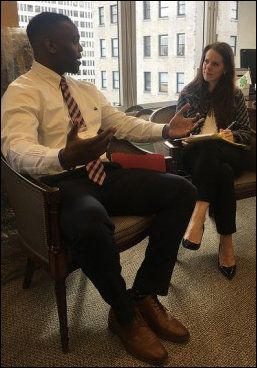
    Justin Moore talks to Jennifer Moon, legislative assistant to Sen. Jill Vogel, R-Winchester. Photo credit: Capital News Service

    The Capital News Serviceย has published an article on how the higher ed lobby is working state legislators at the General Assembly. The report describes Virginia Commonwealth University student Justin Moore, a clean-cut, well-dressed young man, meeting with a legislative assistant to Sen. Jill Vogel, R-Winchester.

    Representatives like Moore came armed with statistics they handed out to legislators, the article says. “From 2008 to 2017, they said, spending per student in Virginia decreased by $1,069, putting a greater financial burden on students.”

    These young people are very well intentioned, and they’re using data that someone has provided them. Exactly who has organized this effort and supplied talking points to the students is unclear in this case. The data sounds about right, and I’ll accept the fact that the number is accurate. But it is largely meaningless without context.

    Here’s the context: According to State Council of Higher Education for Virginia (SCHEV) data (found here), the average cost of attendance (tuition, fees, room, board) across all public four-year Virginia institutions of higher education for undergraduate students was $14,683 in the 2007-2008 school year. Adjusting for inflation, that’s $17,358 in today’s dollars. Today the cost of attendance is $22,987.

    Let me do the math for you: Adjusting for inflation, an undergraduate’s cost of attending a four-year college increased $5,629 over the decade. If reductions in state support for higher education amounted to $1,069, it accounted for about 19% of the total increased cost of attending college.

    Even if we look at tuition only, the average cost rose from $4,761 ($5,560 in inflation-adjusted dollars) to $8,614, or $3,054. Thus, cuts in state support accounted for a little more than a third of the tuition increase over this period. You can get different results if you compare different periods — but these were the years that advocates of increased state spending chose themselves.

    However you slice and dice the numbers, state cutbacks in support to higher-ed account for only a fraction of tuition inflation and cannot begin to explain all the inflation in fees, room, and board. To be sure, the General Assembly has not helped the cause of college access and affordability, and earnest students like Justin Moore are more likely to land a one-on-one audience with a legislative aide than they are with presidents of their universities. But perhaps in seeking sympathy for their plight they also should petition administrators who make craft university budgets and the boards of trustees that rubber stamp them.


  • Farewell Parade

    Don’t mess with Virginia.

    by Stephen D. Haner

    I was very flattered that the U.S. Navy arranged that parade of ships just to mark my departure from Newport News Shipbuilding last month.

    Iโ€™m kidding, of course, because the recent demonstration of naval firepower out in the Pacific (pictured above) was arranged for Dear Leader Kim and his friends Vladimir and Xi. But it is such a magnificent image I had to share it. I donโ€™t think enough Virginians know that all three of those nuke carriers were built right here in the Old Dominion, along with the other eight in the fleet.ย  And many of the nuclear submarines submerged around that task force are also Virignia-built.

    Virginiaโ€™s most famous product is not peanuts or tobacco.

    Virginia builds naval supremacy.

    Shipbuilders come and go from the shipyard every day โ€“ most with far more than my 12 years of service — and a lobbyist is far less important and far easier to replace than a nuclear-qualified welder.ย  I stole that line from the CEO, who is fond of saying even his job is easier to fill than some of the specialty jobs on the waterfront.

    When I started, they issued me a Blackberry, and I joked that it was a leash.ย  โ€œNo,โ€ the vice president dryly responded. โ€œThis is a nautical company. Thatโ€™s a tether.โ€ The tether later became a smartphone, but it has never been more than a few feet away in the past 12 years except for two trips overseas. It has been gone almost a month now and I still reach for it.

    And it was a tether. My relationship with Baconโ€™s Rebellion started long before I got hired by the yard, but I quickly discovered that the yard was off limits for my commentary. As a former reporter and political communicator my lobbying style has always involved working with the media, and in my first session I had a routine discussion with a local reporter about a routine bill. When my quotes appeared in the Daily Press, the negative reaction was swift and instructive.

    So I have never discussed the shipyard on Baconโ€™s Rebellion and rarely mentioned it. Now that Iโ€™m an ex-shipbuilder that may change a bit, at least with regard to its general operations and its products and its importance to the Virginia economy. Somebody else will be responsible for communicating its views to the General Assembly and the state executive branch. I may use this space from time to time to share with you some of the things I learned working in that marvelous place with so many dedicated people building the most complicated machines in the world.

    Reports of my retirement are like the reports of Twainโ€™s death โ€“ premature.ย  I may handle a few more clients in the coming years. But the shipyard is fading from sight off the fantail.

    Stephen D. Haner, principal of Black Walnut Strategies, is a Richmond-based lobbyist.


  • A New Generation of Fuzzy Thinkers for Henrico

    Henrico County has flipped from a majority-Republican to a majority-Democrat board of supervisors. That could be a good thing or a bad thing, depending. If Democrats nudge the county toward more rational, Smart Growth-like land use patterns — more infill, more density, more mixed use, more walkability — it could be a good thing. If they push the county into ill-thought-out spending initiatives, it could be a bad thing.

    Based on the Richmond Times-Dispatch’s coverage of a two-day board retreat, it looks like spending will top the list. The three Democratic members of the board indicated their desire to expand the GRTC (Greater Richmond Transit Company) Route 19 to the Short Pump retail center at an estimated cost of $800,000 annually.

    The purported benefit is greater access for job seekers. Tyrone E. Nelson, representing the Varina district at the east end of the county, said he could not understand why a county with a budget of nearly $1 billion had not yet devoted funds to bring bus service to the employment center. “I still don’t understand why it’s like pulling teeth to get public transportation to Short Pump. This is a 2018 need.”

    His fellow Democrats expressed the same sentiment. “We’re not doing enough for job access,” said newly elected Courtney Lynch. “When you look at things we should spend money on, this should be something where we can get creative and get things done.”

    Democrats and Republicans alike can agree that helping people gain access to jobs is a worthy goal. We want people to work so they can support themselves and their families. In Henrico County, the poorest residents tend to live in the far east end of the county, far from the affluent Short Pump commercial district where many jobs are available. GRTC already runs buses out Broad Street to Costco, and the expansion would extend the service a few miles more at seemingly modest cost.

    That makes sense as a starting point for an inquiry: Hey, extending the bus line just a couple miles more would provide passengers access to a whole bunch of jobs they can’t reach now. Let’s take a closer look and see if it makes economic sense. From what I glean from the Times-Dispatch article and county documents, however, the supervisors skipped that let’s-see-if-it-makes-economic-sense step.

    Henrico County Public Works has posted a slide presentation online covering proposed investments in roads, highways, sidewalks, bike trails, and mass transit. The slides contain a lot of information, but not everything that we, as citizens need to reach an informed conclusion. Perhaps the speaker making the slide presentation had more to say about the economics of bus service, but there is no indication of it in the Times-Dispatch article.

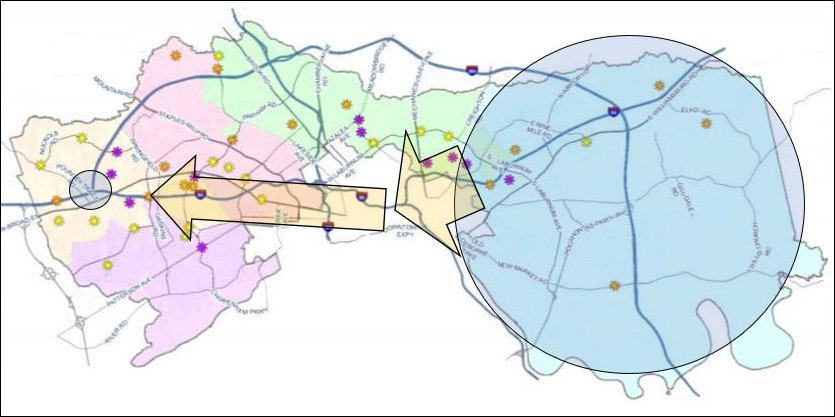
    Let’s start with the map at atop this post. The big blue circle on the right is Mr. Nelson’s supervisor district. The small blue circle on the left is the Short Pump employment center. To get there, Nelson’s job-seeking constituents must take the bus into downtown Richmond where they would transfer to another bus running out to Short Pump.

    The first question is how many passengers avail themselves of the bus service to access retail and service jobs along Broad Street at present? One hundred a day? A thousand? Ten thousand? Presumably, existing passenger loads would give us an order-of-magnitude idea of what might be expected if we extended the line. Alas, existing passenger numbers are not provided.

    The more pertinent question is how many additional passengers are projected to avail themselves of the bus service going all the way to Short Pump. Again, in orders of magnitude, are we walking about 100 passengers, 1,000, or 10,000? This would seem to be a critical matter because, if the new service costs $800,000 a year to operate to benefit 100 passengers daily, we’re talking about an annual subsidy of $8,000 per passenger — an extraordinary sum. Why not just buy each passenger a new car? If we’re talking about benefiting 10,000 passengers, then the subsidy is only $80 per passenger, a nominal sum in which the social and tax benefits clearly outweigh the expenditure. If we’re talking about something in between, then the decision is not so clear.

    As always, we should ask if there are alternative expenditures of money that would yield greater social benefits. Eight hundred thousand dollars is a nice chunk of change. I were a supervisor representing Nelson’s district, I would convene a meeting of GRTC, Uber, Lyft, Bridj, and other transportation-service companies and ask them, what kind of service could you provide my constituents for $800,000 worth of subsidies? Could you provide more point-to-point service providing more convenient schedules and shorter travel times, making it even easier to make the trip and find a job? Can you come up with a more imaginative solution than simply extending the existing bus schedule?

    When such basic questions go unasked, we can be assured that money will be ill spent. Truly, Henrico has entered a new era — from one in which it made lousy land use decisions to one in which it will make lousy spending decisions.


  • Solar Power Building Momentum in Virginia

    Dominion solar farm in Buckingham County.

    Dominion Energy has grown its solar fleet in Virginia and North Carolina over the past two years from near zero to nearly 1,350 megawatts in service, in construction or under development — enough to power 340,000 homes during peak sunshine. That makes Dominion sixth among owners of electric utilities, the company said in a press release issued yesterday.

    In Virginia, there are 27 solar generating facilities on 4,683 acres, equating to about 444 MW of solar capacity either in operation or under development. Construction of another 300 MW of solar is planned to support aย Facebook data center planned in Henrico County. The company’s long-term energy forecast calls for 5,200 megawatts of new solar generation over the next 25 years.

    Nationally, parent company Dominion Energy now claims to have the sixth largest fleet of solar facilities in the country. Meanwhile, Appalachian Power, has issued RFPs for up to 10 megawatts of solar production. Virginia’s second-largest utility is leaning more on wind power to build its renewable energy portfolio.

    โ€œItโ€™s not just about Dominion Energy meeting its clean energy goals, itโ€™s also about helping our customers achieve theirs,โ€ said Paul Koonce, president and CEO of Dominion Energyโ€™s Power Generation Group. โ€œWe have a responsibility to offer the right programs, resources and solutions so our customers can make smart decisions about their energy future, and the key is weโ€™re doing it together.โ€

    Two years ago critics were blasting Dominion Virginia Power for its slow adoption of renewable energy. You don’t hear that much any more. Today foes contend that the utility is interested only in projects that it can own, operate, and generate profits from itself.

    Working with solar companies and environmental groups, Dominion cut a “community solar” deal last year in which independent outfits would own and operate the solar farms while Dominion would own the entity that bundled the electricity generation and marketed it to consumers.

    Now attacks tend to focus on charges that Dominion discourages development of rooftop solar by individuals and businesses. Virginia, critics say, needs to move to a distributed (more decentralized) grid that can accommodate thousands of small, independent contributors to the grid. A big sticking point is the level of compensation Dominion receives for the critical task of maintaining the transmission and distribution system as well as back-up capacity for when the sun doesn’t shine.

    The company says it is seeking State Corporation Commission approval “for a 100 percent renewable energy option for residential and small commercial and industrial customers, as well as an option for business customers to purchase renewable generation equal to a specific portion of their energy usage.”

    Dominion also has signaled its intention to modernize the electric grid to make it safer from cyber threats and to accommodate distributed contributors to the grid. “A smart energy grid,” said the press release, “will enable the company to seamlessly connect with cleaner energy resources, including private solar and other local generation sources.”

    Ivy Main, who tracks solar energy developments for the Virginia chapter of the Sierra Club, wrote in her blog, Power to the People, that she expects a raft of solar energy bills to be submitted in the 2018 session of the General Assembly. At the top of her list of wants, she would like to end the 1% cap on the amount of energy that can be supplied through net-metered distributed energy and also to remove standby charges on residential solar. She also would like to liberalize power purchase agreements (PPAs) that would allow third parties to structure deals allowing universities, schools, local governments and non-profits to take advantage of solar tax credits.

    Main also calls for pilot products to test the concept of microgrids, which are appearing in other states. “Promoting microgrids as one way to keep the lights on for critical facilities and emergency shelters when the larger grid goes down,” she writes. “A microgrid combines energy sources and battery storage to enable certain buildings to ‘island’ themselves and keep the power on. Solar is a valuable component of a microgrid because it doesnโ€™t rely on fuel supplies that can be lost or suffer interruptions.”


  • Make College Trustees More Accountable to Students, Taxpayers

    Students at Missouri State University’s aquatic center in 2014. Photo credit: New York Times

    James V. Koch

    In a competition to woo students, public universities are increasingly offering lavish amenities that have nothing to do with education.

    Theย latest trendย is lazy rivers, which have been installed at several big institutions, including the Universities of Alabama, Iowa and Missouri. Last year, Louisiana State University topped them all with a 536-foot-longย โ€œleisureโ€ riverย in the shape of the letters โ€œLSU,โ€ part of an $85 million renovation and expansion of its gym. It was L.S.U. students who footed the bill.

    At a time when college has never been more expensive, this is the last thing students should be paying for. According to the College Board, tuition and fees at public four-year institutions grewย more than 60 percentย over the past 10ย years. State budgets for higher education have been slashed, and students have to make up the difference.

    In the case of L.S.U., the lazy river was financed entirely by student fees, an addendum to their annual tuition.ย According to the Chronicle of Higher Education, over the past five years, those fees increased by 60 percent, nearly triple the amount L.S.U. students paid in 2000.

    Tuition and fee hikes at public universities donโ€™t come out of nowhere. Each has to be approved by a schoolโ€™s governing board, whose trustees are typically appointed by the governor. Ensuring affordable, quality education is an essential part of trusteesโ€™ responsibility, but unfortunately often not part of their practice.

    Trustees of public universities are stewards of a public trust that rests nobly on the notion that an enlightened citizenry is vital to a democratic society. They have a fiduciary duty to represent the citizens and taxpayers who support public institutions of higher education, as well as the students who attend them. But even though the best interests of students and taxpayers revolve around college access, affordability and graduation outcomes, too often presidents and boards are more focused on the rankings, reputation and popularity of the institution itself.

    In my career as the president of two state universities and a consultant to nearly 50 higher-education institutions, Iโ€™ve observed dozens of college presidents skillfully co-opt their governing boards into approving costly projects that make schools look more attractive. (Of course, every college president has to increase costs sometimes. But the goal is to make sure it is necessary, while keeping expenses as low as possible for students.)

    Trustees, who typically meet four to eight times each year, are entertained as if they are visiting heads of state, flattered for their service and financial contributions to the institution. College presidents sweeten requests for new buildings and research centers, as well as additional student affairs programming, with cleverly branded words like โ€œpromiseโ€ and โ€œexcellence.โ€ What board would want to withhold promise and excellence from its beloved student body?

    College presidents also tranquilize trustees into agreement with impossibly large volumes of reading material. Trustees get binders full of documentation about institutional successes that are padded with expensive plans for increasing growth and reputation. Most come away impressed by their presidentโ€™s expertise and vision and assured that โ€” thanks to their efforts โ€” the university is on the right track.

    The unfortunate truth is that while most college presidents care deeply about their institutionโ€™s success, an important part of their job is to shake free more resources. They seldom initiate serious campaigns to contain costs.

    This means it falls on trustees to be better prepared to help challenge costly proposals that donโ€™t add educational value. When it comes to state schools, the states themselves should educate trustees to understand their responsibilities to the citizenry and students. Training on big-picture issues and higher-education trends, such as the financial trade-off between instruction and research, the costs of intercollegiate athletics, and the expansion of amenities, would help trustees develop courage to ask college presidents probing questions that look beyond institutional narratives and cherry-picked rhetoric.

    Our nationโ€™s governors must also play a role. As they appoint public university trustees, they can and should mandate training to make university boards responsible to taxpayers and students. I donโ€™t mean to imply that trustees should devote themselves to ritual opposition to presidents, who usually possess an unmatched understanding of the institutions they lead.

    But presidents are not infallible.

    James V. Koch, a member of the board of Partners for College Affordability and Public Trust, served as president of the University of Montana and Old Dominion University. Partners for College Affordability sponsors this blog.

    This op-ed, published originally in the New York Times, appears with the author’s permission.


  • Blockchain, Data Analytics, and the Future of Energy and Transportation

    Blockchain,ย a digital ledger in which transactions made in cryptocurrencies are recorded chronologically and publicly, is most closely associated in the public mind with BitCoin, a crytocurrency that is undergoing a mania like the 17th-century Dutch tulip crisis. I venture no predictions about the future of BitCoin, but I’m increasingly reading that blockchain has the potential to disrupt all kinds of industries.

    One of those, according to this article in Oilprice.com, is the energy sector. By enabling peer-to-peer trading, blockchain is disrupting traditional markets and enabling decentralized networks. That’s particularly promising for renewable energy and distributed energy grids. Writes the author:

    Blockchain has the potential to shake up the energy industry in countless ways, but perhaps the most disruptive would be a new, radical level of transparency. A wide-scale adoption of blockchain would create significantly more transparency at all levels. On a grand scale, every time a barrel of oil is bought or sold, it would be documented on a digital ledger, leaving an unprecedented โ€œpaperโ€ trail. While the buyers and sellers themselves will remain anonymous, these transactions will be publicly visible like never before.

    But before you break out the bubbly and toast the end to fossil fuels, consider this: The same article discusses how oil & gas companies are using data analytics to help drillers move faster, make better decisions, and recover more oil and gas at a fraction of the price.

    (Hat tip: Rick Gechter)

    Perhaps the bottom line is this: Blockchain, data analytics, the Internet of Things, and other technologies are enabling a new wave of innovation that will make energy — fossil fuels and renewables alike — cheaper. Does anyone remember the goal of achieving energy independence? Well, we’re almost there. The Persian Gulf can kiss my grits!

    Some say the U.S. economy has entered a slow-growth era in which there are no transformative technologies to drive invention and productivity to new heights. Building another social media app won’t make a material improvement to our lives. The pessimists might be right about social media apps, but I suspect that’re missing a lot of action in the real world.

    What does this mean for public policy in Virginia? When technology is scrambling the economics of the energy industry, we should be careful about making large, long-term investments that run the risk of becoming obsolete. Absent some technology breakthrough, nuclear is not looking like a good way to go. Speaking in broad generalities, the electricity future looks like renewables and natural gas.

    I’d issue the same warning for investment in transportation infrastructure. The Uber revolution, driverless cars, and electric vehicles will upend the personal-mobility industry. There is no way to predict with any confidence how it will shake out. All I can say is that we should scrutinize any large public investment in highways and mass transit predicated on the assumption that the driving and commuting patterns of the next 50 years will look like the driving and commuting patterns of the past 50 years.