• I Love this Goal: 10 Billion More Oysters

    Oyster reef. Photo credit: Jay Fleming Photography.

    I love this goal: Adding 10 billion oysters to the Chesapeake Bay by 2025.

    Aย partnership of more than 20 organizations, businesses, non-profits, and educational institutions announced that objective earlier today.ย The 10 billion oysters will come from a combination of expanded restoration activities, fishery repletion activities, and the continued growth of the Bayโ€™s oyster aquaculture industry.

    โ€œOysters are so much more than the tasty bivalves that many know them to be. They are a crucial part of our ocean planet,โ€ said John Racanelli, National Aquarium chief executive officer. โ€œThey help keep our waterways clean by removing harmful pollutants and they provide a hospitable place for other animals to liveโ€”from the backwaters of the Chesapeake Bay to the vast Atlantic Ocean.”

    The partnership has established as its top three priorities ensuring robust funding for oyster restoration, establishing sound science-based management that ensures sustainable harvest of the Bayโ€™s oyster population, and expanding the oyster aquaculture industries in Maryland and Virginia.

    While I am a skeptic of global-warming alarmism, I consider myself an environmentalist. I happen to think that there are more productive ways to spend scarce public dollars than re-engineering the industrial economy of the globe to adjust CO2 levels in the atmosphere. Locally, we can accomplish far more good by investing funds in restoring the health and adaptability of the Chesapeake Bay. Oysters are a keystone species. If we can restore their numbers, we can make a huge, visible difference.


  • The Future of Health Care Delivery: Homes not Hospitals

    VCU hospital. The future of health care delivery… or the past?

    “The days of the hospital, as we know it,” may be numbered,” declares Laura Landro in a Wall Street Journal articleย today.

    In a shift away from their traditional inpatient facilities, health-care providers are investing in outpatient clinics, same-day surgery centers, free-standing emergency rooms and microhospitals, which offer as few as eight beds for overnight stays. They are setting up programs that monitor people 24/7 in their own homes. And they are turning to digital technology to treat and keep tabs on patients remotely from a high-tech hub.

    For the most part, the investments in outside treatment are driven by simple economics: Traditional hospital care is too costly and inefficient for many medical issues. Inpatient pneumonia treatment, for example, can cost 15 to 25 times more, yet many low-risk patients who could be safely treated as outpatients are hospitalized, studies have shown.

    That’s what’s happening nationally. But I don’t see many signs of it happening here in Virginia. Indeed, when a rural hospital in Patrick County goes out of business, everyone’s instinct is to think about how to revive it so someone else can take it over rather than rethink how health care in a rural county might delivered more effectively and efficiently.

    I’m old enough to remember when the Virginia legislature back in the 1980s moved too slowly to deregulate the banking industry. North Carolina got the jump on us, allowing its banks to merge with one another and then acquire out-of-state banks before our banks had a chance to merge, grow and acquire. The Carolina banks ate up the Virginia banks, and the top banking jobs and financial clout shifted from Richmond and Norfolk to Charlotte and Atlanta.

    I’m worried that something similar is happening today with the health care sector. The problem is not that Virginia hospitals haven’t merged — to the contrary, huge health care systems have swallowed up competitors in every metropolitan area in the state. The problem is that the General Assembly hews to an outmoded model of the health care industry. By clinging to that model, more appropriate to the 1960s than the 2010s, we run the risk that Virginia healthcare providers will stifle innovation, thwart productivity, and burden the population with an obsolete health care system.

    The underlying assumption is that health care should be organized around something called “hospitals,” which are medical complexes in which scores, even hundreds, of medical services are bundled under one roof under common ownership. State policy buttresses this arrangement by requiring providers to obtain a Certificate of Public Necessity (COPN) in order to build a new facility, thus protecting hospitals from competition by free-standing entities. State policy also perpetuates the status quo by allowing nonprofit hospitals to go untaxed, giving them a huge competitive advantage over for-profit competitors organized by physicians or entrepreneurs.

    I have long railed against this arrangement without benefit of knowledge of what’s happening in other states. The Wall Street Journal, however, makes it vividly clear how healthcare enterprises in other states are innovating.

    Perhaps the biggest drawback to hospitals is that they are germ factories. With the rise in antibiotic-resistant bacteria, any patient entering a hospital runs the risk of infection. Indeed, at any time, reports the WSJ, one in 25 patients in the U.S. is battling a hospital-acquired infection.

    It’s also becoming apparent that health care providers often can deliver care at lower cost and better outcomes in independent facilities or at home. Studies, says the WSJ, show that “hospital-level care at home for certain conditions can be provided for 30% to 50% less than inpatient care with fewer complications, lower mortality rates, and higher patient satisfaction.”

    Acute care hospitals will always be necessary to deal with medical conditions requiring highly specialized, highly technical, or highly intensive care. But hospitals are clearly not the best setting for chronic or non-intensive conditions.

    New York’s Mount Sinai Hospital has developed a hospital-at-home program, HaH-plus, for patents who show up at the emergency room or are referred by primary care physicians. A mobile acute-care team provides staffing, medical equipment, medications and lab tests at home, and is on call around the clock if a condition worsens, says the WSJ. Mount Sinai estimates that nationally, 575,000 cases yearly could qualify for the program. Treating just 20% of them could save Medicare $45 million annually.

    Another new concept — potentially well adapted to rural counties — is the microhospital, sometimes referred to as the neighborhood hospital. Typically, says the Journal, 92% of microhospital patients are treated and sent home in an average of 90 minutes, and 8% are admitted overnight for care such as intravenous-medication administration. Says the CEO of Lousiana-based Ochsner Health Systems, 80% of its capital expenditures are going to outpatient clinics. “I don’t see us building new hospitals.”

    The primary justification for maintaining COPN in Virginia is that preserving hospitals’ monopoly status enabled them to generate the profits they need to cover charity care, bad debts and money-losing Medicaid. If the General Assembly enacts Medicaid expansion, thus relieving hospitals of a significant charity care/bad debt burden, it will kick the props from under COPN.

    I would argue that eliminating COPN would be worth the price of expanding the entitlement state. Competition in Virginia would lead to more innovative healthcare delivery systems. If the health care systems didn’t introduce the innovations, local physicians or out-of-state enterprises would. Potential savings for Virginia patients would run into the billions of dollars.

    It’s time for an innovation-driven healthcare system. Let’s do it.


  • Race, Responsibility and the Welfare State

    by Vic Nicholls

    What is the justification for taxing people to provide healthcare? There is no mandate for it in the Constitution. The “general welfare” was never considered to include health care. The campaign slogans of the Founding Fathers never included, “Free leech treatments for all!”

    Are all men “created equal”? No. Everyone has different talents. I can’t get on a football or basketball team. They can’t do what I do in Information Technology. Is it the job or responsibility of the United States government to make me equal to them or them equal to me? No. Are we equal in the sight of God? Yes.

    Should people who sacrificed to made the personal choices to earn college degrees and delay having children until they were married be penalized for making those choices by forcing them to pay for others who didn’t? Would you expect to pay higher insurance because your neighbors’ kid wrecked two of his parents cars? Is it fair to discriminate against those with bad driving records? Should the government require equal insurance premiums for everyone?

    If we institute Medicare/Medicaid for all, where would personal responsibility start and end? If there is a shortage of doctors, how do we determine who gets one and who doesn’t? Since we were given the right to “life, liberty and the pursuit of happiness,” how does freedom from the tyrant’s power to tax me to fund his armies and empire translate into the power of my fellow countrymen to tax me to provide them 21st-century medical care?

    Nowadays, appeals to personal responsibility and initiative are described as justifications for white privilege. If you earned a B.A. degree, got a job in your field, married, and then had kids, would you expect your children to have a better start in life than one who’s parents didn’t? Of course! Does that make you “privileged”? Not at all.

    Notice that in listing the essential requirements for success in life, I didn’t mention race. That’s because I know non-white spouses who followed the formula and live as well as I do.

    Many assume that all differences between the races are due to racism. But once you factor out marriage, education, in-wedlock birth, age (whites are older on average than blacks and Hispanics and have had more time to climb the income scale), and inheritance from parents who made the same responsible choices, what difference is there left?

    If it’s racism that keeps people down rather than hard work and grit that allow people to rise, how do we explain the career of the noted African-American economist Dr. Walter Williams? He grew up in the projects with his mother and sister, but no father. He earned a Ph.D. in 1972, and has been teaching at George Mason University since 1980, and he publishes a nationally syndicated column. Racism was worse back then than it is now. How do we explain his success?

    Explain Mae Jemison. She was born in Alabama in 1956. Her mother was an elementary English/math school teacher and her father was a maintenance supervisor. Her family moved to Chicago to give her better educational opportunities. She graduated high school in 1973 and went to Stanford at age 16, graduating 4 years later with a B.S. in chemical engineering and B.A. in African/Afro-American studies. Engineering professors would pretend she wasn’t there. Her family was always encouraging, though. She got her M.D. in 1981 at Cornell.

    Explain Dr. Ben Carson, Dr. Charles Drew, or countless others less famous. Explain my African-American next-door neighbors, both of whose kids have masters’ degrees. I can explain their success: My neighbors married before the kids were born and have lived in the same house since the ’80’s. They sacrificed a ton to make sure their kids got a solid start in life.ย 

    It’s time we asked a different question: When government takes away from those who worked for their success and gives it to those who didn’t, does it subsidize failure? When government subsidizes failure, do we get more of it?

    Vic Nicholls lives in Chesapeake. For more on the topic, she recommends viewing Walter Williams’ speech, “How much can discrimination explain?” on the video above.


  • ACP Cost Overrun Could Run to $1 Billion

    The Atlantic Coast Pipeline, originally estimated to cost about $5 billion to $5.5 billion, now is expected to cost between $6 billion and $6.5 billion. That estimate comes from CEO Lynn Good of Duke Energy, one of the pipeline’s four corporate partners, in a Tuesday earnings call, as reported by the Richmond Times-Dispatch.

    โ€œDue to delays and more stringent conditions in the permitting process, ACP now estimates total project costs between $6 (billion) and $6.5 billion,โ€ Good said. A Duke spokesman affirmed that the pipeline still remains “the most competitive of all the options we evaluated in the early planning phases” and that “consumers in the region will realize significant energy cost savings.โ€

    ACP spokesman Aaron Ruby said he could not confirm Good’s estimate. โ€œWeโ€™ll have more information to provide with our financial disclosure next week,โ€ he said.

    โ€œItโ€™s no surprise that the cost of the Atlantic Coast Pipeline keeps going up,โ€ said Buppert, an attorney with the Southern Environmental Law Center. โ€œDominion and Duke chose a route with dozens of complex problems through some of the steepest, most undeveloped lands in the Southeast.โ€

    The big question to Virginians is how much, if any, of this added cost will be passed on to rate payers. At some point, Dominion Energy Virginia (a subsidiary of Dominion Energy, which is the managing partner of the pipeline) will have to file with the State Corporation Commission for permission to build its fuel procurement contract into the rate base. The SCC will have to determine whether the costs embedded in the contract were prudently incurred. That hearing ought to be very interesting.


  • Questions Virginia Tech’s Board Should Be Asking

    Thanks to a new state law, Virginia Tech has issued a notice of its intention to raise tuition for the next academic year. At its March 26 meeting, the board of visitors will consider changing undergraduate tuition & fees by between 2.8% and 4.9%.

    The university justified cost increases as follows:

    While Virginia Tech is often viewed as an excellent value and the university works to continue that value, the board will consider a combination of tuition and fee adjustments to address increasing costs of personnel, fringe benefit rate increases, escalation in fixed costs, investment in academic programs including faculty, and enhancing high demand student support services. Academic investments are designed to help the state meet the needs for graduates in key areas.

    To further advance the affordability of a Virginia Tech education, the university is also working to expand private philanthropy and increase student financial aid programs. Student financial aid programs are critical to ensuring the affordability of a Virginia Tech education for all Virginians. …

    The university will utilize mandatory non-E&G fee resources to address increasing demand for counseling and health services, transit service, career services, and advanced networking in addition to the other costs listed above.
    The recommendations, notes the university statement, “continue a trend of slowing increases in undergraduate tuition and fees and expanded student financial aid, which will help expand access and affordability for Virginia residents at Virginia Tech.”

    Inflation over the past 12 months has been 2.1%, so a portion of Tech’s expenses can be attributed to higher costs. However, the state is budgeting a meaningful increase in state support — $7.2 million in fiscal year 2019, or about 3.8%. (State funding numbers are based on former Governor Terry McAuliffe’s proposed budget, and don’t reflect any tweaking by the General Assembly.) In the past, public colleges and universities have blamed cutbacks in state funding for tuition increases.

    Raising tuition and fees by the low end of the proposed range, 2.9%, would exceed inflation once again, and it would do so in the face of a fairlyย generous increase in state funding.

    Virginia Tech’s board of trustees can do one of two things: (1) It can rubber stamp the administration’s proposals, adopting whatever recommendations are put in front of them, or (2) it can ask some tough questions.

    If I were a board member, here are some questions I would ask:

    Has the university increased the number of administrative staff employees over the past year?ย What’s the head count for staff? What is the costs of salary and benefits? What are the associated expenses, such as office space, travel and the like? How much has the university increased administrative spending over the past year?

    What business process changes has the university implemented to reduce administrative spending? What savings have been achieved, and what is being done with the freed-up money? Private businesses are continually looking for ways to shave administrative overhead. How aggressive has Virginia Tech been?

    What is the ratio of tenured faculty, tenure-track faculty, instructors, and adjunct faculty? What is the average teaching burden of each category? How many classes do the most senior (and most highly paid) faculty members teach? Has faculty teaching productivity increased or decreased over the past year? How has the university deployed technology (computerized learning, distance learning) to bolster teaching productivity? Does the university track any faculty productivity measures?
    To what degree is sponsored research subsidized by undergraduate and graduate student tuition?ย Break out expenditures for university research and explain exactly where the money comes from. If the administration says it’s impossible to determine if undergraduates are subsidizing research or not, ask why that’s so. Isn’t it a basic accounting function to answer basic questions like that?

    How efficiently is the university utilizing its buildings and grounds?ย The budget envisions spending money on building renovations and new buildings. What is the space-to-student ratio at each building? Is the space-to-student ratio for the university increasing or decreasing? Has the university implemented state-of-the-art technology to track and optimize space utilization? Has the university built an unfunded maintenance backlog, or has it kept its buildings in good working order? What are the associated expenses relating to heating, cooling, lighting and other energy costs? How effectively has the university controlled those costs?

    How do increases in room and board (which account for roughly half of the cost of attendance) compare to increases in the Consumer Price Index?ย Universities are engaged in an amenities arms race. Students from affluent students can pay the costs; students from poor families must borrow heavily. How do Virginia Tech room-and-board charges compare to other universities?
    What has the university done, if anything, to rein in the cost of textbooksย Textbooks typically cost students more than $1,000 a year, making them a significant contributor to the overall cost of attendance)?

    Finally, a general question: What has the university done to make attendance more affordable — not just for lower-income students by increasing financial aid (in part by raising tuition higher for others) — but for all students?

    Virginia Tech’s board is loaded with intelligent men and women who have achieved success in their professional careers. Serving on the Virginia Tech board is one of the most important civic contributions they’ll ever make to the Commonwealth. They owe it to the public to dig deep, demand answers to the kinds of questions they would ask in their own businesses, and keep the university’s top executives accountable.

    Board members must always remember that university presidents, and provosts, and the rest of the academic establishment have their own imperatives — the first and foremost of which is increasing the prestige of the university — that may conflict with the interests of students, parents and taxpayers. If board members don’t hold university administrators accountable to the people paying the bills, then the only people who have the power to do so are the politicians. And if the politicians begin micro-managing higher ed, we could all rue the results.

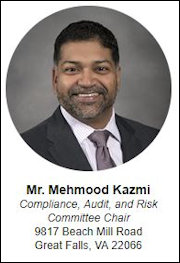
    For photos and bios of all 14 board members, click here.


  • More Facts, Less Alarmism, Please, Regarding Offshore Drilling

    Coal Oil Point in California

    I don’t know much about offshore drilling for oil and gas. But, then, I’m not sure that many vociferous opponents of drilling off the Virginia coast know much about it either.

    A case in point is a quote, reported in today’s Richmond Times-Dispatch, by Rep. A. Donald McEachin, D-4th:

    As we learned from the Deepwater Horizon catastrophe, accidents can be unimaginably destructive, devastating the marine environment, wrecking entire industries and potentially affecting the health of local residents.

    McEachin said he would resist offshore drilling “every step of the way.”

    Yes, Deepwater Horizon was an environmental disaster. But is that catastrophe a useful comparison for offshore drilling in Virginia? Deepwater Horizon was drilling a deep exploratory well at a depth of about 5,100 feet. The drilling took place in conditions of massive water pressure that would be absent on the continental shelf of the Virginia coast where the average water depth is about 200 feet.

    An appropriate comparison would be with offshore drilling operations taking place on the continental shelf in the Gulf of Mexico.ย According to LiveScience,ย 1.3 million gallons of petroleum are spilled into U.S. waters from vessels and pipelines in a typical year.ย Between 1971 and 2000, U.S. Outer Continental Shelf offshore facilities and pipelines accounted forย only 2 percentย of the volume of oil spilled in U.S. waters.

    Compare that to the volume of oil that naturally seeps from the seafloor.ย A single seep, Coal Oil Point on the California coast, releases about 10,000 gallons per day — about 3.6 million barrels yearly — according to the Stop Oil Seeps California website. Has that turned the coastline into an ecological disaster zone?

    Here’s what the Coal Oil Point Reserve website has to say about the wildlife there:

    One of the best remaining examples of a coastal-strand environment in Southern California, the Coal Oil Point Natural Reserve protects a wide variety of coastal and estuarine habitats. Largely undisturbed coastal dunes support a rich assemblage of dune vegetation and rare wildlife, including the dune spider, the globose dune beetle andย the threatened Western Snowy Plover. …

    Thousands of migratory birds visit throughout the year. Coal Oil Point Reserve is part of Audubon’s Important Bird Area (IBA)ย and it is visited daily by birders. …

    Vernal pools host a number of rare and endemic species. ย At low tide, the intertidal and subtidal zones at the reserve provide an opportunity to observe the rich assemblage of invertebrates and algae living on the rock formations.

    Not exactly a toxic hellhole.

    The conditions in Virginia are not the same as in California; they aren’t the same as in the Gulf of Mexico.ย Maybe a sober-minded analysis would show that offshore drilling would pose a genuine threat to Virginia’s precious coastal environment. I await that study. In the meantime, I’m not paying much heed to politician’s heated rhetoric regarding topics about which they know nothing.


  • Who Needs a Car, or Bus, When You’ve Got Uber?

    The Uber revolution keeps on churning. The transportation service company has finally rolled out a service in the Washington region that resembles the kind of ride-hailing jitney service that I long predicted eventuallyย wouldย enter the marketplace. This service is potentially so disruptive that it could drive public mass transit out of the market for all but the highest-volume transportation corridors — although Uber denies that such is its aim.

    From the Washington Post:

    Beginning Wednesday … riders will be directed to pickup points within two blocks of their origin and dropped offย within two blocks of their destinations, according to Uber. Riders will endure a slightly longer wait for a driver matchย โ€” up to two minutesย โ€” while Uber works to place them along the optimal route.ย They then will be instructed where toย catchย their ride.

    The perk for riders?ย Discountedย trips. Express Pool is up to 50 percent cheaper than ride-splitting option UberPool and 75 percent cheaper than UberX, the door-to-door ride-hailing service, Uber says.

    Finding rides won’t be a problem. Uber has 50,000 active drivers in the Washington region.

    Hopefully, local governments will not throw roadblocks in Uber’s way to protect their local transit authorities. Rather, they should ask themselves what they can do to make the service operate more efficiently. In particular, they should proactively brainstorm with Uber to see how to make it easy for riders to congregate at loading spots and for Uber drivers to access them without blocking traffic.


  • This Bitcoin Mania Is out of Control

    If you don’t understand how to mine bitcoin, try reading this Wall Street Journal graphic. You still won’t understand, but at least you’ll have tried. (Click for larger image.)

    If people want to invest in bitcoin, or invent competing cryptocurrencies, or dedicate their computers to “mining” bitcoin by solving computationally difficult puzzles, well, it’s a free country and they can do what they want. As a political-policy commentator, I would never advocate banning such endeavors. As a social commentator, I am moved to ask, are these people out of their minds? What a socially useless activity.

    As a economic-development commentator,ย  however, I must cheer the initiative of Frederick Grede, Michael Adolphe, and other principals of Bcause, a company that aspires to become the largest bitcoin mining operation in North America. The Virginia Beach-based company has raised $5 million in funding led by Japanese financial-services firm SBI Holdings and plans to raise more.

    A Wall Street Journal article today describes how Michael Poteat, an engineering student at Old Dominion University, started mining bitcoin four months ago. He purchased 20 “mining rigs,” computers that solve complex equations to generate new coins. The 20-year-old kept tripping the circuit breaker in his house, and he struggled to find a place to accommodate his operations.ย “It’s just difficult as an individual to handle all the logistics,” he says.

    Then Poteat came across Bcause, which provides the infrastructure, security, and electricity to enable large-scale bitcoin mining.ย  The WSJ elaborates:

    Bitcoin miners are rewarded with new coins and transaction fees for performing the calculations that make the bitcoin network tick. The more valuable a bitcoin is, the greater the incentive to start mining. But the more miners who participate, the more computations are needed to earn rewards.

    The process can be expensive and cumbersome, requiring specialized hardware and large amounts of power. Such challenges have long prompted miners to share space and resources. Now, companies that harbor mining equipment are fielding more requests than ever. …

    Bcause is one of the firms that have sprung up to cater to aspiring bitcoin miners. In an old beverage warehouse in Virginia Beach, the start up is running thousands of rigs for clients from the U.S. to Asia. … Bcause has contracts with clients to house about 60,000 mining rigs and will serve retail clients by renting out spare machines, a process known as “cloud mining.” It has about 5,000 machines up and running, and plans to outfit another site in eastern Pennsylvania.

    The profitability of mining bitcoin hinges on the cost of buying the mining rigs — the Antminer S9 is the most popular — electricity, and, of course, the price of bitcoin. Right now, despite a recent slide, the price is still high by historical standards, and bitcoin mining is said to be “insanely profitable.”

    As a hosting service, Bcause says it is insulated from price volatility because it doesn’t invest in the mining equipment or the cryptocurrency itself. However, it does plan to build out a one-stop shop for trading bitcoin, including a clearinghouse, and derivatives exchanges.

    I confess: I don’t get it. I don’t understand what bitcoin is good for, other than as a vehicle for maniacal speculation. I don’t understand how bitcoin mining works. Maybe there is some social utility from all this fevered activity, but maybe we’re just bystanders to the 21st tech-economy answer to the 17th-century Dutch tulip bulb mania. Will bitcoin become the Next Big Thing, like the Internet, that will revolutionize commercial transactions and transform our lives? I don’t know. Will it crash and burn? I don’t know.

    Peter Diamandis, serial tech entrepreneur and founder of the X Prize Foundation, spoke at the Richmond Forum earlier this month. He made the case that technological change is accelerating, driven by the geometric increase in computational power and the growing capabilities of Artificial Intelligence. A colleague of Ray Kurzweil, the author who coined the phrase, “The Singularity,” Diamandis said that technology is rapidly approaching escape velocity in which change will no longer be in human hands. So, yeah, it won’t be long before the robots take over.

    Curse you, bitcoin!

    In a world in which all the rules are changing, how do we know what to do? Will our skills and knowledge be worth anything a decade or two? What will happen to our pension funds and personal investments as half the companies in any given portfolio is disrupted and rendered worthless? Will there be any work to do, or will robots do it all for us? Will there be any purpose or meaning to human existence?


  • More Data to Inform the UVa Seminar on Race

    Earlier this week I asked, “Will UVa Provide the Data Needed for an Open Discussion about Race?” The University of Virginia is organizing a seminar to instruct faculty members about the history of race locally and nationally and current issues relating to health, educational and economic disparities. On the assumption that seminar participants will examine UVa’s role in race relations, I humbly suggested a few data points that should be considered.

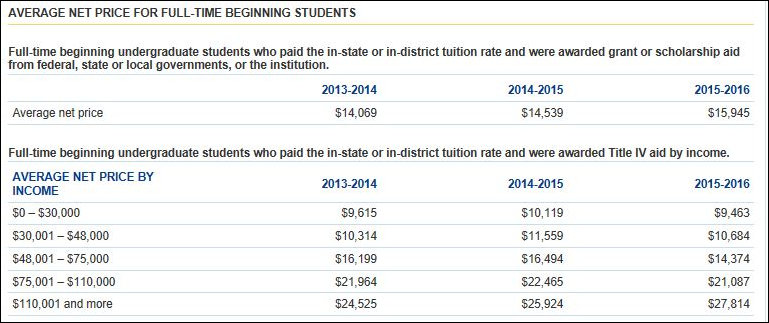
    I lacked hard data on several topics that I thought worth examining. But I have since been directed by a friendly source to two data sets. The first tells us the net price paid to attend the University of Virginia, broken down by income range. Net price takes the list price and deducts all sources of federal aid (Pell grants primarily), state assistance, and institutional assistance. The table above, taken from the College Navigator database maintained by the National Center for Educational Statistics, provides that information for UVa.

    Entering full-time students from poor families (making less than $30,000 per year) paid an average net price of $9,463 in the 2015-16 school year to attend UVa. Students from affluent families (making more than $110,101) paid almost three times as much — $27,814. UVa kids from poor families pay considerably less than poor kids at, say, Norfolk State University, where the net tuition works out to $13,952.

    How is that relevant to a discussion of race? Insofar as black students are statistically more likely than whites and Asians to come from poor families, they benefit disproportionately from UVa’s financial aid system. If we’re talking about the persistence of institutional racism at UVa, then a highly relevant data point is how much members of different racial/ethnic groups actually pay to attend. (College Navigator does not break down financial aid by race, but UVa undoubtedly has that information.)

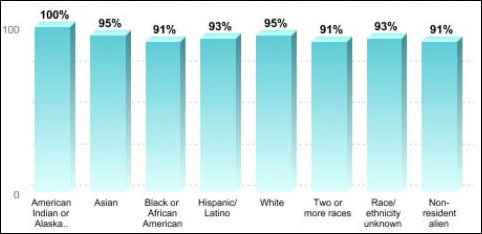
    A second data set tells us how likely African-Americans are to graduate from UVa within six years. I had speculated on the basis of incomplete information that the differential was about 6 or 7 percentage points. In fact, the disparity is only 4 percentage points.

    Percentage of Full-time, First-time Students Who Began Their Studies in Fall 2010 and Received a Degree or Award Within 150% of “Normal Time” to Completion for Their Program

    We can look at this data in two ways. If we adopted the approach of theย Center for Investigative Reporting’s research on mortgage loan discrimination (See “Racism, Racism, Everywhere You Look“), we would emphasize that African-Americans are almost twice as likely as whites (9% compared to 5%) to drop out. Sounds like institutional racism to me! On the other hand, we could emphasize that African-Americans are only 4.4% less likely to graduate than whites. Sounds like African-Americans thrive at UVa!

    One could dig even deeper, comparing the graduation rates of whites, Asians, Hispanics, and African-Americans within the same income ranges. That would filter out the effects of socio-economic advantage and disadvantage.

    To my mind, these data help provide a starting point for an honest, open discussion about race at UVa. We could broaden the conversation by developing comparable data for all public institutions of higher education in Virginia and by comparing UVa’s performance to that of other colleges and universities.

    Will these data become part of the dialogue, or do the organizers of the seminar have some other approach in mind? I have no idea. But I would love to be a fly on the wall to find out.


  • Another Lesson in Virginia Political Corruption

    by D.J. Rippert

    Say governor, is that a Rolex youโ€™re wearing?ย On Sept 4, 2014 former Virginia governor Bob McDonnell was found guilty of 11 counts of corruption. While the US Supreme Court unanimously overturned the conviction Chief Justice John G Roberts correctly described the former governorโ€™s actions as โ€œtawdry.โ€ Back in Virginia, Governor McAuliffe formed an ethics panel to make recommendations and at least one law was passed limiting gifts from lobbyists to state politicians to $100 per year. Case closed, problem solved โ€ฆ right? Of course not! This is the Commonwealth of Corruption. The greased eels of the General Assembly arenโ€™t going to let a little thing like a law โ€œunlineโ€ their pockets.

    Out of the office.ย One constant complaint by General Assembly members is how poorly theyโ€™re paid. They make about $18,000 per year. On an annual basis thatโ€™s pretty low. On a โ€œunits of value createdโ€ basis itโ€™s astronomical given how little they accomplish to benefit the citizens of Virginia. Either way, they also get a $15,000 allowance for โ€œoffice expenses.โ€ Thatโ€™s a lot of Bic pens. In fact, itโ€™s income. Former Lieutenant Governor Bill Bolling wanted to reclassify the money as income. โ€œItโ€™s not that they would make more money, but we would actually be transparent about the money they were making,โ€ said Bolling. โ€œLetโ€™s call it what it is: Itโ€™s income.โ€ No wonder heโ€™s no longer active in Virginia politics!

    Buddy, can you spare a dime, or $100,000?ย The $100 gift limit has several minor exceptions and one major exception. The major exception relates to โ€œpersonal friends.โ€ย  The exception for personal friends is nebulous.ย  Moreover, who do politicians have as friends? CEOs? Union leaders? Why should a sitting politician be able to take a material gift from anyone outside his or her family?ย  Perform this mental test โ€“ when was the last time somebody from outside your family gave you a gift worth more than $1,000? For most people that never happens but apparently this happens a lot to our politicians. I wonder why โ€œfriendsโ€ give politicians lavish gifts?

    Thereโ€™s a little something in this envelope for you.ย Two years ago, long after the McDonnell affair, the Virginian-Pilot published an article entitled, โ€œLawmakers live large on campaign cash, the Virginia Way.โ€ One would assume that the money donated by fun groups like Dominion Resources and Omega Protein as campaign contributions would be used to pay campaign expenses. In the Commonwealth of Corruption that would be a very bad assumption. Hereโ€™s what the Virginian-Pilot has to say about one of our upstanding legislators:

    โ€œAn Associated Press review of the state’s finance system turned up examples like Chesapeake Democrat Del. Lionell Spruill, who hasn’t faced an opponent in two decades.

    Since 2011, Spruill has spent $300,000 from his campaign account on numerous luxuries: a membership in a private business club, meals at Ruth’s Chris steakhouses around the country, and more than $2,000 at high-end Richmond restaurants during legislative sessions. More than 90 percent of the money Spruill raised came from corporations, trade organizations or special interest groups.

    Spruill, who has not listed an outside income in years, declined to comment.โ€

    The Associated Press analysis went on to note:

    โ€œBehavior that would get lawmakers locked up in other states or at the federal level is perfectly fine in the Old Dominion. Virginia is the only state where lawmakers can raise unlimited campaign donations from anyone, including corporations and unions, and spend the money on themselves.โ€

    โ€œA handful of lawmakers, including senior members in both parties, rely almost entirely on business interests and their representatives for campaign contributions. For instance, GOP Senate President Pro Tem Steve Newman has raised more than $360,000 since 2012; 99 percent of that money came from corporations, trade groups, lobbying firms or special interest groups.โ€

    โ€œThe current system has little accountability. Lawmakers must disclose their spending but are free to do so in the vaguest details. Some lawmakers reimburse themselves thousands of dollars from their campaigns with only scant explanation, like “travel reimbursement.” Further, Virginia’s State Board of Elections does not audit or investigate campaign finance reports. Elected prosecutors can investigate campaign finance violations, but longtime political watchers could not recall a case ever being brought.โ€

    The Virginia Way.ย Even those who hold our General Assembly in the lowest possible regard must find this shocking. Despite a national embarrassment over Governor Rolexโ€™s activities four years ago the clowns in The Imperial Clown Show in Richmond (a wholly owned subsidy of Dominion Resources and Omega Protein) can solicit hundreds of thousands of dollars in โ€œcampaign contributionsโ€ which are not needed for campaigns and spend that money on pretty much anything with absolute impunity. Virginia, the most corrupt state in America.


  • Is Amazon Leaning towards Washington?

    In today’s buzz about the location of Amazon’s second headquarters, often referred to as HQ2: There has been an unusual spike in traffic — more than 6,000 views over the past week — for an obscure article in ARLNow, entitled “County Wins Top Environmental Award from U.S. Green Building Council.”

    The vast majority of the traffic can be traced back to an internal Amazon page devoted to its HQ2 search, says ARLNow.

    Of Amazon’s Top 20 candidates, three are located in the Washington metro area: one each Washington, D.C., Montgomery County, Md., and Loudoun-Fairfax in Virginia. Has the e-retail giant added Arlington to the mix?

    Why wouldn’t Amazon lean toward Virginia? The state has a long track record of cooperation with the company on data centers and solar energy. At this very moment, Dominion Virginia Energy has included in its list of proposed grid-modernization projects the expensive burial of a high-voltage transmission line through the Haymarket area of Prince William County to serve an Amazon data center. Although the project would require State Corporation Commission funding, it has raised few eyebrows to date. Amazon jolly well ought to love the Old Dominion.


  • Conservatives Win Big with House Healthcare Plan

    by John Fredericks

    Virginia conservatives โ€“ and the Trump Administration โ€“ should embrace the health care plan rolled out this week by House of Delegates Speaker Kirk Cox, R-Colonial Heights. The House budget includes a plan to bring billions in taxpayer dollars back to Virginia to help uninsured Virginians get health care coverage through Medicaid Expansion.

    For four years, I sang a different tune. I stood shoulder-to-shoulder with my fellow conservatives at Americans for Prosperity, former Speaker Bill Howell, and other Republicans to fight Medicaid Expansion.

    At the time, the future of the Affordable Care Act seemed uncertain, and banking on its promises appeared financially risky. There were fears it would collapse, or be repealed, leaving states to pay for a huge new entitlement we couldnโ€™t afford. That seemed like an unsafe bet for Virginia.

    That all changed in 2017.

    Today, I unequivocally support the House plan to expand Medicaid to hardworking families in Virginia. Hereโ€™s why:

    Obamacare isnโ€™t going anywhere anytime soon. After years of trying, Congressional Republicans showed us in 2017 they couldnโ€™t repeal the law. And even if they try again, which seems unlikely, itโ€™s doubtful they will be successful this year or beyond.

    In addition to lacking votes, federal Republicans last year showed us theyโ€™ve never had anything approximating a viable replacement plan after years of making empty promises to constituents in fund-raising letters. In other words, they misled us.

    The most shocking realization came last spring at a White House briefing on the Republican plan to repeal and replace Obamacare. I sat the in briefing room aghast at what I heard โ€“ the GOP plan rewarded GOP states that expanded Medicaid (like Indiana, Ohio, and Arkansas) with continued funding, and penalized states that resisted expansion by cutting their funding through reduced block grants.

    Instead of benefiting from being a prudent holdout, Virginia would have received less Medicaid funding from Washington! Thanks for nothing.

    While itโ€™s easy enough to retreat into orthodox ideology in the face of complex policy decisions that donโ€™t fit into neat partisan boxes, I prefer to deal in reality rather than bury my head in the sand.

    The House of Delegates budget plan takes the same clear-eyed, reality-based approach by opting to work with President Trump to secure key conservative reforms such as work rules and personal responsibility standards.

    Letโ€™s be honest, this is a plan many Democrats wonโ€™t like. If youโ€™re a Republican, that means youโ€™re doing something right. Youโ€™re reforming a program rather than just providing a handout.

    Speaker Cox is developing a plan incorporating conservative ideals like those Vice President Mike Pence championed when he was Governor of Indiana.

    In my mind, if itโ€™s good enough for a conservative like Mike Pence and Indiana, then itโ€™s good enough for Virginia.

    Speaker Cox undoubtedly will face misguided criticism from those who canโ€™t see past the politics of the moment. Itโ€™s better to have Speaker Cox negotiating the details with Democratic Governor Ralph Northam now than waiting too long and ending up with Del. David Toscano, D-Charlottesville, driving the talks.

    Because make no mistake: Many Democrats want straightforward Medicaid expansion, or worse โ€“ Bernie Sanders-style socialized healthcare.

    The GOP-controlled House is taking the conservative approach to health-care reform and will work with the Trump administration to achieve that goal.

    The House plan aims to put low-income Virginians in private insurance plans with premiums and co-pays, giving them skin in the game. The plan sets up health savings accounts so people are incentivized to make their own health-care decisions. And, most importantly, theyโ€™ve created a โ€œTraining, Education, and Employment Opportunityโ€ program to put people on a path to self-sufficiency. (more…)


  • The Latest Twist in Newspapers’ Downward Spiral

    More Virginia victims of media downsizing:

    Richmond Times-Dispatch. “We are repositioning the Richmond Times-Dispatch in 2018,” says Publisher Tom Silvestri today. “The continued disappearance of print advertising, now coupled with rising newsprint costs, will mean in 2018 we will have to do more with fewer resources.”

    The newspaper, part of the BH Media Group, is raising its subscription rates. Explains Silvestri: “We are shifting from a predominantly advertising-supported business to an operation that relies more on subscription revenue.”

    It’s alsoย eliminating 21 positions and laying off nine employees, leaving 435 jobs. Silvestri did not say how many of the deleted positions are in the newsroom.

    Roanoke Times. Meanwhile the Roanoke Times, also part of the BH Media Group, is eliminating seven jobs. Citing the “harsh reality” of rapid change in the industry, CEO Terry Kroeger cited advertising cutbacks by regional and national clients.

    Fredericksburg Free Lance-Star. The Free Lance-Star and its Print Innovators printing plant are laying off nine employees.ย Publisher Dale Lachniet cited problems with the decline of print advertising. On the bright side, he noted, the newspaperย experienced strong growth in its digital products in the past year, an increase in web and mobile traffic to more than 41 million page views, and a more than 150% increase in digital-only subscriptions.

    Digital advertising doesn’t yield as much revenue per reader as print did. Judging from the Free Lance Star’s digital media kit, those 41 million page views probably translate into less than $2 million a year in advertising revenue. As for that 150% increase in digital-only subscriptions, how does that compare to the loss of print subscriptions?

    Slowly but surely, Virginia’s newspapers, like local newspapers across the country, are cannibalizing themselves. Eventually,ย all but a handful of national newspapers (New York Times, Wall Street Journal) and vanity projects subsidized by billionaires (Washington Post) will shrivel into oblivion. As local newspapers cut editorial staff, they will publish less content and lose eyeballs. As theyย  boost subscription fees, they’ll lose eyeballs even faster.

    The downward spiral will be marked by restructurings, bankruptcies, corporate takeovers, and more restructurings. For example, the Charleston Gazette-Mail in Charleston, W.Va., declared bankruptcy last month. Another media company likely will acquire it, but not before the 206-employee company lays off 50. Here in Virginia, BH Media is the dominant newspaper owner. The corporation is totally unsentimental about preserving its bottom line. It will not hesitate to continue cutting to maintain profitability.

    When the local newspapers are gone, or so diminished that they are barely recognizable, who, then, will report the news? Google? Facebook? Russian fake-news propagandists? What a farce!


  • Drowning Puppies at Senate Finance

    The Senate Finance Committee in action.

    Barring a Lazarus-like resurrection from the dead, a bill that would require Virginia colleges and university boards to allow public input on tuition increases has been killed in the state Senate. The bill won approval in the House of Delegates 99 to 0, sailed through the Senate Committee on Education and Health 14 to 1, but died in the Senate Finance Committee on a 7 to 6 vote.

    The bill, championed in the legislature by Del. Jason Miyares, R-Virginia Beach, and Sen. Chap Petersen, D-Fairfax, had been a top priority of Partners for College Affordability and Public Trust as well as this blog. Reports the Virginian-Pilot:

    James Toscano, president of Partners for College Affordability and Public Trust, testified in support and said after the hearing that the Senate missed an easy opportunity to let Virginiaโ€™s students and paying parents know they care about the high cost of college.

    โ€œItโ€™s bad enough that the cost of higher education in Virginia is spiraling out of control,โ€ Toscano said. โ€œBut failing to ensure the voices of students and parents are heard before public appointees set tuition is a blow to good governance and transparency.โ€

    But the views of the University of Virginia and the College of William & Mary, two of the public institutions that have raised their tuition the most aggressively in recent years, prevailed.

    Representatives for both the University of Virginia and the College of William & Mary said they donโ€™t oppose getting input, but said they give plenty of opportunities throughout the year

    Betsey Daley, U.Va.โ€™s representative, said the board members, president and other officialsโ€™ emails are easily accessible online. The student representative on the Board of Visitors also holds meetings on the issue and is โ€œvery aware of the sentiment and mood.โ€

    โ€œOne public hearing is not a substitute for year-round input we have at U.Va.,โ€ Daley said.

    Bacon’s bottom line: Seriously? Affordability and access are the most important issues facing higher ed today. Student indebtedness, a direct result of unaffordability, is creating a social crisis so acute that President Donald Trump now is contemplating allowing students to discharge their debt through bankruptcy, thus foisting tens of billions of dollars of liabilities onto taxpayers. The real objection is that UVa and W&M don’t want their boards to endure the tedium of hearing the little people bitching about tuition.

    Virginia’s colleges and universities, especially its elite colleges and universities, need more transparency and accountability.ย Their arrogance will haunt them.ย To paraphrase John Paul Jones: We have not yet begun to fight!


  • One Man’s Descent into Healthcare Price Opacity

    In theory, Americans could control runaway healthcare costs if they shopped around for the best deal on big-ticket medical procedures. But in practice, there are limits to a patient’s willingness to compare doctors and hospitals when he’s clutching his chest while medical technicians slap an oxygen mask to his face and trundle him into an ambulance. Likewise, there may be limits if the treatment options are so complex and require such specialized knowledge that a layman cannot make an informed judgment.


    Still, some procedures should lend themselves to comparison shopping. Take hip transplants, for instance.ย The procedure is easily explained by doctors, and the risks are readily grasped by patients. Rarely do patients require emergency surgery. They have ample time to check around to find the optimal balance of price and quality.ย 

    In 2010, according to the Centers for Disease Control, surgeons performed more than 310,000 hip transplants. At an average cost of $40,000 per procedure, hip surgeries account for more than $12 billion a year in health care expenditures. Americans could literally save billions of dollars if they were empowered to spend as much time looking for the best deal on hip surgeries as they do, say, buying a car.

    I had the opportunity last year to put that theory to the test. I had been suffering from an arthritic right hip for several years. While the discomfort usually was tolerable, the infirmity was limiting my mobility. I had trouble getting in and out of the car. I found it difficult to straighten my body when I stood up from a chair. I couldn’t walk more than a mile or so without my hip giving out. If I wanted to live an active life as I approached retirement age, I knew I had to do something.

    My primary care physician referred me to an orthopedic surgeon in the Richmond area, Dr. Jason Hull. He took an x-ray of my hip and found that most of the cartilage had worn away — the hip and socket were scraping bone on bone. I was an obvious candidate for surgery.

    Although he performed 450 to 500 hip and knee replacements a year, Hull confessed that he couldn’t tell me how much the procedure would cost — or even what he would charge. I’d have to ask the business office of his practice, Tuckahoe Orthopedics. As for what Bon Secours St. Mary’s Hospital would charge, I’d have to ask them.

    While I liked Hull’s forthright demeanor and had full faith in his competence, I also felt a responsibility as a health care consumer to check out my options. Over and above what the surgery would cost me personally, I felt a moral obligation to see if I could save “society” some money. As it turned out, being a good health care consumer was all but impossible.

    One idea particularly appealed to me. My friend Bill Moscowitz, a Virginia Commonwealth University pediatric surgeon, highly recommended Health City, a state-of-the-art hospital on Grand Cayman founded by renowned Indian heart surgeonย Dr. Devi Prasad Shetty. Its value proposition: By focusing on a narrow range of high-volume procedures, it could provide treatment at comparable outcomes to the best U.S. hospitals but at much lower cost. Indeed, the hospital was known to put up the patient and a family member in a resort hotel on Grand Cayman’s famed Seven Mile Beach for post-operative recuperation. That sounded like a great way to recover from surgery! When the website confirmed that the hospital performed hip replacements, I had fantasies of my wife and me sipping margaritas and lounging under umbrellas on soft sandy beaches.

    Seven Mile Beach — my kind of rest & rehabilitation.

    I submitted an email inquiry to Health City but, alas, the hospital never responded. Then I thought to inquire if my health insurance company, UnitedHealthcare, even covered procedures conducted at Health City. When I checked, the answer was no. That was a deal killer. It didn’t matter if Health City could under-price an American hospital by 50%, without insurance, I’d personally pay more. So, I restricted my search to hospitals in the Richmond area.

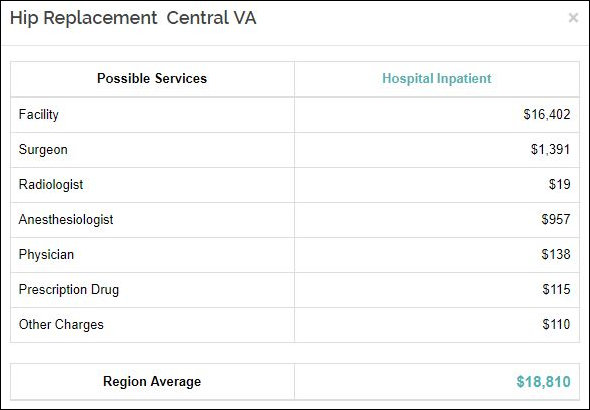
    The Virginia Health Information website provides average cost data for various high-volume procedures performed in Virginia hospitals. Based on 2015 data, the website reveals that the average price of a hip replacement in Central Virginia — $18,810 — was lower than in any other region of the state. (The statewide average was $20,697.) As I recall, when I searched the website last year, it provided average cost figures for individual institutions. I can’t find that data any longer. Here’s all the database offers now:

    Given the fact that a dozen Central Virginia hospitals conduct orthopedic surgeries, this table isn’t remotely helpful. As I recall, VFI data indicated last year that Bon Secours St. Mary’s Hospital had the lowest, or almost the lowest, charges among the high-volume hospitals in the region. The hospital performs more than 2,000 procedures a year, and 10% of its total business consisted of orthopedic surgeries. Dr. Hull also conducted his surgeries there, so I felt certain that, whatever the price, at least I was assured of a positive outcome.

    From a medical point of view, sticking with Hull and St. Mary’s turned out to be a good decision. (more…)