
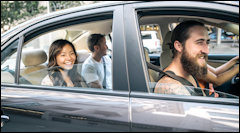
Who Needs a Car, or Bus, When You’ve Got Uber?
Share this article
ADVERTISEMENT
(comments below)
Comments
Comments
5 responses to “Who Needs a Car, or Bus, When You’ve Got Uber?”
-
Seems like good news for everybody except the automakers and oil refiners. If this is a real trend isn’t it also another reason not to start drilling new oil wells near shore?
-
If we ever see the development of cheap, lightweight batteries, the options will explode. Electric motor-boosted bicycles and skateboards, anyone? But Uber and competitors will have a lock on bad/cold weather getting around. My kids already use Uber most evenings in the D.C. region; one does not own a vehicle at all.
-
I’m not sure Uber hurts transit – any more than Airbnb has hurt hotels.
I don’t think people who would us Uber Pool are typical transit users although people who use Uber ARE taxi users.
And they’re both likely to INCREASE congestion, not reduce it.
“uber”-like services while just starting in this country have been common in less developed nations with fewer regulations…
And they may end up with perverse impacts because unlike taxi’s which are a fixed number and in high demand periods – people essentially que up to waiting for the “next available”… the number of Uber drivers and cars will increase in response to demand. In other words at peak demand periods – the streets will be filled with Uber cars and congestion will increase.
I’m not saying it’s necessarily a “bad” thing. It’s a good thing to have a resource that dynamically can serve demand and to have a price than varies in responding to that demand – much like the price of an airline ticket or hotel room varies according to the demand.
The way that traditional transit – subway and bus dealt with that was to add cars and increase the service tempo… i.e. run more seats more frequently.
The difference is that when transit adds more cars – they’re adding dozens of passengers per car whereas Uber will be adding dozens of cars with fewer people – even Uber Pool which have less capacity than traditional transit.
It’s also yet to be proven that Uber can – with sophisticated computer programs – receive calls for service one at a time – and be able to successfully sort them according to origin and destination and then allocate them to nearby vehicles.. The “one or two” block “goal” is just that … It may well “slip” to 3 or 4… especially at rush hour and I’m suspecting that for some folks that kind of a distance might be a deal-breaker especially if they have to proceed on foot across a busy road that really is not good place for pedestrians.
There would end up being a lot of “tweaks” to the computer program – unique to the service area…
by the way – Uber is not the only one doing multi-passenger trip scheduling software. Google “trip scheduling software”.. it’s a “thing” for school bus systems and other …
and yes.. this is yet another area where there are jobs in the 21st century economy – that don’t necessarily require a traditional 4yr degree – but rather technical training in software and specialized fields…
and again – you have to have an education that is well grounded in higher level language, math and science… trip scheduling software uses a specialized field of math…
-
Transit adds more cars – they’re adding dozens of passengers per car whereas Uber will be adding dozens of cars with fewer people.
You’re making the unfounded assumption that transit buses and trains are fully loaded with passengers. They may be — for a few hours out of the day, but they often nearly empty the rest of the day.
And you’re ignoring the possibility that Uber’s shared ridership services can upgrade from vans to buses if volume demands.
Finally, you’re ignoring the potential for Uber to encourage people to sell their cars and switch from single-occupancy vehicles to shared ridership.
-
From what I see, both WMATA and Fairfax County are driving quite a few buses with few (and sometimes no) passengers on board. And in more affluent neighborhoods, the only bus passengers are people coming to work in service jobs and returning home. I’ve even seen a few neighborhoods in McLean fight to get bus routes out of their neighborhoods.
Like rail, buses only work where there is a level of density and willingness to ride the buses. Smaller buses could help.
We have an argument going on in McLean right now. The Comp Plan for the Community Business District (CBD), that is downtown McLean, is 20 + years old and badly in need of revision. It’s up for study. Some people are arguing for more residential density in the CBD to get a walkable, bikeable community. Others oppose more density because it adds to auto traffic, which is growing rapidly because of growth in Tysons.
The latter group is pushing the former to address the fact that few McLean residents take buses and the nearest rail station (McLean station on Route 123) doesn’t serve the CBD. The former doesn’t really have much of an answer, but say Uber will fix the bill. The Palladium condos, built some 12 years ago, has one resident who rides the bus with any regularity.
I’m pretty flexible on the issues, but am pushing to require aggressive TDM plans for any new residential density. So far, we got the County to impose TDM on the Benchmark Properties’ Plan Amendment. Should be an interesting fight in the community.
-


Leave a Reply
You must be logged in to post a comment.