by Dick Hall-Sizemore
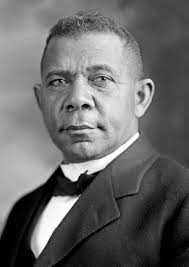
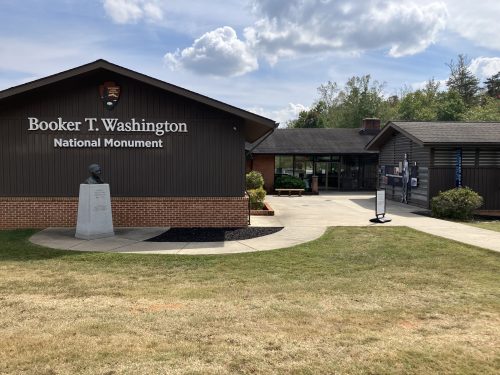
Nestled among the commercial development and luxury homes along Smith Mountain Lake along Rt. 122 between Bedford and Rocky Mount is a National Monument to a slave born in Virginia.
Booker T. Washington was born in 1856 in the community of Hale’s Ford in Franklin County. His enslaved mother, Jane, was the cook on the tobacco plantation of James Burroughs. Burroughs would have been considered a hardscrabble farmer by the wealthy plantation owners in Tidewater Virginia. The Burroughs men and hired hands worked in the fields alongside the slaves. However, his neighbors in Franklin County probably considered Burroughs as one of the well-to-do.
Most of Burroughs’ wealth was bound up in his human property. At his death in 1861, the value of the slaves on his property exceeded the combined value of everything else he owned. That total included the valuation of five-year old Booker–$400.
From an early age, Washington longed for an education. One of his duties was to carry the books for Burroughs’ daughter to school. Washington later wrote that he thought that going to school would be like “getting into paradise.”
After their emancipation, Washington’s mother moved with her children to West Virginia to be with Washington’s stepfather, who had escaped slavery earlier. While in West Virginia, he worked in the salt and coal mines, but his stepfather allowed him to go to school at night. At some point, he left the mines and went to live with and work for a family in the community. The wife of the family “taught him proper conduct and cleanliness and encouraged him to get an education.”
During this time, he heard about Hampton Institute (now Hampton University), a school established for Blacks in 1868. In 1872, at the age of 16, he set out for Hampton Institute, 500 miles away, walking most of the way.
To pay for his tuition and board at Hampton, Washington worked as the school’s janitor. After graduating from Hampton, he went back to West Virginia to teach for two years and then studied briefly at Wayland Seminary in Washington, D.C. He returned to Hampton Institute to teach there. Upon the recommendation of Gen. Samuel Armstrong, the founder of Hampton Institute, Washington was hired to start a school for Blacks in Tuskegee, Alabama.
When he arrived at Tuskegee in 1881, at the age of 25, he found 30 “anxious and eager students,” but little else. There was no land, teachers, or money. The only building was a leaky shanty. Washington and the students literally built the school themselves, using bricks they fired in a kiln they built. At Washington’s death in 1915, Tuskegee Institute had more than 100 buildings, approximately 1,500 students, 200 faculty members, and an endowment of about $2 million.
(more…)