
by Dick Hall-Sizemore
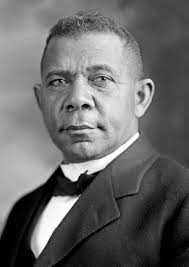
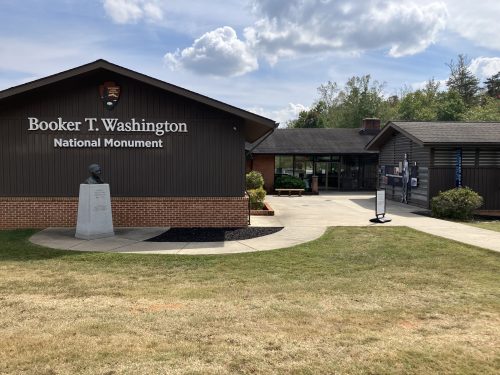
Nestled among the commercial development and luxury homes along Smith Mountain Lake along Rt. 122 between Bedford and Rocky Mount is a National Monument to a slave born in Virginia.
Booker T. Washington was born in 1856 in the community of Hale’s Ford in Franklin County. His enslaved mother, Jane, was the cook on the tobacco plantation of James Burroughs. Burroughs would have been considered a hardscrabble farmer by the wealthy plantation owners in Tidewater Virginia. The Burroughs men and hired hands worked in the fields alongside the slaves. However, his neighbors in Franklin County probably considered Burroughs as one of the well-to-do.
Most of Burroughs’ wealth was bound up in his human property. At his death in 1861, the value of the slaves on his property exceeded the combined value of everything else he owned. That total included the valuation of five-year old Booker–$400.
From an early age, Washington longed for an education. One of his duties was to carry the books for Burroughs’ daughter to school. Washington later wrote that he thought that going to school would be like “getting into paradise.”
After their emancipation, Washington’s mother moved with her children to West Virginia to be with Washington’s stepfather, who had escaped slavery earlier. While in West Virginia, he worked in the salt and coal mines, but his stepfather allowed him to go to school at night. At some point, he left the mines and went to live with and work for a family in the community. The wife of the family “taught him proper conduct and cleanliness and encouraged him to get an education.”
During this time, he heard about Hampton Institute (now Hampton University), a school established for Blacks in 1868. In 1872, at the age of 16, he set out for Hampton Institute, 500 miles away, walking most of the way.
To pay for his tuition and board at Hampton, Washington worked as the school’s janitor. After graduating from Hampton, he went back to West Virginia to teach for two years and then studied briefly at Wayland Seminary in Washington, D.C. He returned to Hampton Institute to teach there. Upon the recommendation of Gen. Samuel Armstrong, the founder of Hampton Institute, Washington was hired to start a school for Blacks in Tuskegee, Alabama.
When he arrived at Tuskegee in 1881, at the age of 25, he found 30 “anxious and eager students,” but little else. There was no land, teachers, or money. The only building was a leaky shanty. Washington and the students literally built the school themselves, using bricks they fired in a kiln they built. At Washington’s death in 1915, Tuskegee Institute had more than 100 buildings, approximately 1,500 students, 200 faculty members, and an endowment of about $2 million.
It was a speech in 1895 to a largely white audience at the Cotton States and International Exposition in Atlanta that brought Washington national attention. In that speech, he advocated an incremental approach, in which Blacks would accept racial segregation and discrimination in exchange for free education, vocational training, and economic opportunities. He declared:
“The wisest among my race understand that the agitation of questions of social equality is the extremest folly, and that progress in the enjoyment of all the privileges that will come to us must be the result of severe and constant struggle rather than of artificial forcing. No race that has anything to contribute to the markets of the world is long in any degree ostracized. It is important and right that all privileges of the law be ours, but it is vastly more important that we be prepared for the exercises of these privileges. The opportunity to earn a dollar in a factory just now is worth infinitely more than the opportunity to spend a dollar in an opera house.”
As one historian explained, through moderation, Washington “hoped to secure the good will of the white man and the eventual recognition of the constitutional rights of American Negroes.”
As he traveled in his attempts to raise funds for Tuskegee, he received other invitations to speak at national venues. He built up a wide network of contacts, philanthropists, and politicians. He consulted with the leaders of industry and finance. He dined at the White House with President Theodore Roosevelt, the first Black person to do so. As one scholar noted, Washington “was arguably the most influential black man in the country.”
Washington’s positions were controversial within the Black community. His most prominent critic was W.E.B. Du Bois. “Washington, the more conservative of the two, advocated a gradual approach toward gaining civil rights, starting with economic concerns rather that political or social issues. Du Bois, the more radical of the two, insisted on immediate and full civil rights in all areas.” Du Bois also objected to “Washington’s emphasis on industrial education as the sole method of education for blacks, because he believed that training them primarily for manual labor did not prepare them for higher learning or better opportunities.”
Du Bois labelled Washington’s famous 1895 speech in Atlanta as “the Atlanta Compromise.” That term has stuck through the ensuing years and historians have generally agreed with Du Bois that Washington was an accommodating figure.
More recent historians have advanced a more nuanced, positive view of Washington. They have discovered that, while refusing to publicly criticize Southern steps to disenfranchise Blacks, Washington was “nevertheless secretly engaged in attacking them by legal actions.” He raised money to fight electoral provisions of several Southern states and he spent a great deal of his own money to finance court challenges. A leading Washington biographer, Louis Harlan, argued that Washington had to walk a fine line. “An open and direct challenge to Jim Crow would wreck his precarious relationship with southern whites. Even the northern philanthropists who aided him would frown on tactics of social conflict.” Unlike his northern Black critics, Washington had “frequent reminders that the violent race relations of the era could touch him.” Describing the elaborate steps, including the use of third parties, spies, and secret codes, Washington took to conceal his involvement in efforts to to influence legal fights against disenfranchisement and in “many schemes for black strength, self-improvement and mutual aid,” Harlan likened Washington to “a Machiavellian prince.”
Two other historians have summarized Washington in these terms:
“Booker T. Washington advised, networked, cut deals, made threats, pressured, punished enemies rewarded friends, greased palms, manipulated the media, signed autographs, read minds with the skill of a master psychologist, strategized, raised money, always knew where the camera was pointing, traveled with an entourage, waved the flag with patriotic speeches, and claimed to have no interest in partisan politics. In other words, he was a artful politician. He was not a lawyer, scholar, college-bred man, or a military hero. But he knew how to use the power of symbolism through the lens of a storyteller.”
It was a remarkable journey from being born into slavery on a tobacco farm in Franklin County, Virginia to hobnobbing with titans of American industry and finance, dining at the White House with the President of the United States, and being considered the most influential Black person of his era.
(Note on sources: Except where indicated, my source of most of the biographical background in this article was a pamphlet published by the National Park Service, available at the Booker T. Washington National Monument.)
My Soapbox

Trump’s complaint about museums talking about “how bad Slavery was” and his administration’s actions to remove material, including items dealing with slavery, that “disproportionately emphasize negative aspects of U.S. history without acknowledging broader context” from national parks and monuments do not seem to have reached the Booker T. Washington National Monument.
The introductory film in the visitor center starts off, “Slavery was the primary cause of the Civil War.” The information pamphlet available at the visitor center includes the following description of Washington’s childhood as a slave on the Burroughs plantation:
- Washington later wrote that he was born “in the midst of the most miserable, desolate, and discouraging surroundings.”
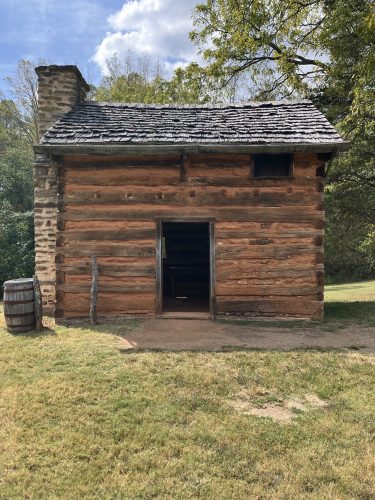
- Washington, his mother, and his two siblings lived on the first floor of the cabin that doubled as the kitchen for the plantation. They “slept on a pile of rags on the dirt floor of the kitchen cabin.”
- Even as a small child, Washington “cleaned the yards, carried water to the men in the fields, and took corn to the mill.”
- Washington later wrote, “From the time that I can remember anything, almost every day of my life has been occupied in some kind of labour.”
- Burroughs rationed food for his slaves. They often went hungry. Washington “remembered his mother sometimes waking them late at night to secretly feed them chicken.”
- There was no mealtime for Washington and his family as a boy on the plantation. He said they got a piece of bread here and a scrap of meat there, “much as dumb animals get theirs.”
- “When he was older, [Washington] fanned flies away from the Burroughs’ table while they dined. He saw the bounty of their meals, so different from what he ate.”
- “Masters controlled enslaved people with fear. Many, even children, were flogged or whipped for the most trivial offense.” Washington later related, “…when I was late getting home [from delivering corn to the local mill] I knew I would always get a severe scolding or a flogging.”
- A memory that haunted Washington for the rest of his life was the sight of his uncle being stripped, tied to a tree, and beaten with a cowhide whip. “As each blow touched his back, Pray Master! Pray Master! came from his lips….”
Leave a Reply
You must be logged in to post a comment.