
Includes $21.8 million paid to managed care programs for dead enrollees.
-
Virginia’s Medicaid Finances
-
How to Make Sure Virginia Universities Are Governed by Unaccountable, Leftist Oligarchies Forever
-
SCC Rejects Effort to Reverse Its Gas Plant Approval
by Steve Haner

Rendering of Chesterfield project from Dominion’s public website. The Virginia State Corporation Commission has rejected a petition for reconsideration pushed by opponents of Dominion Energy’s planned Chesterfield natural gas generators. The environmental activist groups could now appeal the SCC’s approval of the plant to the Virginia Supreme Court.
The SCC is a court, after all, so its decisions can be appealed. Whether continued legal wrangling over the 944-megawatt facility will delay the utility’s construction timeline is not clear, but there was no order from the SCC for the utility to pause preliminary work during the two months of this reconsideration process.
The petition for reconsideration was filed on December 15 last year and answered by Dominion on January 16 this year. In a decision that was dated February 12, the three-member Commission stood by its conclusion that imminent threats to the electrical system’s reliability were sufficient to authorize the utility to build a new carbon-emitting power plant, despite the hurdles put in place by the Virginia Clean Economy Act.
“In addition to Dominion’s evidence on this issue, expert witnesses for the Commission’s Staff (“Staff’) and for the Office of the Attorney General’s Division of Consumer Counsel (“Consumer Counsel”) did not question Dominion’s conclusion that a threat to reliability exists,” the Commission wrote.
-
Best of Intentions, Unintended Consequences

by Matt Hurt
Maintaining an appropriate level of orderliness in school is a delicate, nuanced balance when done well. Without discipline learning can’t take place. Good teachers are loath to remain in schools that do not maintain appropriate student behavior. Students respond to some practices by some teachers and administrators, and run roughshod over others. Many strategies have been put in place over the years to address positive disciplinary approaches, but none seem to be able to compete with good old-fashioned high expectations and relationships.
During this General Assembly session our legislators in Richmond are considering HB298, a bill which intends to prohibit schools from suspending or expelling students prior to considering evidence-based restorative disciplinary practices. Generally speaking, evidence-based restorative disciplinary practices are intended to replace punitive disciplinary actions with other approaches such as mediation, relationship building, harm repair, etc.
There are currently more suspensions and expulsions than are desired, and this is a real problem. In some schools, these are the primary methodologies for maintaining discipline in the building. There are many incentive structures that cause student misbehavior, and just as many strategies to successfully mitigate those behaviors. When our primary tool is a hammer (suspension), then every problem presents as a nail.
There are problems with suspension as the primary response to negative student behaviors. First, when students are suspended, they are not learning. Once students are out of our sight, we have no way of making sure that they attend to their studies. Second, when students are suspended, they are likely having more fun than they would have if they were sitting in class. Sometimes the freedom from school provides enough incentive for additional negative behaviors in the future.
(more…)
-
Jeanine’s Memes
See more memes at The Bull Elephant
-
Bacon Meme of the Week

-
Big Batteries Lose Big Energy Every Charging Cycle
by Steve Haner

An inconvenient truth of utility-scale battery operations is that they take in more power than they later put out. From an energy grid operations point of view they are considered “net load” and certainly not a generation asset.
In a previous post about the battery mandate legislation now poised for passage in both the Virginia Senate and the House of Delegates, a national energy laboratory was cited as reporting the batteries lose about 15 percent of stored energy on one “round trip”, a charge-discharge cycle. For every 100 megawatt hours stored, they can later discharge 85 megawatt hours.
A local energy engineer then contacted Bacon’s Rebellion to argue that the efficiency figure is worse than that. He came armed with actual performance data on North Carolina and Virginia utility scale batteries from 2020 to 2024, culled directly from U.S. Energy Information Agency public data.
Of the 36 battery installations tracked, 33 were in North Carolina, which is ahead of Virginia in using both solar power and related battery backup facilities. The utilities report to EIA how much power the batteries took off the grid over the year, and how much they put back in when called upon.
(more…)
-
“The facility staff failed …”

by James C. Sherlock
Either the title of this article or “the facility failed” is stock language used in every summary of a citation for a nursing home’s violation of federal regulation. It is the truth, but not the whole truth.
Inspectors come to a nursing home in Virginia once every couple of years. The staff of each chain-owned nursing home is instructed on what to do and how to do it and is closely monitored year-round by the chain’s regional operations and nursing representatives.
So, a change in the language seems appropriate.
Perhaps write “the management and staff of chain xxx, and the staff of the facility failed …” for each citation. That is the full truth and would enable both the Centers for Medicare & Medicaid Services (CMS) and state oversight authorities to track chain performance through a new metric.
The author, with a high tolerance for boredom, reads journalist reports and academic and government studies on the effects of ownership structures on the quality of care in nursing homes. Many make a great deal out of small differences. He decided to examine that topic in Virginia.
The differences here are stunning in their scale and consistency.
Consider some of the facts.
Ownership Structures
Virginia has 289 nursing home operating companies certified for Medicare and Medicaid, for Medicare alone or Medicaid alone. Of those, an assessment of ownership records reveals:
- 171 facilities owned by private equity;
- 60 by 501(c)(3)s;
- 23 by corporations;
- 14 by individuals;
- 12 by partnerships; and
- 9 by state or local governments.
CMS provides a Survey Summary database as a baseline to assess compliance with federal nursing home regulations. To that is added for this discussion:
- the names of the chains. Chains control all of the private equity facilities.
- The current staffing ratings and occupancy rates offer context for chain business models.
The chart below shows the chains with the highest average number of health violations per facility in the current inspection cycle.
-
A Delinquent Water Bill Dashboard?
by Jon Baliles
The City of Richmond put out a release last week touting the Department of Public Utilities (DPU) “Back on Track” program that offers any customer with an outstanding balance to sign up for a payment plan before March 31st. Both residential and commercial customers with delinquent balances can set up an interest-free payment plan without any convenience fees for up to 24 months to avoid service disruption. Those customers with already existing payment plans will also be able to renegotiate outstanding balances. Residential customers may enroll with a 10% down payment of their delinquent balance and commercial customers may enroll with a 20% down payment, and plans can run up to 24 months, depending on the account balance.
DPU Director Scott Morris said, “Back on Track is an important campaign to help maintain and strengthen DPU’s financial health and long-term stability, both key factors in ensuring our ability to meet the needs of our customers and keep rates affordable. This campaign strikes a balance between fiscal responsibility and compassion for our community by offering customers a meaningful opportunity to resolve past-due utility balances.
It’s good the city is facing the delinquent billing issue and trying to be helpful with payment plans and terms. But what’s missing from the public view (again, there’s that lack of transparency thing) is the question, how will the city and the public track this program and measure if it is a success?
Even before Covid, DPU was facing an acute delinquent billing problem; since 2020 it is has been downright massive. Last fall when Mayor Danny Avula kicked off his MAP (Mayoral Action Plan), he talked about using dashboards to measure progress for all kinds of things, and this payment plan initiative is one of those things that’s perfect for measuring progress and using a dashboard to show it.
(more…)
-
Governor Youngkin’s Fiscal Legacy
Jim Bacon chats with former Finance Secretary Cummings about former Governor Glenn Youngkin’s budgetary achievements, Virginia’s economic development track record, and how well positioned the commonwealth is to survive a federal financial meltdown.
Lightly edited transcript
Jim Bacon: Hello, everyone. I’m Jim Bacon, and this is the Oinkonomics podcast.
Whatever your feelings about Glenn Youngkin’s performance as governor, it’s hard to deny that he left Virginia in sound financial condition. Many states are struggling with current-year budget deficits, and even more with year-ahead and long-term deficits. Virginia consistently ran budget surpluses during Youngkin’s term and built up its financial reserves, even while giving back $9 billion to taxpayers and tax cuts and rebates while funding a 7% inflation-adjusted growth in general fund spending. Here with us today to talk about Governor Youngkin’s fiscal legacy, we have his former Secretary of Finance, Steve Cummings. Greetings, Steve.
Steve Cummings: Hi, Jim. Thanks for having me.
Bacon: Why don’t we start off with you describing how Governor Youngkin chose you to be Secretary of Finance and how he thought of your job as a chief financial officer?
Cummings: I will be honest, when I got the first call on this, I was mystified — I asked first, did you have the right number? — because my professional life has been in the private sector in all different forms of banking over the course of 40 some years. After we got through that, I talked about my background and how it I felt like I wasn’t sure how it fit. The Governor basically said, Steve, those are exactly the reasons I want you. I want to bring private sector orientation, how we provide transparency around what we’re doing, how we provide real truth in numbers, and through that create more accountability and ownership throughout our team, and just make sure we’re running this the best possible way we can on behalf of the citizens of Virginia.
(more…)
-
Mandated Public-Sector Unions Will Drive Up Property Taxes

Image credit: Chat GPT by the Liberty Unyielding staff
In Virginia, the Democratic state legislature is likely to adopt legislation that requires local governments to engage in collective bargaining with public-employee unions. If the local government and the union can’t agree on a big wage hike, an arbitrator will still be able to order the big wage hike if the arbitrator thinks it is a good idea. That means huge costs for local governments, which will likely result in property tax increases.
Democratic legislators don’t mind imposing those big costs on local governments. But local governments do — even some controlled by Democrats. The Democratic head of the Prince William County School Board called the bill “The single largest tax increase in Virginia history.”
WJLA reports:
The Prince William County School Board Chair is slamming a bill, supported by Gov. Abigail Spanberger, that would expand collective bargaining for public sector employees.
“This new bill wants to mandate collective bargaining and mandate what’s called binding arbitration, which forces districts to pay a salary based on some unelected person who’s an arbitrator who tells us what we have to do,” School Board Chairman Babur Lateef told me. “And we don’t agree with that. We don’t believe that should be done for any school division in the state or any locality. We believe local governments should have the right to choose whether they want to collectively bargain or not, and it shouldn’t be mandated. The current bill, as it stands, doesn’t fund the mandate, so the state wants to mandate it, but they don’t want to pay for it. If this bill passes, it will be the single largest tax increase in Virginia history, because all of the responsibility for these payments and salaries will be on the localities, local taxpayers, property taxes, and everyone in communities, and it will bankrupt local governments and bankrupt school divisions.”
(more…)
-
Gutting Two Constitutions To Rig Future Elections
by Derrick A. Max
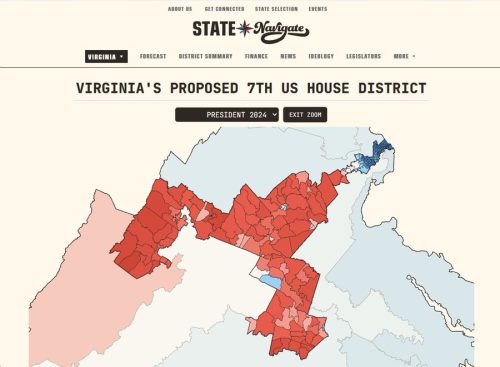
In a dizzying display of power, the Democrats in the General Assembly voted this week to assign Virginia’s electoral college votes to the Presidential candidate who wins voter-dense urban and suburban areas in other states nationwide. They also voted to approve a gerrymandered congressional map that will give progressive and populous Northern Virginia control over five Virginia congressional districts, three more than it should have based upon its population.
All Virginians will have their votes for President diluted and marginalized, and voters in many of Virginia’s cities and counties outside Northern Virginia will have their choices for Congress decided by a handful of precincts far away. The brilliant Electoral College devised by the Founders two centuries ago and the Virginia Constitution’s brand-new amendment to prevent this kind of gerrymander will both be forgotten.
With both chambers of the General Assembly voting along party lines to enroll the Commonwealth in the National Popular Vote Interstate Compact (NPVIC), Virginia has agreed to award all of its presidential electors to the candidate who wins the national popular vote, even if that candidate was rejected by a majority of Virginia voters (imagine the irony: Donald Trump would have won Virginia’s electors in 2024 under this proposal).
While this compact will not go into effect until enough states have joined to account for 270 electoral votes, Virginia brings the total to 222.
-
Several Senate GOP Bills Seek to Amend or Repeal Clean Economy Act
By Steve Haner,
Several legislative attempts to either repeal outright or reduce the cost impact of the Virginia Clean Economy Act (VCEA) will have their fifteen seconds in the sun later today. Their chances of surviving until sundown are slim.

Senator Bill DeSteph The various bills, all with Republican sponsors, are set to be discussed in the Virginia Senate Commerce and Labor Committee. So far, that panel has been taking up various bills to expand or add complexity to the 2020 legislation’s various mandates.
Now come the efforts to kill it. In 2022, following Governor Glenn Youngkin’s election, the House of Delegates with its refreshed GOP majority passed a VCEA repeal bill. It could not clear the Senate, still controlled by the Democrats, and frankly that first repeal effort got no support from Youngkin or his team.
This year, the strong push to get Virginia out of this self-imposed energy straight jacket is coming from the Senate, and House Republicans didn’t mount a serious charge.
Adding a touch of drama, today is also the day the Trump Administration is going to repeal the 2009 Environmental Protection Agency ruling that carbon dioxide is a pollutant subject to air pollution regulations. That “endangerment finding” is the justification for the state-level VCEA just as much as it is for all the federal efforts to ban coal and natural gas electricity.
(more…)
-
Just Askin’
Does anyone think this story would be huge news if Glenn Youngkin were still governor?
-
A Recent Graduate’sTake on VMI
by Dick Hall-Sizemore

Because I have no personal contact or knowledge of VMI, I have been loath to weigh in on the debates that have been raging on this blog. However, last week, I had the opportunity to have an extended conversation with a recent VMI graduate, which I found enlightening.
Here is some background about the graduate in order to provide some context for his remarks:
- He is white.
- He and his family are moderate Democrats, very critical of Donald Trump.
- Although his parents supported him, VMI would not have been their choice of a college for him.
- He did not choose to enter the active military after graduation.
- He is on a path for a successful career.
He was dismissive of the proposed actions of the General Assembly and took issue with the charge that there is racism at VMI. He felt the core of the problems lay with athletes who were recruited by the school. They agreed to come to VMI because they wanted to play for a Division I school, not because they were attracted by the culture of VMI. On the contrary, they disliked being at the school. He pointed out that every cadet gets a copy of the “blue book”, which sets out the rules that cadets must follow. Every cadet, even athletes, is expected to follow those rules. Many of the athletes did not like being at the school and certainly did not like being bound by the strict rules. As a result, they often did not follow them. Consequently, they were disciplined and they complained.
In response to my question about Confederate heritage, the recent graduate replied that he did not see any emphasis on it at all.
He lavished praise on the academics of VMI. Each class has about 15 students. The classes are all taught by faculty members, not teaching assistants. The faculty members are well versed in their fields, but prefer a small college, teaching environment rather than a larger, research institution. Faculty members are readily available for consultation with their students. He related how one of his teachers had been especially helpful in helping him decide on his career path.
In summary, he recognized that the VMI experience was not suitable for everyone, but “it was good for me.”

