
by Steve Haner
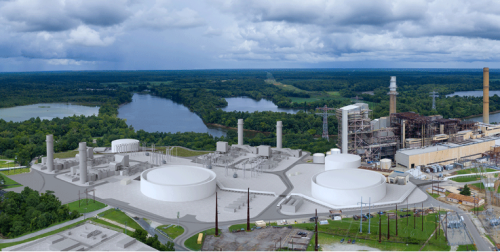
The Virginia State Corporation Commission has rejected a petition for reconsideration pushed by opponents of Dominion Energy’s planned Chesterfield natural gas generators. The environmental activist groups could now appeal the SCC’s approval of the plant to the Virginia Supreme Court.
The SCC is a court, after all, so its decisions can be appealed. Whether continued legal wrangling over the 944-megawatt facility will delay the utility’s construction timeline is not clear, but there was no order from the SCC for the utility to pause preliminary work during the two months of this reconsideration process.
The petition for reconsideration was filed on December 15 last year and answered by Dominion on January 16 this year. In a decision that was dated February 12, the three-member Commission stood by its conclusion that imminent threats to the electrical system’s reliability were sufficient to authorize the utility to build a new carbon-emitting power plant, despite the hurdles put in place by the Virginia Clean Economy Act.
“In addition to Dominion’s evidence on this issue, expert witnesses for the Commission’s Staff (“Staff’) and for the Office of the Attorney General’s Division of Consumer Counsel (“Consumer Counsel”) did not question Dominion’s conclusion that a threat to reliability exists,” the Commission wrote.
What a lawyer might call a fact not in evidence, but something the SCC may have noticed, is there seems to be no legislation pending at the 2026 General Assembly to amend or repeal that reliability exception language. One bill that would have created some new delaying tactics before another gas plant could be approved was defeated. The General Assembly’s process is far from complete, of course, and Governor Abigail Spanberger (D) will have many bills on her desk where such an amendment from her would be possible.
A pending revision to the state-mandated integrated resource planning process, legislation with many bad provisions that will require a close examination at a later point, does allow the electric utilities to offer future IRP plans which rely on that reliability exception for future hydrocarbon generation. Perhaps enough members of the “net zero” caucus now recognize that natural gas will need to be around beyond its stated 2045 death sentence in the VCEA.
The opponents of the Chesterfield plant also accused the SCC of ignoring evidence that the plant, to be built on the location of a closed coal-burning facility, violated the state’s environmental justice law. The Commission asserted it was thorough.
“As with the above issues on reconsideration, the Commission considered the entire record on environmental justice issues, not simply the parts expressly discussed in the Final Order. And that record includes Dominion’s evidence establishing that no “disproportionate” share of negative impacts falls on identified environmental justice communities,” the Commission wrote.
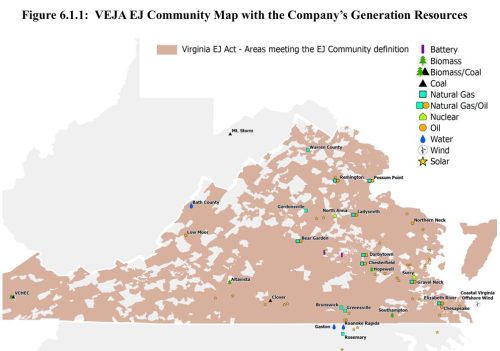
In its most recent IRP update, Dominion shared with the Commission and the rest of us the map set out below. With all the various group of people who are deemed disadvantaged or worthy of extra deference when siting an energy facility, there are not many parts of Virginia that are not covered by the “environmental justice” label.
One might suspect the goal of all that falderol is to simply keep anything with any kind of environmental impact (and what has none?) from being built.
Leave a Reply
You must be logged in to post a comment.