• General Assembly Democrat Bill Supports Gender Transition at 16 Without Parental Consent

    Del. Candi King, (D) – House District 2 Stafford and Prince William (Facebook)

    by James C. Sherlock

    I note that House Bill No. 2091, with Patrons Munden-King,ย Clark, Hope, Maldonado, Rasoul and Simon does two things:

    1. It modifies Code of Virginiaย ยง 20-124.6. Access to minor’s recordsย to permit health care providers to deny a minor patient’s records to parents if, in the providerโ€™s judgment, providing those records would be “reasonably likely to deter the minor from seeking care.”
    2. It modifies Code of Virginiaย ยง 54.1-2969. Authority to consent to surgical and medical treatment of certain minorsย by adding:

    “L. Any minor 16 years of age or older who is determined by a health care provider to be matureย and capable of giving informed consent shall be deemed an adult for the purpose of giving consent toย consultation, diagnosis, and treatment of a mental or emotional disorder by a health care provider orย clinic.”

    “Deemed by a health care provider.”

    Going out on a limb, letโ€™s take gender dysphoria as an example. (more…)


  • Virginia’s Four Largest Not-for-Profit Health Systems and Medically Underserved Areas Next to their Headquarters


    by James C. Sherlock

    A challenge to Virginiaโ€™s largest not-for-profit health systems: just do it.

    Take the lead.

    Note the medically underserved areas (MUAs) next to your headquarters and flagship hospitals and provide primary care in those locations.

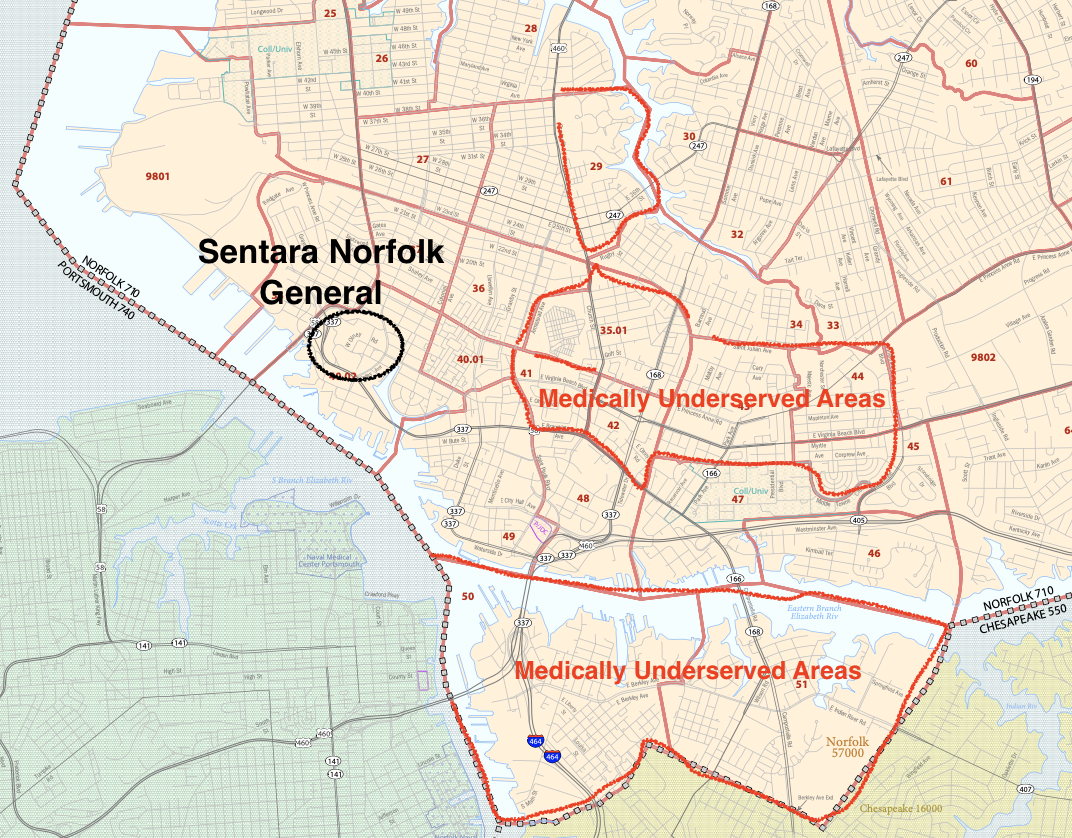
    Virginia has federally-designated MUAs in Arlandria (INOVA), Norfolk (Sentara), Roanoke (Carilion) and Lynchburg (Centra). Those health systems are each headquartered in those cities.

    1. Arlandria is four miles from INOVA Alexandria Hospital. It was just designated in 2022.
    2. The medically underserved census tracts in Norfolk (pictured above) are closer than that to Sentaraโ€™s flagship Norfolk General Hospital. Those are just the worst of them. Eight more Norfolk census tracts made the list. Pretty much every poor area of the city. I got tired of outlining them. But you get the idea. Originally designated in 1994. Updated in 2009.
    3. Carilion Roanoke Community Hospital is right at the edge of that cityโ€™s underserved tracts. Originally designated in 1998. Updated in 2012.
    4. Underserved areas in east Lynchburg are in the service area of Centra’s flagship Lynchburg General Hospital. Designated in 1994. Updated in 2011.

    The leadership of those health systems drive through those areas on the way to work.

    Not-for-profit health systems conduct community health needs assessments (CHNA) once every three years to meet federal and state requirements. The CHNAs of those four health systems have recognized that those areas are underserved in primary care for a very long time.

    Time for them to take the lead to provide primary care in communities a bicycle ride from their headquarters and major hospital facilities.

    Then as a state we can move forward into more challenging areas. (more…)


  • Jeanine’s Memes

    from The Bull Elephant


  • Virginia Medically Underserved Areas for General Assembly Consideration

    by James C. Sherlock

    We have a new General Assembly session. With that comes lots of healthcare bills.

    I will not examine each one, but I have a suggestion for criteria to be applied by the Senate and House committees that do.

    Ask yourselves how, if at all, each bill helps the federally designated medically underserved areas (MUAs) in Virginia.

    Then ask how can any bill be a priority for funding ahead of those that do help that problem.

    Then remember that providing primary care to underserved areas is proven to save a ton of Medicaid money net where it has been tried, as in Maryland, because of inpatient care avoidance.

    Then ask the not-for-profit health systems that serve those areas to testify how, exactly, they can be medically underserved when that is what the health system tax exemptions are meant to prevent, and free cash flows have been extraordinary for decades.

    And, finally, if you have no bills that help provide additional primary care to those areas, you arenโ€™t doing it right. (more…)


  • Youngkin Wants to Jump-Start Economic Growth

    Governor Glenn Youngkin delivering his State of the Commonwealth address. Photo credit: WTVF.org

    by James A. Bacon

    Governor Glenn Youngkin addressed many topics in his State of the Commonwealth address last week, ranging from the meltdown in K-12 education to the surge in suicides, drug overdoses, and homicides. But he spent the most time talking about Virginia’s declining economic competitiveness.

    Once upon a time, making the Commonwealth economically competitive globally and within the U.S. was a primary preoccupation of Virginia governors and lawmakers, both Democratic and Republican. There was a bipartisan consensus that a rising tide lifts all boats, that the path to prosperity was attracting corporate capital, fostering technological and business innovation, creating jobs, and raising wages.

    In the Age of Wokeness, you don’t hear the term “economic competitiveness” much anymore. For instance, at the University of Virginia the unremitting emphasis is on achieving “social justice” and, secondarily, combating climate change. The terms “wealth creation” and “economic prosperity” have dropped out of the vocabulary. UVa is hardly unique. The same priorities can be seen in the media, across higher ed, and, remarkably enough, in some of Virginia’s leading business lobbies.

    Ironically, the more Virginia’s new ruling class has focused on social justice, the less of it we have gotten. In large measure that’s because Virginia is falling behind in economic competitiveness. The biggest losers in a stagnant economy are the working poor. Youngkin’s diagnosis of what ails Virginia is worth recounting. (more…)


  • Bacon Meme of the Day


  • Has COVID Already Peaked for Winter 2023?

    Screen capture from Virginia Department of Health website, using Virginia Hospital and Healthcare Association data. Click for larger view.

    Last year in Virginia, the COVID-19 hospital count hit its winter season peak on January 12 at more than 3,700 beds occupied. Now the 7-day average is below 1.100, and Thursday’s daily count (reported Friday) dropped below 1,000 to 990. The most recent peak was Jan. 4. Flu and RSV are also on the wane, only a handful of weeks after the media scarecrows ran story after story of the coming triple-demic disaster. Being sick remains something to avoid, and the vulnerable can still die from any one of the three (or a combination, shudder). I personally give most of the credit to the vaccinations, especially among the elderly or vulnerable. Those who have actively sought to discourage them should be ashamed of themselves, but the nonsense remains rampant.

    (Update:ย  The hospital count as of Jan. 16 is now down to 905.ย  The decline has lasted almost two weeks.)


  • In Search of the Fountainhead of Religious Freedom in Virginia

    In Search of the Fountainhead of Religious Freedom in Virginia

    by James Wyatt Whitehead, V

    A recent trip to study the Civil War battlefield of Fredericksburg brought me to stately Washington Avenue in one of Virginiaโ€™s most historic cities. The street is adorned with grand Victorian mansions and Kenmore, the colonial home of Fielding and Betty Lewis (George Washingtonโ€™s sister). Here stands a statue to Patriot Hugh Mercer, the famed officer who led the Continentals to victory at the Battle of Princeton and died from wounds received in battle.

    Not far away stands a stone monument bearing bronze plaques memorializing the January 1777 meeting of Thomas Jefferson, Patrick Henry, Edmund Pendleton, George Mason, George Wythe, and Thomas Ludwell Lee to draft the Bill Establishing Religious Freedom in Virginia. I have traveled this street many times, and I knew of this famed meeting of luminary patriots, but I had never noticed this modest yet important memorial.

    I couldn’t help but wonder: Had I stumbled onto the very fountainhead of religious freedom in Virginia? A brief search on my cell phone revealed that this memorial dated back to 1932. No fountain here, but I was close, for the memorial had originally been installed on George Street near the site of Weedonโ€™s Tavern, where Jefferson and company began their earnest work. It was moved in 1977 to its current, more attractive location.

    My journey next brought me to the site of Weedonโ€™s Tavern. The building that stands there today looks like an old A&P Supermarket that is now an antique store. Old Weedonโ€™s Tavern burned in 1807. The establishment was owned by one of Washingtonโ€™s generals, George Weedon. (I have to assume Washington slept here too.) It is here that members of the Committee of Law Revisors began their task to remake the government of Virginia. (more…)


  • Newport News Schools Making Changes After Shooting – But Not Enough Yet

    Evolve Technology
    Courtesy Kenton Brothers

    by James C. Sherlock

    Better late than never. Truly.

    The Daily Press reported today that the Newport News school board has secured funding for state-of-the-art metal detectors.

    State-of-the-art means systems that can detect weapons without the long lines and delays we associate with such systems.

    As an example, a 125-year-old company, Kenton Brothers, offers Evolve Technology that combines artificial intelligence with digital sensors that they claim can screen visitors and students 10 times faster that older methods.

    Kenton Brothers inevitably has competitors with similar technologies. Perhaps better ones. ย These systems wonโ€™t keep teachers or kids from getting assaulted in schools, but should reduce knifings and shootings.

    Which is something.

    But to restore order, metal detectors must be paired with old-school zero tolerance discipline. The long-adopted, utterly failed Positive Behavioral Interventions and Supports (PBIS) discipline system must be scrapped in Newport News schools.

    Which is something else. (more…)


  • Virginia Democrats’ Rent Control Bills Would Make Housing Scarcer

    by Hans Bader

    In Virginia’s legislature, rent-control legislation has been introduced by five Democratic delegates and a Democratic state senator. Economists oppose rent control because it makes it more difficult for people to find decent housing in the long run. In a 1992 poll, 93% of those surveyed said rent control reduces the quantity and quality of housing available.

    But Democrat-run Loudoun County is now asking the Virginia legislature for the power to impose rent control. DC News Now reported in December that “New policies could soon be introduced in Richmond at the request of Loudoun County. One would place a limit on rent increases.”

    This is surprising, because even left-leaning economists mostly think rent control is stupid, as expressed by Swedish economics professor Assar Lindbeck. He said, โ€œRent control appears to be the most efficient technique presently known to destroy a city โ€” except for bombing.โ€

    In 1989, Vietnamโ€™s socialist leaders reluctantly admitted that their policy of rent control had destroyed the housing stock of Vietnamโ€™s capital city, which had been sturdy enough to survive years of American bombing during the Vietnam War. Vietnamโ€™s foreign minister said, โ€œThe Americans couldnโ€™t destroy Hanoi, but we have destroyed our city by very low rents. We realized it was stupid and that we must change policy.โ€

    Yet State Senator Jennifer Boysko, who represents Virginia’s Loudoun County, has introduced SB 1278, a rent-control bill. It would allow cities and counties to adopt rent control ordinances, under which rent increases would be limited to inflation or less. Her legislation states that such ordinances “shall prohibit any increase in the rent by such landlord of more than” the “percentage increase in the Consumer Price Index,” and “may allow rent increases … by an amount not to exceed” that inflation rate. The same bill has been introduced in the Virginia House of Delegates by Democratic socialist Nadarius Clark and four other Democrats, as HB 1532. (more…)


  • What Happened to All Those Promises to Defend Virginia’s Heritage?

    by Donald Smith

    Many Baconโ€™s Rebellion readers โ€” me included โ€” worry that Virginiaโ€™s history is being erased and scourged and its heroes demeaned. The November 2021 state elections gave us cause for cheer. During his campaign, Glenn Youngkin indicated that he would stand up to the โ€œWokeratiโ€ working their way through the Old Dominionโ€™s institutions. On November 14, we got more good news: Delegate Todd Gilbert, R-Shenandoah, would be the new Speaker of the House of Delegates. โ€œTodd Gilbert ready to take on powerful House Speaker job,โ€ was the headline of Charles Paulinโ€™s Northern Virginia Daily article on December 30.

    โ€œAs Speaker,โ€ wrote Paulin, โ€œGilbert will be responsible for overseeing the business of the House, including deciding which bills are called to the floor for a vote and appointing committee chairs.โ€

    Virginia heritage activists had good reason to cheer Gilbertโ€™s speakership. In 2020, when the sitting Speaker of the House pulled statues and busts of Confederate leaders out of the state Capitol building, Gilbert didnโ€™t ignore it. He pushed back. Mocking the claims of the then-speaker, Eileen Filler-Corn, that she wanted to โ€œtruly tell the commonwealthโ€™s whole history,โ€ Gilbert pointed out that the state Capitol building had also been the seat of the Confederate government โ€” so shouldnโ€™t we now raze it to the ground?

    When the Northam administration and activists pressured Virginia Military Institute’s Superintendent Binford Peay into quickly resigning over sensational charges of systemic racism at VMI,โ€ Gilbert reacted harshly:

    When Governor Northam admitted to wearing blackface and appearing in a racially offensive photograph, he sought the grace of the publicโ€™s forgiveness. If polling is to be believed, the public has largely extended that grace to him. Now the Virginia Military Institute stands accused of accommodating racist incidents. Itโ€™s a shame that Governor Northam couldnโ€™t extend the same amount of grace that heโ€™s been afforded with his own past, at least until we know all the facts.

    Another reason for cheer was that Gilbert appeared to be a โ€œSomewhere,โ€ instead of an โ€œAnywhere.โ€ British author David Gilbert coined the terms to differentiate between people who have close ties to a region or culture, versus people who view their current home as simply an address (perhaps temporary) of convenience. Gilbert didnโ€™t represent Fairfax or Loudon or any of the other Northern Virginia counties now dominated by people new to Virginia. His 15th District covers Page and Shenandoah Counties โ€” two Shenandoah Valley counties with many residents whose Virginia ties go back to at least the Civil War. Those people are “Somewheres,” in other words. (more…)


  • The Alumni Rebellion Spreads to JMU

    by James A. Bacon

    A group of James Madison University alumni has organized a new group, the Madison Cabinet for Free Speech and Accountability, to promote “freedom ofย  expression, intellectual diversity, and academic freedom on campus.”

    The JMU group marks the fourth university in Virginia to organize in protest of the takeover of an institution by woke administrations and campus cultures. The others include The Jefferson Council (at the University of Virginia), The General’s Redoubt (at Washington & Lee), and The Spirit of VMI PAC. Virginia can claim more dissident alumni groups than any other state.

    In the spirit of James Madison, the nation’s fourth president and primary author of the Constitution, the organization has two broad goals: (1) to maximize transparency, open government, and accountability from the university Board of Visitors and executive leadership; and (2) to increase tolerance, academic freedom and diversity of expression from and among students, faculty, staff and university leadership. (more…)


  • Note to Subscribers

    For reasons too tedious to explain, I accidentally published some notes I had written to myself regarding comments on a previous post. I have to assume that the notes were broadcast to our subscribers. I did not mean to make them public. My apologies.


  • UVa Student Council Peddles Its Character Assassination to the General Assembly

    by James A. Bacon

    The executive board of the University of Virginia Student Council has asked the Virginia General Assembly to reject Governor Glenn Youngkin’s appointment of Bert Ellis to the Board of Visitors.

    The letter was addressed to Democratic Party leaders of the state Senate. The Senate is comprised of 22 Democrats and 18 Republicans, which gives Democrats the power to block the nomination if they follow a party-line vote. None have commented publicly yet on their intention.

    The letter, which recycled charges made earlier this year by the UVa Student Council and Faculty Senate, described the Ellis appointment as “reckless, ill intentioned and threatening to the safety of the marginalized students at this University.”ย 

    The Daily Progress repeated the allegations and linked to the letter without any offsetting comment from Ellis, the Youngkin administration, or The Jefferson Council, a UVa alumni organization of which Ellis is president. Ellis’ email is readily available: it is listed on The Jefferson Council website, as is that of the executive director (me).

    The vendetta against Ellis amounts to character assassination. The portrayal of him is so one-sided as to make him unrecognizable. Ellis offered to give his side of the story to the Faculty Senate but the offer was declined. The Jefferson Council has published rebuttals, and letters have been written to The Cavalier Daily, but Ellis’ critics have acknowledged none of the exculpatory facts and testimony. They appear to be impervious to anything that might disturb their narrative. (more…)


  • No Comment Needed