• Part II: School Discipline, Virginia Data and Virginiaโ€™s Disproportionality Concerns

    This is the second of a three-part series on school discipline. The authors present information and provide discussion questions for the audience to respond. We hope the discussion will further an understanding of the complexity of school discipline and safe and orderly schools within the context of the presented data.

    by Matthew Hurt and Kathleen Smith

    Findings from Virginia Data

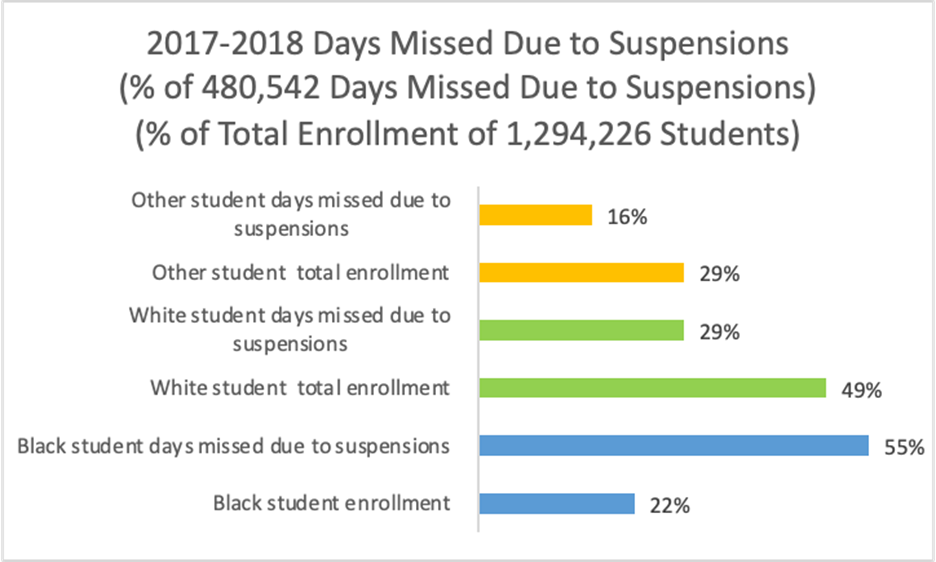
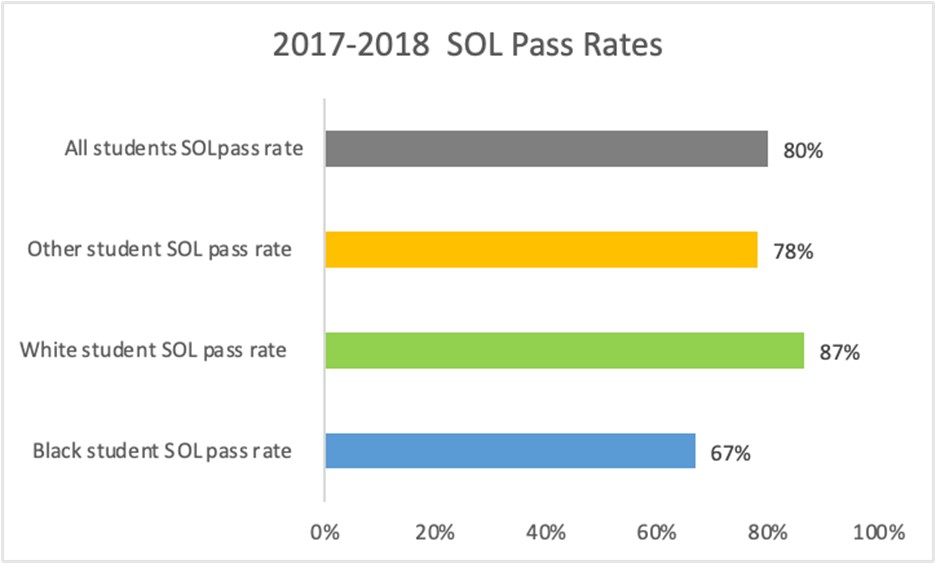
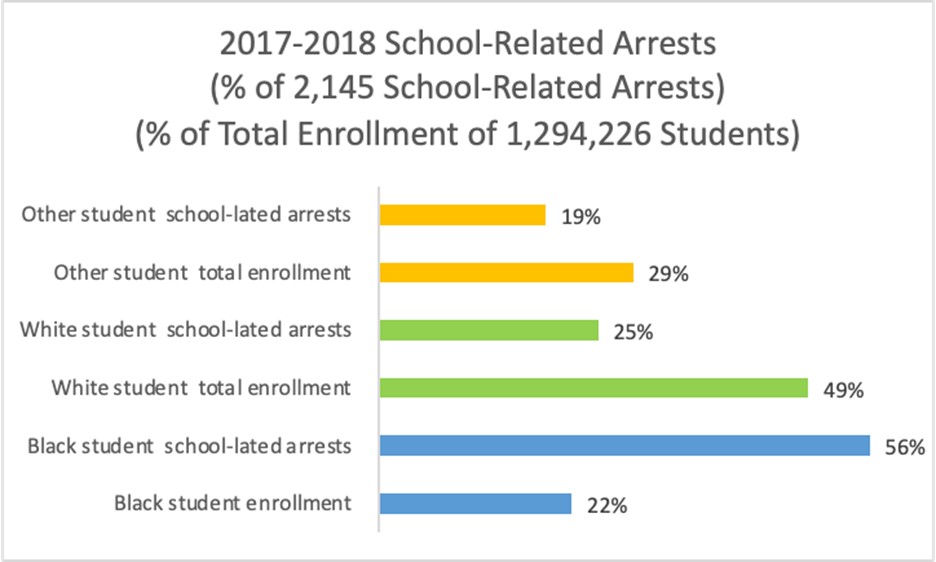
    Data on school discipline are abundant, but not always reliable. The reasons are many. Overall, data are reported by infraction to the Virginia Department of Education (VDOE) and to the Office of Civil Rights by each school division. One kind of infraction in one school division may be deemed another kind of infraction by another division. For example, using a curse word while talking to a teacher could be considered disrespect or a threat, depending on who is entering the data in the system. Although the VDOE has attempted to clarify the language over time, it still may not be reliable. For this reason, the data used herein refer to only a few data points of what is reported to the Office of Civil Rights by divisions for each school every two years in 2015-2016 and 2017-2018. This data can be found here. Some data are highlighted below.
    Congruency Matters in Learning and Discipline Data

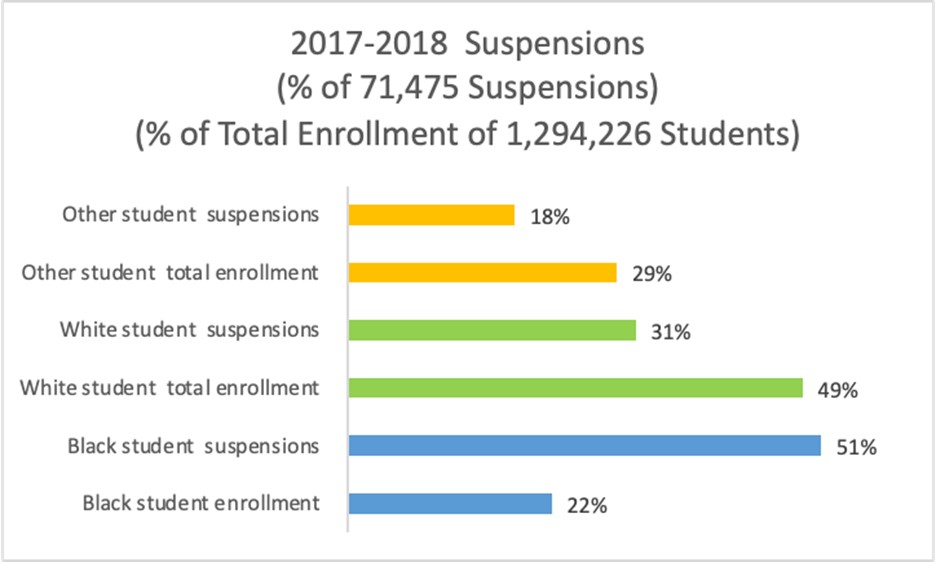
    Congruency means that percent of total of a discipline indicator should be similar or equal to the enrollment percent of total. In other words, in 2017-2018, if 22 percent of students are Black, then 22 percent of Black students should have been suspended. In 2017-2018, 51 percent of the total number of suspensions were of Black students. This means that the Black populationโ€™s results are not congruent to the actual percent of the Black students in the total population. (more…)


  • Now, What is That Number?

    A recent article in The Washington Post described how the U.S Secretary of State has ordered that all documents sent to the Secretary’s office must use the Calibri font and be in 14 point. It reminded me of the period in which staff in the Virginia Department of Planning and Budget were directed to use 14 point font for any budget documents being sent to the Governor to review. The reason we were given was that the Governor (I won’t say which one) did not like to admit that he needed to wear glasses in order to read anything in a smaller font.


  • School Discipline, Part I: Framing School Discipline and National Data

    by Matthew Hurt and Kathleen Smith

    This is the first of a three-part series on school discipline. The authors present the information and then provide discussion questions. We hope the discussion will further an understanding of the complexity of school discipline and safe and orderly schools. Part I of this series frames school discipline and provides the latest national data from the Office of Civil Rights. Part II dives into Virginia data regarding suspensions, expulsions, and school arrests and context for Virginiaโ€™s disproportionality concerns. Part III discusses how discipline has been โ€œreframedโ€ in recent years.

    School discipline is not a simple problem. There are some aspects that educators have a great deal of power to address and other aspects that are outside their ability to influence. Recent events have also likely caused school discipline to become more complex and difficult to address.

    From an Administratorโ€™s Experience

    When Dr. Matthew Hurt was an assistant principal in a K-8 school 20 years ago, discipline was among his main duties. By working with teachers, students, parents, and staff, disciplinary infractions declined each year.

    He learned early-on that suspending students was like throwing Brer Rabbit into the briar patch. The practice gave students a vacation where likely no one was there to help them catch up on their work. As it provided no disincentive to stop negative behaviors, the administration focused on in-school suspension. Staff found this was a significantly better deterrent. With in-school suspensions (ISS), the school employed an individual who worked with the kids to make sure any missed instruction was mitigated. For smaller infractions, students would be assigned to ISS during their lunch and exploratory classes (PE, music, etc.) so they wouldn’t miss any core instruction. Kids hated missing the social time with their peers, and this provided great incentive to improve their behavior.

    The second lesson Dr. Hurt learned is that the administration had to support teachers with discipline. Teachers realized that what they did in their classrooms was prized, and that they were supported for not tolerating any shenanigans while teaching. Their instructional time was extremely precious. The administration supported the in-class disciplinary measures that teachers implemented and told them to send kids to the office as soon as their behavior became untenable. Students realized quickly that once their teacher sent them out of the classroom, consequences were quickly and progressively meted out.

    Like every other school, this school enrolled students who frequently needed discipline, and a lot of time was spent with those students. The administrationโ€™s philosophy was that if a student was misbehaving, there were usually factors that must be taken into consideration. Disciplinary consequences were consistent regardless of those factors, but they realized there may be some mitigating interventions that could be applied to improve future behaviors. Many of these students lived in chaotic and sometimes violent homes. Staff realized that they had to double their efforts to ensure that these students had stability during the school day and realized that teachers and administrators were there to support their efforts to be successful at school. The administration spent a lot of time working with parents to find out their perspective about their kidโ€™s behavior. They also worked with outside agencies to better coordinate necessary services. The more successful school staff were at identifying student social/emotional needs and mitigating those, the more successful they were at mitigating their negative behaviors.
    (more…)


  • “We Have Failed Our Students Under the Guise of Grace”

    by James A. Bacon

    The breakdown of discipline in some of Virginia’s public schools is so stark that it has penetrated the ideological filters of the The Washington Post news staff. The lede to the WaPo’s article about last night’s Newport News School Board meeting sums up the picture nicely:

    Dozens of teachers and parents unleashed fury, fear and frustration on the Newport News school board Tuesday evening, saying systemic problems throughout the district created the climate in which, police said, aย 6-year-old boy shot his teacherย earlier this month.

    Emotions ran so high that in “something of a mass catharsis” citizens called for the superintendent to be fired.

    Many said discipline at district schools had deteriorated, resulting in unsafe classrooms, and they noted that the shooting at Richneck Elementary School was the third in the district since fall 2021. Several teachers said they were not supported when facing violence in the classroom or even attacks by students. And speakers repeatedly charged that the district cared more about keeping its official discipline statistics low than properly handling students who act out.

    What’s this? Deteriorating discipline? Teachers feeling unsupported by administrators when threatened or attacked by students? Administrators suppressing the violent reality by manipulating statistics? Where-o-where have readers heard that before? Oh, here on Bacon’s Rebellion. Over and over. now it’s not just us saying it. Now it’s The Washington Post. (more…)


  • Pass Me the Napkin, Please. I Need to Write an Appeal.

    Carrie Roth, VEC Commissioner. Photo credit: Richmond Times-Dispatch

    by Dick Hall-Sizemore

    The Youngkin administration has come up with a new way to deal with the backlog of appeals filed with the Virginia Employment Commission (VEC): reduce the amount of time claimants and employers have to file an appeal to the agency’s decision.

    As reported by the Richmond Times-Dispatch, a House subcommittee has acted favorably on HB 1639, introduced by Del. Wendell Walker, R-Lynchburg, at the request of the administration. The bill would give claimants and employers 15 days instead of 30 to appeal decisions on claims for unemployment insurances, as well as to ask for a review of an initial appeal ruling.

    The administration and the bill’s proponents contend that the bill would make the process more efficient. “The impetus behind this is to make sure we give them a very timely final decision in an expedited fashion,โ€ VEC Commissioner Carrie Roth told the subcommittee.

    In reply to Democrats’ concerns that people who might want to appeal could be “disenfranchised,” Roth replied that filing an appeal is not difficult. Apparently inspired by Arthur Laffer, she said, “โ€œYou can write it on a napkin and we will accept that appeal.”

    Appeals filed on napkins would certainly enable the VEC to speed up the process of reviewing appeals.


  • Parents’ Rights Under Assault in Richmond

    by Kerry Dougherty

    HB2091 – SUMMARY AS INTRODUCED:

    Parental access to minor’s medical records; consent by certain minors to treatment of mental or emotional disorder. Adds an exception to the right of parental access to a minor child’s health records if the furnishing to or review by the requesting parent of such health records would be reasonably likely deter the minor from seeking care. Under the bill, a minor 16 years of age or older who is determined by a health care provider to be mature and capable of giving informed consent shall be deemed an adult for the purpose of giving consent to treatment of a mental or emotional disorder. The bill provides that the capacity of a minor to consent to treatment of a mental or emotional disorder does not include the capacity to (i) refuse treatment for a mental or emotional disorder for which a parent, guardian, or custodian of the minor has given consent or (ii) if the minor is under 16 years of age, consent to the use of prescription medications to treat a mental or emotional disorder.

    Parental rights continue to be under assault by Democrats in the General Assembly. They will never give this up until they are all voted out of office.

    Fortunately, the GOP majority in the House of Delegates will be able to kill HB2091, a bill that would create an avenue for โ€œhealth care providersโ€ to keep information and treatment of mental or emotional disorders secret from parents.

    We all know what โ€œmental and emotional disordersโ€ are code for: transgenderism and other associated behaviors. (more…)


  • After Federal Threat to Gas Stoves, Virginia Republicans Try Again on Right to Gas

    Status by state of legislative efforts to preserve the natural gas option. The bill is again pending here in the 2023 General Assembly.ย  Click for better view.

    by Steve Haner

    First published this morning by the Thomas Jefferson Institute for Public Policy.

    Legislation to enshrine the right to use natural gas and propane in Virginia law, a repeat of a failed effort from 2022, cleared a House of Delegates committee Tuesday. The ultimate showdown will come not in the Republican-controlled House but in the Democrat-controlled Senate, where the effort hit a wall last year. (more…)


  • Senate Subcommittee Nixes DEI Transparency

    by James A. Bacon

    A General Assembly senate subcommittee has voted down a bill that would require public Virginia colleges and universities to report the number and salaries of employees in the field of Diversity, Equity & Inclusion. Sen. Bryce Reeves, R-Spotsylvania, had sponsored the bill, SB 1197, which also called for disclosure of sums spent on lobbying and for the recording and online posting of Board of Visitors board and committee meetings.

    The Richmond Times-Dispatch coverage of the subcommittee meeting reported little discussion. The closest thing to an explanation for defeating the transparency measure came from Sen. Chap Petersen, D-Fairfax City. According to reporter Eric Kolenich:

    Petersen questioned why colleges should be required to publish this information, which is already publicly available. Petersen called the bill โ€œoverly confrontational.โ€

    That’s about as lame as it gets.

    First point: no, actually, the information is not already publicly available — not readily. (more…)


  • Dominion Energy Scholarships Define “Communities” by Race

    Dominion Energy Scholarships Define “Communities” by Race

    By Carol J. Bova

    Dominion Energy is offering 60 undergraduate Equitable Education Scholarships totaling $500,000 for “students from historically underrepresented communities.”

    The rules exclude White students (unless they identify as Hispanic), no matter what “community” they’re from, because to be eligible, applicants must:

    โ€” Self-identify as Black or African American; Hispanic or Latino; American Indian or Alaska Native; Asian; or Native Hawaiian or other Pacific Islander with higher education expenses;

    โ€” Be high school seniors or graduates or current college undergraduates residing in Connecticut, Ohio, West Virginia, Virginia, Maryland, North Carolina, South Carolina, Idaho, Wyoming, or Utah, with plans to enroll full-time at an accredited two- or four-year college, university or vocational-technical school for the entire upcoming academic year.

    The press release quotes Robert M. Blue, Dominion Energy’s president and chief executive officer, who said: “We have already seen a tremendous return on investment supporting students obtaining higher education. Dominion Energy remains committed to investing in students’ access to higher education, strengthening our communities and future generations, and building a sustainable workforce.”

    Scholarship America, a nonprofit specializing in managing scholarship and tuition assistance programs, says it “will support Dominion Energy in the selection of finalists.” Scholarship America says: (more…)


  • Why Did Youngkin Spurn a $3.5 Billion Investment?

    The Berry Hill mega-site in Pittsylvania County — still waiting for a mega-investment

    by James A. Bacon

    When you nix what might have been a $3.5 billion investment creating a reported 2,500 jobs in one of Virginia’s most depressed regions, you’d better have a good explanation. But when mammoth economic development deals are wrapped in secrecy backed by non-disclosure agreements, it’s difficult providing that explanation.

    That’s the pickle Governor Glenn Youngkin finds himself in following his decision to halt discussions with Ford Motor Co. to build a battery plant in Pittsylvania County. The Governor scuttled Virginia’s bid for the project upon learning that Ford’s partner would be China-based Contemporary Amperex Technology Co., the world’s largest maker of electric vehicle batteries — and what the administration calls a “front for the Chinese Communist Party.”

    Not surprisingly, Democrats are criticizing Youngkin, who is contemplating a national run for president, for putting national politics before economic development in Southside Virginia. Sen. Scott Surovell, D- Fairfax, told the Richmond Times-Dispatch: โ€œTo deny [people in the community] jobs because youโ€™re in last place in Republican presidential primaries [is] gubernatorial malpractice.โ€

    The Youngkin administration’s response was weaker than it could have been. Reports the RTD: (more…)


  • The Box and the Snowball

    by Joe Fitzgerald

    Thereโ€™s a box, and thereโ€™s a snowball.

    The box is the support of the Bluestone Town Center. It is a well-constructed but beautifully decorated box, built on strong buzzwords. Affordable Housing, and Climate Change, and Dense Development are the shiny wrapping on this gift. The snowball of opposition rolling toward City Hall grows each time a post on social media begins, โ€œI didnโ€™t realize ….โ€ Didnโ€™t realize how big it is, how much traffic, how much impact on the schools, how far from the center of town it is.

    The box is being built purposefully. Proponents on the Planning Commission and City Council who have not yet heard the presentation of pros and cons are publicly and privately adding items to the box. Their box is a container for their support of the project, and they will only add those things that bolster their case.

    The snowball is built on surprise. With local journalism struggling, people find out in bits and pieces how large the thing is, how many cars and students it will add, how badly proponents have considered flooding, runoff, and blasting.

    The box includes support thatโ€™s at best half-hearted from city staff. The recommendation from the Community Development staff reads less like approval and more like, โ€œWell, we guess itโ€™s OK.โ€ The City Attorney outlines why the offers to mitigate school impact are illegal under current law and an administrative nightmare if the city changes the law to accommodate them.

    The Harrisonburg Redevelopment and Housing Authority (HRHA) and the tax specialists will open their box at the Planning Commission meeting Tuesday, where they will explain how this is the greatest thing since the golf course. The snowball of citizens will attempt to deliver death by a thousand cuts. They donโ€™t have the staff, they donโ€™t have the legal help, and they donโ€™t have elected and appointed officials whoโ€™ve already made up their minds. They only have the spirit of those who have throughout our history stood up and told their government itโ€™s wrong.

    Opponents have already been described in whispers as NIMBYs, or โ€œnot in my back yard.โ€ I live two miles away, so itโ€™s hardly in my back yard. But what if it were? Rezoning requests like this one are required to inform neighbors. The whole idea of zoning is to regulate what is built next to what. Homeownersโ€™ defense of their surroundings should not be subordinate to what a planning commission or HRHA chair thinks is best for them and their neighbors.

    As this proposal goes forward, I hope elected and appointed officials will remember that they serve the entire city and not just the preferences of a vocal political minority. For the people we elect and the people they appoint, the whole city is supposed to be their back yard.

    Joe Fitzgerald is a former mayor of Harrisonburg. This column is republished with permission from his blog, Still Not Sleeping.


  • Have Virginia Republican Elected Officials Given Up on Charter Schools?

    by James C. Sherlock

    Two things we know:

    1. ย There is absolutely no question that charter schools run by successful charter management organizations (CMOS) are proven to be the most efficient and effective American public schools in instructing poor urban kids.
    2. There is also no question that many Democratic politicians, having eliminated any doubt about their hierarchy of values, have thrown those kids off the lifeboat in favor of the teachersโ€™ unions.

    But where, exactly, are Virginia Republican elected officials on this issue?

    The only school choice bill I have seen from Republicans introduced in the General Assembly this session, education savings accounts, does not appear to help poor kids at all.

    What is the thinking there?

    If Democrats representing those districts — and they are all Democrats — are going to vote against their own kids in deference to the teachersโ€™ unions (and they have in the past) why bother?

    If that is it, I urge Republican elected officials to re-think this. (more…)


  • Right Help, Right Now

    Gov. Youngkin announces his mental health budget proposals. Photo credit: Richmond Times-Dispatch

    by Dick Hall-Sizemore

    Probably the most important set of budget proposals made by Governor Youngkin for the upcoming General Assembly has been in the area of mental health. It has already been discussed generally on this blog. (See here and here.)ย  It might be helpful to examine the details of the proposal.

    The Governor, and others, have called his proposals โ€œtransformational.โ€ That borders on the hyperbolic, but every governor engages in hyperbole in describing his proposals. His proposal actually accelerates a transformation begun several years ago, while placing additional emphasis on one aspect of governmentโ€™s reaction to mental health needsโ€”crisis management. Therefore, his description of his proposal as moving โ€œfrom slow evolution to accelerated revolutionโ€ is entirely appropriate.

    There is another aspect of the Governorโ€™s proposal that is unusual and admirableโ€”a three-year plan. Most Virginia governors wait until their second year in office and their first biennial budget bill before advancing any major initiatives. As a result, they actually have only a year and a half to implement it before leaving office. In contrast, Youngkin has proposed funding for the second year of the current biennium, to be followed up with additional funding in the 2024-2026 biennial budget bill. Therefore, his administration will be in a position to get the major components of his proposal well established during his term. (more…)


  • Miyares Reminds Republicans the Difference a Year Makes

    by Shaun Kenney

    If Virginia Republicans needed a sizzle reel, this was it.

    With news that leftist Commonwealth Attorneys are openly refusing to enforce the law in some cases, the threat to the rule of law and the problem of selective enforcement is greater now than ever before.

    Which is why a long list of actual accomplishments is enough to lift the spirits of anyone kicking the dirt about what Virginia Republicans might be in future:
    Short list?

    โ€ข Miyares actually reminds us of his constitutional oath (something his predecessor set aside rather quickly);
    โ€ข Launching Operation Ceasefire;
    โ€ข Keeping repeat offenders off Virginiaโ€™s streets;
    โ€ข Listening to and working with local law enforcement across Virginia;
    โ€ข Protecting consumers from bad corporate actors;
    โ€ข $1 billion in settlements while tackling the opioid crisis, specifically targeting the cheap availability of fentanyl โ€” which is more of a problem than most people realize;
    โ€ข Protecting Virginia energy ratepayers;
    โ€ข Touring Virginia public schools regarding school safety;
    โ€ข Perhaps the marquee issue: investigating Loudoun County Public Schools for their horrific and heavy-handed treatment of concerned parents.

    There are also these: (1) Virginia Republicans are moving forward with a focus on process rather than agenda; (2) Miyares knows Virginia like the back of his hand; and (3) Miyares intends to move in coalition. (more…)


  • Consumers Be Wary When Energy Elephants Dance

    By Steve Haner

    First published this morningย  by the Thomas Jefferson Institute for Public Policy.ย 

    The Virginia House of Delegates is expected to vote this week to exempt certain Virginia manufacturers, which ones to be determined later, from the coming wave of energy costs created by Virginiaโ€™s rapid transition to unreliable forms of power generation. (more…)