by James A. Bacon
Americans are rightly concerned about the impact of the flood of foreigners entering the country illegally through a broken border — not just the fiscal burden of increased outlays for healthcare, schools, and social services but the longer-term risk of creating an unassimilable mass in the body politic. Such fears gain traction when we observe cultural elites trying to radicalize “people of color” by portraying them as victims of systemic racism. Every racial disparity in the metrics of wellbeing is said to be evidence of oppression — as if immigrants from Third World villages should feel entitled to the same income level as native-born Americans who have been lifted up over generations.
One of the disparities that critics of American society see as unjust is the racial/ethnic gap in educational outcomes. English Learners score much lower on their Standards of Learning (SOL) test scores than English-fluent students. The learning gap is often said to be proof of bias.
A close examination of the testing data, however, shows quite the opposite. It shows remarkable upward mobility for immigrants, at least in terms of academic achievement.
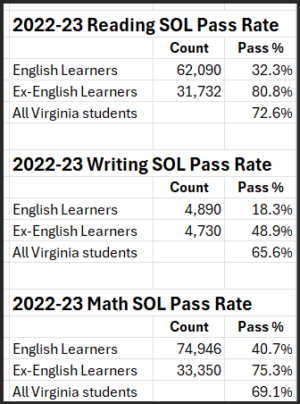
We cannot tell from Virginia Department of Education (VDOE) data how many immigrant children there are in public schools. But we have a decent proxy. VDOE tracks the number of “English Learners.” By VDOE’s count, there were about 130,000 in the 2022-23 school year. Not surprisingly given the difficulty in understanding their teachers, they passed their Reading, Writing, and Math SOLs at rates that were half to one-third of their English-fluent peers.