• Advocates for the Energy Poor Want to Make Them Poorer

    By Steve Haner

    A national industry group that advocates for home energy efficiency contractors has produced another report on how energy costs squeeze the poor the hardest, with Richmond one of its examples. The data was then used as an excuse to call for (you guessed it) the return of an energy carbon tax which paid those same contractors to do energy home improvements.

    The American Council for an Energy Efficient Economy (ACEEE) is correct that the lowest income households struggle with basics like electricity, natural gas and other fuels, along with food, rent and clothing. It sucks to be poor.ย My big concern with the new report (full text here) is it doesnโ€™t seem to account for the various government and private programs that provide hard cash to help with these bills, including the nascent Percentage of Income Payment Plan. ย 

    Richmond has a slightly deeper problem than the nation as a whole.ย Nationally 15% of low-income households face an โ€œenergy burdenโ€ because they spend more than 6% of their income on it, but in Richmond that exceeds 17%. The big disparity is among renters (13% nationally but 16% in Richmond.)

    The pitch of RGGI as the solution came Thursday morning in this from Virginia Mercury, which outlined the problem and then spent the final three paragraphs on the suspended Regional Greenhouse Gas Initiative, or RGGI. Mercury did a similar story back in April, based on a state report about energy assistance programs, and it also ended with a hard pitch for RGGI dollars to return. From the April report:

    ‘Since the first RGGI auction that Virginia participated in back in 2021, RGGI has provided nearly $400M for low-income energy-efficient housing,’ said Chelsea Harnish, executive director of the Energy Efficiency Council, a group that supports RGGI involvement and backed a bill this session that would increase transparency in energy efficiency program determinations. ‘There are no alternative funding options available at either the state or federal level for these programs in terms of program design nor funding levels.’

    (more…)

  • How Wise County Schools Excel

    From left to right: Matt Hurt, director of the CIP program; Hannah Perrigan, assistant principal at St. Paul’s Elementary School; Marcia Shortt, director of elementary and middle schools; Amber Boggs,ย director of federal programs and preschool; and Karen Dickenson, principal at St. Paul’s Elementary School.

    by Martin Davis
    Editor-in-Chief, FXBGAdvance

    Fat Boyโ€™s restaurant in St. Paul, Virginia, is well-known โ€” at least in Wise County โ€” for the two BBQ items that sit atop its menu hanging behind the counter. The Heart Attack, and the Stroke.

    This 1930โ€™s-era diner, marked by low-rent flooring, plain tables, and chairs that are best described as sturdy but hardly comfortable, proved a more-than-suitable place to sit down and reflect on a day seeing first-hand what makes one of the poorest places in Virginia one of its most academically successful, at least when the measuring stick is Standards of Learning scores.

    For the second year in a row, Wise County schools have had the third-best overall SOL pass rate in the state of Virginia. It hasnโ€™t ranked lower than eighth since 2013.

    An impressive feat considering itย spends less per student thanย Fredericksburgย city,ย Spotsylvaniaย County, orย Staffordย County public schools; is riddled with a meth epidemic that has led to a startlingly high incarceration rate ofย 721 per 100,000ย people (Virginiaโ€™s rate is notoriously high atย 679 per 100,000 people); and nearlyย 20% of its citizens live in povertyย (more than 25% of children grow up in poverty).

    In the Richmond halls of the Virginia Department of Education, and among education policy wonks, the reason for the countyโ€™s success is captured in a simple acronym โ€” CIP, which stands for โ€œComprehensive Instructional Program.โ€

    The program alone, however, doesnโ€™t explain why Wise County, where CIP was born, has proven so successful.

    There are 65 Virginia school districts participating in the program, says CIP Director Matt Hurt, and โ€œwe have 10 years of data showing that some school districts adopting the program have great success, while in other districts CIP hardly moves the needle.โ€

    (more…)

  • Atlantic Park Part 4: Seven Years of Negotiations

    Atlantic Park Part 4: Seven Years of Negotiations

    by James C. Sherlock

    Atlantic Park should prove a first-rate attraction when it opens next May.

    The design is attractive, quality should be good, and the surf park will be unique in the mid-Atlantic, at least for a while.

    But it has taken what seems like forever to get the deal done, and taxpayers got our hats handed to us.

    Developers can expect profitability on their $116 million investment because:

    • Council members intervened to both drive down developers’ costs and drive up their returns on those costs;
    • The developers have paid a very low price for 309 apartments; more than 100,000 square feet of retail, restaurants and office spaces; and food and drink concessions that should yield steady rents; and
    • they were paid to design and build the entire complex and will be paid to operate it.

    City Council will pay almost $300 million and own a concert hall and parking.

    The surf park has taken on so much debt that professional investors question if it will be able to pay it back.

    This is the story of a deal that was never final. A brief history of the years-long procurement will indicate how City Council led citizens to where we are, but not why.

    (more…)

  • Hurricane Hustlers Rooting For Deadly Storms

    by Kerry Dougherty

    You would think that the 2024 hurricane season, which just set a record for the longest stretch in more than 50 years without a single late-summer cyclone, would be a cause of celebration.

    Until this week there wasnโ€™t a named storm since August.

    Those of us who live along the coast are delighted that our roofs are still intact, we arenโ€™t doing the backstroke in our living rooms and Jim Cantore, the Weather Channelโ€™s โ€œHurricane Hunk,โ€ hasnโ€™t lashed himself to a lamppost on Atlantic Avenue.

    You know who isnโ€™t celebrating?

    Climate alarmists. You know, those unwashed sourpusses who cheer for violent and especially deadly storms so they can point fingers at those of us who drive gas-powered cars to work. Itโ€™s all our fault. There were never hurricanes or tornadoes until the invention of the combustion engine.

    Oh, and one other group is mopey: hurricane hustlers.

    You know, those soothsayers who publish scary predictions every year about how many Category 5 โ€˜canes will be buzz-sawing through our towns. Read the whole thing.


  • Virginia AI Hiring Is On Fire

    by James A. Bacon

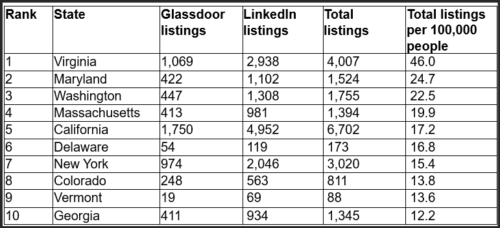
    Based on a tally of listings in online job sites, AI-related job offerings expressed as a percentage of the population are higher in Virginia than any other state. In absolute numbers, California employers have 6,702 listings on LinkedIn and Glassdoor, more than the 4,007 counted in Virginia. But AI listings per 100,000 people are the highest in Virginia at 46.0 — more than double that of the runner-up, Maryland.

    The data come from a study by Getac, a “rugged computing solutions specialist,” which scraped the listings on LinkedIn and Glassdoor. I can’t vouch for the methodology, but it seems valid as a rough indicator of relative intensity of AI-related job offerings.

    The jobs on offer in Virginia include “Artificial Intelligence (AI) Pilots Project Manager,” “AI Technical Writer,” and “AI Solution Sales Specialist,” stated the Getac press release.ย 

    (more…)


  • Atlantic Park Part 3: The Deal of the Century

    Atlantic Park Part 3: The Deal of the Century

    By James C. Sherlock

    Updated September 18, 2024 at 10:07 AM and 3:27 PM

    Atlantic Park is due to open on nearly 13 acres of city land near the Virginia Beach oceanfront in May of 2025. The new entertainment district is the largest public-private partnership project in the history of the Commonwealthโ€™s biggest city.

    It is striking in concept. There was real vision behind Atlantic Park. Readers are urged to read a 2019 article in Virginia Living to get a sense of it.

    The idea for execution of the concept was simple at first.

    • The city owned land that had been a surface parking lot in the 25 years since the old Dome concert hall was torn down;
    • In the winter of 2016-17, several developers submitted proposals to redevelop the property;
    • At that same time, the city wanted to build a new concert hall;
    • The cityโ€™s development authority issued a request for qualifications to fold its requirement into a broader plan that would redevelop the entire property.

    In 2017 the city planned to provide the land (now $40 million value) and pay for the concert facility and a parking garage.

    In 2020, dollar costs after the final agreement with the developer were planned to be $95.6 million. Developers would pay for the rest. The original concept evolved under redesigns, delays and constant renegotiations. Seven years later Atlantic Park is under construction.

    Today it is considered by municipal bond professionals to be a major risk – a โ€œspeculative betโ€ of

    • over $300 million in equity and Virginia Beach Development Authority (VBDA) and Atlantic Park Community Development Authority (the CDA) revenue bond obligations that will be made by city council appropriations; and
    • two city properties, the land and a package of 400 parking places, worth a total of $52 million leased to the developer at a dollar a year for up to 100 years.

    Two major story lines have emerged. One is about the deal between developers and the City Council. The other is about the surf park venue, its owner and its funding and its economic risks. Each is complex and costly enough and brings enough risk to warrant telling in this multi-part series.

    This is the lead article about the developer-city deal.  And how so much money was shifted from developer obligations to city obligations in the four years after the 2020.

    Later in the series we will discuss how tax exempt municipal bonds were issued for the surf park by the state with VBDA authorization.

    (more…)

  • Docs Up in Arms

    by James A. Bacon

    A letter from 128 physicians to the University of Virginia Board of Visitors has urged the Board to uphold academic freedom, free speech and patient safety by replacing UVA Health Systems CEO Craig Kent and medical school Dean Melina Kibbe.

    In the letter issued last week, the physicians accused Kent and Kibbe of compromising patient safety, spending excessively on the C-Suite, and creating a culture of fear and retaliation, among other abuses. The signatories withheld their names from the public but said they were willing to reveal them to select members of the board.

    The Board of Visitors is scheduled to meet Thursday morning to discuss health system business, but there is no mention in the board agenda, typically prepared by Rector Robert Hardie and President Jim Ryan, that the issues raised by the letter will be addressed. It is an open question whether other members of the board will attempt to shoehorn a discussion into what is a time-constrained and carefully scripted two-day meeting.

    In a letter to the medical school faculty, Ryan expressed his skepticism about the charges but promised to look into them. Every organization has malcontents, and the letter signatories represent only 9% of the medical school faculty, he wrote. Moreover, the charges in the letter are vague, and the signatories are unwilling to reveal their names. He wrote:

    (more…)


  • APCo Rate Case is a Battle of Accountants Over Details, Profit Margin

    By Steve Haner

    The latest review of base rates for the Appalachian Power Companyโ€™s 540,000 Virginia customer accounts may end with yet another price increase, the second in two years, but a fierce and detailed battle of accountants will determine the size.

    The State Corporation Commission held a public comment session Monday and a full evidentiary hearing Tuesday on the request from the company, known usually by its acronym APCo. It is part of the larger American Electric Power system, with the bulk of its actual power generation assets not located in this state.

    The application for the rate increase is based on the companyโ€™s financial performance in 2023, when it claims it earned a profit (measured as return on equity) of only around 3%. The SCC in its previous rate review had authorized 9.5%, but what that actually means is the company has an opportunity to earn and keep that much. It might not and in this case did not get there. The SCCโ€™s own staff accounting analysis came up with a similar anemic profit estimate. (more…)


  • Atlantic Park Part 2: City Council, Campaign Contributions and City Money

    Atlantic Park Part 2: City Council, Campaign Contributions and City Money

    By James C. Sherlock

    Elections in republics are transactional everywhere. We vote for and contribute to those who we think will vote as we would.

    This series is about Virginia Beach. We do not vary from that script.

    Council members run as independents. An in-depth review of seven years of Council meeting minutes has revealed that on most matters members have seemed relatively apolitical. After months of research for this series, the author cannot identify with assurance whether many of the members are conservative or liberal in their personal politics.

    City Council appoints the members of the cityโ€™s development authority that holds title to the cityโ€™s land and has tourism development and business recruitment budgets. Many appointees historically have been developers or their representatives. They played a significant role in Atlantic Park. But development authority bond issues and budgets must be approved by Council, which thus maintains control.

    City money. Virginia Beach is the largest city in the Commonwealth and has a budget to match. In 2025 the city had a $2.5 billion operating budget and a $385 million capital budget.

    Influence over the capital budget is concentrated in the hands of the real estate development interests who dominate campaign donations.

    Election costs. The costs of City Council election campaigns vary between ward and at-large seats, but have grown to cost more than the four years of pay for the work, which until this year was capped by law statewide at $28,000. For cities of over 260,000, the caps are now mayor $56,000 and other Council members $52,000. So most Council members have day jobs.

    Update 1:30 PM Sept. 10. For civilians, the General Assembly bill that raised the limit singled out Virginia Beach for the highest Council compensation without admitting it. The populations of Virginia cities:

    1. Virginia Beach: 453,649
    2. Chesapeake: 253,886
    3. Arlington: 235,845
    4. Norfolk: 230,930
    5. Richmond: 229,247
    6. Hampton: 137,061
    7. Alexandria: 165,317
    8. Newport News: 187,906

    Stop update.

    Underfunded candidates occasionally win here but that is not usually the way to bet.

    (more…)


  • Atlantic Park Part 1: Prologue

    Atlantic Park Part 1: Prologue

    Updated September 18 at 10 AM and 3:16 PM

    By James C. Sherlock

    Atlantic Park is under construction as a massive new entertainment district near the oceanfront in Virginia Beachโ€™s resort area. The centerpiece, a surf park, will be surrounded a 3,500-seat concert hall, shops, restaurants, offices, and apartments.

    If it succeeds, Atlantic Park will transform the resort district of Virginia Beach and generate additional tax revenues for the city.

    But the City Council early on rejected a plea from the city manager to be able to โ€œtell them it will pay for itselfโ€ and never looked back. Council never asked for a city business plan, perhaps because it would have served as a rebuke as spending on the project spiraled out of control. 

    In 2023 city officials were forced by SEC requirements for a city bond issue to publicly acknowledge the manifest economic risks to Atlantic Park, but did so only buried in a 900+ page bond prospectus. Those risks, which led a report in Bloomberg in review of that bond issue to call Atlantic Park a โ€œspeculative bet,โ€ would have ruined the story.

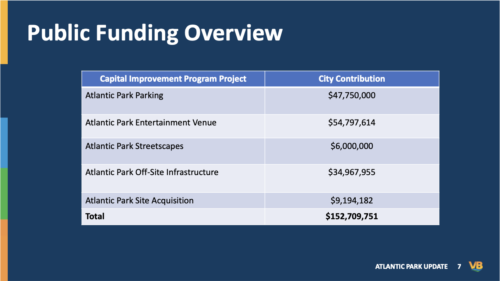
    Here are two views of city spending. First, a slide presented to city council on May 28 of this year.

    But the city borrowed the money.

    A second slide below is compiled by the author from the documentation of three series of bonds issued in 2023 and 2024 which city bond authorities must repay through providing money from revenues for city appropriations:

    That view shows the city at over $300 million in equity and debt for what the council slide called $153 million in city contributions.  

    Expensively improved city land worth $40 million is leased to the developer at a dollar a year for up to 100 years.  Four hundred parking spaces that cost $30,000 each to build are also leased to the developer for a dollar a year plus contributions to a maintenance fund.

    This series will tell the story of how we did it, but not why.

    (more…)

  • Argh! Tech Tops UVA in WSJ Ranking

    by James A. Bacon

    There are many ways to tally the “top” universities. One is to measure an institution’s prestige or reputation. Another is to capture the educational value added based on metrics of cost, salary after graduation, and return on investment. Yet another is to rank universities by their success in promoting upward social mobility.

    The U.S. News & World-Report, which basically measures reputation, is the best known. The Wall Street Journal tracks return on investment.

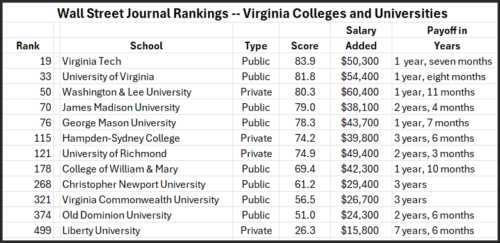
    As much as it pains me to draw peoples’ attention to the fact, Virginia Tech outranks the University of Virginia in the latest WSJ ranking.

    The outcomes of rankings like this hinge on the factors considered and the relative weight apportioned to those factors. Methodology is everything. The WSJ does not track students’ intellectual growth, development as informed citizens, or transformation into social-justice crusaders. It’s all about the Benjamins.

    (more…)


  • An Antisemitic Act Denounced at UVA!

    Finally, an antisemitic act that University of Virginia authorities could forcefully condemn!

    The McIntire School of Commerce’s Rouss Hall showcases flags representing the home countries of students past and present. One of them is an Israeli flag. On Friday someone vandalized the flag with the statement, “Where is Palestine.”

    McIntire Dean Nicole Thorne Jenkins said the incident is being treated as an instance of antisemitism. “Questions about the showcase of flags are welcome; however, this was an act of vandalism. Vandalism is not protected speech: it is criminal conduct.”

    โ€œThis act of antisemitism is antithetical to the values and norms of the McIntire School and the University as a whole,โ€ said Provost Ian Baucom and President Jim Ryan in a joint statement. โ€œAs we all begin another year together on Grounds, we want to make it as clear as possible that while we are committed to free expression, vandalism is not protected speech. Like bigotry and harassment of any kind, it has no place at the University.โ€

    Not a hint of moral ambiguity. Good.

    I can’t help but wonder, though, what the reaction would have been if someone had defaced the American flag.

    — JAB


  • Jeanine’s Memes

    From The Bull Elephant


  • A Polite Golf Clap, Please, for Virginia Free Speech Rankings

    by James A. Bacon

    Virginia colleges and universities fare well in the Foundation for Individual Rights and Expression (FIRE) survey of free speech on college campuses this year. The University of Virginia moved to the No. 1 spot, making it the university most hospitable to free speech among the 257 U.S. institutions polled.

    Among other Virginia universities included in the ranking, the College of William & Mary and George Mason University ranked “above average”: 12th and 16th place respectively.

    Virginia Commonwealth University, Washington & Lee University, and James Madison University were classified as “slightly above average,” in 32nd, 33rd and 37th places respectively.

    Virginia Tech was a Virginia laggard in 116th place, but even that qualified as “average.”

    (Liberty University was excluded from the survey because its policies “clearly and consistently state” that it prioritizes values other than free speech.)

    As in past years, elite private universities in the Northeast were among the most hostile to free speech. FIRE ranked Harvard and Columbia as the two very worst — “abysmal” — in the entire country.

    The high scores for Virginia institutions are no great honors. The bar is set exceedingly low. Snagging the No. 1 spot is like being awarded “cutest pooch” in an ugly dog contest.

    But I suppose it’s of source of solace to observe that UVA, William & Mary, GMU and its Virginia brethren are less oppressive places to learn, teach and conduct research than their peers nationally.

    (more…)


  • Bacon Meme of the Week