

by James C. Sherlock
Atlantic Park should prove a first-rate attraction when it opens next May.
The design is attractive, quality should be good, and the surf park will be unique in the mid-Atlantic, at least for a while.
But it has taken what seems like forever to get the deal done, and taxpayers got our hats handed to us.
Developers can expect profitability on their $116 million investment because:
- Council members intervened to both drive down developers’ costs and drive up their returns on those costs;
- The developers have paid a very low price for 309 apartments; more than 100,000 square feet of retail, restaurants and office spaces; and food and drink concessions that should yield steady rents; and
- they were paid to design and build the entire complex and will be paid to operate it.
City Council will pay almost $300 million and own a concert hall and parking.
The surf park has taken on so much debt that professional investors question if it will be able to pay it back.
This is the story of a deal that was never final. A brief history of the years-long procurement will indicate how City Council led citizens to where we are, but not why.
The process is below.
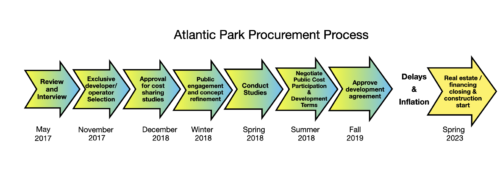
Dates are highlighted below to assist in following the ten-step path.
1. The city’s economic development authority issued in January of 2017 a request for qualifications (RFQ) for what is now Atlantic Park. It planned to spend $37.5 million for a concert venue and parking on a large plot of land near the oceanfront. That site had been a surface parking lot since demolition of the legendary Dome concert venue 25 years prior.
The RFQ requested qualifications from developers to fulfill that requirement within a broader multi-use project on the property. One of the statements from that RFQ deserves a plaque on the premises:
It is the City’s and the (Virginia Beach Development) Authority’s (VBDA) goal to … minimize the City’s financial participation in the project.
The criteria used in those interviews were as subjective as possible and no commitments were made. From the RFQ:
Review Criteria: Upon receipt and review of the RFQ Submittal, the Virginia Beach Development Authority (VBDA) will proceed in a manner that best leverages the value of the property and will, in its sole discretion, proceed to request additional information, initiate negotiations or terminate this process.
2. From there, council took hands-on control of city participation in the project from the City Manager and never gave it up.
The selection of a developer was based not on formal project proposals but rather on interviews of candidates who had responded to the RFQ. Interviews were conducted by a committee led by two council members, Louis Jones (now deceased) and John Uhrin.
RFQ interviews were finished in late May 2017. The City could have issued a Request for Proposals (RFP). Or it could have proceeded with a design-build procurement. Or it could have first competed the design and architecture and then competed ownership and development separately.
Any of those approaches would have produced a firm price and construction schedule.
3. In June of 2017, council was briefed by the City Attorney on a state procurement law for public-private infrastructure development. It is a good law with well-established procurement practices, but was not mandatory in this case. The timing was excellent for choosing that path. But council decided not to use those procedures for this project.
No RFP was issued, so no architectural, pricing, schedule, or financing plans were submitted.
4. In November of 2017, a team led by Venture Realty Group was announced as the exclusive developer of the project. There is no evidence publicly available on what happened between the completion of interviews in May and the developer selection in November.
5. From developer selection, it took a year and an intervention by a couple of council members with the City Manager (below) to increase the developer’s returns on costs in a term sheet signed on December 21, 2018.
6. Another year later, on October 22, 2019 a “Final Dome Site Development agreement” was signed.
It proved anything but final.
7. In 2021, the council created an Atlantic Park Community Development Authority (the CDA) to enable it to tax and to issue bonds to fund that project. Council then appointed each of its own members to the board of the CDA. The 2022 amended ordinance (see here starting on page 84) contains both the original petition to the General Assembly to establish the new authority and the amendment.
8. The scope of Atlantic Park continued to expand. The initial agreement was renegotiated more than once. Multiple delays dragged the project through the hyperinflation of commercial construction costs in 2021 and 2022. Nationally, 2022 proved the biggest year in commercial construction in decades because of pent-up demand. That drove up costs. But Atlantic Park was stalled.
Neither the Virginia Beach Development Authority nor the CDA offered to help the developer out of a surf-park financing bind, but the council forgave a missed deadline while they figured it out.
9. In 2022, the developer, unable to get commercial of city financing for the surf park, passed the rights to build it to a North Carolina 501(c)(3).
10. On September 20, 2022, the Virginia Small Business Finance Authority (VSBFA) authorized the issuance of unrated municipal bonds to an as-yet-non-existent subsidiary of the North Carolina entity.
11. A week later, in order to meet SEC and IRS requirements, Virginia Beach’s development authority authorized VSBFA to do what it had already done.
12. The surf park revenue bonds sold on March 31, 2023 at extraordinarily high yields because of investor-perceived economic risk of the venue. In turn, principal and interest costs on those mortgage bonds, $207 million, significantly raised those risks. On that same day the city went to market with its own revenue bonds.
13. The story of the bonds issued by the two city authorities in 2023 and 2024 has already been told.
Mr. Uhrin intervenes. In 2015, Councilman John Uhrin voted in favor of giving $18 million of taxpayer money to the Cavalier Hotel redevelopment project. But one week after the vote, the developer hired Mr. Uhrin’s wife to market luxury homes on Cavalier property.
Investigations of his vote by the FBI and a federal grand jury for potential public corruption made the press. He claimed that he had no foreknowledge that his wife would be hired. She backed him up and the U.S. Attorney chose not to proceed.
In an interview for a 2015 TV 13 article titled “Virginia Beach council under the microscope,” Jesse Richman, a political professor at Old Dominion University, said:
… all Virginian politicians need to carefully examine their involvement (in) public and private partnerships. It’s time to be a bit more careful about cozy relationships between developers and politicians.
That was good advice. The Council as a body did not take it. Neither did Mr. Uhrin.
Councilman Uhrin and Vice Mayor Jones (now deceased) were chosen in early 2017 to lead the panel that picked an exclusive Atlantic Park developer.
Mr. Uhrin was defeated in the council elections in November of 2018.
A November 21, 2018 email was sent from the city manager to those same two gentlemen. He pushed back. He noted that they had asked him to increase the returns on costs for the developer in the performance incentive package in the upcoming term sheet.
The city manager thought the staff recommendation “a more acceptable rate of return for such a large project”.
He lost the argument. The Uhrin/Jones recommendations appeared in the Term Sheet in late December. Lame duck Mr. Uhrin left office a week later.

Then-Councilman John Moss, when interviewed for this report, said he had never heard of the intervention on the side of the developer. (Councilman Moss was the only member to oppose the city’s increasing expenditures on the project.)
Years later Mr. Uhrin bragged that he “helped bring Atlantic Park to Virginia Beach.”
He did indeed.
Commentary. Council and development authority discussions of Atlantic Park were held in closed session for all of those years.
In a series of 10-0 votes, Council transferred increasing costs from the developer to the city. Only the acquisition of the additional land for $9.2 million did not draw a unanimous vote.
Moss abstained in each vote because of a conflict of interest — Atlantic Park would increase the value of nearby property he owned.
Significant economic risks to Atlantic Park will be discussed in another article. Because most of the value of the city’s Atlantic Park bonds is guaranteed by appropriations, Virginia Beach taxpayers are exposed to losses should the project not meet revenue forecasts.
On the matter of Mr. Jones’ and Mr. Uhrin’s joint intervention with the city manager in favor of the developer, there are at least three unanswered questions:
- What the heck were they doing?
- Who did the work to develop the change request in so much detail?
- Who else on the council other than the two project liaison members knew about it?
Mayor Dyer will know the answer to the second question. Mr. Uhrin will know the answers to both.
Leave a Reply
You must be logged in to post a comment.