
By Steve Haner

The latest review of base rates for the Appalachian Power Company’s 540,000 Virginia customer accounts may end with yet another price increase, the second in two years, but a fierce and detailed battle of accountants will determine the size.
The State Corporation Commission held a public comment session Monday and a full evidentiary hearing Tuesday on the request from the company, known usually by its acronym APCo. It is part of the larger American Electric Power system, with the bulk of its actual power generation assets not located in this state.
The application for the rate increase is based on the company’s financial performance in 2023, when it claims it earned a profit (measured as return on equity) of only around 3%. The SCC in its previous rate review had authorized 9.5%, but what that actually means is the company has an opportunity to earn and keep that much. It might not and in this case did not get there. The SCC’s own staff accounting analysis came up with a similar anemic profit estimate.
The shortfall in the return on equity was one of the justifications for APCo’s initial request to increase its customer revenue by $95 million annually. It also proposed that the new authorized return on equity be 10.8%. Arguing against that, and advocating something closer to the current 9.5%, has been a major focus of expert testimony so far.
Since filing the case, APCo has reduced its revenue request and is now seeking about $62 million additional from its customers. That is still based on the proposed 10.8% profit margin. The SCC staff analysis is recommending an increase, but one even smaller.
The profit margin is only one of dozens of accounting disputes, however. This is a fairly traditional “cost of service” review, focused on just about every aspect of the operation – how to account for coal storage, employee compensation, amortization of storm damage, costs for clearing the lines in wooded territory and costs for repairing poorly performing circuits. Some customer groups are arguing for basically no increase in the rate at this time.
For the most part, the Virginia Clean Economy Act’s dictates on future use of green energy are not in play. But the newly proposed Environmental Protection Agency rules for coal plants could play a role.
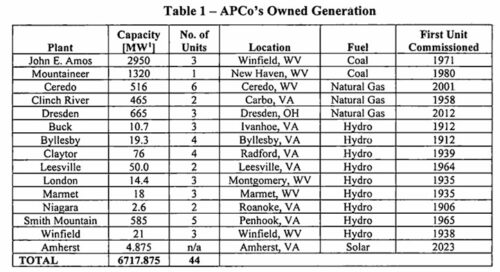
APCo directly owns only a small amount of generation, less than 7,000 megawatts. About 64% of its generation capacity is in two West Virginia coal plants, John E. Amos and Mountaineer. Another 25% comes from three natural gas plants, including one in Virginia. Both coal plants are scheduled to close in 2040. The Virginia natural gas plant, Clinch River, was set to close in 2025 but now APCo plans to keep it in operation until 2030.
The EPA rules, published in April, do not ban coal, but the cost of using coal in any plant that operates beyond 2031 will grow substantially. A plant which expects to operate into and beyond 2039 needs a carbon capture system trapping 90% of its carbon emissions. A plant planning to close between 2031 and 2038 will need to limit its emissions to a level consistent with using at least 40% natural gas. And the emissions reductions – via natural gas or a carbon capture system — would need to be made years before those deadlines. Virginia is among the states in court seeking to block the rules.
Citing the new EPA rules for coal plants, the SCC staff projected they would actually close sooner than 2040 and suggested a target of 2036. Closing them sooner would accelerate their depreciation schedules and thus add $23 million per year in new revenue for the company, further raising customer rates.
APCo concedes there is a timing disconnect between its plans and the EPA’s coal plant rules but begs the SCC to delay consideration of any proposed solution until the next rate case. It wrote:
In short, given that regulations are subject to both change and legal challenge as they are being implemented, it is premature to conclude definitively that the Company’s coal plants will be shut down prior to the current assumption of 2040. Furthermore, the methods to comply with the new EPA regulations continue to be evaluated, as there are options, including refueling the units with natural gas, that would result in the plants operating beyond 2036.
The question often comes up, why are the rates for APCo so much higher than those for the larger Dominion Energy Virginia, serving the majority of Virginia’s population. With this rate case the cost of 1,000 kilowatt hours of power for a residential APCo customer will hover around $180, compared to about $143 for Dominion’s residential customers.
Customer pain has produced a flood of complaints in testimony. Here is a good example.
With the economy the way it is how are people expected to pay another increase in electricity when they can’t afford it now??? You have to cut down on the electric use as much as possible and then make the decision of buy a few groceries or the most important bottle of medicine you HAVE TO HAVE!!! Then if we call AEP for assistance on bill, we’re told to call local churches to see if they can help!!!! When is enough enough?
The heavy reliance on coal is one factor driving up comparative cost. APCo doesn’t own a nuclear plant. Dominion’s fleet includes four nuclear plants, uses very little coal, and uses a far higher percentage of natural gas than APCo. In filed testimony Aaron Walker, the president of American Electric Power, the parent company, lays out some other reasons:
APCo’s service territory remains a beautiful but difficult place to operate as an electric utility. Significant portions of the Company’s service territory are rural and sparsely populated, with rugged and mountainous terrain, which presents numerous challenges to the Company in providing safe and reliable electric service….
Collectively, the population across the Company’s service territory was approximately 1.35 million people in 2023, which represents approximately 15% of the Commonwealth overall. During the Earnings Test Period, the economy within APCo’s service territory slowed and lagged the US economy. This relative underperformance can be attributed in large part to a contraction in manufacturing activity and demographic struggles. Looking forward, the pace of economic growth in our service territory is projected to slow even further due to the cumulative effects of inflation and higher interest rates.
With a shrinking population and shrinking business demand for its product, the cost per remaining customer of keeping the lights on is bound to rise. But for the long term, keep an eye on those proposed EPA coal plant rules and then the Virginia Clean Economy Act. Almost 90% of APCo’s existing generators could disappear and need to be replaced with less reliable choices.
Leave a Reply
You must be logged in to post a comment.