• Immigration: The Open Borders of the United States

    (First article in a series)

    by Dick Hall-Sizemore

    โ€œGive me your tired, your poor,
    Your huddled masses yearning to breathe free,
    The wretched refuse of your teeming shore.
    Send these, the homeless, tempest-tost to me,
    I lift my lamp beside the golden door!โ€

                                        Emma Lazarus

    How quaint!

    Todayโ€™s sentiments toward immigrants range from Donald Trump labeling them as โ€œanimalsโ€ who have been released from prisons and insane asylums to subsequently โ€œplunder, rape, slaughter, and [destroy] our American suburbs, cities, and townsโ€ and โ€œpoison the blood of our countryโ€ to Joe Biden instituting restrictions on asylum when the 7-day average of crossings exceeds 2,500.

    In 2022, the size of the foreign-born population in the United States was estimated to be 47.9 million people, about 14.3 percent of the total population, which was below the high of 14.8 percent in 1890.ย Of those 47.9 million, 23.4 million, 49 percent, were naturalized citizens.ย There were 11.5 million (23 percent) lawful permanent residents and two million (four percent) temporary lawful residents.ย The remaining 11 million (23 percent) were undocumented. The undocumented constituted about 3.3 percent of the total U.S. population in 2022.

    In its American Community Survey, the U.S. Census Bureau estimates there were 1,163,486 foreign-born residents in Virginia in 2023. Of that group, 662,372, or 57 percent, were naturalized U.S. citizens.ย The data does not break down the 501,114 foreign-born who were not U.S. citizens into how many were legal residents or undocumented immigrants.

    (more…)

  • Kiss Good-Bye to Nonpartisan Elections

    by Ken Reid

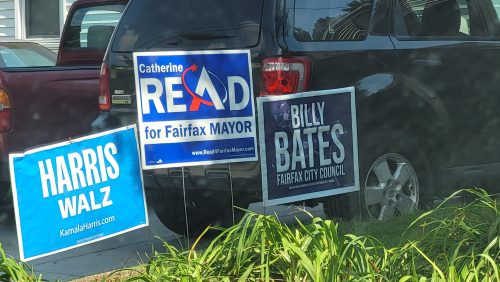
    In Virginia, town, city and school board candidates appear on the ballot without โ€œDsโ€ and โ€œRsโ€ next to their names, as do some constitutional officers (i.e. commissioner of the revenue and treasurer). There are some exceptions by each city or townโ€™s charter.

    The theory behind holding these as โ€œnonpartisan electionsโ€ is that local issues, like trash pickup, school boundaries, zoning and utility rates, are generally not partisan in nature. As such, many towns and cities in the Commonwealth held their elections in May, to remove them from the
    partisanship on the November ballot.

    But political parties often use the legislative process to gain advantage in elections, notably through redistricting or the timing of elections. In addition, the parties frequently endorse candidates in municipal and school board races and push them on their โ€œsample ballots,โ€ which
    are handed to voters as they walk into the polls.

    So, in 2021, the Democrat-controlled Virginia General Assembly and Gov. Ralph Northam (D) decided to mandate that all town, municipal and school board elections be in November. The May option is no longer available.

    (more…)

  • Jeanine’s Memes

    Found at The Bull Elephant


  • Ballot Includes a Constitutional Question Adding a Tax Exemption

    They could have voted early!

    Most early voters are probably surprised to find that they also have a proposed constitutional amendment to consider on the Virginia 2024 ballot. As happens often in Virginia, the proposal has received no serious attention from the (dying) news media, and the state itself makes no real effort to inform people about it.

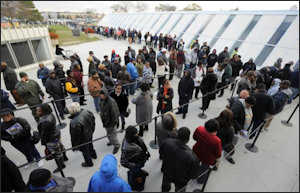
    It is one more reason the lines will form and move slowly on November 5 and another good reason to find your way to your local early voting location, which will be far less crowded than your main precinct.ย 

    The ballot question involves expanding an existing tax exemption from paying local real property (home and land) taxes. Right now the surviving spouse of a member of the armed forces gets the exemption if their spouse is killed in action. If this passes, the exemption would be available after death from another cause which is determined by the U.S. government to be โ€œin the line of duty.โ€

    The underlying legislation passed during the 2023 and 2024 sessions, sponsored by Senator Jeremy McPike, D-Prince William. The bills did not receive any financial impact analyses which might inform voters how many additional exemptions would be authorized, and how much they would reduce local tax revenue. The exemption applies only to a โ€œprincipal place of residenceโ€ owned and occupied by the spouse and expires if they remarry.

    Election officers will get plenty of questions about it, but in general will know no more about the fine points of Article X than the voters do. It will be a long, long day, especially in locations with contested local elections on top of the federal contests.

    Early voting is not proving as popular as it did in 2020, at least not so far, which is fascinating because the evidence indicates more Republicans are doing it this time. Please vote early.

    — SDH


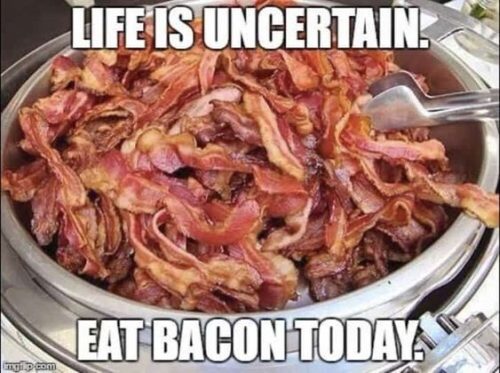
  • Bacon Meme of the Week


  • Data Shows Murder Drop in Virginia Ceasefire Cities

    by James A. Bacon

    In a column last month, I asked if Virginia Ceasefire, a collaboration between the Attorney General’s office and 14 urban police departments, had succeeded in combatting violent crime. I was responding at the time to a gauzy video and vacuous website highlighting the program but providing no hard data demonstrating the program’s effectiveness.

    Well, today, on the two-year anniversary of the initiative, AG Jason Miyares has some answers. He says Virginia Ceasefire deserves a big share of the credit for a 30% statewide drop in homicides so far this year compared to last year, and an 11% reduction in overall violent crime.

    There have been 116 fewer murders in Virginia through August than during the same period last year. Ceasefire cities, representing 19.4% of all offenses in the Commonwealth, saw 77 fewer murders, accounting for 66% of the reduction.

    “Ceasefire Virginiaโ€™s targeted actions to dismantle networks of violent crime [are] working,โ€ said Attorney General Jason Miyares in the press release. โ€œBy focusing on the small percentage of individuals committing a disproportionate share of serious violence, our message is clear: if you endanger Virginiansโ€™ lives and terrorize our neighborhoods with violence, the Commonwealth of Virginia will ensure you face the full force of justice. There is no escaping the consequences.โ€

    In reviewing the data, I think it’s probably fair to say that Virginia Ceasefire deserves some credit for the decline, although deeper analysis is called for. More than half the reduction in the number of homicides occurred in just two cities — Hampton and Newport News — which raises the possibility that local factors unrelated to Virginia Ceasefire might have come into play.

    (more…)


  • Want Energy Both “Green” and Reliable? Send Natural Gas and Money

    By Steve Haner

    With the release of its latest 15-year plan to expand energy generation in the Commonwealth, Dominion Energy Virginia has increased the projected cost of residential electricity in 2035 to almost $216 per 1,000 kilowatt hours, a 24% increase over the same projection in its 2023 planning document.ย 

    If the $216 comes to pass, it will represent about $100 per megawatt hour more (up 86%) than the same residential customer was paying in 2020, just before the implementation of the Virginia Clean Economy Act.ย  If 1,000 kilowatt hours is the monthly average usage, the annual bill will be up about $1,200.ย  Many customers, of course, use much more power than that per month.ย ย ย 

    The comparable projection in the plan introduced last year was $174 for 1,000 kilowatt hours of juice in 2035.ย  The current price is about $143 for that much residential electricity.ย  Another projected future price in the analysis, using assumptions dictated by regulators but resisted by the utility, sets the new 2035 price at $277 and puts the 2039 price at $315 — more than three Benjamins for one modest monthly power bill.ย ย 

    This analysis also includes, for the first time, a projected future cost for Dominionโ€™s thousands of customers in northeastern North Carolina.ย  With different state laws and regulators, Dominion reports North Carolinians will pay $127 for that 1,000 kWh by the end of this year and only $202 by 2035.ย  Somewhere in the 406-page document, the difference might be explained.ย ย 

    (more…)


  • Performance Problems at TJ?

    by John Butcher

    The excellentย Jim Baconย recently posted two discussions (hereย andย here) of a recent decline in theย ranking of TJ (aka, Fairfax Countyโ€™s Thomas Jefferson School for Science and Technology). The excellentย Dick Hall-Sizemoreย has penned aย rejoinder.

    Jim points out declines from 2019 (i.e.ย pre-pandemic) to 2024 in math and science SOL pass rates; and the change in percentage of Asian-American students; and the decrease in TJโ€™sย US News ranking; and changes in the Advanced pass rates of math and science SOLs. He relates those to the 2021 change in admissions standards. Dick argues that the US Newsย ranking change is based on data that pre-dated the change in admission standards. He does not address the other changes.

    Theย SOL dataย on the VDOE Web site paint a complicated and interesting picture.

    Notes: the 2021 (โ€œ2020-2021โ€ in the database) testing was voluntary so that yearโ€™s data probably are not reliable measures. The โ€œPass/Advancedโ€ย descriptor indicates a score at or above 500 on the 600 point scale; โ€œPass/Proficientโ€ indicates a score above the minimum level of 400. The change in admission scoring at TJ first took effect with the 2021-2022 entering class. We would expect any effect of that change to show first in the โ€˜22 data, and to increase in each of the next three years.

    The Big Three forย accreditationย are reading, math, and science. Letโ€™s start with reading.

    image

    (more…)


  • Election Obstructionism Comes to Virgina

    by Dick Hall-Sizemore

    Two Republican members of the Waynesboro Electoral Board, a majority, have asked a court to declare the use of voting machines a violation of the Virginia Constitution and of state law.

    The constitutional complaint is based on the provision in the constitution that votes shall not be counted in secret. The electoral board members assert that, because they and members of the public do not have access to the programming of the computer that enables it to determine how many votes to assign to each candidate, the counting is being done in secret. Virginia law requires electoral boards to declare which candidate got the most votes and to issue a certificate of election to that person. The plaintiffs say that they cannot do that in good conscience because they do not know whether the computer is programmed to count the votes accurately and to do so would be a violation of their oath of office. The only remedy would be a hand count. In case the court cannot hear and reach a decision before election day, the plaintiffs have asked for a temporary injunction. (These arguments are the same made earlier by the Hanover Republican party, which did not pursue them in court.)

    Aside from the suggestion of a complex conspiracy to program the voting machines to produce false results, there are two curious aspects to this situation. The first is that Donald Trump, who consistently questions the validity of elections and accuses the Democrats of plotting to steal the upcoming election from him, handily was the top vote-getter in Waynesboro in the 2016 and 2020 Presidential elections.

    (more…)


  • Tools of Bureaucratic Repression

    Image credit: Chat GBT

    by James A. Bacon

    The biggest controversy roiling the University of Virginia today swirls around accusations leveled by 128+ letter signatories against leaders of the UVA Health System and School of Medicine for using the tools of bureaucratic repression to create a culture of fear and intimidation. The accusers have yet to release any specifics to the public. But outsiders can get a glimmering of what they might be talking about by reading a petition to the U.S. Supreme Court filed in September by Kieran Bhattacharya, a medical student who ran afoul of UVA’s administrative apparatus in 2018 after daring to question the academic premises behind microaggression theory.

    It is important to note that the incidents described in the petition occurred before Craig Kent became CEO of the health system and Melina Kibbe joined as dean of the Medical School. The two key figures in the current controversy played no role in the Bhattacharya case. However, evidence surfaced by the Bhattacharya proceedings reveals the nature of the medical bureaucracy that Kent and Kibbe inherited. What they did with the system they were bequeathed is beyond the matters I discuss here.

    Multiple tools of control play prominently in the Bhattacharya court pleadings. One is the anonymous system for filing complaints. Another is a system for filing “professionalism concern cards.” Another is the existence of a tribunal exercising the powers of investigator, judge, and jury to administer complaints. Another is the ability of university officials to order mental health evaluations and commit people against their will to psychiatric hospitals. And finally, there is the ability to expel people from the university by means of No Trespass Orders (NTOs).

    (more…)


  • New School Accountability System Needs New Funding Approach

    By Chris Braunlich

    Braunlich

    When the Virginia State Board of Education approved a new state accountability system, it predictably drew attacks from the usual sources.

    The new system places greater emphasis on student mastery of subject information (50-65%) over student growth (20-25%).ย But while growth is critical and should be recognized, under the process approved during the McAuliffe-Northam Administrations, a school could be accredited even if its students never reached the goal of actually learning the material.ย Youngkinโ€™s appointees sought to correct this.

    It also brought Virginia state accreditation into alignment with long-standing federal requirements that English Learners (ELs) be included in school ratings after three semesters (previously, Virginia did so only after 11 semesters).ย This was deemed unfair by the Virginia education establishment.ย On first glance, three semesters seems unrealistic to many.

    However, as Todd Truitt, an Arlington education parent leader and active Democrat points out, civil rights groups have long supported including English Learners in school accountability systems. Truitt notes Education Trustโ€™s observation that, by delaying their inclusion up to five and a half years, โ€œgenerations of students โ€” particularly students of color, students from low-income backgrounds, students with disabilities, and multilingual learners โ€” have been systematically denied equitable access to โ€ฆ educational opportunities.โ€ย 

    By including such students earlier in Virginiaโ€™s accreditation process, as is the case in other states, the ability of school systems to hide English Learner performance is made more difficult.ย Perhaps that transparency is why, in the National Assessment for Educational Progress โ€“ an assessment separate from state accreditation —ย 30 percent of Florida Hispanic students score at the Proficient level, while only 18 percent of Virginia Hispanic students do.ย 

    (more…)


  • Hampton Roads Military Bases Swarmed By Drones

    by Kerry Dougherty

    Itโ€™s not clear why we are just now learning that dozens of drones buzzed local military installations night after night for more than two weeks last December. 

    Neither is it clear why military brass just stood there, sucking their thumbs and staring at the sky, while these airborne spy machines made repeated passes through restricted air space over Langley Air Force Base, Naval Station Norfolk and Dam Neck.

    The news broke over the weekend in The Wall Street Journal in a story headlined โ€œMystery Drones Swarmed A U.S. Military Base For 17 Days. The Pentagon Is Stumped.โ€

    For several nights, military personnel had reported a mysterious breach of restricted airspace over a stretch of land that has one of the largest concentrations of national-security facilities in the U.S. The show usually starts 45 minutes to an hour after sunset, another senior leader told (US Air Force General Mark) Kelly.

    The first drone arrived shortly. Kelly, a career fighter pilot, estimated it was roughly 20 feet long and flying at more than 100 miles an hour, at an altitude of roughly 3,000 to 4,000 feet. Other drones followed, one by one, sounding in the distance like a parade of lawn mowers.

    The drones headed south, across Chesapeake Bay, toward Norfolk, Va., and over an area that includes the home base for the Navyโ€™s SEAL Team Six and Naval Station Norfolk, the worldโ€™s largest naval port.

    Alarming.

    Yet government officials scratched their heads, trying to decide if this was the work of mischievous drone enthusiasts or foreign enemies. (They eventually ruled out hobbyists.) The White House was briefed on the drones and a series of high-level meetings were held with members of the administration, the FBI, Defense Department and the Pentagonโ€™s UFO department.

    Why didnโ€™t the military simply shoot the drones out of the air. Continue reading.


  • More Nitwittery at UVA

    Ben Doherty. Photo credit: The Daily Progress

    by James A. Bacon

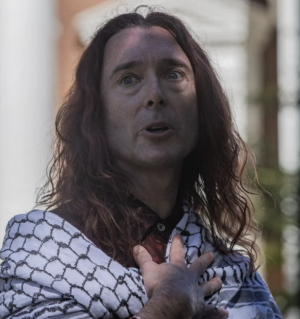
    Ben Doherty, a librarian for the University of Virginia School of Law, was arrested in May during the break-up of the pro-Palestinian encampment, one of 26 detained after defying repeated orders to disband. The trespassing charges against him were dropped, and he suffered no administrative sanction from UVA itself. But he’s still posing as a victim.

    Doherty’s beef: the law school sent him a “letter of counseling” saying that โ€œfuture conduct of this kind โ€ฆ will very likely result in disciplinary action up to and including termination.โ€

    UVA insisted to The Daily Progress that the letter was not a disciplinary action. Indeed, it detailed no consequences for anything Doherty had done, but gave him fair warning of potential consequences for what he might do in the future.

    Still, Doherty interpreted the letter as an effort to “chill” his freedom to protest. โ€œTo me, itโ€™s a written threat of termination for participating in a protest,โ€ he told the newspaper. โ€œIt feels pretty material to me. I think they are using the idea that itโ€™s not a disciplinary action to get away with not following the law.โ€

    Doherty felt his rights so threatened that he and some 30 others marched with impunity down the Lawn last week toward Madison Hall, site of President Jim Ryan’s office, proclaiming loudly, “Proโ€ฆ test is a right! That is why we have to fight!โ€

    (more…)


  • Jeanine’s Memes

    From The Bull Elephant


  • FOIA Fighter

    by James A. Bacon

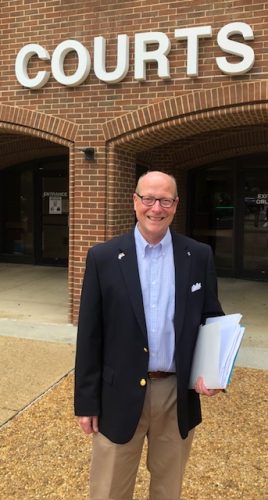
    Walter Smith at the Henrico County courts building

    It was a quiet Monday afternoon in the Henrico County General District Court, and Walter Smith thought he might have the University of Virginia on the ropes. Smith, an attorney and retired insurance industry executive, had spent much of the previous three years using the Freedom of Information Act (FOIA), trying to pry open documents lending insight into UVA decision making. He had been stymied repeatedly on various grounds, including the assertion that the records he sought were exempt presidential “working papers.” But this case was different.

    This time Smith had asked for text messages between University police chief Tim Longo to the Albemarle County Commonwealth’s Attorney Jim Hingely regarding a meeting President Jim Ryan had asked Longo to set up with the local prosecutor. The purpose: to discuss an April press release explaining why the University was withholding release of an independent report into the slaying of three football players in 2022. The local newspaper, The Daily Progress, had obtained the text messages through a FOIA request and published some of them, and Smith wanted to see the complete records. By the time he filed his request, however, he was told they no longer existed โ€” even though, according to UVA’s records-retention policy, the University was supposed to keep text and email messages for three years.

    UVA attorney Robert M. Tyler took on the awkward task of explaining to Judge B. Craig Dunkum why the texts were deleted: Longo’s phone, set on Apple’s default setting, auto-deleted them. There were no sanctions in the state code spelling out a penalty for such an occurrence.ย 

    Dunkum accepted Tyler’s argument that the deletions were not deliberate, but he pronounced himself “troubled.” “If you can delete the records … somehow, that doesn’t seem right to me,” he said. “It rewards bad behavior.”

    (more…)