
by James A. Bacon
In a column last month, I asked if Virginia Ceasefire, a collaboration between the Attorney General’s office and 14 urban police departments, had succeeded in combatting violent crime. I was responding at the time to a gauzy video and vacuous website highlighting the program but providing no hard data demonstrating the program’s effectiveness.
Well, today, on the two-year anniversary of the initiative, AG Jason Miyares has some answers. He says Virginia Ceasefire deserves a big share of the credit for a 30% statewide drop in homicides so far this year compared to last year, and an 11% reduction in overall violent crime.
There have been 116 fewer murders in Virginia through August than during the same period last year. Ceasefire cities, representing 19.4% of all offenses in the Commonwealth, saw 77 fewer murders, accounting for 66% of the reduction.
“Ceasefire Virginia’s targeted actions to dismantle networks of violent crime [are] working,” said Attorney General Jason Miyares in the press release. “By focusing on the small percentage of individuals committing a disproportionate share of serious violence, our message is clear: if you endanger Virginians’ lives and terrorize our neighborhoods with violence, the Commonwealth of Virginia will ensure you face the full force of justice. There is no escaping the consequences.”
In reviewing the data, I think it’s probably fair to say that Virginia Ceasefire deserves some credit for the decline, although deeper analysis is called for. More than half the reduction in the number of homicides occurred in just two cities — Hampton and Newport News — which raises the possibility that local factors unrelated to Virginia Ceasefire might have come into play.
The $5 million Ceasefire Virginia program funds seven Special Assistant U.S. Attorneys who have pursued 170 federal and one state indictment so far. More than 50 investigations remain ongoing.
Ceasefire Virginia attorneys have racked up a conviction rate nearing 100%, with 68 convictions and a total of 5,649 months — 470.75 years — of federal prison time for violent repeat offenders. Under federal guidelines, inmates are required to serve at least 85% of their sentences.
What I appreciate about the latest press release is that it provides the detailed data the claims are based upon. You can find the data here.
The AG’s office broke down key crime metrics for the period January 1 through August 31 for 2023 and 2024. There has been a downward trend statewide through the first eight months of the year. The overall crime numbers show little difference between Ceasefire cities and the rest of Virginia.
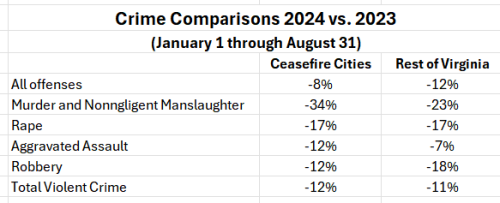
However, the Ceasefire project focuses on homicides (murder and nonnegligent manslaughter), and the numbers show a sharper reduction for the Ceasefire cities (34%) than the rest of the state (23%).
The analysis gets more complicated if we drill down by individual Ceasefire cities, which we can do with the numbers provided by the AG’s office. It turns out that of the 77 reduced deaths for all Ceasefire cities, 40 occurred in just two cities: Hampton and Newport News.
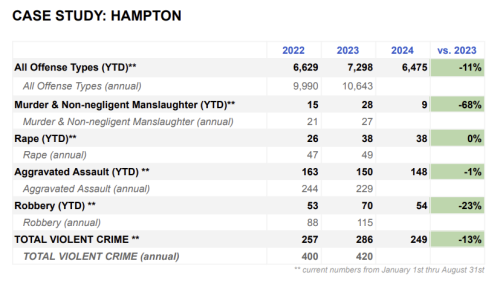
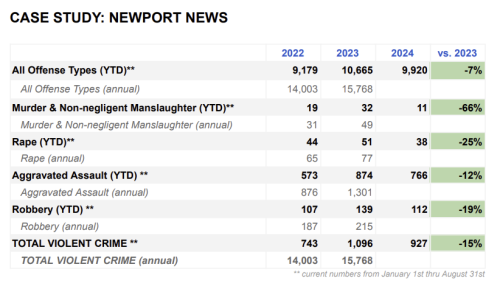
Thus, we see that murders plummeted by 68% in Hampton and 66% in Newport News, but only 17% in the other twelve Ceasefire cities (less than the statewide average).
If we find that Ceasefire indictments and convictions were concentrated in Hampton and Newport News, that would be powerful — perhaps irrefutable — evidence that the Ceasefire strategy of identifying repeat offenders and getting them off the streets is a highly effective crime-fighting strategy. Conversely, if we find that Ceasefire indictments and convictions were spread proportionally across the 14 cities, it would call into question whether Ceasefire accomplished anything more than other strategies. Rather, it would lead us to focus on what Hampton and Newport News were doing locally to bring about such dramatic turnarounds.
To answer that question, we need a breakdown of where the indictments and convictions took place. Hopefully, the AG’s office will expand its commendable display of transparency to a release of that data.
Leave a Reply
You must be logged in to post a comment.