
by Dick Hall-Sizemore
The high cost of housing is a frequent topic of discussion in society and on this blog. Some observers fault local governments for their restrictive zoning practices that limit density. According to this argument, increasing density would help mitigate the increase in housing costs.
The argument has merit. However, its proponents seem to assume that it is a simple matter for local governments to change their zoning policies. After all, they only have to pass an ordinance to do so.
The experiences of two Northern Virginia localities illustrate the difficulties local governments face when trying to increase housing density. In short, they end up in court.
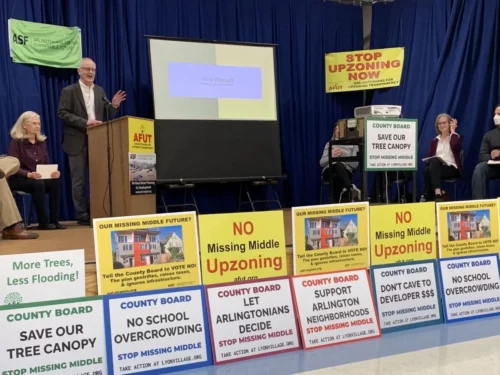
After years of consideration, multiple public meetings and hearings, and much controversy, Arlington County adopted last year what is known as “missing middle” zoning. The policy allows by-right construction of duplexes up to six-plexes in areas previously zoned for single family housing. The ordinance calls for limited implementation—a maximum of 58 such structures per year, for five years, geographically dispersed by zoning district. (The Arlington proposal was the subject of an article on this blog earlier this year.)
Next door, the city of Alexandria amended its zoning ordinance to allow buildings with up to four housing units in any residential neighborhood.
Shortly after the Arlington board adopted the ordinance, a group of nine homeowners challenged the action in court. Trial arguments ended in mid-July. Based on reporting of the trial, the plaintiffs’ arguments seemed to fall into two categories.
The first argument raised is that the county did not think the proposed change and the possible ramifications out thoroughly enough. For example, the plaintiffs complained that the county had given insufficient consideration to how the change in zoning would affect storm water management, school capacity, and the water and sewer infrastructure. One plaintiff testified that she was worried that the resultant school overcrowding would prevent her son from getting the special services he needed. Others cited the lack of parking, the danger of cut-through traffic, and the diminishment of tree canopy.
These might be legitimate arguments against the proposed zoning change, but they are policy issues, not legal issues, and the courts are not the appropriate arena to be raising them. At one point the presiding judge made that point, “I’m allowing you to go into this, but it seems like this is a policy argument, and that is not my province.”
The second argument raised was procedural. The plaintiffs contended that the public had not had adequate notice and time to comment on the proposals. They seemed to focus on the procedure the board used to reach its final decision. After listening to public comments, the board had before it several options. The proposal that was finally voted on was a combination of those options. It seems that the plaintiffs were arguing that the board needed to settle on a final package and then allow comment on that specific combination.
It would be unreasonable to require the board to have a public hearing after every amendment was made to the proposal. The case was heard by a retired judge, appointed to the case after all the sitting judges recused themselves. The court has not announced its decision.
Alexandria has also been sued over its ordinance allowing multi-family residential units in any residential zone. The same judge that presided over the Arlington trial has been assigned to try the Alexandria case. This judge’s decisions will have a significant effect on localities’ efforts to increase housing density and, in the process, slow the increase in housing costs.
Leave a Reply
You must be logged in to post a comment.