
by Jon Baliles
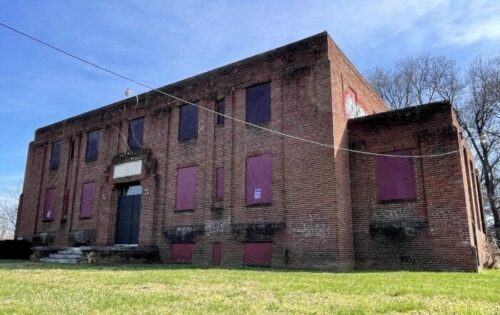
Virginia Union conducted a staged community meeting two weeks ago to feign concern over the fate of the former Richmond Community Hospital (RCH) so they can instead quickly get shovels in the ground to build new housing developments that they find more important than preserving a critical piece of the city’s black history and heritage.
In February, the school announced the project to build 200 new “affordable” apartments for students and the public on the edge of campus and raze the depression-era, art deco style RCH building. After significant community pushback, VUU and the developers (who are based in Philadelphia) said they will preserve the façade of the RCH and incorporate it into one of the two six-story apartment buildings that will be built on site. VUU and the developers will co-own the project and share in the profits.
The school said in an announcement at the time of the recent meeting: “The Virginia Union development intends to adaptively reuse much of the former Richmond Community Hospital and create the City’s largest honor for black medical professionals — permanently preserving the hospital’s legacy after decades of the building being abandoned.”
Using the phrase “much of the former RCH” is a stretch, to say the least, considering the only parts that will be preserved are the façade, which includes the 1932 cornerstone, and some bricks which will be repurposed in the new building.
VUU also said it would invest $5 million in commemorating the legacy of RCH and those who worked there with naming parts of the project and green spaces after some of the medical professionals who worked there. RCH was founded in 1902 by Dr. Sarah Garland Jones in Jackson Ward before moving to the VUU site where it operated from 1932 until 1980, when it moved to the East End and is now part of the Bon Secours network.
At the most recent meeting, VUU President Hakim Lucas said “We’ve always said from the beginning that we were going to find a way to preserve the legacy. We’ve always said that. It’s never been a question. It’s more than just memorialization of the site; it’s a continued legacy moment.”
It is sad to say and worth pointing out that Lucas’ recent statement is just flat out not true. The Richmond Free Press reported after the February unveiling:
When asked whether the vacant hospital building will be preserved, Dr. Lucas replied, “Oh, no. We will be memorializing (the site) and finding ways that historically represent it.”
When asked why the building will be destroyed, Dr. Lucas replied that “it is not in a place that we can convert any useable building in line with anything in the medical field.”
He also boasted that “Those who want to preserve Black History should look to VUU, as this development project shows how Virginia’s oldest HBCU is building on a 158-year legacy, celebrating history, and shaping the Commonwealth’s future.”
Out of the gate the plan was to bulldoze the hospital and build an uninspiring looking apartment building as soon as possible. Only after the community quickly rose up to try and protect the structure and legacy of the city’s first hospital that cared for thousands of Black families and children over the decades of Jim Crow laws did anyone at VUU even take notice. That’s because Richmond Community Hospital was and still is a community treasure, not just a VUU one. Restoration efforts would draw support and resources from a broad swath of organizations and the community if called on to renovate it with new purpose, just as we did with Maggie Walker High School (now the Governor’s School) and the Leigh Street Armory (now the Black History Museum). It worked for saving both of those structures which were in horrible shape (neither had a roof for years and the Armory was close to collapse), but they were saved the old fashioned way — through hard work and rolling up one’s sleeves. LINKS HERE
Committing to preserving history is not an easy task, but it is vitally important and part of what makes Richmond (I argue) one of the most important historical cities in the country. Historian Selden Richardson, author of the (highly recommended) 2005 book entitled Built by Blacks: African American Architecture and Neighborhoods in Richmond, sent a letter to the VUU Board of Trustees recently urging their reconsideration of the school’s “leadership” to raze history. He wrote:
I need not remind you, as members of the Board of Trustees, that you have an obligation to perform due diligence regarding all facets of this proposed development, the first being does destruction of this African American heritage site really conform to the Mission Statement, which proudly proclaims, “Virginia Union University is nurtured by its African American heritage…”. Does this truly further the mission of the University?
…how can you possibly countenance the utter destruction of this historically important and once vital part of the African American community in Richmond? The very name of your committee implies trust, and trust in this case is another name for stewardship of resources. The former Richmond Community Hospital building is in your care and you are responsible, and this is not a resource to squander.
Back in the 2002 rezoning of part of VUU’s campus and obtaining a Conditional Use Permit the application submitted by VUU states in the supporting information: “To address health, economic, civic, and social issues in the local community, the University proposed to renovate and convert a former Richmond Community Hospital building located on campus for a University Outreach Center.”
While this was more than two decades ago, it showed then that the leaders of VUU back then saw the value and importance of preserving the RCH building than the leaders of the school today.
Michael Paul Williams wrote this week:
Virginia Union University, in its treatment of the old Richmond Community Hospital building, reveals its preservation of Black history to be a mere façade. There can be no other explanation for its willingness to demolish all but the outer wall of this monument to the pluck and resilience of Black Richmonders in their quest for medical care.
Mary DePillars, a VUU alumna and former board member of the Richmond Community Hospital Foundation, called out the school’s leadership in MPW’s article:
Tucking the façade of the hospital into a corner on the back side of a six-story apartment building with a small garden in front is not satisfying. Surely an institution of higher education can find a better way to preserve a major part of RVA’s black history and use it as a teaching tool instead of subjugating it to contemporary concrete and glass.
Richardson also sent a sharply-worded Letter to the Editor of the Times-Dispatch:
The callous and ill-advised attitude of the current VUU administration is in heartbreaking contrast to the effort Richmond blacks made to build this hospital in the depths of the Great Depression. Dances, bake sales and fund drives were held and quarters and dimes collected in order to provide badly needed professional health care for blacks in this city.
He also asks for the school to “reconsider this course of action that will forever erase an important African American heritage site on the VUU campus. Let VUU’s rich history truly be nurtured by this asset. It holds enormous potential.”
And the possibilities of that potential have been made clear by the Save Richmond Community Hospital Group which was formed to try and save RCH. Viola Baskerville, a former member of City Council and the House of Delegates, and a former state secretary of administration under Gov. Tim Kaine, teamed up with activist Farid Alan Schintzius to lead the effort and sent a letter filled with possibilities and hope for the building.
MPW mentioned the group offering many possible uses of a restored building in a letter to VUU: student housing for medical professionals-in-training with a community kitchen and clinic for community service education; affordable housing with city and state tax abatement in partnership with the Maggie Walker Land Trust; a training center for midwives and doulas in public health nursing; an honorary museum and wellness center for the community; a black business incubator focusing on medicine, science and business; and a neighborhood meeting space celebrating the history of the building.
Baskerville and Schintzius were clear to note to VUU that the community is not against the development or finding new streams of revenues for the school; “however, it is concerned about the future of one of the few remaining physical examples of America’s early 20th century black hospital movement,” the letter reads.
Sadly, the school has repeatedly ignored offers from Historic Richmond Foundation to evaluate the RCH building’s structural integrity even though they worked together five years ago to save and renovate VUU’s Industrial Hall, which is one of the school’s earliest structures. Richardson also offered in his letter to the VUU Board to do the work necessary to list RCH on the National Register of Historic Places, just as he did to save the Leigh Street Armory even though the structure had no roof for decades and walls that had to be braced to keep from collapsing.
Historian Selden Richardson wrote:
An extensive discovery of the history of this [RCH] building would show the world the heroic efforts made by people of little or no means, during the worst economic crisis this county has ever seen, to ensure modern and efficient health care where patients and doctors alike were treated with racial dignity. A complete account of the Richmond Community Hospital building would also demonstrate clearly the importance of this building to African American Richmonders, the surrounding community, and the City at large.
Baskerville wrote a passionate letter to the Free Press back in the spring cautioning that…
Demolition deprives us all of a true understanding of our history and shows a callous disregard in honoring the struggles of our ancestors. The conservation of black history should be a priority for everyone, especially those institutions under a HBCU banner. If black institutions don’t preserve black history, then we are lost.
Her most recent letter with Schintzius concluded their most recent appeal to VUU to save and rehabilitate the building: “Richmonders are watching to discover how one historically black institution regards another.”
We are indeed. We are also waiting to see if VUU is willing to roll up its sleeves to do the hard work with the RCH that would accomplish a new, dual purpose that new housing just can’t quite match — teach students new skills they can utilize in the future and do so in a building that also educates them about the not-so-pleasant (and not so distant) past where great odds were overcome and determination demonstrated the path to success in overcoming any and all barriers thrown in the way (and there were many).
Those are the types of vitally important lessons and skills that you would think any educational institution would embrace in providing its students — skills that we can all learn from and utilize — but only if we are less interested in housing as a revenue “solution” and more interested in learning from history to make sure we do not repeat it.
The Save Richmond Community Hospital Group is circulating a petition to support its efforts to save the building from demolition that you can sign on to here.
Jon Baliles is a former Richmond City Councilman. This column has been republished with permission from his blog RVA 5×5.
Leave a Reply
You must be logged in to post a comment.