
by Steve Haner
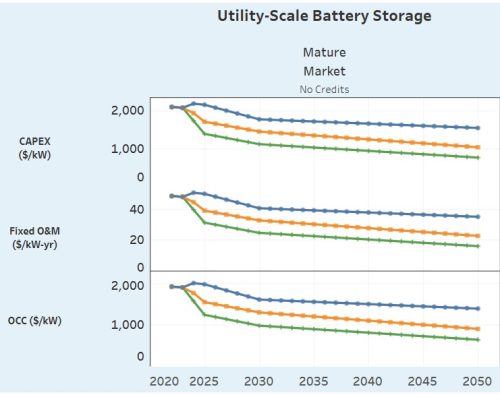
A federal renewable energy laboratory’s public website on the cost of building utility battery storage indicates the cost now being paid by Virginia’s two major utilities is well above the average. Predicting future costs is always iffy, but the National Laboratory of the Rockies website does that, too.
In earlier posts, Bacon’s Rebellion reported (accurately) that Dominion Energy Virginia has applications pending at the State Corporation Commission to build battery storage at average costs of about $675,000 per megawatt-hour.
The federal data puts the 2026 cost of a four-hour battery system at $520,000 per megawatt hour, or $520 million* per gigawatt hour, with a slightly lower cost for 10-hour units. Reworking the numbers from the earlier post, the utilities would still need more than $50 billion to build all storage called for in House Bill 895 at today’s prices. Some numbers are detailed at the end.
The earlier post did spark a response from one of the advocates for the bill, which is a massive expansion on the utility battery mandate now included in the Virginia Clean Economy Act. He made the point that there are examples of battery projects costing far less than Dominion’s, and that the utility does not have a stellar record of keeping its costs in line with or below outside competition. Their bill also promotes competition, which is good.
One example of somebody getting a better price comes from Georgia, where Tesla has signed a $2.7 billion deal to provide four-hour batteries. If that is 12 gigawatt hours, as it appears to be in the Tesla release, that works out to $225 million per gigawatt hour. It does seem that it is the price of the batteries, but not the full capital cost of placing, installing and connecting them to the grid, where the Dominion cost is all inclusive.
House Bill 895 calls for about eleven times more storage for Virginia than Tesla just sold to Georgia.
Even if the Dominion current price is too high, and if technology progress tends to decrease cost over time (as it could), the purchase of 135 gigawatt-hours of battery storage by Dominion and Appalachian Power remains a massive capital undertaking for facilities that simply store but do not generate energy. Legislators need to pay attention.
The feedback from the bill’s advocate was welcome. If the result is that the cost of these proposals, and the way they will impact ratepayer bills, becomes a major focus of the lobbying debate, wonderful. Advocates will then claim the cost is justified by all kinds of benefits, again all very debatable, but legislators need to understand that utility capital costs turn into new charges on everybody’s electric bills.
The data from the National Laboratory of the Rockies (it was the National Renewable Energy Laboratory pre-President Trump) includes conservative, moderate and “advanced” prices (perhaps a better word is optimistic), so there is a range. I used the conservative numbers for this.
It also provides an estimated 2026 price for 10-hour batteries, which are also called for in House Bill 895, of $466 million per gigawatt hour. That is as high as it goes now, with no price estimates for the 24-hour or longer duration batteries in this battery industry “dream bill” pending in Virginia. They do not yet exist.
It projects that the four-hour batteries will cost $429 million per gigawatt hour in 2035, and the 10-hour units $363 million per gigawatt hour. It also makes a key point that will weigh heavily on the ultimate consumer cost if this bill is approved and implemented:
Base year installed capital costs for (battery storage systems) decrease with duration (for direct storage, measured in $/kWh) whereas system costs (in $/kW) increase. This inverse behavior is observed for all energy storage technologies and highlights the importance of distinguishing the two types of battery capacity when discussing the cost of energy storage.
In other words, some aspects of the cost of delivered energy get higher as the battery systems expand to longer durations. That really is going to matter when any utility is proposing 24-hour-plus batteries. What is the business case that makes them justified and the most reasonable choice?
Again, this underlines the major problem with this awful bill. Legislators have no idea what they are doing, no way to predict what makes sense five, ten or twenty years out. They shouldn’t try to. The Virginia State Corporation Commission already has all the authority it needs to approve all the batteries it deems reasonable, prudent and necessary.
*Some details: The national lab’s conservative projection of the capital cost of 4-hour utility scale batteries for 2026 is $2,083 per kilowatt. Multiply that by 1,000 and you get $2,083,000 per megawatt. Since these are four-hour batteries, that works out to $520,000 per megawatt-hour.
Under HB 895, Dominion would be directed to build or buy 64,000 megawatt-hours’ worth of four-hour batteries, costing $33 billion on that basis. That doesn’t include the longer duration batteries also called for in the bill. It is the all-in capital cost, plus the utility’s profit margin, that determines what ratepayers will pay monthly to build these.
Using the NLR 2026 estimates, and assuming all the long-duration batteries called for in the bill are 10-hour duration, what was a $90 billion estimate in the earlier post is still over $50 billion at today’s NLR capital expenditure estimates. And that is for far less than the 135 gigawatt-hours of storage the bill calls for if 24-hour batteries do become available.
Leave a Reply
You must be logged in to post a comment.