
by Steve Haner
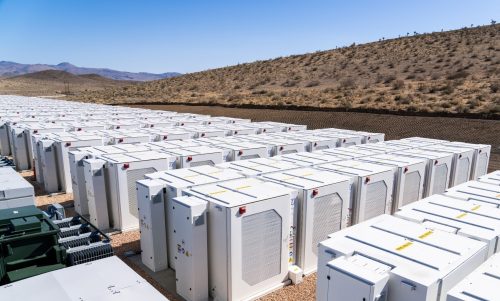
Proposed legislation to require Virginia’s two main electric utilities to load up on battery storage in the next 20 years has now been introduced, and the target battery amounts for Dominion Energy Virginia grew even larger than in the version of the bill previewed by a study commission in December. It is way larger and more expensive than the bill vetoed by Governor Glenn Youngkin (R) last year.
For Dominion and Appalachian Power Company combined, doing a bit of simple math, the bill is calling for more than 135 gigawatt hours of battery storage. That is probably enough stored electricity to meet their current customer demand three or four times over (five times on a slow day). At the estimated price per gigawatt hour used in this previous post, the capital cost (less profit and operating expenses) would surpass $90 billion.
If they existed today, they would hold enough electricity to cover the entire 13-state PJM regional transmission organization on all but a few days. These folks want to back up the entire PJM system with batteries paid for by Virginia ratepayers. (It is a bit more complicated than that, but this does indicate the scale of power involved. Their first hour of combined discharge would be 21 GW, still a stunning amount of electricity.)
Incoming Governor Abigail Spanberger (D) has since listed this $90 billion battery legislation as one part of her “energy affordability” agenda, so a veto this time seems unlikely. It is also fair to assume Spanberger or at least some of her advisors saw this new draft before it appeared as a bill in the past 24 hours. This new version is House Bill 895, from Delegate Richard Sullivan, D-Fairfax, and a Senate companion bill is expected.
Most of the capital cost and years of profit for the utilities would show up on people’s bills long after Spanberger leaves office in four years.
The bill also calls for more storage for Dominion than did the version discussed in late 2025 by the Commission on Electric Utility Regulation, which sparked that earlier reported cost of $62 billion. Patrons said they were making additional changes but did not mention specific construction targets. With the legislative process just kicking off, further changes are likely.
The legislation speaks of short duration batteries (which can discharge for up to 10 hours) and two categories of long duration batteries (some discharging from 10 to 24 hours and others discharging more than 24 hours.) To get the estimates included in this summary, the assumption was the short duration batteries would average four hours of discharge (the most common now), the medium duration units would work 10 hours, and the longest duration ones 24 hours. Using that, the two utilities are directed to develop batteries with 135 gigawatts of combined output.
If the proponents of the bill have a different calculation, Bacon’s Rebellion will share it. If they dispute the underlying capital cost assumption of $675,000 per megawatt-hour they can also share their own expected price. That is what Dominion is currently proposing to pay for construction of two four-hour duration projects pending at the State Corporation Commission. Some legislator should ask the SCC about that.
The bill language does not give Virginia’s independent regulators a clear path to deny any of this should they decide these future projects are not necessary, reasonable and prudent, the traditional key regulatory tests. But it does say the in the bill it:
“…shall become effective only upon a determination by the State Corporation Commission (the Commission) that the technology referenced in such subdivisions is technically viable and that the construction, acquisition, or procurement targets referenced in such subdivisions are reasonably achievable.”
The translation is the SCC can only say no if the evidence is the batteries do not actually work or they cannot be found in the market. It does not say the batteries can be turned down if they are imprudent, unreasonable, unnecessary or too expensive. Omitting those words tells all.
The bill also directs the SCC to approve a demonstration program on the long duration technology, 10 hours of discharge or greater. They want to demonstrate 4,000 megawatt hours, equal to 400 megawatts of 10-hour batteries or some similar combination. The SCC can only say no to that if “in its discretion determines that long-duration energy storage resources are not reasonably available in sufficient quantities to support such petitions.” Well, duh, yes, the utilities cannot be ordered to install what doesn’t exist.
All this is at ratepayer expense, with full profit, of course. That is not the kind of consumer protection the SCC was created to provide. Just close your eyes, click your heels, and repeat three times: This will lower my electric bill, this will lower my electric bill, this will lower my electric bill.
Leave a Reply
You must be logged in to post a comment.