

by Todd Truitt
Senator Stella Pekarsky, D-Fairfax County, is sponsoring a bill this legislative session that would require the Virginia Board of Education to develop and “implement alternative graduation pathways” that allow students to earn a Standard Diploma without passing the statewide Standards of Learning (SOL) assessments.
Currently to graduate from high school in Virginia, students must pass end of course (EOC) SOL exams in specific courses in English, Math, Science and Social Studies. Under Sen. Pekarsky’s bill, the Board would have to consult a range of stakeholders — from educators and administrators to parents and students — to design options that could include “non-assessment demonstrations of competencies” like locally developed performance assessments, portfolios, capstone projects, work-based learning, dual-enrollment courses, or industry credentials.
As directed by Governor Abigail Spanberger’s inauguration day education executive order, Secretary of Education Jeffrey O. Smith and State Superintendent Jenna Conway will conduct listening sessions throughout Virginia during the first 100 days of her administration with “students, parents, educators, school leaders, superintendents, school board members, and community members about the challenges and successes facing their schools.”
Will changing this EOC graduation requirement even be a major concern to this broad section of stakeholders?
National Landscape on Graduation Testing Requirements
The states with testing requirements for graduation are as follows:
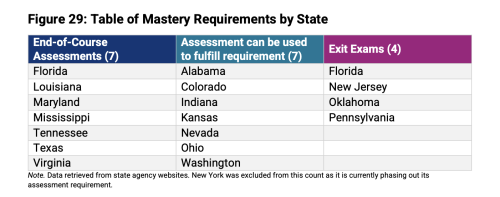
Source: December 2025 Massachusetts report, “Reimagining High School, Reimagining Readiness”
Nationally on the left, the leading education civil rights group The Education Trust is a strong defender of graduation testing requirements based on educational equity.
Recent national scandals have put more focus on the importance of standardized testing from an equity perspective. Last year, a Connecticut high school graduate sued her high school because she cannot read or write, even though she had graduated with honors. And one of the top ranked public universities (that had gone standardized test blind in admissions), University of California San Diego, announced that 12% of its incoming college freshman had math abilities below middle school level, even though 42% of this cohort passed precalculus or calculus courses in high school and 25% earned a 4.0 GPA in high school math classes.
Although Massachusetts voted in a statewide referendum in 2024 to do away with its exit exam, a graduation council organized by the administration of Democratic Governor Maura Healy recently proposed replacing that exit exam with EOC exams for graduation similar to Virginia (while also proposing a non-test pathway like Sen. Pekarsky proposed). Their report found “EOC assessments are generally positively correlated with high school graduation rates, with the impacts of Math and English Language Arts EOC assessments being statistically significant.”
Likely Bipartisan Opposition to Ending Graduation Testing Requirement
Sen. Pekarsky did not propose this bill while Governor Glenn Youngkin was in office. His administration had publicly defended such graduation testing requirements, stating: “We continue to set high standards and hold high expectations for our students.”
It is unclear if Gov. Spanberger would sign such a bill either if it was to pass both houses, especially if it was a party line vote. A major plank of Spanberger’s August 2025 Strengthening Virginia Schools Plan was “Uphold academic excellence and rigor in Virginia’s public schools,” and her inauguration day executive order committed to “academic excellence” while providing a number of pro-rigor directives.
It is also uncertain if the bill can make it out of the Senate Public Education subcommittee, which has 3 Democrats (including Sen. Pekarsky) and 2 Republicans. Republicans would likely oppose it, seeing it as a political lifeline to claim Democrats are trying to lower educational standards again now that they’re back in power. Moreover, Democratic Senator Schuyler VanValkenburg (D-Henrico County) is the chair of that subcommittee, a high school Social Studies teacher and a vocal defender of Virginia’s graduation exam requirement.
At the Senate Public Education subcommittee hearing on January 15, 2026, Sen. Pekarsky’s bill was docketed. But Sen. VanValkenburg said the bill was getting “passed by for the day.”
In November 2024, Sen. VanValkenburg defended this graduation requirement in the Richmond Times-Dispatch:
“If we want students across the commonwealth to do well, there has to be a state standard that is a good standard, because I think that localities are not positioned – for a variety of reasons – to create a high standard and to have high-quality tests.”
He is also the sponsor of the Senate bill to update our standardized tests to make them higher quality and more rigorous. (Delegate Dan Helmer, D-Fairfax County, is the sponsor of the companion bill in the House of Delegates.) Spanberger’s school plan and her inauguration day executive order endorsed these efforts, the implementation of which will likely be a massive $100M+ effort and a potential major achievement of her administration’s K-12 education policy team. (Disclosure: I serve on the state’s Innovative Assessment Work Group related to this SOL exam revamp.)
Revising Cut Scores for Graduation
Regardless of this bill, the Spanberger administration will at a minimum need to address the cut scores required for EOC courses for graduation. I am a strong supporter of the 3-year plan to raise the English and Math cut scores for proficiency from their current lowest level in the country to levels consistent with the “nation’s report card,” the National Assessment of Educational Progress (NAEP). But that proficiency level is too high as a graduation requirement considering Massachusetts (widely regarded as the nation’s best public school system) had only 45% and 51% of students meet its NAEP-level proficiency cut scores for its Math and English high school state standardized tests, respectively.
The Virginia Board of Education has discussed possibly setting an additional cut score for EOC courses for graduation, which I strongly support. I believe a minimum starting place for such additional cut scores for Math and English would be the cut scores prior to their lowering in 2019 and 2020, respectively. I also agree with Board member Dr. Beth Ackerman, who has recommended a state graduation committee to address this issue, with the Virginia Department of Education conducting focus groups throughout the state.
Leave a Reply
You must be logged in to post a comment.