by Dick Hall-Sizemore
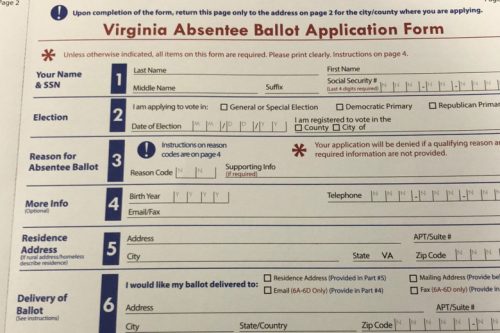
In response to my recent article on the Postal Service and mail-in ballots, Randy Hoffman posed a good question. In effect, his question was: What is all the fuss about if the Postal Service is going to use a state’s list of mail-in ballots?
The article had focused on the federal court decision enjoining the implementation of President’s Executive Order and Postal Service regulations in the 23 states, including Virginia, that were parties to the suit. Because I did not have a good answer to Hoffman’s question at hand, I decided to dig deeper. Note: In Virginia, we are used to referring to absentee ballots, but Virginia law now allows “no excuse” absentee voting, although registered voters must request a ballot to be mailed in. However, some states, such as California and Utah, send mail-in ballots to all registered voters. For the sake of simplicity, this article will use the general term, mail-in ballots.
The previous article dealt primarily with that portion of the President’s Executive Order that concerned how the Postal Service would deliver mailed-in ballots. However, the Executive Order needs to be considered in its entirety to understand its possible ramifications and to understand why a large number of states challenged the Order in court.
Section 2 of the Order directs the Secretary of Homeland Security to compile and submit to each state “a list of individuals confirmed to be United States citizens who will be above the age of 18 at the time of an upcoming Federal election and who maintain a residence in the subject State (State Citizenship List). The State Citizenship List shall be derived from Federal citizenship and naturalization records, SSA records, SAVE data, and other relevant Federal databases.”