
by James A. Bacon
Fairfax County educators are dissatisfied with the Youngkin administration’s new accountability system for Virginia’s public schools. They are arguing that the Every Student Succeeds Act (ESSA) plan, which goes into effect next year, will paint an inaccurate picture of how schools and students are performing, reports WTOP News.
During a school board work session last week, Michael Molloy, director of the school district’s government relations office, said the system is “extremely heavily weighted toward mastery, toward passing a test.” While there is a growth component included in the evaluation, he said, it’s “a relatively limited component, less so than I think the current system accounts for growth.”
Under the new regimen just approved by the Virginia Board of Education, public schools will be classified in 2025 as Distinguished, On Track, Off Track, or Needs Intensive Support. More than half of Virginia’s public schools would be labeled “off track” under the new system. Using a provisional model based on partial data, Virginia Board of Education staff estimated that 58 would be labeled as needing “intensive support.”
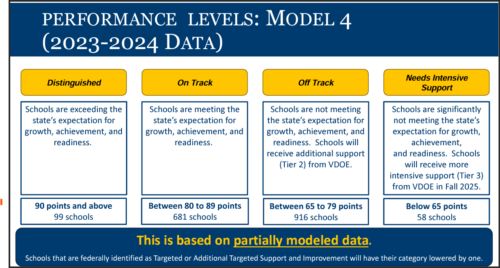
I don’t know how many, if any, of those 58 schools are located in the Fairfax public school district. SOLs are a significant component of the ratings, so given the higher-than-average performance of Fairfax students on the exams, I would expect the Fairfax district to look pretty good compared to the rest of the state. But Molloy and other school officials wouldn’t be complaining if Fairfax came off looking like a shining star.
There is more to this controversy than meets the eye.
Partisan mistrust might enter into the equation. “This is a way to delegitimize public schools, so that conservative elected officials can move money for public schools for all, to vouchers for parents to choose some other schools that will magically appear as choices in communities,” said Fairfax school board member Melanie Meren.
How the new rating methodology would delegitimize public schools is not intuitively obvious. In defending the methodology, Governor Glenn Youngkin has said that identifying the truly troubled schools would provide a basis for steering extra state dollars to the schools that need the most support. His advocacy of charter schools has been limited to so-called lab schools operated in collaboration with public universities.
I suspect that differences between Fairfax educators and Governor Youngkin run deeper. They disagree about fundamentals.
The new ESSA methodology incorporates several metrics including SOL scores, absenteeism rates, graduation rates, and advanced coursework. Here is the breakdown for high schools:
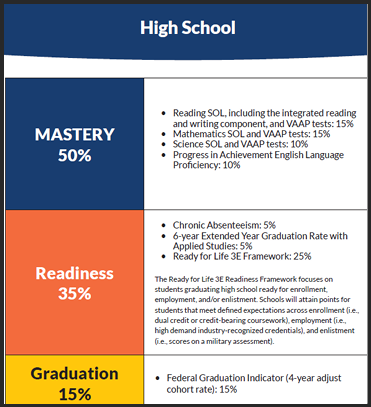
The methodology gives “growth” a 20% weight in elementary schools, and a 25% weight for middle schools. In theory, even if students do not achieve “mastery” — meeting minimum grade-level standards — it is an achievement of sorts if they manage to gain ground relative to their past performance or to that of their peers. The theory is that schools with large populations of at-risk students should be given credit for helping them progress, even if they fall short of state standards.
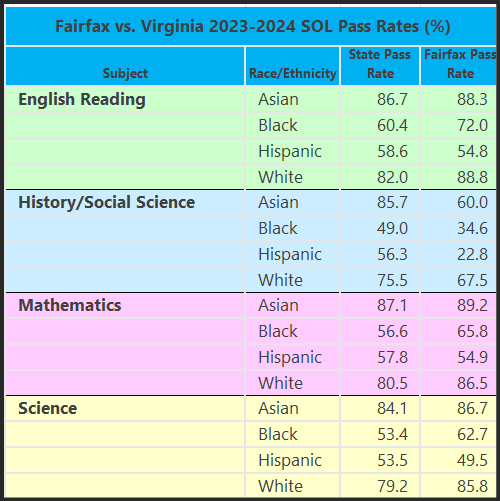
Why is student “growth” such an issue for Fairfax officials? After all, Fairfax Students overall consistently out-perform their counterparts elsewhere in Virginia. Whites do. Blacks do. Asians do.
But Hispanic students do not. Not only do they pass their SOLs at rates significantly lower other racial-ethnic groups in Fairfax, they under-perform Hispanics outside the state. That is an embarrassment for the state’s largest, richest school district.
The table below breaks down the pass rate for Reading, History, Math, and Science by race for Fairfax students and all Virginia students. (I exclude Writing because there are anomalies in the VDOE data that require explanation.) Hispanics fare the worst across the board.
Many Hispanic students are English Learners, which partially explains their lower scores. WTOP explains the English Learner connection to the ESSA controversy:
Molloy highlighted the new way English language learners will be incorporated into the system. Under the current system, English language learners’ scores don’t count toward a school’s overall score until the student has received 11 semesters of English language instruction. The new system will change that to three semesters, Molloy said.
Translation: English Learners drag down SOL pass rates. The current methodology excludes more English Learners than the new methodology, thus making districts with lots of English Learners, like Fairfax, look better. Conversely, the new system will make Fairfax look worse.
Even if you switch the lens from “Hispanics” to “English Learners” (which largely overlap), English Learners in Fairfax also pass their SOLs at lower rates in every single subject than their peers elsewhere.
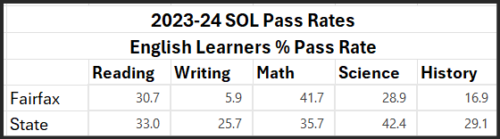
That, too, is an embarrassment to Fairfax.
But the unhappiness with Youngkin goes even deeper than that.
WTOP unknowingly gets to the root of the matter when it quotes school board member Marcia St John-Cunning:
I have seen many of our multilingual learners go on to become doctors, become teachers, become business owners in our community. But if we are going to measure them by the standard that this state is putting forward right now, they’re going to be perceived as failures, and the message that we’re sending to our students and to our families is that they are failures.
Youngkin, by contrast, thinks students, their parents, and schools need to know if students are making the grade or not. The priority is giving people information they can use to improve their lives (or improve their schools), not making people feel good about themselves.
Deep down, that difference in philosophies is what the controversy is really about.
Leave a Reply
You must be logged in to post a comment.